> ## Documentation Index
> Fetch the complete documentation index at: https://vaquill.ai/docs/llms.txt
> Use this file to discover all available pages before exploring further.
# Chat
> The main conversation surface: what it can search, how to scope it, and how to steer an answer
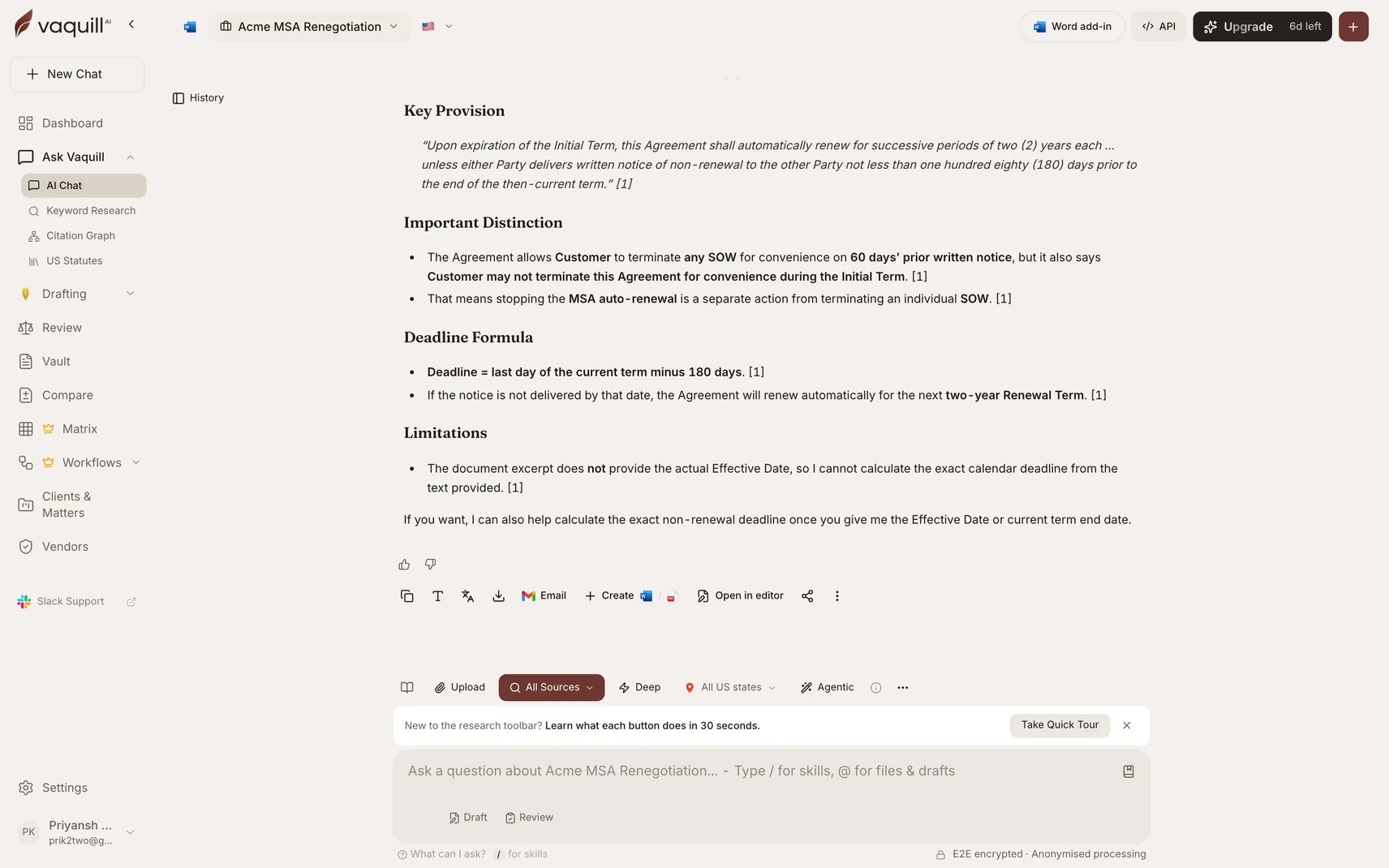
Chat is where most work in Vaquill starts. It lives under **Ask Vaquill, AI Chat** in the sidebar. Ask a question in plain language and get an answer with clickable citations back to the source.
What separates it from a general assistant is **what it is allowed to read**. You control that, per conversation.
 ## The four research sources
Chat draws on up to four sources, each toggled independently from the research selector.
Your uploaded documents. The default for questions about your own contracts, pleadings, and correspondence.
Vaquill's corpus of statutes, regulations, and case law.
Live web search for current developments not yet in the corpus.
A comprehensive multi-source pass taking 30 to 120 seconds. Answers a hard question properly rather than quickly.
**Deep research replaces the other sources rather than adding to them.** Turning it on disables document and corpus retrieval for that question. Use it for open research; leave it off when the answer is in your own files.
## Scoping a conversation
Beyond the toggles, several things narrow what a question looks at:
| Scope | Effect |
| ---------------- | ------------------------------------------------------------------------------------- |
| **Matter** | Threads the matter through the conversation, so retrieval is limited to its documents |
| **@ a document** | Pins one document so the question is answered against it specifically |
| **@ a draft** | Brings a draft into the conversation |
| **Corpus scope** | Restricts the legal database to chosen jurisdictions or sources |
Pinning a document is the single most effective way to sharpen an answer. "What does the indemnity say?" across a whole matter is a search; the same question with the agreement pinned is a read.
## Agent mode
Agent mode lets the assistant pick its own tools and iterate, instead of retrieving once and answering. Use it when the right next step depends on what the previous one found. See [Agent Mode](/docs/guides/agent-mode).
## Citations
Every answer carries citations you can click to open the source passage. Answers also run through claim-level verification against the cited sources before reaching you, so a fabricated authority is caught rather than shipped. See [Answer Verification](/docs/guides/answer-verification) and [Citations](/docs/guides/citations).
If an answer has no citation, treat it as unsupported. That is the signal, not a formatting quirk.
## Steering an answer
Run a saved playbook with a slash command for a repeatable structured analysis. See [Skills](/docs/guides/skills).
Insert a saved prompt, edit it, and send. See [Prompt Library](/docs/guides/prompt-library).
Activate a structured tool such as Contract Review or NDA Triage from the conversation bar. See [Legal Tools](/docs/guides/legal-tools).
Context the assistant carries between conversations, so you stop repeating your jurisdiction and your side. See [Memories](/docs/guides/memories).
## Handoffs
When a question is better served by another surface, chat offers a handoff chip rather than doing a worse job inline: comparing two versions, building a matrix, drafting a document, or running a redline. Accepting one carries your context across.
## Follow-ups and threading
Follow-up questions inherit the conversation's scope, so you can ask "and what about termination?" without restating the matter. To branch a side discussion off one passage without derailing the main thread, use [Inline Threading](/docs/guides/inline-threading).
## Sharing
A conversation can be shared with colleagues or via a link. See [Conversation Sharing](/docs/guides/conversation-sharing).
## Limitations
* Answers are grounded in what you let chat read. With every toggle off, it has nothing to cite.
* Deep research does not read your documents.
* Citations point to a source passage; they do not certify that the source is good law. Run a [Citation Graph](/docs/guides/citation-graph) check before relying on authority in a filing.
* Chat is a research and drafting aid, not legal advice.
## Related
Searching your own documents in depth.
Letting the assistant pick its own tools.
The comprehensive multi-source pass.
When the job is repeatable and ends in a file.
## The four research sources
Chat draws on up to four sources, each toggled independently from the research selector.
Your uploaded documents. The default for questions about your own contracts, pleadings, and correspondence.
Vaquill's corpus of statutes, regulations, and case law.
Live web search for current developments not yet in the corpus.
A comprehensive multi-source pass taking 30 to 120 seconds. Answers a hard question properly rather than quickly.
**Deep research replaces the other sources rather than adding to them.** Turning it on disables document and corpus retrieval for that question. Use it for open research; leave it off when the answer is in your own files.
## Scoping a conversation
Beyond the toggles, several things narrow what a question looks at:
| Scope | Effect |
| ---------------- | ------------------------------------------------------------------------------------- |
| **Matter** | Threads the matter through the conversation, so retrieval is limited to its documents |
| **@ a document** | Pins one document so the question is answered against it specifically |
| **@ a draft** | Brings a draft into the conversation |
| **Corpus scope** | Restricts the legal database to chosen jurisdictions or sources |
Pinning a document is the single most effective way to sharpen an answer. "What does the indemnity say?" across a whole matter is a search; the same question with the agreement pinned is a read.
## Agent mode
Agent mode lets the assistant pick its own tools and iterate, instead of retrieving once and answering. Use it when the right next step depends on what the previous one found. See [Agent Mode](/docs/guides/agent-mode).
## Citations
Every answer carries citations you can click to open the source passage. Answers also run through claim-level verification against the cited sources before reaching you, so a fabricated authority is caught rather than shipped. See [Answer Verification](/docs/guides/answer-verification) and [Citations](/docs/guides/citations).
If an answer has no citation, treat it as unsupported. That is the signal, not a formatting quirk.
## Steering an answer
Run a saved playbook with a slash command for a repeatable structured analysis. See [Skills](/docs/guides/skills).
Insert a saved prompt, edit it, and send. See [Prompt Library](/docs/guides/prompt-library).
Activate a structured tool such as Contract Review or NDA Triage from the conversation bar. See [Legal Tools](/docs/guides/legal-tools).
Context the assistant carries between conversations, so you stop repeating your jurisdiction and your side. See [Memories](/docs/guides/memories).
## Handoffs
When a question is better served by another surface, chat offers a handoff chip rather than doing a worse job inline: comparing two versions, building a matrix, drafting a document, or running a redline. Accepting one carries your context across.
## Follow-ups and threading
Follow-up questions inherit the conversation's scope, so you can ask "and what about termination?" without restating the matter. To branch a side discussion off one passage without derailing the main thread, use [Inline Threading](/docs/guides/inline-threading).
## Sharing
A conversation can be shared with colleagues or via a link. See [Conversation Sharing](/docs/guides/conversation-sharing).
## Limitations
* Answers are grounded in what you let chat read. With every toggle off, it has nothing to cite.
* Deep research does not read your documents.
* Citations point to a source passage; they do not certify that the source is good law. Run a [Citation Graph](/docs/guides/citation-graph) check before relying on authority in a filing.
* Chat is a research and drafting aid, not legal advice.
## Related
Searching your own documents in depth.
Letting the assistant pick its own tools.
The comprehensive multi-source pass.
When the job is repeatable and ends in a file.