> ## Documentation Index
> Fetch the complete documentation index at: https://vaquill.ai/docs/llms.txt
> Use this file to discover all available pages before exploring further.
# Clause Library
> Reusable contract clauses you can search by type and tone, add your own to, and rewrite with AI
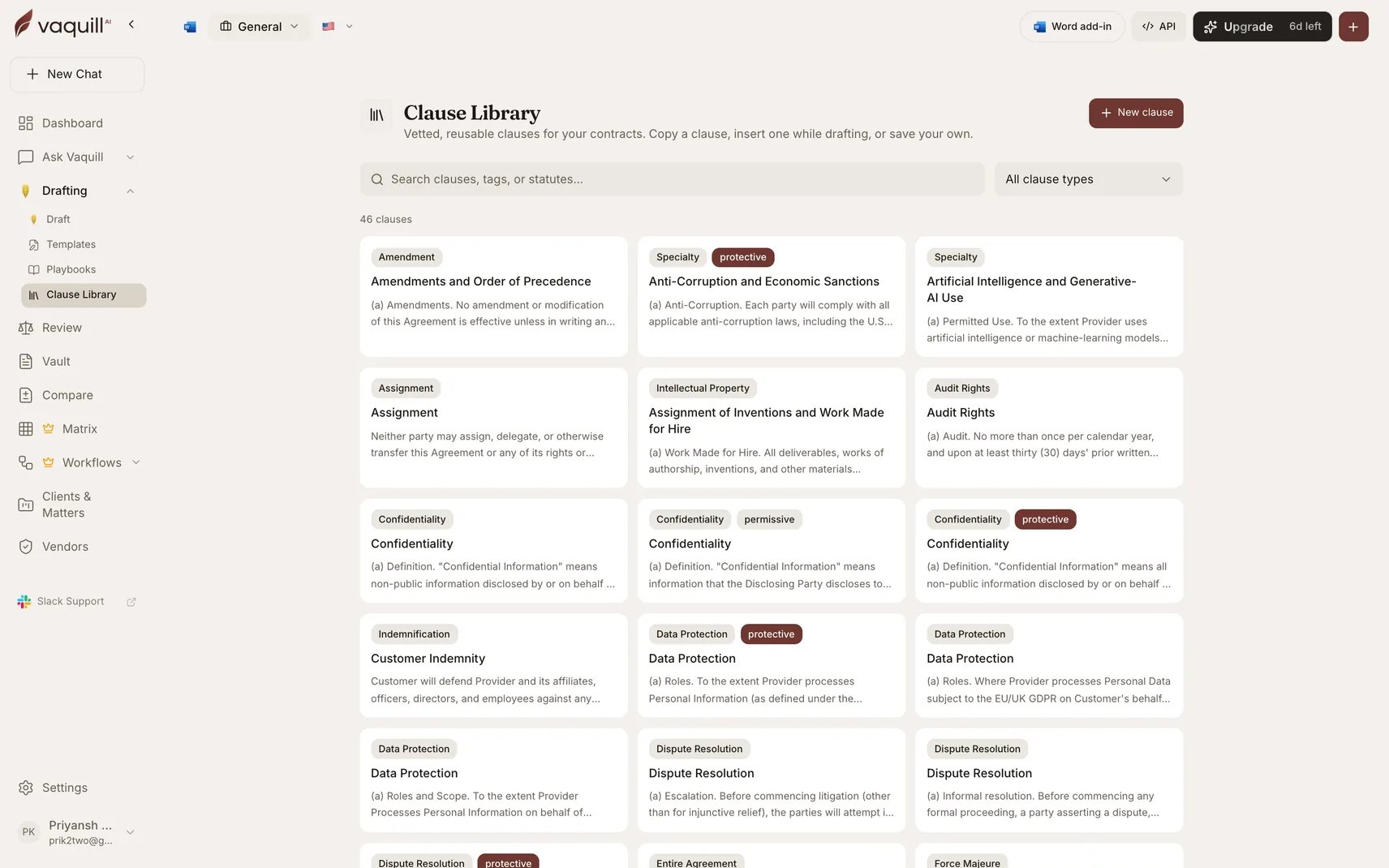
The Clause Library is a searchable collection of contract clauses: indemnification, limitation of liability, confidentiality, termination, and the rest. Find the clause you need by type and tone, drop it into a draft, or save your own so the whole team stops re-typing the paragraph your firm always uses.
Find it under **Drafting, Clause Library** in the sidebar.
 ## When to use it
* Drafting and needing a solid starting clause rather than writing from scratch
* Standardizing on one version of a clause across the team
* Capturing a clause you negotiated hard for, so it is reusable next time
* Seeing how the same clause reads at different tones, from protective to permissive
## Searching
Filter by **clause type** and **tone**. Tone is one of **protective**, **balanced**, or **permissive**, and it matters more than people expect: the same indemnification clause drafted protective versus permissive is a genuinely different negotiating position, and picking the wrong one wastes a round.
Clause types are kept aligned with the [Playbooks](/docs/guides/playbooks) taxonomy, so a clause type in the library is the same clause type your playbook takes a position on. Review and drafting speak the same vocabulary.
## Where clauses come from
The library has three sources, and the distinction matters.
Vaquill-authored starter clauses. Jurisdiction-specific and reviewed, but **not a substitute for your own legal review**.
Clauses you created, or that were learned from your precedents. These are the ones that encode how your firm actually drafts.
A third source exists: clauses machine-extracted from the legal corpus. These are **unverified and deactivated by default**, and are deliberately not surfaced as vetted content. If you ever encounter corpus-extracted clauses, treat them as raw material, not as reviewed precedent.
## Adding your own
Create a custom clause and it joins the library for future searches. This is how the library becomes genuinely useful: the shipped clauses are a reasonable start, but your negotiated language is what you actually want to reuse.
## AI rewrite
Any clause can be rewritten by AI: shift its tone, adapt it to a jurisdiction, or narrow its scope, without leaving the library.
Treat the output as a draft. A rewritten clause has not been reviewed by anyone, and a small wording change in an indemnity or a liability cap can move real money.
## How it fits with drafting
The Clause Library is clause-level reuse. Its neighbors:
| Surface | Granularity |
| ------------------------------ | ----------------------------------------- |
| [Templates](/docs/guides/templates) | A whole document skeleton with variables |
| **Clause Library** | A single clause |
| [Playbooks](/docs/guides/playbooks) | Your position on a clause, plus fallbacks |
| [Drafting](/docs/guides/drafting) | Where you assemble the document |
A common pattern: the playbook says what your position is, the clause library holds the language that expresses it, and drafting is where it lands.
## Limitations
* System clauses are starting points, not vetted precedent for your matter.
* A clause that fits one jurisdiction may be unenforceable in another. Check the governing law.
* AI rewrites are unreviewed output.
* The library holds clauses, not context. It cannot tell you whether the clause is the right one for this counterparty.
## Related
Where clauses get assembled into documents.
Positions and fallbacks per clause type.
Whole-document reuse.
The review side of the same clause taxonomy.
## When to use it
* Drafting and needing a solid starting clause rather than writing from scratch
* Standardizing on one version of a clause across the team
* Capturing a clause you negotiated hard for, so it is reusable next time
* Seeing how the same clause reads at different tones, from protective to permissive
## Searching
Filter by **clause type** and **tone**. Tone is one of **protective**, **balanced**, or **permissive**, and it matters more than people expect: the same indemnification clause drafted protective versus permissive is a genuinely different negotiating position, and picking the wrong one wastes a round.
Clause types are kept aligned with the [Playbooks](/docs/guides/playbooks) taxonomy, so a clause type in the library is the same clause type your playbook takes a position on. Review and drafting speak the same vocabulary.
## Where clauses come from
The library has three sources, and the distinction matters.
Vaquill-authored starter clauses. Jurisdiction-specific and reviewed, but **not a substitute for your own legal review**.
Clauses you created, or that were learned from your precedents. These are the ones that encode how your firm actually drafts.
A third source exists: clauses machine-extracted from the legal corpus. These are **unverified and deactivated by default**, and are deliberately not surfaced as vetted content. If you ever encounter corpus-extracted clauses, treat them as raw material, not as reviewed precedent.
## Adding your own
Create a custom clause and it joins the library for future searches. This is how the library becomes genuinely useful: the shipped clauses are a reasonable start, but your negotiated language is what you actually want to reuse.
## AI rewrite
Any clause can be rewritten by AI: shift its tone, adapt it to a jurisdiction, or narrow its scope, without leaving the library.
Treat the output as a draft. A rewritten clause has not been reviewed by anyone, and a small wording change in an indemnity or a liability cap can move real money.
## How it fits with drafting
The Clause Library is clause-level reuse. Its neighbors:
| Surface | Granularity |
| ------------------------------ | ----------------------------------------- |
| [Templates](/docs/guides/templates) | A whole document skeleton with variables |
| **Clause Library** | A single clause |
| [Playbooks](/docs/guides/playbooks) | Your position on a clause, plus fallbacks |
| [Drafting](/docs/guides/drafting) | Where you assemble the document |
A common pattern: the playbook says what your position is, the clause library holds the language that expresses it, and drafting is where it lands.
## Limitations
* System clauses are starting points, not vetted precedent for your matter.
* A clause that fits one jurisdiction may be unenforceable in another. Check the governing law.
* AI rewrites are unreviewed output.
* The library holds clauses, not context. It cannot tell you whether the clause is the right one for this counterparty.
## Related
Where clauses get assembled into documents.
Positions and fallbacks per clause type.
Whole-document reuse.
The review side of the same clause taxonomy.