> ## Documentation Index
> Fetch the complete documentation index at: https://vaquill.ai/docs/llms.txt
> Use this file to discover all available pages before exploring further.
# Starter Templates
> 28 curated playbooks covering both sides of 14 agreement types, with fallback ladders and sign-off rules built in
Most teams should not start a playbook from a blank page.
The template gallery ships 28 curated starting points that already carry real negotiation depth: an ordered fallback ladder per clause, a walk-away floor, a negotiability tier, a sign-off level, and in most cases conditional escalation rules.
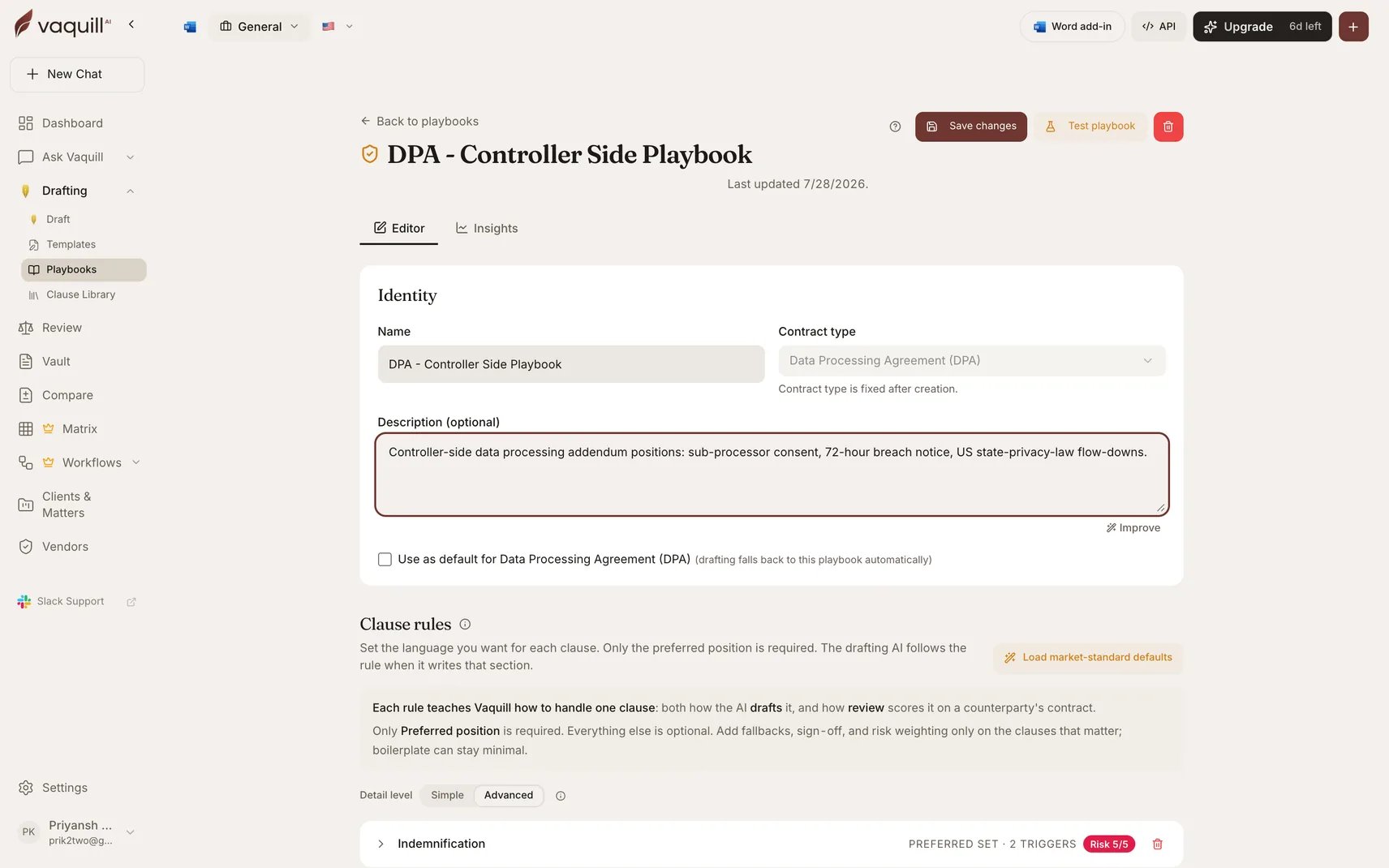
Cloning one gives you an editable playbook of your own in a single click.
Templates come in pairs, one tuned for each side of the deal.
A vendor and a customer want inverted positions on liability, indemnification, and IP, so "SaaS, Customer side" and "SaaS, Vendor side" are genuinely different playbooks rather than the same file with the labels swapped.
 ## The gallery
Open **Start from a template** on the Playbooks page or on the new-playbook form.
Templates are grouped into five sections, and you can search across name, use case, contract type, side, and the clause names each template tunes.
### Commercial
| Template | Best for |
| ------------------------------------------------------ | ----------------------------------------------------------------------------------------------------------------------------------------------------------------------------------------------------------------- |
| **SaaS - Customer side** | Buying SaaS. Tightens liability cap protections, secures IP and data-breach indemnities, locks down auto-renewal and data-portability rights, and demands proper sub-processor controls. |
| **SaaS - Vendor side** | Selling SaaS. Caps liability proportionally, scopes indemnification to IP infringement, secures payment discipline, and protects feedback and usage-data rights. |
| **MSA - Customer side** | A master services framework you sign once and order against. Tighter warranties, IP-favorable on deliverables, balanced liability, termination flexibility. |
| **MSA - Vendor side** | Vendor-side master agreement. Tight liability cap, IP retained, payment discipline, reasonable termination protections. |
| **Professional Services (PSA + SOW) - Client side** | Own deliverables as created, a real acceptance and rejection right, and an order of precedence where the statement of work controls. |
| **Professional Services (PSA + SOW) - Provider side** | Assigns deliverables on payment, keeps a deemed-acceptance mechanic, retains tools and methodologies, caps liability per statement of work. |
| **Consulting / Professional Services - Client side** | Hiring a consultant or services firm. Strong work-product IP transfer, milestone-tied payments, named-personnel commitments, balanced termination. |
| **Consulting / Professional Services - Provider side** | The consulting firm being engaged. |
| **License Agreement - Licensee side** | Licensing software, data, or IP in. Locks down scope of use, audit limitations, IP indemnification, and fair use after termination. |
| **License Agreement - Licensor side** | Licensing out. Narrow grant, all rights reserved, audit and true-up rights preserved, capped IP indemnity. |
| **Reseller / Channel - Supplier side** | Appointing a reseller. Narrow revocable brand license, pricing floors, end-user terms flowed through, liability for the reseller's conduct limited. |
| **Reseller / Channel - Reseller side** | Workable margins and price protection, a real supplier IP and product indemnity, deal registration and non-circumvention, post-termination pipeline commissions. |
| **Service Level Agreement (SLA) - Customer side** | Negotiating uptime and support commitments as the buyer. |
| **Service Level Agreement (SLA) - Vendor side** | Committing to uptime. Achievable target, realistic exclusions, credits as the sole financial remedy, bounded downtime liability. |
| **AI / Gen-AI Addendum - Customer side** | Buying AI features on top of a SaaS or services deal. Secures output ownership, a strict no-training default, an output-infringement indemnity, and a real service warranty despite the hallucination disclaimer. |
| **AI / Gen-AI Addendum - Vendor side** | Providing AI features. |
| **M\&A Acquisition - Buyer side** | Acquiring a private company by stock, asset, or merger. |
| **M\&A Acquisition - Seller side** | Selling a private company or its assets. Qualifies reps and narrows the indemnity exposure. |
### Privacy and Data
| Template | Best for |
| --------------------------------------- | ----------------------------------------------------------------------------------------------------------------------------------------------------------------- |
| **DPA - Controller side** | Pushing personal data to a vendor and setting the processing terms. |
| **DPA - Processor side** | The vendor processing customer data. Realistic breach response windows, sub-processor notice patterns, liability limited outside vendor negligence. |
| **HIPAA BAA - Covered Entity side** | The covered entity, or an upstream business associate, sharing protected health information. |
| **HIPAA BAA - Business Associate side** | The vendor handling protected health information. Commits to the mandatory obligations while keeping breach windows operationally workable and capping liability. |
### Non-Disclosure
| Template | Best for |
| --------------------------------- | ---------------------------------------------------------------------------------------------------------------------------------------------------------------------------------------- |
| **Mutual NDA** | Two-way confidentiality for evaluation, diligence, or pre-contract collaboration. Balanced obligations with carve-outs for compelled disclosure and independently developed information. |
| **One-way NDA - Receiving party** | You are the one being asked to sign and take on the obligations. |
### HR and Employment
| Template | Best for |
| ------------------------------ | ------------------------------------------------------------------------------------------------------------------------------------------------------------------------------------------- |
| **Employment - Employer side** | Offer letters and employment contracts. Reasonable confidentiality and IP assignment, jurisdiction-aware non-compete handling, at-will or notice-based termination. |
| **Employment - Employee side** | Reviewing an offer. Narrows IP assignment to work within scope, rejects non-competes where they are void, tightens "for cause", and preserves whistleblower and regulator-reporting rights. |
### Intellectual Property
| Template | Best for |
| --------------------------------- | --------------------------------------------------------------------------------------------------------------------------------------------------------------------------------------------------- |
| **IP Assignment - Assignee side** | Receiving IP from a contractor, founder, or acquired company. Full assignment of work product, trailing IP delivery, moral-rights waiver where lawful, warranties against third-party encumbrances. |
| **IP Assignment - Assignor side** | The party assigning IP out. |
## Preview before you clone
Every card has two actions.
Opens the full position list for that template: preferred position, acceptable range, fallback ladder shown best to worst, walk-away floor, escalation triggers, and rationale for each clause.
Clauses tagged as must-have carry a badge, as do clauses that require sign-off, and conditional rules are spelled out in plain language such as "If deal value over 1000000, require GC sign-off".
Clones the template into a new playbook you own and opens it in the editor.
Nothing is shared or linked back: it is your copy from that moment on.
Positions are resolved for your active jurisdiction when the template is cloned.
A few clauses, non-competes in particular, carry jurisdiction-specific wording, so the copy you get reflects the jurisdiction that was selected at clone time rather than a generic one.
## After cloning
Treat the clone as a first draft of your house position, not a finished one.
* Read the walk-away floors first. Those are the strongest statements in the file and the ones most likely to be wrong for your business.
* Check the sign-off levels against how your team actually escalates.
* Run the [Structure Check](/docs/guides/playbooks/structure-check) to see the score the template starts you at.
* Compare it against the market-standard baseline from inside the editor to see where the template is harder or softer than typical market terms.
## Limitations
* Templates are curated starting points, not legal advice, and not tailored to your business. Review before you rely on one.
* A clone is a snapshot. Improvements made to a template later do not flow into playbooks you already created from it.
* Coverage is 14 agreement types. Anything outside that list starts from a blank playbook or from an [imported contract](/docs/guides/playbooks/import-from-contracts).
* Depth varies by template. Most carry conditional escalation rules; the M\&A pair does not.
* The market-standard comparison panel is hidden for M\&A and for the specialized addenda, because there is no meaningful generic baseline to compare those against.
* The gallery does not merge templates. If you need both a services framework and a data processing addendum, that is two playbooks.
## Related
What a playbook holds and where it gets used.
Edit the clone, add clauses, and test-drive the result.
What each field on a cloned position actually does.
How the approval levels a template ships with behave in review.
## The gallery
Open **Start from a template** on the Playbooks page or on the new-playbook form.
Templates are grouped into five sections, and you can search across name, use case, contract type, side, and the clause names each template tunes.
### Commercial
| Template | Best for |
| ------------------------------------------------------ | ----------------------------------------------------------------------------------------------------------------------------------------------------------------------------------------------------------------- |
| **SaaS - Customer side** | Buying SaaS. Tightens liability cap protections, secures IP and data-breach indemnities, locks down auto-renewal and data-portability rights, and demands proper sub-processor controls. |
| **SaaS - Vendor side** | Selling SaaS. Caps liability proportionally, scopes indemnification to IP infringement, secures payment discipline, and protects feedback and usage-data rights. |
| **MSA - Customer side** | A master services framework you sign once and order against. Tighter warranties, IP-favorable on deliverables, balanced liability, termination flexibility. |
| **MSA - Vendor side** | Vendor-side master agreement. Tight liability cap, IP retained, payment discipline, reasonable termination protections. |
| **Professional Services (PSA + SOW) - Client side** | Own deliverables as created, a real acceptance and rejection right, and an order of precedence where the statement of work controls. |
| **Professional Services (PSA + SOW) - Provider side** | Assigns deliverables on payment, keeps a deemed-acceptance mechanic, retains tools and methodologies, caps liability per statement of work. |
| **Consulting / Professional Services - Client side** | Hiring a consultant or services firm. Strong work-product IP transfer, milestone-tied payments, named-personnel commitments, balanced termination. |
| **Consulting / Professional Services - Provider side** | The consulting firm being engaged. |
| **License Agreement - Licensee side** | Licensing software, data, or IP in. Locks down scope of use, audit limitations, IP indemnification, and fair use after termination. |
| **License Agreement - Licensor side** | Licensing out. Narrow grant, all rights reserved, audit and true-up rights preserved, capped IP indemnity. |
| **Reseller / Channel - Supplier side** | Appointing a reseller. Narrow revocable brand license, pricing floors, end-user terms flowed through, liability for the reseller's conduct limited. |
| **Reseller / Channel - Reseller side** | Workable margins and price protection, a real supplier IP and product indemnity, deal registration and non-circumvention, post-termination pipeline commissions. |
| **Service Level Agreement (SLA) - Customer side** | Negotiating uptime and support commitments as the buyer. |
| **Service Level Agreement (SLA) - Vendor side** | Committing to uptime. Achievable target, realistic exclusions, credits as the sole financial remedy, bounded downtime liability. |
| **AI / Gen-AI Addendum - Customer side** | Buying AI features on top of a SaaS or services deal. Secures output ownership, a strict no-training default, an output-infringement indemnity, and a real service warranty despite the hallucination disclaimer. |
| **AI / Gen-AI Addendum - Vendor side** | Providing AI features. |
| **M\&A Acquisition - Buyer side** | Acquiring a private company by stock, asset, or merger. |
| **M\&A Acquisition - Seller side** | Selling a private company or its assets. Qualifies reps and narrows the indemnity exposure. |
### Privacy and Data
| Template | Best for |
| --------------------------------------- | ----------------------------------------------------------------------------------------------------------------------------------------------------------------- |
| **DPA - Controller side** | Pushing personal data to a vendor and setting the processing terms. |
| **DPA - Processor side** | The vendor processing customer data. Realistic breach response windows, sub-processor notice patterns, liability limited outside vendor negligence. |
| **HIPAA BAA - Covered Entity side** | The covered entity, or an upstream business associate, sharing protected health information. |
| **HIPAA BAA - Business Associate side** | The vendor handling protected health information. Commits to the mandatory obligations while keeping breach windows operationally workable and capping liability. |
### Non-Disclosure
| Template | Best for |
| --------------------------------- | ---------------------------------------------------------------------------------------------------------------------------------------------------------------------------------------- |
| **Mutual NDA** | Two-way confidentiality for evaluation, diligence, or pre-contract collaboration. Balanced obligations with carve-outs for compelled disclosure and independently developed information. |
| **One-way NDA - Receiving party** | You are the one being asked to sign and take on the obligations. |
### HR and Employment
| Template | Best for |
| ------------------------------ | ------------------------------------------------------------------------------------------------------------------------------------------------------------------------------------------- |
| **Employment - Employer side** | Offer letters and employment contracts. Reasonable confidentiality and IP assignment, jurisdiction-aware non-compete handling, at-will or notice-based termination. |
| **Employment - Employee side** | Reviewing an offer. Narrows IP assignment to work within scope, rejects non-competes where they are void, tightens "for cause", and preserves whistleblower and regulator-reporting rights. |
### Intellectual Property
| Template | Best for |
| --------------------------------- | --------------------------------------------------------------------------------------------------------------------------------------------------------------------------------------------------- |
| **IP Assignment - Assignee side** | Receiving IP from a contractor, founder, or acquired company. Full assignment of work product, trailing IP delivery, moral-rights waiver where lawful, warranties against third-party encumbrances. |
| **IP Assignment - Assignor side** | The party assigning IP out. |
## Preview before you clone
Every card has two actions.
Opens the full position list for that template: preferred position, acceptable range, fallback ladder shown best to worst, walk-away floor, escalation triggers, and rationale for each clause.
Clauses tagged as must-have carry a badge, as do clauses that require sign-off, and conditional rules are spelled out in plain language such as "If deal value over 1000000, require GC sign-off".
Clones the template into a new playbook you own and opens it in the editor.
Nothing is shared or linked back: it is your copy from that moment on.
Positions are resolved for your active jurisdiction when the template is cloned.
A few clauses, non-competes in particular, carry jurisdiction-specific wording, so the copy you get reflects the jurisdiction that was selected at clone time rather than a generic one.
## After cloning
Treat the clone as a first draft of your house position, not a finished one.
* Read the walk-away floors first. Those are the strongest statements in the file and the ones most likely to be wrong for your business.
* Check the sign-off levels against how your team actually escalates.
* Run the [Structure Check](/docs/guides/playbooks/structure-check) to see the score the template starts you at.
* Compare it against the market-standard baseline from inside the editor to see where the template is harder or softer than typical market terms.
## Limitations
* Templates are curated starting points, not legal advice, and not tailored to your business. Review before you rely on one.
* A clone is a snapshot. Improvements made to a template later do not flow into playbooks you already created from it.
* Coverage is 14 agreement types. Anything outside that list starts from a blank playbook or from an [imported contract](/docs/guides/playbooks/import-from-contracts).
* Depth varies by template. Most carry conditional escalation rules; the M\&A pair does not.
* The market-standard comparison panel is hidden for M\&A and for the specialized addenda, because there is no meaningful generic baseline to compare those against.
* The gallery does not merge templates. If you need both a services framework and a data processing addendum, that is two playbooks.
## Related
What a playbook holds and where it gets used.
Edit the clone, add clauses, and test-drive the result.
What each field on a cloned position actually does.
How the approval levels a template ships with behave in review.