> ## Documentation Index
> Fetch the complete documentation index at: https://vaquill.ai/docs/llms.txt
> Use this file to discover all available pages before exploring further.
# Risk Assessment
> 5x5 severity-likelihood matrix for any legal matter, with mitigation options and escalation guidance
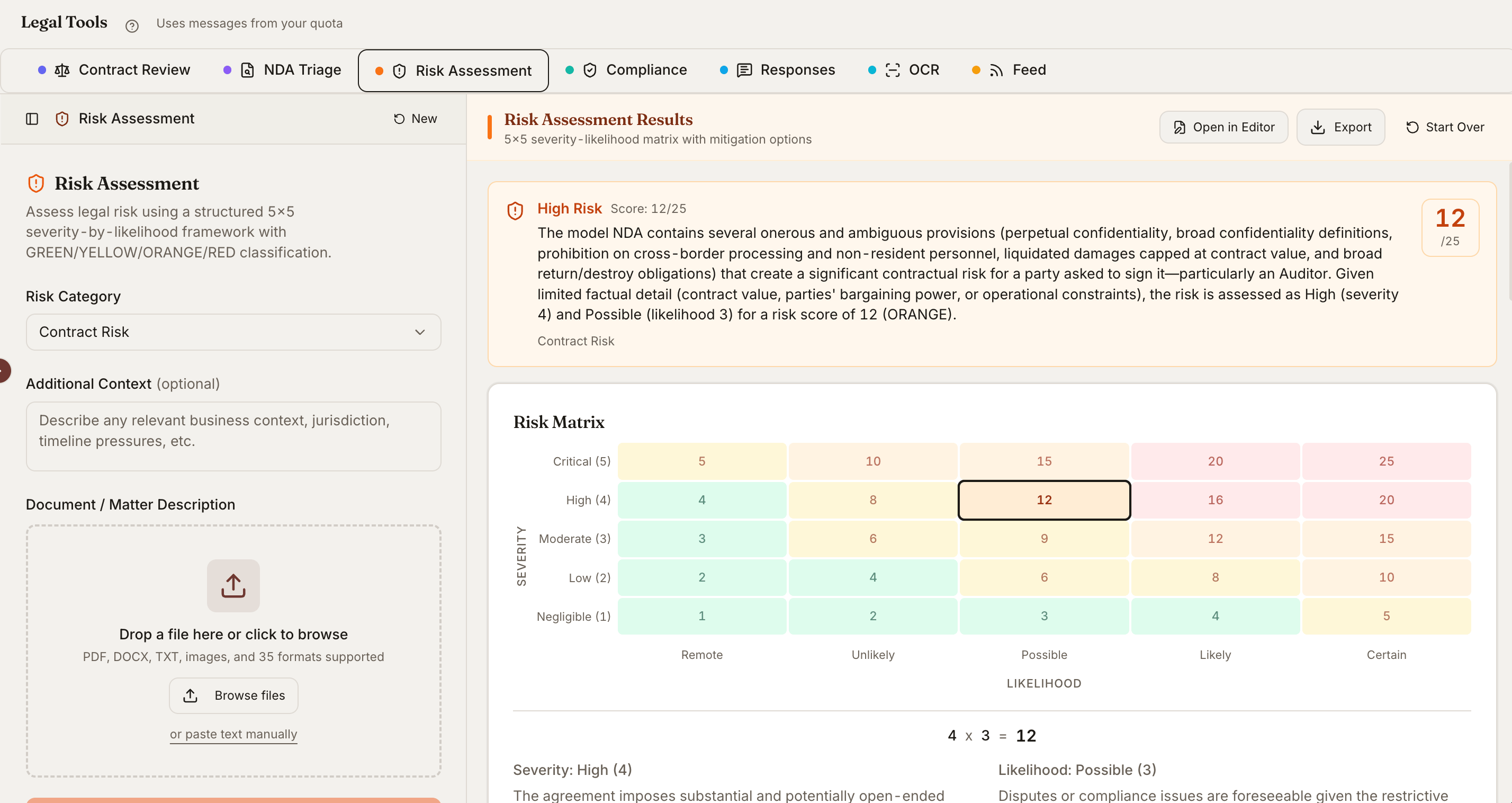
Risk Assessment produces a structured risk register for a matter, a contract, or a corporate decision. Each risk is plotted on a 5x5 severity-likelihood matrix, mapped back to specific clauses or facts, and paired with mitigation options ranked by effort and effectiveness.
 ## When To Use It
* Pre-signing review on a high-value contract
* Litigation case assessment for settlement positioning
* Pre-IPO or pre-deal diligence
* Corporate decision memos that need a defensible risk record
* Regulatory exposure analysis
## Risk Categories
The assessment covers eight categories. The tool picks the relevant subset based on the documents and facts you provide:
* **Contract** - Breach, performance, indemnity, limitation gaps
* **Regulatory** - Compliance exposure, licensing, reporting obligations
* **Litigation** - Claims risk, defense strength, damages exposure
* **IP** - Infringement, ownership, license scope, third-party rights
* **Data Privacy** - Personal data, cross-border transfers, breach exposure
* **Employment** - Misclassification, harassment, wage and hour, separation
* **Corporate** - Governance, fiduciary, change-of-control, securities
* **Other** - Anything that does not fit the above
## The 5x5 Matrix
Each risk is scored on a 1-5 scale for **severity** (impact if it materializes, from negligible to existential) and a 1-5 scale for **likelihood** (from remote to near certain). The combination places each risk on a 5x5 heat map - the upper-right quadrant is the critical-attention zone, the lower-left is monitor-only. The same matrix is used by the [Risk Assessment Skill](/docs/guides/skills) so scoring stays consistent across matters.
## What You Get For Each Risk
| Element | What It Includes |
| ------------------------- | ----------------------------------------------------------- |
| **Risk statement** | One-sentence description in plain English |
| **Category** | Which of the eight categories it falls in |
| **Severity / Likelihood** | Scored 1-5 each with reasoning |
| **Contributing factors** | What makes the risk worse |
| **Mitigating factors** | What is already in place to reduce it |
| **Source** | The clause, fact, or document the risk was derived from |
| **Mitigation options** | Three options ranked by effort and effectiveness |
| **Residual risk** | The score after the recommended mitigation is applied |
| **Escalation** | Whether the risk warrants partner, GC, or board involvement |
## Mitigation Options
For each risk, the tool generates three mitigation paths:
* **Low effort / partial mitigation** - What you can do this week
* **Medium effort / substantial mitigation** - Negotiation or process change
* **High effort / full mitigation** - Restructure, exit, or full remediation
Each option shows the new residual risk score so you can see the trade-off.
## Ready-to-run prompt
Run **Risk Assessment** on the attached documents and facts.
For every distinct risk you identify:
1. Write a one-sentence **risk statement** in plain English.
2. Classify into one of the eight categories: Contract, Regulatory, Litigation, IP, Data Privacy, Employment, Corporate, Other.
3. Score **severity** (1-5) and **likelihood** (1-5). Justify each score in one sentence and cite the clause, fact, or document the risk was derived from.
4. List **contributing** and **mitigating** factors already in play.
5. Propose **three mitigation options** - low-effort partial, medium-effort substantial, and high-effort full - with the residual severity x likelihood score after each.
6. Set the **escalation** level: associate, partner, GC, or board.
7. For any risk that cannot be fully eliminated, draft a **monitoring plan** (what to watch, who is responsible, review cadence).
Output a risk register sorted by severity x likelihood (highest first), followed by a one-page executive summary that flags the top three risks, the recommended mitigations, and a go / no-go recommendation a partner can sign off on.
## Monitoring Plan
For risks that cannot be fully eliminated, the assessment outputs a monitoring plan:
* What to watch (a metric, an event, a date)
* Who is responsible
* The review cadence (quarterly, on event, on milestone)
## Export
* **Word memo** - Full risk register formatted as a partner-ready memo
* **Spreadsheet** - Tracker format with one row per risk, sortable and filterable
* **Heat map PDF** - Visual 5x5 matrix for board or executive presentations
## Tips
**Pair with the source documents.** Run Risk Assessment inside a matter so it can draw on every uploaded contract, complaint, and email, not just the facts you typed into the prompt.
**Re-score after mitigation.** Update the assessment as risks are addressed - the residual score becomes the new baseline for the next review.
**Sort by the escalation column.** It is the most useful single field for triaging partner attention on a register with more than ten risks.
## Related
Clause-level review feeds risk entries straight into the register.
Compliance gaps roll up into the risk view automatically.
Read a counterparty's markup that drives shifting contract risk.
The matching Risk Assessment Skill enforces consistent scoring across teams.
## When To Use It
* Pre-signing review on a high-value contract
* Litigation case assessment for settlement positioning
* Pre-IPO or pre-deal diligence
* Corporate decision memos that need a defensible risk record
* Regulatory exposure analysis
## Risk Categories
The assessment covers eight categories. The tool picks the relevant subset based on the documents and facts you provide:
* **Contract** - Breach, performance, indemnity, limitation gaps
* **Regulatory** - Compliance exposure, licensing, reporting obligations
* **Litigation** - Claims risk, defense strength, damages exposure
* **IP** - Infringement, ownership, license scope, third-party rights
* **Data Privacy** - Personal data, cross-border transfers, breach exposure
* **Employment** - Misclassification, harassment, wage and hour, separation
* **Corporate** - Governance, fiduciary, change-of-control, securities
* **Other** - Anything that does not fit the above
## The 5x5 Matrix
Each risk is scored on a 1-5 scale for **severity** (impact if it materializes, from negligible to existential) and a 1-5 scale for **likelihood** (from remote to near certain). The combination places each risk on a 5x5 heat map - the upper-right quadrant is the critical-attention zone, the lower-left is monitor-only. The same matrix is used by the [Risk Assessment Skill](/docs/guides/skills) so scoring stays consistent across matters.
## What You Get For Each Risk
| Element | What It Includes |
| ------------------------- | ----------------------------------------------------------- |
| **Risk statement** | One-sentence description in plain English |
| **Category** | Which of the eight categories it falls in |
| **Severity / Likelihood** | Scored 1-5 each with reasoning |
| **Contributing factors** | What makes the risk worse |
| **Mitigating factors** | What is already in place to reduce it |
| **Source** | The clause, fact, or document the risk was derived from |
| **Mitigation options** | Three options ranked by effort and effectiveness |
| **Residual risk** | The score after the recommended mitigation is applied |
| **Escalation** | Whether the risk warrants partner, GC, or board involvement |
## Mitigation Options
For each risk, the tool generates three mitigation paths:
* **Low effort / partial mitigation** - What you can do this week
* **Medium effort / substantial mitigation** - Negotiation or process change
* **High effort / full mitigation** - Restructure, exit, or full remediation
Each option shows the new residual risk score so you can see the trade-off.
## Ready-to-run prompt
Run **Risk Assessment** on the attached documents and facts.
For every distinct risk you identify:
1. Write a one-sentence **risk statement** in plain English.
2. Classify into one of the eight categories: Contract, Regulatory, Litigation, IP, Data Privacy, Employment, Corporate, Other.
3. Score **severity** (1-5) and **likelihood** (1-5). Justify each score in one sentence and cite the clause, fact, or document the risk was derived from.
4. List **contributing** and **mitigating** factors already in play.
5. Propose **three mitigation options** - low-effort partial, medium-effort substantial, and high-effort full - with the residual severity x likelihood score after each.
6. Set the **escalation** level: associate, partner, GC, or board.
7. For any risk that cannot be fully eliminated, draft a **monitoring plan** (what to watch, who is responsible, review cadence).
Output a risk register sorted by severity x likelihood (highest first), followed by a one-page executive summary that flags the top three risks, the recommended mitigations, and a go / no-go recommendation a partner can sign off on.
## Monitoring Plan
For risks that cannot be fully eliminated, the assessment outputs a monitoring plan:
* What to watch (a metric, an event, a date)
* Who is responsible
* The review cadence (quarterly, on event, on milestone)
## Export
* **Word memo** - Full risk register formatted as a partner-ready memo
* **Spreadsheet** - Tracker format with one row per risk, sortable and filterable
* **Heat map PDF** - Visual 5x5 matrix for board or executive presentations
## Tips
**Pair with the source documents.** Run Risk Assessment inside a matter so it can draw on every uploaded contract, complaint, and email, not just the facts you typed into the prompt.
**Re-score after mitigation.** Update the assessment as risks are addressed - the residual score becomes the new baseline for the next review.
**Sort by the escalation column.** It is the most useful single field for triaging partner attention on a register with more than ten risks.
## Related
Clause-level review feeds risk entries straight into the register.
Compliance gaps roll up into the risk view automatically.
Read a counterparty's markup that drives shifting contract risk.
The matching Risk Assessment Skill enforces consistent scoring across teams.