> ## Documentation Index
> Fetch the complete documentation index at: https://vaquill.ai/docs/llms.txt
> Use this file to discover all available pages before exploring further.
# Branching and loops
> Conditional routing, fanning a step out across every document, and the rules the platform enforces at config time
A workflow is not limited to a straight line. Three mechanisms handle real-world variation.
 ## Branching
There are two ways to add conditional routing, with identical semantics.
Expand the **Branching** section in any step's config pane. Read a field from an upstream step's output, pick an operator, and choose which sibling steps run on TRUE versus FALSE.
Use this when the decision naturally belongs to the step that produced the data.
The same shape, but the decision becomes its own row in the chain. Use this when the decision logic does not belong to the step that produced the data, or when you want the decision visible in the run timeline as its own event.
### Operators
Six operators are available:
| Operator | Meaning |
| ------------------ | --------------------------------------------------- |
| **equals** | The field's value matches exactly |
| **does not equal** | The field's value differs |
| **greater than** | Numeric comparison |
| **less than** | Numeric comparison |
| **contains** | The field's value contains the target |
| **is one of** | The field's value appears in a comma-separated list |
Nested-path navigation and regex conditions are deliberately not available. A condition reads one top-level field from one upstream step, which keeps branch behavior predictable and statically checkable at publish time.
### In graph view
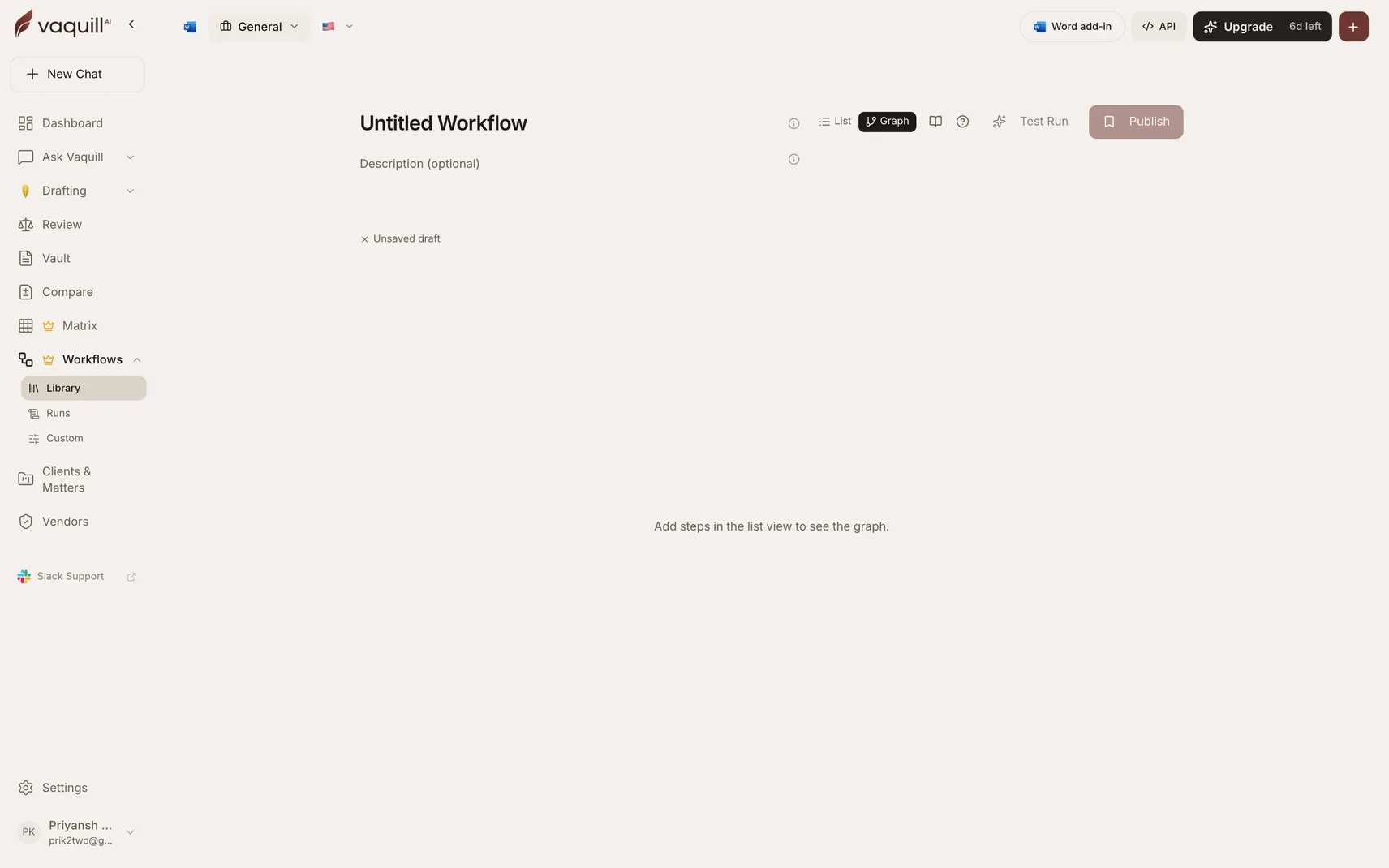
Drag from one node's bottom edge onto another node to route an edge in one click. The color shows the routing type: green for TRUE, red for FALSE, grey for linear.
### The downstream rule
**A branch target must run strictly after the branching step.** The executor walks the chain in order, so a target at or before the branching step could never fire. Publishing rejects both dangling targets and targets that are not downstream, and names the offending step so you can retarget it.
## Loops
The **Loop Over Documents** step runs another step type once per document, with bounded concurrency.
| Setting | Range | Notes |
| ------------------------ | --------------------- | ------------------------------------------------------------------------------------------------------------- |
| Documents | 1-50 | Wire from an upstream Pick Documents step. |
| Step to run per document | Any allowed step type | Picked from a dropdown. |
| How many to run at once | 1-5 | Higher is faster but may hit external provider rate limits. Defaults to 2. |
| Continue on error | On/off | On records a per-document error and keeps going; off fails the whole loop on the first error. Defaults to on. |
The current document is injected into the inner step on every iteration, and the loop config form gives you click-to-insert chips for the document's id and filename.
The step returns per-iteration results plus counts of iterations, successes, and failures, so a downstream step can react to a partial run.
### What cannot go inside a loop
Two categories are refused, **at config time rather than at run time**, so you see a clear error in the builder instead of a silent no-op mid-run:
* **Nested loops.** A Loop Over Documents step cannot be its own inner step.
* **Side-effect steps.** Anything that mutates state outside the run, such as Save to Matter. Running a side effect N times over a document set is almost never what someone meant, and the amplification is hard to undo.
Move those outside the loop body.
## Agentic step
When the right next move depends on what the last step actually returned, hand off to a constrained agent instead of hard-coding the sequence.
| Setting | Notes |
| ------------- | -------------------------------------------------------------------------------------------------------------------------------------- |
| Goal | What you want accomplished, up to 5,000 characters. |
| Tools | Chosen from a fixed set: search uploaded documents, search US case law, look up a US statute, web search. Defaults to the first three. |
| Maximum steps | 1 to 10 research rounds. Defaults to 5. |
The agent returns its final answer plus the iteration count, tool-call count, and why it stopped, so you can tell "finished" apart from "hit the cap".
This is a bounded tool loop, not an open-ended agent: it can only call the tools you enabled, and only as many times as you allowed.
## Related
Full field-level detail on all three routing steps.
Branch and loop validation errors and how to clear them.
## Branching
There are two ways to add conditional routing, with identical semantics.
Expand the **Branching** section in any step's config pane. Read a field from an upstream step's output, pick an operator, and choose which sibling steps run on TRUE versus FALSE.
Use this when the decision naturally belongs to the step that produced the data.
The same shape, but the decision becomes its own row in the chain. Use this when the decision logic does not belong to the step that produced the data, or when you want the decision visible in the run timeline as its own event.
### Operators
Six operators are available:
| Operator | Meaning |
| ------------------ | --------------------------------------------------- |
| **equals** | The field's value matches exactly |
| **does not equal** | The field's value differs |
| **greater than** | Numeric comparison |
| **less than** | Numeric comparison |
| **contains** | The field's value contains the target |
| **is one of** | The field's value appears in a comma-separated list |
Nested-path navigation and regex conditions are deliberately not available. A condition reads one top-level field from one upstream step, which keeps branch behavior predictable and statically checkable at publish time.
### In graph view
Drag from one node's bottom edge onto another node to route an edge in one click. The color shows the routing type: green for TRUE, red for FALSE, grey for linear.
### The downstream rule
**A branch target must run strictly after the branching step.** The executor walks the chain in order, so a target at or before the branching step could never fire. Publishing rejects both dangling targets and targets that are not downstream, and names the offending step so you can retarget it.
## Loops
The **Loop Over Documents** step runs another step type once per document, with bounded concurrency.
| Setting | Range | Notes |
| ------------------------ | --------------------- | ------------------------------------------------------------------------------------------------------------- |
| Documents | 1-50 | Wire from an upstream Pick Documents step. |
| Step to run per document | Any allowed step type | Picked from a dropdown. |
| How many to run at once | 1-5 | Higher is faster but may hit external provider rate limits. Defaults to 2. |
| Continue on error | On/off | On records a per-document error and keeps going; off fails the whole loop on the first error. Defaults to on. |
The current document is injected into the inner step on every iteration, and the loop config form gives you click-to-insert chips for the document's id and filename.
The step returns per-iteration results plus counts of iterations, successes, and failures, so a downstream step can react to a partial run.
### What cannot go inside a loop
Two categories are refused, **at config time rather than at run time**, so you see a clear error in the builder instead of a silent no-op mid-run:
* **Nested loops.** A Loop Over Documents step cannot be its own inner step.
* **Side-effect steps.** Anything that mutates state outside the run, such as Save to Matter. Running a side effect N times over a document set is almost never what someone meant, and the amplification is hard to undo.
Move those outside the loop body.
## Agentic step
When the right next move depends on what the last step actually returned, hand off to a constrained agent instead of hard-coding the sequence.
| Setting | Notes |
| ------------- | -------------------------------------------------------------------------------------------------------------------------------------- |
| Goal | What you want accomplished, up to 5,000 characters. |
| Tools | Chosen from a fixed set: search uploaded documents, search US case law, look up a US statute, web search. Defaults to the first three. |
| Maximum steps | 1 to 10 research rounds. Defaults to 5. |
The agent returns its final answer plus the iteration count, tool-call count, and why it stopped, so you can tell "finished" apart from "hit the cap".
This is a bounded tool loop, not an open-ended agent: it can only call the tools you enabled, and only as many times as you allowed.
## Related
Full field-level detail on all three routing steps.
Branch and loop validation errors and how to clear them.