The lawyer who trusted the eloquent answer
In June 2023 a New York lawyer filed a brief in Mata v. Avianca that cited a string of cases. The cases read beautifully. They had names, reporter numbers, holdings, the works.
They also did not exist. ChatGPT had invented them, and the lawyer, charmed by how confident the output looked, never checked. The sanctions that followed turned into the opening act of a genre.
By April 2026, EDRM's tally of the AI sanction wave put U.S. courts at roughly $145,000 in fabricated-citation penalties for the first quarter of 2026 alone, and noted that judges had clearly run out of patience.
I bring this up because it is the single most useful frame for picking a legal API. Everybody asks me about features. They should be asking about what the response actually returns, and whether they can trace it back to a real, citable source.
An eloquent answer you cannot verify is a liability with good prose. A boring structured record you can open and confirm is an asset. That distinction is the whole ballgame in 2026.
So let me walk through what a legal API really is, the five axes that actually separate a good one from a bad one, and what a real request and response looks like when you query primary law.
TL;DR
- "Legal API" is not one category. The data splits into four types (statutes and regulations, case law, dockets, filings), and a second split runs across all of them: primary-law data APIs versus AI-answer APIs. Conflating them is the most common evaluation mistake.
- Pick on five hard axes: coverage, freshness, response shape, auth, and pricing transparency. Feature lists lie. These do not.
- After the fabricated-citation sanctions of 2023 to 2026, the API that returns a verifiable, citable primary-law record beats the one that returns a clever answer you cannot trace.
- Statutes and regulations are the part of the legal corpus you should never try to scrape and maintain yourself. The pipeline is a tax you pay forever.
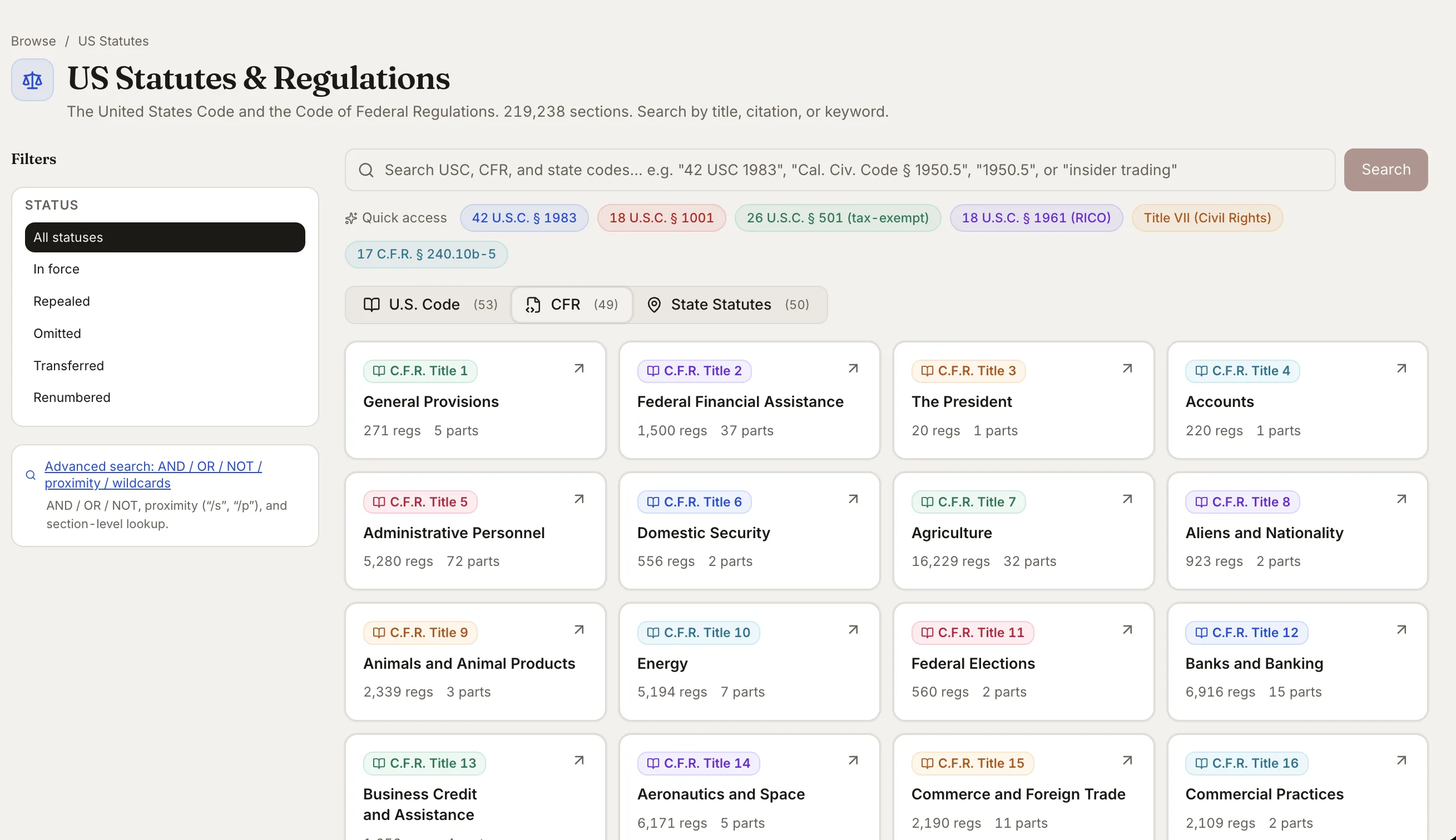
- A good statutes response is structured: citation, title hierarchy, breadcrumb, relevance score, and direct links to the official text. A credible public legal API in this category is scoped to exactly that, US Code, CFR, and 50-state codes.
Part of our MCP and developer guide series.
For related MCP / API / developer coverage, see Best Legal Data APIs for Developers in 2026.
What does Vaquill AI's public legal API cover?
What a legal API actually is
A legal API is an HTTP endpoint that lets your code request legal data (statutes, regulations, court opinions, dockets, or filings) and get it back as structured, machine-readable JSON or XML, without a human opening a browser. It turns the law into something your software can query, render, and verify on demand. That is the boring, correct definition.
The interesting part is that "legal data" hides two completely different products under one phrase, and developers conflate them constantly.
The first kind is a primary-law data API. You send it a query or a citation, it returns the underlying source: a statute section, a regulation, a court opinion. The value is in the corpus and the structure. Think of it as a database with an HTTP front door.
The second kind is an AI-answer API. You send it a question in plain English, it returns a generated answer, ideally grounded in primary law with citations attached. The value is in the synthesis. Think of it as a research associate behind an endpoint.
These are not interchangeable, and the failure mode of treating them as one is exactly what bit the Mata lawyer. An AI-answer API that does not anchor every claim to a retrievable source is producing confident prose.
A primary-law API never hallucinates, because it is not generating anything. It is handing you the text that already exists.
The right mental model: the AI-answer layer should sit on top of a primary-law layer, and the primary-law layer should be auditable on its own. If you cannot click through from the answer to the actual section of the U.S. Code, you do not have a legal research tool. You have a confident stranger.
The four types of legal API (and who provides them)
Under the two layers above, "legal data" itself splits into four corpora, and most APIs specialize in one or two. Knowing which type you need is the first decision, because pricing, freshness, and licensing differ wildly across them.
- Statutes and regulations. The codified law: the U.S. Code, the Code of Federal Regulations, and 50 separate state code trees. Best when you need the current text of a section, its hierarchy, and amendment history. Free government sources include govinfo.gov (GPO) and the Federal Register API for daily executive actions. OpenLaws and Vaquill AI package this layer for developers.
- Case law. Court opinions and precedent. LexisNexis and Westlaw sell proprietary case-law access under enterprise contracts; some tools expose millions of US court opinions through their own product layer.
- Dockets and litigation data. The live record of who filed what, when: parties, entries, documents, and deadlines. PACER is the federal source; Docket Alarm and UniCourt offer commercial docket APIs with notifications and analytics layered on top.
- Filings and agency records. Regulatory and enforcement documents: SEC EDGAR filings, Regulations.gov rulemaking dockets, and openFDA for FDA records. These are filing-specific feeds, not general legal research.
| Type | What it returns | Example providers | Typical access |
|---|---|---|---|
| Statutes and regulations | Code sections, hierarchy, amendment history | govinfo, Federal Register, OpenLaws, Vaquill AI | Free gov / self-serve |
| Case law | Court opinions, precedent, citations | LexisNexis, Westlaw | Enterprise |
| Dockets and litigation | Parties, entries, deadlines, documents | PACER, Docket Alarm, UniCourt | Paid per-use / subscription |
| Filings and agency records | SEC, FDA, rulemaking documents | SEC EDGAR, Regulations.gov, openFDA | Free gov |
A practitioner tip: the two corpora you should never try to scrape and maintain yourself are statutes and case law. The pipeline is a permanent cost, covered below. Dockets and filings change so fast that you almost always want a vendor's feed anyway.
The five axes that actually matter
Forget the marketing grids. When I evaluate any legal API, I score it on five things.
1. Coverage: which corpora, and how deep
Coverage is the first filter and the one most easily faked. "Comprehensive US legal data" means nothing. Ask: which corpora, and how many sections within each?
For case law, the bar is breadth of precedent: a serious tool should cover the bulk of precedential U.S. decisions across federal and state courts, with millions of opinions reachable by citation and by semantic query. Vaquill AI's own case-law research, for example, spans 8M+ US court opinions inside the product.
On the statutes side, coverage means the full U.S. Code, the Code of Federal Regulations, and the 50 separate state code trees, each of which is published differently, formatted inconsistently, and amended on its own schedule.
A vendor that says "we cover statutes" should be able to hand you section counts per corpus. If they cannot, the coverage is thinner than the homepage suggests.
2. Freshness: how often the corpus refreshes
Statutes amend. Regulations get rewritten. Executive actions land daily. A legal API that returns last year's text of a section is not just stale, it is dangerous, because the reader assumes it is current.
So ask about cadence per corpus, not in the aggregate. Federal Register material (executive orders, proclamations, presidential memos) should refresh daily, because it changes daily.
The U.S. Code, the CFR, and state codes move slower and can be re-ingested on a weekly-to-monthly cycle, but the vendor should preserve amendment history per section so you know what changed and when.
"We keep it updated" is not an answer. "Federal Register daily, statutory codes weekly to monthly, amendment year preserved" is, and a vendor worth buying from can walk you through what refresh cadence means source by source.
3. Response shape: structured fields versus prose blobs
This is the axis that most developers underweight and later regret. The shape of the response determines what you can build.
A prose blob (one big string of generated text) is easy to display and impossible to build on. You cannot filter it, score it, deduplicate it, or verify it without re-parsing.
A structured response gives you fields: a citation you can render as a link, a hierarchy you can show as a breadcrumb, a relevance score you can sort on, a corpus type you can filter by, format links you can hand to a user for verification. Those fields, and the promise that they are still there next quarter, are what the schema contract a legal data API owes you is made of.
Here is the rule, sharpened by the sanction wave: the response should make verification cheap. If every source comes back with a citation and a direct link to the official text, your users can confirm the law in one click.
If it comes back as a paragraph, they have to trust you. After Mata, trust is not a feature you want to be selling.
4. Auth: how you get in and stay in
Auth is the least glamorous axis and the one that quietly determines whether you ship this quarter. Look for plain Bearer-token authentication over HTTPS, keys you can rotate from a dashboard, and a prefix convention so you can spot a leaked key in your logs (a vq_key_ style prefix is one example you will see in this category).
Avoid anything that requires a sales call to get a sandbox token. If you cannot generate a key and make your first call in ten minutes, that friction is a preview of the whole relationship.
| Axis | Good signal | Red flag |
|---|---|---|
| Coverage | Section counts per corpus, stated case-law breadth | "Comprehensive US data" with no numbers |
| Freshness | Federal Register daily, codes weekly-monthly, history preserved | "Kept up to date" |
| Response shape | Citation, hierarchy, relevance score, format links | One prose blob |
| Auth | Bearer token, dashboard key rotation, prefix convention | Sales call for a sandbox key |
| Pricing | Self-serve, sign up without a sales call | "Contact sales" or "from $X/mo" |
5. Pricing transparency: can you see the meter
The incumbents are opaque on purpose. Lexis and Westlaw run on enterprise contracts negotiated behind NDAs; one 2026 reported figure put LexisNexis at "from $171/mo," but "from" is doing heavy lifting and the real number is whatever your procurement team can negotiate.
For a developer trying to estimate unit economics, opacity is disqualifying.
What you want is self-serve pricing you can read and sign up for without a sales call, so you can model your unit economics before you commit.
Pricing you can see and start on your own, no NDA and no procurement queue, is the transparent answer.
A real statutes request and response
Enough theory. Let me show you what a primary-law response actually looks like, using a statute every litigator knows: 42 U.S.C. 1983, the civil-rights provision for deprivation of rights under color of law.
A credible public legal API in this category is deliberately scoped to statutes and legislation, the US Code, the CFR, and 50-state codes, which is exactly the layer you should never build yourself. A search against a statutes endpoint looks like this:
curl -X POST https://api.example.com/api/v1/us/statutes/search \
  -H "Authorization: Bearer $API_KEY" \
  -H "Content-Type: application/json" \
  -d '{"query": "deprivation of rights under color of law", "corpusType": "USC"}'
Two things to notice before the response. The auth is a single Bearer header, no OAuth dance.
And corpusType scopes the search to the U.S. Code, so you are not wading through 50 states of look-alike provisions. (The endpoint also accepts a state filter when you do want a specific jurisdiction.)
The response comes back as structured JSON with a data and meta envelope. The shape is the point:
{
  "data": [
    {
      "citation": "42 U.S.C. § 1983",
      "corpusType": "USC",
      "hierarchy": "Title 42 > Chapter 21 > Subchapter I > § 1983",
      "breadcrumb": "The Public Health and Welfare > Civil Rights > § 1983",
      "relevanceScore": 0.94,
      "lastAmended": 1996,
      "links": {
        "html": "https://api.example.com/...html",
        "pdf": "https://api.example.com/...pdf",
        "xml": "https://api.example.com/...xml",
        "txt": "https://api.example.com/...txt"
      }
    }
  ],
  "meta": { "corpusType": "USC", "count": 1 }
}
Every field here earns its place. The citation renders as a link. The hierarchy and breadcrumb tell your user (and you) exactly where this provision sits in the code, which matters because § 1983 means nothing without "Title 42, Civil Rights" around it.
The relevanceScore lets you sort and threshold. The lastAmended year is your freshness signal in-band. And the format links are the verification path: a user can open the official text and confirm the law for themselves.
That is the response shape that survives a sanctions motion.
This is hybrid search under the hood (dense embeddings fused with BM25 keyword matching), so a semantic query like "deprivation of rights under color of law" surfaces § 1983 even though those exact words are not the section's title.
If you want the actual text, a section-text fetch returns the full provision in HTML and plain text, ready to cite. A credible vendor lets you see pricing and sign up on your own, so you can prototype before you commit.
For the deeper mechanics of how queries get matched, the Boolean search guide goes into operator syntax across legal databases.
What most people get wrong
They treat "legal API" as one category. They compare a case-law data API to an AI-answer API on price and conclude one is "cheaper," when the two are doing different jobs. Decide which layer you need first.
They optimize for the clever answer over the traceable record. A demo where the AI writes a gorgeous paragraph feels impressive. In production, the question your user (and eventually a judge) asks is "where does this come from?" Build for that question from day one.
ABA Formal Opinion 512, issued in July 2024, makes independent verification of AI output a professional obligation, not a nice-to-have. Your API choice either supports that duty or undermines it.
They ignore freshness until it burns them. A statute that was amended last month and an API that last refreshed last quarter is a quiet bug that ships wrong law to a confident user. Check the cadence per corpus.
They assume they have to build their own statute pipeline. This is the expensive one. Sourcing USC, CFR, and 50 state code trees from inconsistent government sites, parsing broken PDFs and XML, building semantic search, tracking section hierarchy and amendment history, and keeping all of it current is a permanent engineering tax.
It is not a project you finish. It is a system you feed. Unless statute ingestion is your product, buy the layer and spend your engineers on what makes you different.
If you want the full build-versus-buy math, the API call versus RAG pipeline comparison runs the numbers.
How this fits the broader stack
Picking a legal API is really picking which layers you outsource. Most teams I talk to land on a sensible split: statutes and regulations from a primary-law API (the maintenance trap), case-law access from a provider that maintains the corpus for you (the coverage trap), and an AI layer on top that is grounded in both, with citations you can open.
Two more reads worth your time as you evaluate. If you are weighing the legal exposure of ungrounded AI, the piece on AI hallucinations and sanctions connects the Mata lineage to today's penalties.
And if procurement or your security team is asking the hard questions, where your legal AI data actually goes is the one to send them, because the data-handling story matters as much as the response shape.
The throughline across all of it: in 2026, the legal API worth building on is the one that hands you a record you can verify, on a schedule you can trust, at a price you can read off the page. Everything else is prose.
FAQ
What is a legal API? A legal API is an HTTP endpoint that lets your code request legal data (statutes, regulations, court opinions, dockets, or filings) and get it back as structured JSON or XML. Instead of a person searching a website, your application sends a query or a citation and receives a machine-readable record it can render, store, and verify.
What types of legal API are there? Four main ones: statutes and regulations (the codified law), case law (court opinions), dockets and litigation data (live case records), and filings and agency records (SEC, FDA, rulemaking). A separate split runs across all of them: primary-law data APIs return the source text, while AI-answer APIs return a generated answer that should be grounded in that source.
How do legal APIs work? They use a standard request-response pattern. You authenticate with an API key, send a request (a search query, a citation, or a filter like jurisdiction or corpus), and the server returns a structured response. A good one gives you fields you can act on: a citation, a hierarchy, a relevance score, and links to the official source text.
Are legal APIs free? Some are. U.S. government sources like govinfo, the Federal Register API, Regulations.gov, and openFDA are free. Commercial providers range from self-serve pricing to enterprise contracts. Lexis and Westlaw publish no flat price; one 2026 reported figure put LexisNexis at "from $171/mo" (Software Finder), but the real number is negotiated.
Can a legal API hallucinate? A primary-law data API cannot, because it returns text that already exists rather than generating anything. An AI-answer API can, which is why every claim it returns should link back to a retrievable primary source. The fabricated citations that drew sanctions in Mata v. Avianca came from ungrounded generation, not from a data API.
What is the difference between a legal API and legal research software? Research software is a browser product a person logs into. A legal API is the same data exposed to your code, so you can build it into your own application, workflow, or AI system. Many vendors offer both; the API is the developer-facing door to the corpus.
Which legal API should I use for US statutes? For raw federal text at no cost, use govinfo and the Federal Register API. If you need search, structured fields, citation hierarchy, and amendment history without building the ingestion pipeline, a self-serve statutes API is the faster path. Vaquill AI's public API is scoped to exactly this: US Code, CFR, and 50-state codes.
For more on what a statutes-and-legislation API looks like end to end, see the US primary law API, or email contact@vaquill.ai.
New legal AI guides, weekly.
Further Reading
Top Legal Data APIs for Developers in 2026
Read postUSC API: How to Pull US Code Sections Programmatically
Read postHow Legal API Pricing Works (and Why Vendors Hide It)
Read postLexisNexis and Westlaw API Alternatives for Developers
Read postCourt Records API vs Court Data API: Which One Your App Actually Needs
Read postBoolean Search for Legal Databases
Read post
Co-Founder & CTO
Priyansh leads engineering and AI at Vaquill, from the matter workbench to drafting, document comparison, document matrix, and citation-verified research.