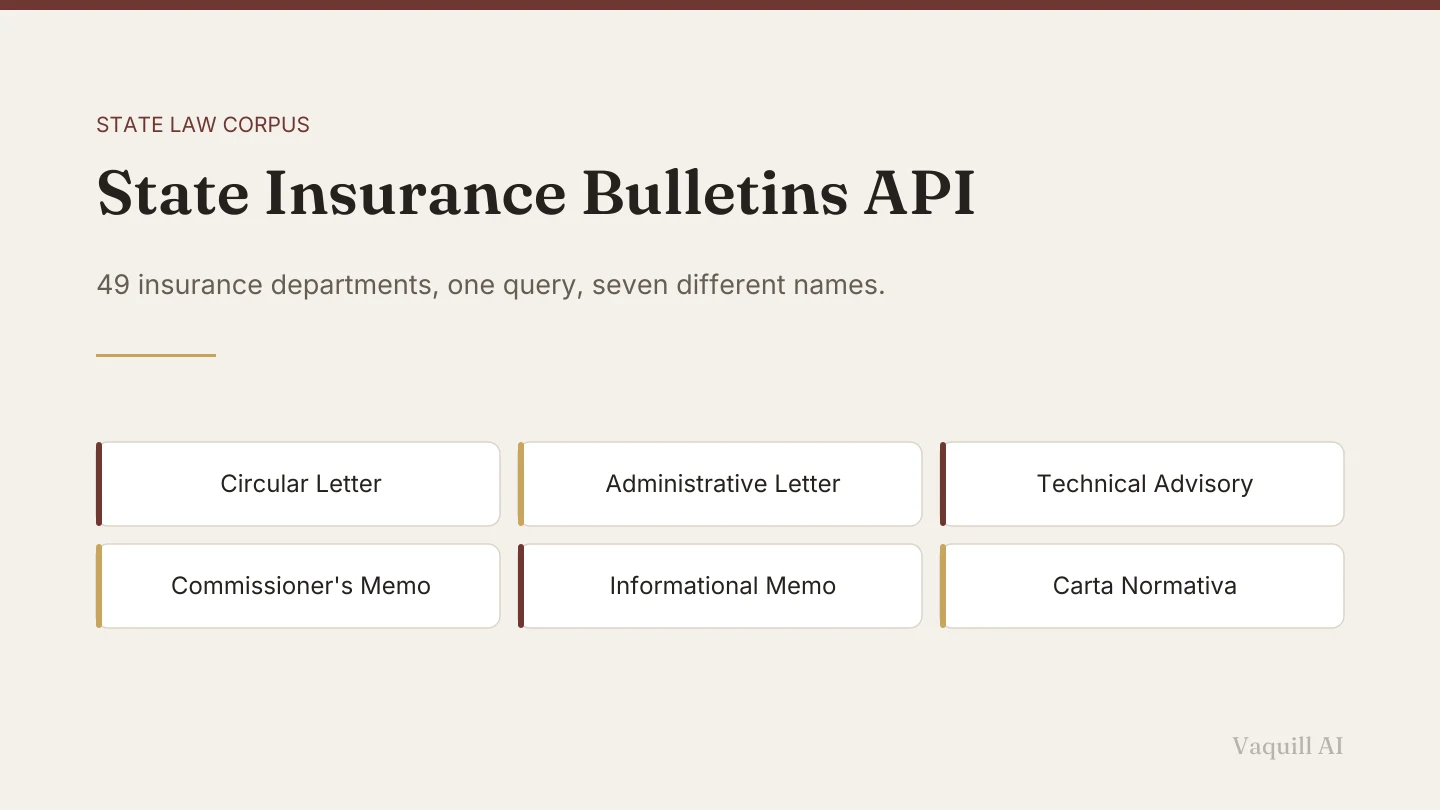
State insurance department bulletins from 49 jurisdictions are served through one endpoint, POST /us/statutes/search, filtered with corpusType=STATE_AGENCY_GUIDANCE and a list of states. That can stand in for a job many multi-state carriers do by hand: opening dozens of regulator websites, each with its own search box, its own PDF conventions, and its own name for the same document. New York calls it a Circular Letter. Virginia calls it an Administrative Letter. Washington calls it a Technical Assistance Advisory. They are all the commissioner telling the market how a statute or regulation gets applied, and until you normalize the naming you can't query across them at all.
This post covers what is in the corpus, the exact call, the per-state counts, and how to check what is held before you rely on it.
Reviewed and corrected on 12 October 2026. Per-state counts below come from the live coverage endpoint as of that day. This is general information, not legal advice.
TL;DR
- One filter covers all of it.
corpusType=STATE_AGENCY_GUIDANCEonPOST /us/statutes/searchreturns state regulatory guidance across 49 jurisdictions and more than 13,000 sections, almost all of it insurance department bulletins, refreshed on a per-state schedule. - Every state names it differently, and the naming is the reason cross-state search normally fails. Circular Letter, Administrative Letter, Technical Assistance Advisory, Commissioner's Memorandum, Carta Normativa, Informational Memorandum, and Advisory Memo are all the same instrument.
- Bulletins are guidance, and examiners read them. They are how a commissioner states an interpretation. Virginia's Bureau of Insurance says its administrative letters "are not law but are positions that the Bureau of Insurance has taken," and Washington says its advisories "are advisories only," yet a department's stated reading is what its own staff are likely to apply.
- It lands state by state. Of the 56 jurisdictions in the wider corpus, 49 carry bulletins; Colorado, Louisiana, Pennsylvania, Guam, the Northern Mariana Islands, the US Virgin Islands and American Samoa do not. Volume varies widely (Puerto Rico 1,641 documents, DC 27).
- NAIC model law text is a different kind of document. It is an NAIC publication, not a state's own bulletin, and the corpus holds the state-issued documents only.
- Refresh is checkable.
GET /boardsis free and returnslastRetrievedAtandcadenceper source, so you can see when each state was last pulled and compare that against its cadence instead of trusting a marketing page.
Why does a carrier selling in 30 states answer to 30 insurance regulators and not one federal one?
Filed with the rest of our US primary law corpus series, which takes the corpus source by source.
For the practitioner view of the same material, read Insurance Compliance Across 50 States: Where the Rules Actually Live. For the layer these bulletins interpret, read State Regulations API.
The problem: 50 websites, 50 vocabularies
An insurtech licensed in 30 states has 30 regulators who can change what compliant behavior looks like without amending a single statute. The change arrives as a bulletin. It shows up on the department's website, sometimes as a PDF, sometimes as a table row, sometimes only inside a year archive page that lists nothing before 2019.
There is no shared format, no shared feed, and no shared name. A compliance engineer who wants "every bulletin about claim handling issued since January" has to write 30 scrapers, and then keep writing them, because departments redesign their sites and move their archives.
The naming problem is the one that quietly breaks search first. If your crawler looks for the word "bulletin," it misses New York entirely.
What each state calls the same instrument
| Jurisdiction | What it is called | Issuing body |
|---|---|---|
| New York | Circular Letter | Department of Financial Services |
| Virginia | Administrative Letter | SCC Bureau of Insurance |
| Washington | Technical Assistance Advisory | Office of the Insurance Commissioner |
| Hawaii | Commissioner's Memorandum | Insurance Division |
| Puerto Rico | Carta Normativa | Oficina del Comisionado de Seguros |
| Florida | Informational Memorandum | Office of Insurance Regulation |
| Montana | Advisory Memo | Commissioner of Securities and Insurance |
| Most other states | Bulletin | Department of Insurance |
A short history: how insurance became a state-by-state business
The story runs through two Supreme Court decisions, a convention and a short statute.
In 1869, in Paul v. Virginia, the Court said that "[i]ssuing a policy of insurance is not a transaction of commerce." If insurance isn't commerce, Congress's commerce power doesn't reach it, and that left the field to the states. A couple of years later, in May 1871, state insurance officials held the first National Insurance Convention in New York City. The Superintendent of the New York Insurance Department, George W. Miller, had invited them. He called the meeting to order, proposed Albert W. Paine of Maine as temporary chairman, and used his opening remarks to name the problem. Doubts about life insurance, he said, came from the want of "an intelligent, comprehensive and uniform system of supervisory and legislative action." The convention opened on May 24, 1871 and adjourned to a second session that autumn, and the printed official report is still around. That convention is the ancestor of today's National Association of Insurance Commissioners.
That was 1871. The table above of what each state calls a bulletin shows how far the wish for uniformity got on at least this one point.
The federal door opened in 1944. In United States v. South-Eastern Underwriters Association, decided June 5, 1944, the Court reversed the lower court in an antitrust case against a group of fire insurers. Justice Black wrote that "[n]o commercial enterprise of any kind which conducts its activities across state lines has been held to be wholly beyond the regulatory power of Congress under the Commerce Clause. We cannot make an exception of the business of insurance." Congress answered in 1945 with the McCarran-Ferguson Act. Its policy section, 15 U.S.C. § 1011, says that "the continued regulation and taxation by the several States of the business of insurance is in the public interest." So the state patchwork wasn't an accident of history. Congress looked at it in 1945 and chose to keep it.
Why bulletins matter legally
A bulletin is the commissioner explaining, in the department's own words, what an existing statute or regulation means when a carrier applies it. It is the layer between a rule that says "unfair claim settlement practices are prohibited" and an examiner's finding that your specific acknowledgment workflow failed.
Most bulletins aren't adopted through notice-and-comment rulemaking, and some departments disclaim legal force outright. Virginia's Bureau of Insurance describes its administrative letters as "not law but ... positions that the Bureau of Insurance has taken." Washington's insurance commissioner's office calls its advisories "interpretive policy statements" and adds "They are advisories only." The companion post on where insurance rules live shows both pages in context.
That does not make a bulletin safe to ignore. It is the department's published reading of a statute or regulation, and examiners and regulators rely on that reading. A bulletin can also change what compliant behavior looks like without a word of statutory text changing, so it is the layer a compliance stack is most likely to miss.
What people in the business say
The patchwork shows up in the way people describe their jobs. A commenter who said they had spent most of a career in property and casualty and accident and health insurance listed the barriers a software startup would run into, and put regulation second: "Assuming US operations, 50 states with 50 different sets of regs need to be okay with what you're doing." Their advice for a startup: "build compliance and regulatory relations in from day 1. It's the least exciting thing you'll ever do, but is extremely important." (SmellTheGlove, Hacker News, June 2017).
Years later, someone working at an insurtech life carrier described the same job from inside. Many states join a compact with a single set of filings, they wrote, "but you still have plenty of other states to do filings with, analyze changing requirements from, maintain relationships with regulators, respond to regulatory complaints or investigations" (sethhochberg, Hacker News, May 2025). "Analyze changing requirements" is the line that matters here. A bulletin is how a requirement changes without a statute changing, and somebody on that compliance team has to notice it.
What is actually in the corpus
Per-state counts below are the document counts in the coverage matrix on 12 October 2026. They include a small number of financial-institution bulletins in four states (Arizona, New Jersey, Oregon and Vermont), which are served under a separate source value so an insurance search is never handed one. Volume tracks how much a department publishes and how far back its own archive goes, not how strict the state is.
| Jurisdiction | Documents | Jurisdiction | Documents |
|---|---|---|---|
| Puerto Rico | 1,641 | Tennessee | 173 |
| Texas | 1,284 | Hawaii | 171 |
| New York | 1,200 | Utah | 168 |
| Maryland | 677 | Illinois | 159 |
| New Jersey | 523 | Michigan | 153 |
| California | 464 | Montana | 149 |
| Massachusetts | 417 | Oklahoma | 143 |
| Alaska | 398 | Rhode Island | 134 |
| Connecticut | 369 | Nebraska | 120 |
| Arkansas | 359 | North Carolina | 117 |
| South Carolina | 319 | Ohio | 111 |
| Delaware | 301 | Missouri | 106 |
| Indiana | 282 | Oregon | 103 |
| New Mexico | 276 | Florida | 100 |
| Mississippi | 240 | Virginia | 89 |
| Arizona | 235 | Iowa | 83 |
| North Dakota | 235 | Kansas | 79 |
| Wisconsin | 232 | Idaho | 75 |
| Kentucky | 231 | Georgia | 66 |
| Maine | 228 | Wyoming | 62 |
| Vermont | 216 | Minnesota | 35 |
| Alabama | 207 | DC | 27 |
| Nevada | 200 | South Dakota | 27 |
| New Hampshire | 178 | Washington | 24 |
| West Virginia | 174 |
At the corpus level STATE_AGENCY_GUIDANCE held 13,360 documents across 49 jurisdictions on 12 October 2026. A section is one citable item with a stable actId, and long bulletins split into several retrieval passages, which is why passage counts run higher than section counts everywhere in this API. The counts grow, so treat the coverage endpoint below as the current authority rather than this page.
The query
One call, a state list, and a corpus filter. Everything else is optional. You can run it in the API playground first.
curl -X POST https://api.vaquill.ai/api/v1/us/statutes/search \
  -H "Authorization: Bearer vq_key_..." \
  -H "Content-Type: application/json" \
  -d '{
    "query": "claim acknowledgment timeline unfair claim settlement practices",
    "corpusType": "STATE_AGENCY_GUIDANCE",
    "state": ["ny", "tx", "ca", "fl", "wa"],
    "source": "state_insurance_bulletin",
    "matchType": "any",
    "limit": 25,
    "excerptChars": 600
  }'
In our 12 October 2026 run, this returned 25 hits with matchQuality of weak (the top hits were New York Insurance Circular Letter No. 13 (2011), on unfair claims settlement practices, and Texas Department of Insurance Commissioner's Bulletin B-0006-22), and no Washington hit made the first page. A weak rating on a broad query is a cue to narrow by state and read the documents. Four things about that call are worth knowing before you build on it.
corpusType and state both take a list. You can ask one question across five states in one request rather than fanning out five calls and merging by hand. A search is 4 credits per call, per the pricing endpoint on 12 October 2026, however many states you list. The source value state_insurance_bulletin keeps the results to insurance bulletins. The full token list is in the corpusType reference.
Unknown filter values are rejected with a 422, not silently ignored. If you pass a state code that doesn't exist, or a source value that isn't real, you get an error that lists the valid options instead of an empty result set that looks like a coverage gap. Silent zero results are the most expensive failure mode in legal data, because they look like an answer.
Paging is cut from one ranking. Page 2 costs the same as page 1, and results don't repeat or vanish between pages. limit maxes at 50 and offset at 70.
Results carry a source URL. All 25 in our run did, and the links pointed at the department's own pages, for example dfs.ny.gov and tdi.texas.gov. A compliance reviewer clicks through to the regulator, which is the only citation that survives an audit.
Getting the full text of a hit
Search returns excerpts. To pull a whole bulletin, take the actId off the search result and call GET /us/statutes/section/{actId} for the metadata or /section/{actId}/body for the full text.
Do not build the actId yourself. Ids are stable but they aren't guessable, and hand-constructed ones mostly 404. Take the id from a search or citation-resolve response and store it. That id is what makes a bulletin re-fetchable a year later, and it is what a watch is keyed on.
Scope, and how to check it
It lands state by state. Statutes and regulations are served for all 56 jurisdictions in the corpus. Bulletins are served for 49. If your compliance footprint includes Colorado, Louisiana, Pennsylvania or one of the territories other than Puerto Rico, the coverage endpoint tells you before you build anything.
Volume is uneven, and some of that is real. Washington's 24 documents and Florida's 100 are not obviously errors: departments differ in how much they publish and how far back their public archive goes. Treat a thin state as a question to ask about the department's archive rather than a measure of its regulation.
NAIC model law text is a different kind of document. The NAIC model acts and the Market Regulation Handbook are NAIC publications, not a state's own bulletins. The corpus holds the state-issued documents. If you need the NAIC publications, they come from the NAIC.
Earlier bulletin text is a reconstruction. A citation gets you the bulletin as it reads now. Add asOf=YYYY-MM-DD to the body request and an earlier text is rebuilt from the first change we observed after your date. State bulletins are not a held published edition, so the answer rests on our change capture: the asOf block reports isBounded when it is limited by when capture began, and a date from before capture can come back unavailable. Alongside it sit amendment history and lastAmendedYear per section, a yearFrom/yearTo currency filter, change events captured on each refresh, and per-section diffs on watched boards. If your use case needs verified text as of an exam date, confirm it against the department's own archive. The longer argument is in Amendment History and Point-in-Time Law.
Refresh cadence, and how to check it
The bulletin corpus refreshes state by state, and the cadence is declared per source rather than as one number. The registered cadence is monthly, and the documentation says each state's series is re-pulled roughly once a month. A cadence is worth exactly as much as your ability to verify it, so the verification path is free.
curl https://api.vaquill.ai/api/v1/boards \
  -H "Authorization: Bearer vq_key_..."
GET /boards costs no credits and returns every watchable source with lastRetrievedAt and cadence. The insurance bulletin boards carry the corpus name state_insurance_bulletins, one per state (New York's reads "Insurance bulletins NY"). lastRetrievedAt is when we last pulled that state's source, so compare it against cadence before you treat a quiet state as one with no new bulletins.
For monitoring rather than auditing, create a watch on the board and receive change events, then pull a per-section diff for anything that moved. Bulletins are the fastest-moving layer of insurance regulation, which makes watches more useful here than on a statute book that turns over once a year. The mechanics of watches, deliveries, and diffs are covered on the alerts page.
Who this fits
It fits a team that tracks guidance in several states and wants one query, one identifier scheme and change detection instead of a scraper per department. If you need NAIC model act text, that comes from the NAIC. If you need verified bulletin text as it read on a past date, asOf gives you a reconstruction to check against the department's archive, for the reason above.
FAQ
What is a state insurance bulletin?
It is a document issued by a state insurance department that tells regulated carriers how the commissioner reads an existing statute or regulation. It is usually not adopted through notice-and-comment rulemaking, and it usually is what a market conduct examiner tests against. Different states call it a Circular Letter, an Administrative Letter, a Technical Assistance Advisory, a Commissioner's Memorandum, an Informational Memorandum, an Advisory Memo, or a Carta Normativa.
How many states are covered by the bulletin API?
49 jurisdictions, holding 13,360 documents on 12 October 2026, each refreshed on its own schedule. Statutes and regulations are served for all 56 jurisdictions in the corpus, and the bulletin corpus lands state by state. GET /us/statutes/coverage returns the current per-jurisdiction counts for free.
Are insurance bulletins legally binding?
It depends on the state. Some departments say plainly that their bulletins are guidance only, and whether a given one can be enforced depends on that state's administrative law. Examiners and regulators still read them as the department's stated position, which is why compliance teams track them. Check your state's law for the weight of a particular bulletin.
Does the corpus include NAIC model laws?
No. NAIC model acts and handbooks are NAIC publications, not a state's own bulletins, and the corpus holds the state-issued documents. Get the NAIC publications from the NAIC.
Can I search bulletins and statutes in the same call?
Yes. corpusType accepts a list, so you can pass STATE_AGENCY_GUIDANCE alongside STATE and REGULATION and get one ranking across all three layers. That is usually the right first query for a new compliance question, because it shows you which layer actually answers it before you commit to one.
How do I get the full text of a bulletin?
Take the actId from a search result and call GET /us/statutes/section/{actId} for metadata or /section/{actId}/body for the full text. Do not construct the id yourself: ids are stable but not guessable, and hand-built ones usually 404. Results carry a source URL, which in our test run was the regulator's own page, so a reviewer can verify against the publisher.
Can I query what a bulletin said on a past date?
Yes, as a reconstruction. Pass asOf=YYYY-MM-DD to the section body endpoint and the earlier text is rebuilt from the first change we observed after your date. No published edition is held for this corpus, so isBounded flags an answer that rests on when capture began, and a date from before capture can come back unavailable. Also available are amendment history, a lastAmendedYear field, a yearFrom/yearTo currency filter, change events captured on each refresh, and per-section diffs on watched boards.
How do I know a refresh actually ran?
Call GET /boards, which is free and returns lastRetrievedAt and cadence for every watchable source. If you want to be told rather than to check, create a watch and take the change events. The same endpoint is the honest way to audit any freshness claim, including ours, and a lastRetrievedAt older than the cadence allows tells you not to read silence as no change.
Is Puerto Rico served in English?
No. Puerto Rico's Cartas Normativas and Cartas Circulares are stored in Spanish, the enacted language, rather than machine-translated. It is the largest jurisdiction in the corpus at 1,641 documents, so a Spanish-language search path is worth building if Puerto Rico is in your footprint.
Priyansh Khodiyar builds the US primary law corpus at Vaquill AI. Disclosure: we build the API described here. The per-state counts and the corpus total come from our own live coverage endpoint on 12 October 2026, and every one of them is re-checkable against the free GET /us/statutes/coverage endpoint, which is the point.
New legal AI guides, weekly.
Further Reading
Insurance Compliance Across 50 States: Where the Rules Actually Live
Read postState Regulations API: 1.5 Million Administrative Rules Across 56 Jurisdictions
Read postExecutive Orders API: Presidential Documents, Refreshed Daily
Read postFederal Register API: Querying Over 196,000 Final and Proposed Rules
Read postState Constitutions API: 53 Jurisdictions With Article and Section Structure
Read postState Court Rules API: 56 Jurisdictions and How to Query Them
Read post
Co-Founder & CTO
Priyansh leads engineering and AI at Vaquill AI: the pipelines that pull statutes, regulations and court rules from every US jurisdiction's official publisher, and the REST API, MCP server and open dataset that serve them.