AI citation verification is the process a legal AI uses to confirm that every case or statute it cites actually exists, that the quoted language matches the source, and that the authority truly supports the claim. A serious system does this in four independent layers: exact text matching, citation resolution against a real reporter, meaning analysis of the cited holding, and an adversarial cross-check by a second model. A single database lookup is not enough, because a real case can carry a fabricated quote or be cited for a proposition it never stood for.
TL;DR
- How legal AI verifies citations: four independent checks, not one lookup. Existence, exact quote, meaning, and a second-model cross-check.
- A reporter-string match proves almost nothing. Real case plus invented quote, and real case cited for the wrong holding, both pass a single-layer "verified" badge.
- The meaning layer is the one courts care about. Whiting v. City of Athens (6th Cir. 2026) sanctioned a brief for citing a real case for a proposition it never supported.
- Compose the layers as a minimum, not an average. One weak layer should drag the whole score down, not get averaged away.
- False positives are how a verifier loses its users. Flagging accurate paraphrases as fabrication trains lawyers to ignore the flags.
- Five questions at the end let you test any vendor's verifier in one call.
How does a serious 4-layer verifier combine its per-layer scores into a composite?
Part of our legal AI verification and hallucination guide series.
For related verification / hallucination / vendor-trust coverage, see How to Verify AI Legal Citations Before You File (ABA 512 Checklist) and What Legal AI Actually Avoids Hallucinating Cases (and Why Most Do Not).
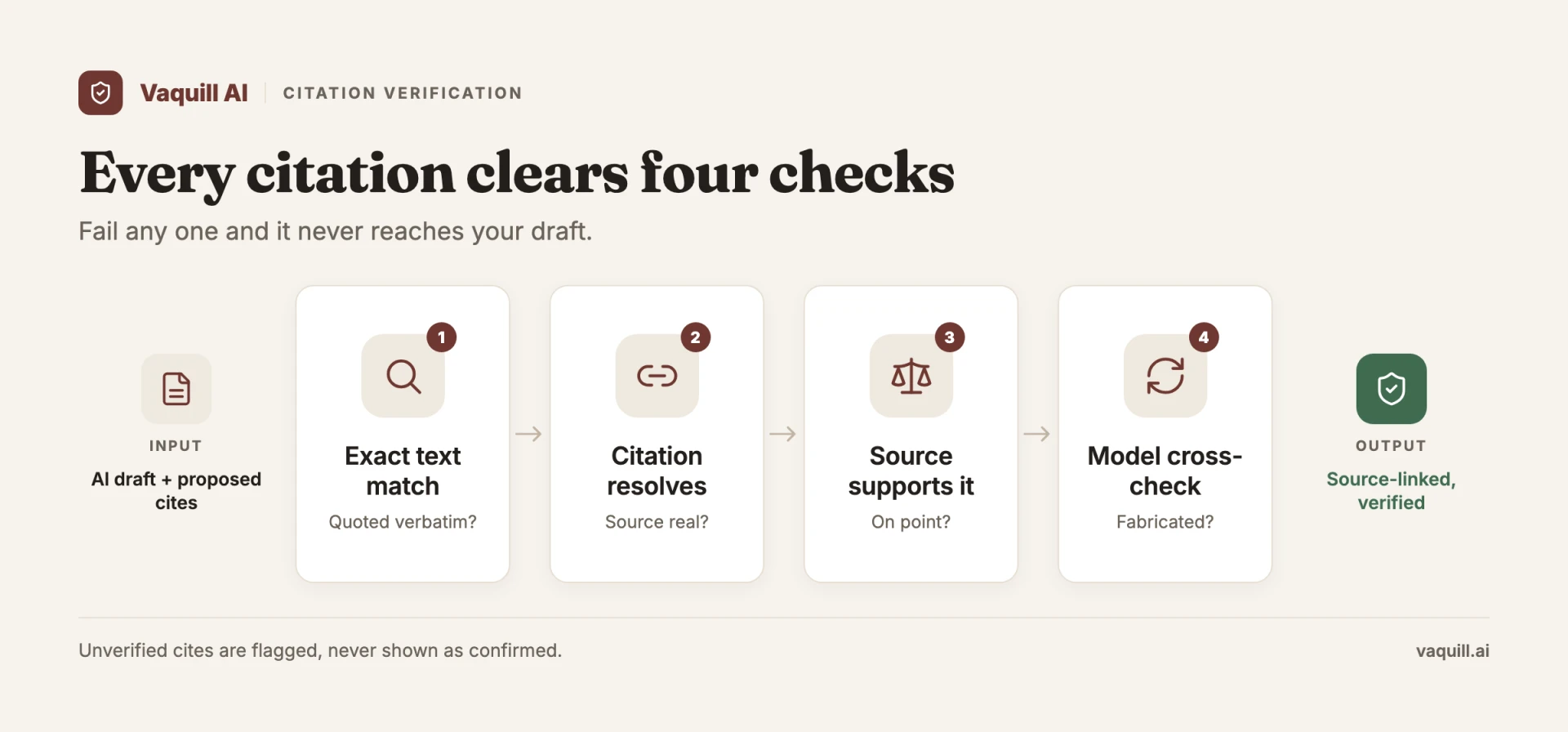
The four independent checks every citation passes before it reaches your draft.
Why legal AI citation verification is now an architecture problem, not a marketing line
This post started as an internal write-up after a 14-page draft motion came through our research workbench in late 2025 citing a real 1998 Eleventh Circuit opinion for a punitive damages standard. The case existed. The quoted phrase appeared verbatim on the pin-cited page.
A naive two-layer verifier would have stamped it green. The phrase sat inside the panel's summary of the appellant's losing argument, not the holding, which went the other way. The brief was a footstep from a Whiting-style sanction.
Every legal-AI vendor in 2026 has a "verification" page. Almost none describe what the verifier actually does. After Mata v. Avianca in 2023 and Whiting v. City of Athens (6th Cir. 2026), "verified" became a liability shield, and shields tend to be opaque.
The risk is measured, not hypothetical. Stanford RegLab and HAI found that even purpose-built legal tools hallucinate on a meaningful share of queries: roughly 1 in 6 for Lexis+ AI and about 1 in 3 for Westlaw AI-Assisted Research (Stanford HAI, "AI on Trial," May 2024). The running catalog of court cases involving AI-fabricated or unsupported citations had passed 600 by early 2026 (Damien Charlotin, AI Hallucination Cases database, accessed June 2026). For the sanctions side of this, see our catalog of AI hallucination sanction cases.
Sanctions are landing on lawyers who relied on a vendor's "verified" badge that turned out to mean only that the citation parsed as a valid reporter string.
Whiting named three failure modes in one order: a citation to a case that did not exist, a real case with a quote nowhere in the opinion, and a real case cited for a proposition it never stood for. The court treated all three as sanctionable.
A single-layer verifier catches one. The rest of this post is the engineering ruler.
Layer 1: Exact text match
Take the language the model emitted as a "quote" and find it in the source document, verbatim. The interesting engineering is not the match, it is the failure modes.
Strict-only matching fails the moment the model normalizes a curly apostrophe, drops an in-line footnote marker, or compresses two spaces to one. The verifier flags the quote missing. The lawyer ignores it. The verifier dies of false positives.
Regex-only matching with whitespace tolerance and Unicode normalization fixes the punctuation, not the paraphrase. The model wrote "the court held that good faith requires," the opinion says "good-faith reliance is required when." Regex returns no match. A perfectly accurate paraphrase gets flagged as fabrication, the lawyer rewrites it to the awkward original, and trust erodes.
Fuzzy-only matching at any tolerance loose enough to catch real paraphrases will match invented quotes against unrelated passages that share vocabulary. The verifier returns green on something the model made up. This is the failure mode most likely to slip past human review.
The fix is to run all three and treat disagreement as the signal. Strict and regex pass: high-confidence verbatim quote. Strict fails, regex passes: confidence high, log the normalization. Both fail, fuzzy passes above threshold: flag as paraphrase, escalate to Layer 3. Fuzzy fails too: treat as fabricated.
A real production bug: a reporter editor cleaned up grammar between the slip opinion and the official reporter version. The model quoted the slip. The verifier indexed the reporter. Strict and regex both failed, fuzzy passed at high similarity.
Without the layered output, an accurate quote would have been flagged as fabricated and rewritten into something worse. A Whiting-style "real case, wrong quote" authored by the verifier itself.
Layer 2: Citation resolution
The second layer asks: does this citation point to a real document, and is the document the one the model thinks it is. Mechanic: a citation parser plus a reporter index. What matters is what the response codes mean.
A clean 200 means the citation parsed, resolved to a single docket, and parties, court, and year match the emitted citation. This catches the original Mata v. Avianca failure mode, where six cited cases did not exist.
A 300-class ambiguity means the citation resolved to more than one document. Parallel citations across reporters can collide on volume and page if the parser is sloppy. A pin cite into a multi-opinion volume can resolve to two opinions.
Surface the ambiguity. A verifier that silently picks is the worst kind: wrong some of the time, confident every time.
A 404 means no document. Either a fabricated cite, or a real cite the index does not cover. If your reporter index is missing Federal Appendix from a specific year, a real cite there 404s and gets flagged as fake.
Most "the AI hallucinated" complaints I have personally traced back land here: real citation, wrong coverage.
The subtler failure: the citation resolves, but to a different case than the one the model named. The model says "Smith v. Jones, 123 F.3d 456 (5th Cir. 2010)," the citation resolves to a real 5th Circuit case at that reporter location, but the parties on the docket are different.
A verifier that does not cross-check parties, court, and year against the resolved document misses one of the most dangerous post-Mata failure modes: an invented case name borrowing a plausible reporter citation from a real case nearby.
One distinction for anyone evaluating vendors: public statutes endpoints (current US Code and CFR text) are a separate product class from internal case-law verifiers. Most credible public statutes APIs are statutes-only. The case-law resolution layer typically lives inside the research product, even where statute and regulation citations resolve over the API.
Vendors sometimes blur the two when describing "verification," for instance by marketing a citation-lookup endpoint that resolves only statute sections as "verifies citations" without flagging that case-law coverage is a separate question. Ask which endpoint is doing the verification, and against what corpus.
Layer 3: Meaning analysis
Layer 1 confirms the quote is in the document. Layer 2 confirms the document exists and is the right one. Neither tells you whether the cited authority actually stands for the proposition. That is Layer 3, and it is the layer the 6th Circuit hammered in Whiting.
The engineering shape is a directed comparison. Inputs: the AI's proposition, and the relevant passage. Output: does the opinion's holding support, contradict, or fail to address the proposition.
Structurally this is an NLI task wearing legal clothes, and the clothes matter. A passage that is dicta, a recitation of the losing argument, or a quoted source the court is itself describing can lexically contain the proposition and still not be authority for it.
The structural features that make this work: section-header heuristics (HOLDING, DISCUSSION, CONCURRENCE, DISSENT), proximity to disposition language ("we hold," "we affirm," "we reverse"), and majority-joining indicators in the heading block.
A rule-of-thumb: a passage more than ~2,000 characters from the nearest disposition verb in the same section is more likely dicta than holding. The rule fails on per curiam opinions and dense multi-issue rulings, which is why it never runs alone, it feeds the cross-check.
Three failure modes show up here.
The dicta trap. Language matches the proposition word for word. The verifier returns supported. The language is dicta. A meaning-analysis layer that does not weight where in the opinion the language sits will green-light a brief opposing counsel will demolish.
The dissent trap. A real case with a real quote on a minority view of a Circuit split. The quote is from the dissent. A verifier that does not distinguish majority from dissent labels it supported. You need a structural parse: majority, concurrence, dissent, plurality, per curiam, and you score support based on which section the passage came from.
The contradicted-by-subsequent-treatment trap. Cited authority does support the proposition. The authority has been overruled. Layer 3 in isolation cannot catch this. The verifier has to be wired to negative treatment metadata so a green "supports the claim" downgrades when the holding has been narrowed or vacated.
The opening incident is a Layer 3 win. Layers 1 and 2 returned green. Layer 3 caught the dicta trap by reading where in the opinion the phrase actually lived.
Layer 4: AI cross-check
The first three layers compute. The fourth layer disagrees.
An independent second model evaluates the first model's claim against the source. Different model family, different prompt, and crucially different objective: the second model is not trying to support the proposition, it is trying to find the strongest case against it. Adversarial cross-check, not redundant ensemble.
This layer exists for two reasons no amount of better Layer 3 fixes. First, single-model systematic errors. A model with a known weakness will repeat it if you run it twice. A different model, particularly with a different post-training regime, fails differently.
Two-model disagreement on the same source is one of the highest-signal flags a verifier can produce.
Both green, likely correct. Both red, likely wrong. Disagreement, escalate to human review.
Second, calibration. A single model's confidence is poorly calibrated on legal claims. Two independent models let you compute an agreement-weighted score that maps to actual error rates, which is how you generate a meaningful Verified / Partially Verified / Unverified label.
A practical sketch of the adversarial prompt, simplified: "Read the attached opinion passage. The drafting model claims this passage stands for [proposition]. Identify the single strongest reason the passage does NOT support that proposition, citing the specific language. If you find no such reason, return null."
Instructing the second model to hunt for the failure, not the support, is the part that matters. Asked the same supportive question as the first, it will mostly produce the same supportive answer.
Model-mix guidance. "Different model family" practically means combining two of: a frontier hosted model from one lab, a mid-size hosted model from a different lab, and a smaller distilled on-prem model.
Training cutoffs matter as much as architecture: a 2023 and a 2025 cutoff disagree on doctrines that shifted between, Loper Bright overruling Chevron in 2024 being the obvious case.
Adding a frontier-class adversarial model to our pipeline raised per-claim inference cost roughly 1.9x and added a few hundred milliseconds of median latency. We absorbed it by running Layer 4 in parallel with Layer 3 and surfacing the early Layer 1-2-3 composite in the UI while Layer 4 resolves.
The honest failure mode: two models sharing training data biases (near certain on US case law) skew disagreements toward edge cases and leave shared errors undetected.
How the layers compose
The four layers are a waterfall, not a parallel circuit. Layer 2 gates Layer 1, because matching a quote against the wrong document is a category error. Layer 1 gates Layer 3. Layer 3 gates Layer 4.
The scoring formula in production is closer to a minimum than a mean. Composite confidence cannot exceed the lowest single-layer confidence, capped by Layer 4's disagreement penalty.
A 95% Layer 1, 95% Layer 2, 95% Layer 3, 40% Layer 4 does not average to 81%. It produces a 40% composite, surfaced as Partially Verified, with the specific disagreement shown. Averaging hides exactly the signal you needed.
The corollary: you cannot skip a layer for performance. A vendor that runs Layers 1 and 2 on every claim and only Layer 3 "when needed" is shipping Whiting failures by design.
A worked example using an anonymized placeholder cite. The model emits, "The Eleventh Circuit has held that punitive damages require specific intent to harm. Doe v. Roe Corp. (11th Cir. 1998)." The verifier returns:
- Layer 2: 0.96 (citation parses, resolves to one docket, parties and court match).
- Layer 1: 0.94 (phrase present on the pin-cited page).
- Layer 3: 0.22 (passage sits inside the panel's summary of the appellant's argument, holding says the opposite).
- Layer 4: 0.18 (second model independently flags the dicta-versus-holding mismatch).
Composite: min(0.96, 0.94, 0.22, 0.18) = 0.18, label Unverified. UI string: "Cited language appears on the pin-cited page but is part of the panel's summary of the appellant's argument, not the holding. Recommended: do not cite for this proposition." A single-confidence verifier averaging to 0.69 would have shipped a sanction.
Practical numbers from production logs. In a representative month, roughly 71 percent of claims clear all four layers at high confidence with no escalation. Roughly 22 percent land in Partially Verified, the band where layer disagreement is the signal a human reviewer needs. The remaining 7 percent are Unverified, dominated by quote-fabrication and dicta-trap patterns.
The 3 to 5 percent false-positive rate on paraphrased-but-accurate quotes comes from our most recent eval set of around 1,200 sampled claims drawn from one month of queries, hand-labeled by two reviewers with a third resolving disagreements (raw inter-annotator agreement in the high 80s by percent).
Methodology matters more than the headline. False positives are how a verifier loses its users.
Where the 4-layer verifier still fails
Three failure classes survive even a well-composed four-layer system.
False positives that erode trust. A verifier that flags accurate-but-paraphrased quotes as fabricated trains lawyers to ignore the flags. Surface uncertainty as uncertainty, not as red, and make the underlying disagreement visible.
Unpublished dispositions and slip opinions. A real opinion not yet published, or designated unpublished and not in the index, looks fabricated. Coverage gaps look identical to hallucinations, which is why knowing exactly where every document in the corpus came from is part of the verifier's job. Fix it with transparent index coverage at the moment of the flag: "Not in index: Federal Appendix 2022 [request retrieval]" rather than a generic red badge.
Treatise and secondary-source citations. Wright and Miller, Restatements, ALR annotations, law review articles do not share the case parser and index. The honest answer is a separate verification path. What we return for a Wright and Miller citation is a different surface: "Secondary source. Volume and section parsed. Text verification not available in this layer. Reviewer recommended." Better to admit the gap than launder a secondary source through a case-law verifier and call it green.
How to evaluate any vendor's verification claim
Five questions, in this order, separate a real verifier from a badge.
- What does "verified" compute? If the vendor cannot describe the layers without marketing language, the system is probably one layer.
- What happens when the citation is real but the quote is paraphrased? "We mark it green" is shipping Whiting failures. "We flag it as paraphrased and escalate to meaning analysis" understands the architecture.
- What is the verifier's reporter coverage, and how does it surface coverage gaps? If a real-but-uncovered case looks identical to a fabricated one, the verifier is dangerous in the directions it does not know about.
- Is the meaning-analysis layer structurally aware? Majority versus dissent, holding versus dicta, current versus negatively treated. If the vendor cannot answer, Layer 3 is decorative.
- Is there an independent second-model cross-check, with disagreements surfaced to the user? A verifier that hides its disagreements is hiding the most useful signal it produces.
A vendor that answers all five concretely is doing serious work. A vendor that pivots to "our accuracy benchmarks show" is selling the badge.
Stanford's Hallucination-Free study is a useful third-party check on aggregate accuracy claims, but it does not replace asking what the verifier actually computes.
FAQ
What is AI citation verification?
It is the process a legal AI uses to confirm a citation is trustworthy before it reaches your draft. A complete check covers four things: the cited case or statute actually exists, the quoted text matches the source word for word, the authority genuinely supports the proposition, and a second independent model agrees. A tool that only confirms the citation parses as a valid reporter string is doing one of those four.
How does legal AI verify citations?
The strongest systems run layered checks rather than a single database lookup. First an exact-text match against the source document, then citation resolution against a real reporter index, then meaning analysis that compares the cited holding to the AI's claim, then an adversarial cross-check by a different model instructed to find the strongest reason the citation does not support the claim. Each layer catches a failure the others miss.
Can AI verify its own citations?
A single model checking its own work tends to repeat its own errors, because the bias that produced the bad citation also colors the review. That is why a credible verifier uses an independent second model with a different training cutoff and a different objective, plus deterministic checks (text match, citation resolution) that do not depend on a model's opinion at all.
Why is a database lookup alone not enough?
A reporter-string match only proves the citation points at something real. It cannot tell you whether the quote is accurate or whether the case stands for the proposition. Whiting v. City of Athens (6th Cir. 2026) named three failures in one order: a case that did not exist, a real case with a quote nowhere in the opinion, and a real case cited for a proposition it never supported. A lookup catches only the first.
How accurate are legal AI citation tools?
Accuracy varies widely and no honest vendor should quote a single clean number. Stanford RegLab and HAI found purpose-built legal tools still hallucinated on a meaningful share of queries, roughly 1 in 6 for Lexis+ AI and about 1 in 3 for Westlaw AI-Assisted Research (Stanford HAI, May 2024). The useful question is not the headline accuracy figure but how a tool handles the gray cases: paraphrased quotes, coverage gaps, and dicta.
What is a false positive in citation verification, and why does it matter?
A false positive is when the verifier flags an accurate citation as a problem, for example marking a faithful paraphrase as a fabricated quote. It matters because it trains lawyers to ignore the flags. A verifier that cries wolf becomes a verifier nobody reads, which is worse than no verifier at all. Surfacing uncertainty as uncertainty, rather than a blanket red badge, is the fix.
Does AI citation verification replace a lawyer's review?
No. ABA Formal Opinion 512 (July 2024) confirms that a lawyer's duties of competence and candor apply regardless of the tool used, so the lawyer remains responsible for every citation filed. A four-layer verifier narrows the set of citations a human must scrutinize and shows exactly where the doubt sits, but the sign-off is still yours.
Does Vaquill AI offer citation verification as an API?
Citation verification is part of Vaquill AI's research and drafting workbench, not a standalone API. Vaquill AI's public statutes API returns current US Code, CFR, and 50-state statute text. Case-law verification runs inside the product, against the research corpus, where the four layers can compose.
Verify before you file
Vaquill AI runs these four layers on every citation in your research and drafting workflow, then shows you the disagreement instead of hiding it behind a green badge.
For more on the broader topic, see our legal AI verification and hallucination guide, how to verify AI legal citations before filing, and what legal AI actually avoids hallucinating cases.
New legal AI guides, weekly.
Further Reading
- AI Hallucination Sanctions: Lawyer Cases and How to Avoid Them
- Damien Charlotin's Hallucination Tracker, Read Like a Risk Manager
- "We Do Not Train on Your Data": How to Verify the Claim
- AI Law Search Engine vs Keyword Search: Find Case Law Faster
- How to Verify AI Legal Citations Before You File (ABA 512 Checklist)
- ABA Formal Opinion 512 (2024): Generative AI Duties for Lawyers

Co-Founder & CTO
Priyansh leads engineering and AI at Vaquill AI: the pipelines that pull statutes, regulations and court rules from every US jurisdiction's official publisher, and the REST API, MCP server and open dataset that serve them.