A liquidated damages clause fixes in advance the dollar amount one party owes for a specific breach, so neither side has to prove actual losses in court. It is enforceable only if it is a genuine pre-estimate of hard-to-measure harm; if it looks like a threat designed to force performance, courts call it a penalty and refuse to enforce it. The line between the two is the entire game, and it turns on how the clause is drafted and what the parties knew when they signed.
TL;DR
- A liquidated damages clause sets a predetermined sum for a defined breach (a late delivery, a missed SLA, a departing employee taking clients), so the non-breaching party recovers without proving actual damages.
- It is enforceable only as a reasonable forecast of damages that were hard to estimate at signing. If the amount is disproportionate to any plausible loss, courts strike it as a penalty.
- A workable rule of thumb: tie the number to a real metric (per-day delay cost, per-record breach cost) and document the reasoning, do not pick a round scary number.
- A valid liquidated damages clause is usually the exclusive remedy for that breach. If the clause also lets the non-breaching party sue for actual damages, courts may read it as a penalty, and in New York a clause that reserves that election is void on its face.
- The most common review miss is a single liquidated sum for breaches of wildly different severity, which is the classic signature of an unenforceable penalty.
What a liquidated damages clause actually does
A liquidated damages clause does two things, and both have to hold for it to work.
1. It pre-sets the recovery. Instead of litigating actual losses after a breach, the parties agree now on what the breach is worth. This is valuable when damages are real but genuinely hard to prove: lost goodwill, business disruption, the cost of a delayed launch.
2. It allocates and caps risk. Both sides price the breach into the deal. The breaching party knows its exposure; the non-breaching party knows its floor and ceiling. That certainty is the legitimate purpose courts protect.
What it cannot do is punish. US law lets parties estimate damages, not impose penalties. A clause that sets a number far above any plausible loss is treated as in terrorem (a threat to compel performance), and most courts will not enforce it. The clause then collapses and the non-breaching party is back to proving actual damages.
The controlling standard is a two-part test. Restatement (Second) of Contracts section 356 phrases it as damages liquidated "at an amount that is reasonable in the light of the anticipated or actual loss caused by the breach and the difficulties of proof of loss," and it declares that a term fixing unreasonably large liquidated damages is unenforceable as a penalty. Both prongs matter: the harm has to be hard to estimate, and the number has to be a reasonable forecast of it.
Why it matters: the dollars at stake
Consider a construction-style services contract with a $2M value and a hard go-live date. The customer adds a liquidated damages clause for late delivery.
This is an illustrative example. Assume the real cost of a one-month delay is roughly $40,000 (idle staff, lost early revenue, extended overhead).
- A clause set at $1,500 per day of delay (about $45,000 a month) tracks the actual harm. A court will likely enforce it, and the customer recovers without proving anything.
- A clause set at $50,000 per day (about $1.5M a month) dwarfs any plausible loss. A court will likely call it a penalty and strike it, leaving the customer to prove actual damages from scratch.
Same delay, same contract. The reasonable clause pays out cleanly; the greedy one is worth nothing and forces full litigation. Overreaching on the number is how a liquidated damages clause becomes self-defeating.
Who wants what
| Non-breaching party (drafting the LD) | Breaching party (exposed to the LD) | |
|---|---|---|
| Amount | Higher, generous "forecast" | Lower, tied tightly to real loss |
| Per-unit metric | Per day, per record, per incident | A single capped total |
| Exclusivity | Wants LDs plus actual damages | Wants LDs as the sole and exclusive remedy |
| Graduation | Flat rate regardless of severity | Tiered by how bad the breach is |
| Cap on LDs | None, or a high ceiling | A clear maximum (often a percentage of contract value) |
| Trigger | Broad ("any failure to perform") | Narrow, specific, defined breaches only |
The tension: the drafting party wants a big, simple number; the exposed party wants a defensible number that will actually survive a challenge. Ironically, the exposed party's position often protects the clause, because a defensible number is an enforceable one.
Market-standard language
A typical liquidated damages clause for late performance reads close to this:
LIQUIDATED DAMAGES.

The parties acknowledge that the actual damages Customer would suffer
from late delivery are difficult to ascertain as of the Effective Date.
Accordingly, if Provider fails to achieve Go-Live by the Target Date,
Provider will pay Customer liquidated damages of $1,500 for each day of
delay, up to a maximum of $135,000. The parties agree that this amount
is a reasonable estimate of Customer's probable loss and not a penalty.
These liquidated damages are Customer's sole and exclusive monetary
remedy for delayed delivery, and are not a forfeiture or penalty.
The recitals are not filler. The acknowledgment that damages were hard to estimate, plus the "reasonable estimate, not a penalty" language and the cap, are what courts look for. They do not guarantee enforcement, because a court will test the substance, but their absence makes a challenge much easier.
The number itself needs a paper trail. Courts protect figures the parties can trace to something real: a rental or financing cost per day, revenue lost per week of delay, notification and remediation cost per breached record. As a rough sanity check, construction practice sometimes anchors a delay rate at roughly $20 to $25 per day for every $100,000 of contract value, but that is a starting point to test against the actual projected loss, not a substitute for it. Keep the worksheet that produced the number; it is the evidence that the amount was a forecast rather than a threat.
The negotiation: standard, fallback, walk-away
Treat the amount, the exclusivity, and the cap as separate trades.
| Issue | Opening position | Fallback both sides accept | Walk-away |
|---|---|---|---|
| Amount basis | Round lump sum | Per-unit rate tied to a documented metric | A number with no relationship to loss |
| Cap on LDs | No cap | Maximum tied to contract value (for example, 5-15%) | Uncapped per-day accrual |
| Exclusivity | LDs plus actual damages and termination | LDs are the sole monetary remedy, termination preserved | LDs stacked on top of full actual damages |
| Severity | One flat rate for any breach | Tiered or per-unit rates by severity | A single sum for breaches of very different magnitude |
| Excusable delay | LDs accrue no matter the cause | Extension of time for owner-caused and force majeure delay | LDs run during delays the paying party did not cause |
| Mutuality | One-sided (only the other side pays) | Mutual where both can cause the breach | One-sided LD plus one-sided uncapped liability |
The cleanest version is a per-unit rate (per day, per record, per missed milestone) with a sensible cap and clear exclusivity. That structure both tracks real harm and reads as an estimate rather than a threat.
Common carve-outs / variations
Liquidated damages show up in several recurring shapes:
- Delay damages. Per-day amounts for missed delivery or go-live dates. The most common and most tested form.
- SLA service credits. Capped credits for missed uptime or response targets, usually styled as the customer's exclusive remedy for that miss. See the service level agreement clause.
- Data-breach liquidated amounts. A fixed sum per affected record. Defensible if tied to real per-record notification and remediation cost.
- Non-solicit and non-compete buyouts. A set fee if a departing employee or a party breaches a restrictive covenant. Courts scrutinize these closely for penalty character.
- Carve-back to actual damages. Some clauses let the non-breaching party elect actual damages instead of LDs for serious breaches, drafted carefully so the LD is not read as a sham. Note the jurisdiction risk below: an open election can void the clause in some states.
Two structural carve-outs decide whether a delay-based clause is fair, and both belong on your review pass:
Extension of time (excusable delay). The paying party should not accrue liquidated damages for delay it did not cause. A well-drafted clause stops the clock for owner or customer-caused delay, force majeure, and other excusable events. Without it, a per-day rate becomes a penalty for events outside the promisor's control. This is where the clause meets force majeure: the two have to line up on what counts as excusable.
Concurrent delay and apportionment. When both sides contribute to the same delay, an apportionment provision divides responsibility instead of charging the full per-day rate to one party. Silence here usually favors the party assessing damages, so the exposed party should ask for it expressly.
A graduated fallback that survives scrutiny often reads:
For each full day Provider fails to meet the Uptime Commitment below
the applicable threshold, Customer will receive a service credit equal
to 5% of the monthly fee per percentage point below target, up to 100%
of that month's fee. Service credits are Customer's sole and exclusive
remedy for failure to meet the Uptime Commitment.
Jurisdiction and enforceability notes
Liquidated damages are generally enforceable across US states when they reflect a reasonable estimate, but the test and its strictness vary.
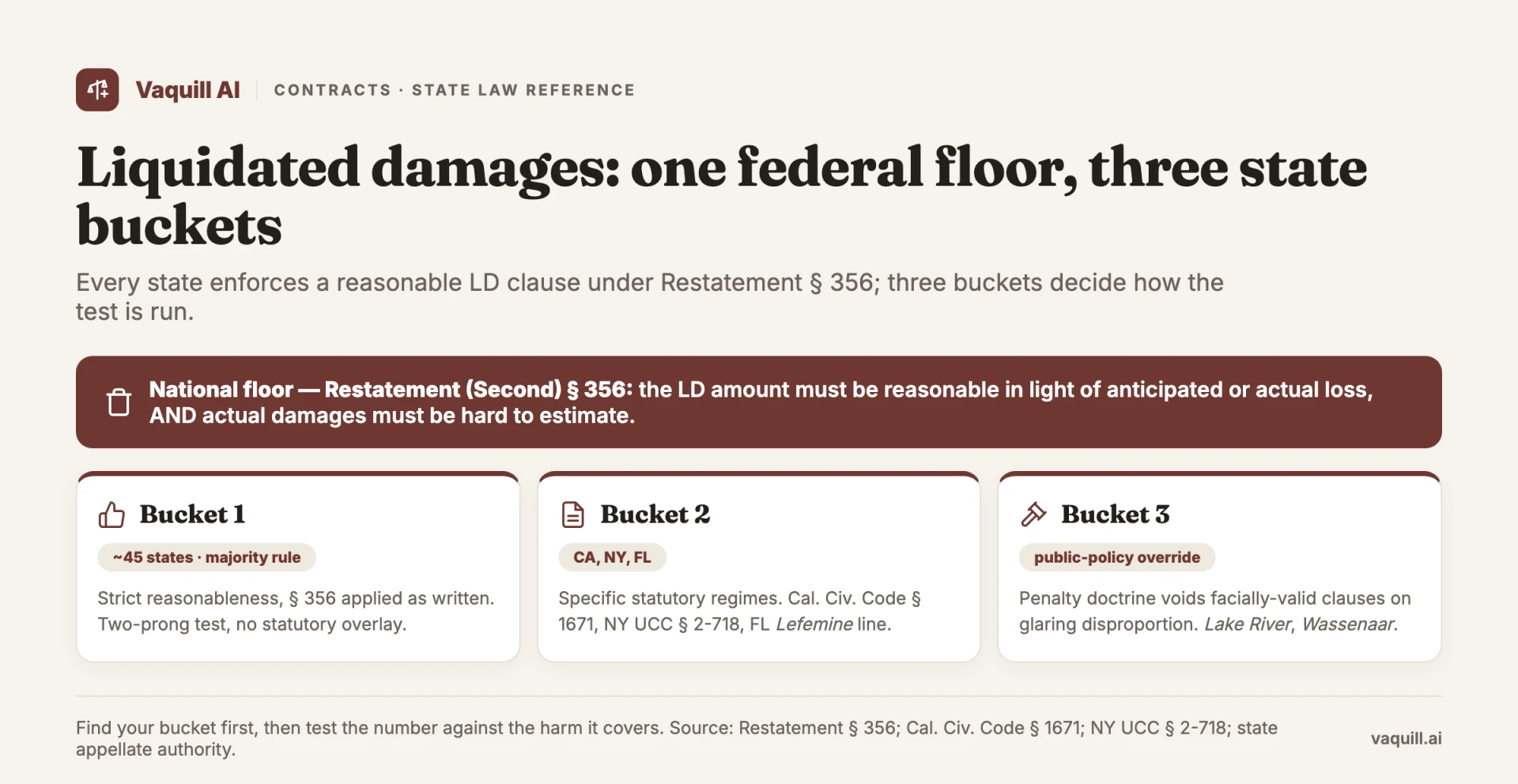
- The reasonableness test. Most states ask whether the amount was a reasonable forecast of damages that were hard to estimate at the time of contracting. Some states also look at actual damages after the fact (the "second look"); others judge it as of signing only.
- Sale of goods. Under the UCC section 2-718(1), liquidated damages in a goods contract must be "reasonable in the light of the anticipated or actual harm caused by the breach, the difficulties of proof of loss," and other factors; a term fixing unreasonably large liquidated damages is void as a penalty.
- California. Civil Code section 1671(b) flips the usual burden for non-consumer contracts: a liquidated damages provision "is valid unless the party seeking to invalidate the provision establishes that the provision was unreasonable under the circumstances existing at the time the contract was made." Commercial LDs start out presumptively enforceable, and the challenger has to prove otherwise.
- New York. A clause that lets the non-breaching party choose between liquidated damages and actual damages is generally unenforceable. The reserved option signals that the fixed sum was never a real pre-estimate, so drafting the LD as the exclusive remedy matters more here than almost anywhere.
- Penalty doctrine. Courts uniformly refuse to enforce penalties. A clause that overshoots plausible loss, or that stacks LDs on top of actual damages, risks being struck entirely, not just reduced.
- Exclusive remedy. A valid liquidated damages clause is usually the exclusive remedy for that breach. Reserving the right to also pursue actual damages can undermine the clause's character as an estimate.
This is general information, not legal advice for a specific deal. Enforceability turns on the governing law and the facts, and the penalty test differs by state, so confirm against the controlling law before relying on the number. For a state-by-state view, see our guide on liquidated damages enforceability by state.
Review checklist: red flags to catch
- A round, large lump sum with no link to any per-unit or documented loss metric.
- The same amount applies to breaches of very different severity, the classic penalty tell.
- The clause lets the non-breaching party recover LDs plus actual damages for the same breach, or reserves an election between them (fatal in New York).
- No cap on per-day or per-incident accrual, so the total can run far past any real loss.
- No extension-of-time or excusable-delay carve-out, so LDs run during delay the paying party did not cause.
- Missing recitals that damages were hard to estimate and the amount is a reasonable forecast.
- The clause is labeled a "penalty" or a "forfeiture" on its face, which invites a court to treat it as one.
- A one-sided liquidated damages clause when the breach could be caused by either party.
- The LD is swept into a consequential-damages waiver or general liability cap with no carve-out, so if the LD is struck there is no fallback to actual damages.
How it interacts with other clauses
A liquidated damages clause sits among the remedy provisions; read it with:
- Limitation of liability: decide whether the general cap limits the liquidated sum or the LD stands outside it. If a consequential-damages waiver would also bar actual damages, carve the LD breach out so a struck clause still leaves a remedy.
- Service level agreement: SLA credits are liquidated damages and follow the same penalty rules.
- Indemnification: confirm an indemnity for the same underlying loss is not stacking a second recovery on top of the fixed sum.
- Force majeure: excusable-delay events should pause LD accrual; keep the two clauses consistent on what qualifies.
- Termination: LDs often pair with a right to terminate for the same breach; confirm they are not double-counting.
- Non-solicitation: buyout-style LDs in restrictive covenants draw close penalty scrutiny.
For the broader workflow, see the in-house contract review playbook.
FAQ
What is a liquidated damages clause? It is a provision that fixes in advance the dollar amount owed for a specific breach, so the non-breaching party recovers that sum without proving actual losses. It is meant for situations where real damages exist but are hard to measure, like delay, lost goodwill, or business disruption.
When is a liquidated damages clause unenforceable? When it functions as a penalty rather than an estimate. If the amount is disproportionate to any plausible loss, or the same sum applies to breaches of very different severity, most US courts will strike it as a penalty and require proof of actual damages instead.
What is the difference between liquidated damages and a penalty? Liquidated damages are a reasonable pre-estimate of hard-to-measure harm; a penalty is a number set to scare a party into performing. Courts enforce the first and refuse the second. The drafting (a metric-based amount, a cap, recitals) is what signals which one you have.
Can you recover liquidated damages and actual damages for the same breach? Usually not. A valid liquidated damages clause is typically the exclusive remedy for the breach it covers. Letting the party also pursue actual damages for the same breach can cause a court to treat the clause as a penalty, and in New York a clause that reserves that choice is void.
How are liquidated damages calculated? Start from a real loss metric and build up: idle labor, extended overhead, financing or rental cost per day, revenue lost per week of delay, or notification and remediation cost per breached record. Construction practice sometimes anchors a delay rate around $20 to $25 per day for every $100,000 of contract value as a rough check, but the defensible number is the one you can trace to the deal's actual projected loss.
Are SLA service credits liquidated damages? Yes, in substance. A capped service credit for missed uptime is a liquidated damages amount and follows the same penalty rules. That is why credits are usually capped and styled as the customer's exclusive remedy for the miss.
What happens if a liquidated damages clause is struck down? The fixed number falls away and the non-breaching party is back to proving actual damages under ordinary contract rules. That is why exposed parties should carve the breach out of any consequential-damages waiver or general liability cap, so a failed LD does not leave them with no remedy at all.
How do you make a liquidated damages clause enforceable? Tie the amount to a real metric (per day, per record, per missed milestone), cap the total, add recitals that damages were hard to estimate and the figure is a reasonable forecast, make it the exclusive remedy, and keep the calculation that produced the number. None of this guarantees enforcement, but it gives the clause the structure courts look for.
Does the penalty rule differ by state? Yes. Most states apply a reasonableness test, but some judge it only as of signing while others also weigh actual damages after the fact, California puts the burden on the party challenging a commercial clause, and New York voids a clause that reserves a choice between liquidated and actual damages. Check the governing law for the specific deal rather than assuming a single national rule.
Related clauses
Clauses that get negotiated alongside this one.
