
ChatGPT can answer a legal question from memory, with no source in sight. A plugin called Vaquill AI Primary Law, in the ChatGPT directory since November 2026, gives it a server that searches US law, reads a section and returns a link to the source.
Short answer: yes, there is a ChatGPT plugin for US law research. Open the listing, choose Install plugin and sign in with OAuth. Then ask for a statute, a citation check or an opinion. Results come with a source link, and the tools tried here only read. In a test of the server's generic search and fetch tools, statute lookups worked and a case-law query did not return case records. The details are in the test section below.
Written and checked on 23 November 2026. This is general information, not legal advice; check the cited opinion before relying on it.
TL;DR
- The listing is real and public. Name "Vaquill AI Primary Law", tagline "Search and cite US law", version 1.0.4 on the day it was checked.
- Sign-in is OAuth. The docs say to leave any API key field empty.
- Deep research uses
searchandfetch. In a test run on 23 November 2026, those two tools returned statutes, rules and agency documents, and no case records for a Miranda query. - A resolved citation is a match on volume, reporter and page. It does not check a case name, a quote or a pincite.
Statute text, as of 23 November 2026
The first example prompt on the listing asks: "Which federal law lets someone sue a state official for violating their constitutional rights? Quote the statute." The statute it points to is 42 U.S.C. § 1983.
What it says (the quoted words are verbatim): the person who, under color of state law, deprives someone of rights secured by the Constitution and laws "shall be liable to the party injured in an action at law, suit in equity, or other proper proceeding for redress" (42 U.S.C. § 1983, first sentence).
Read from: the section text returned by the server's fetch call on 23 November 2026, checked against the 2024 edition on govinfo.gov and Cornell's Legal Information Institute. The words quoted above match in all three.
What the listing shows
The listing has two parts that matter. The top shows the plugin and three example prompts. Further down is a details block.
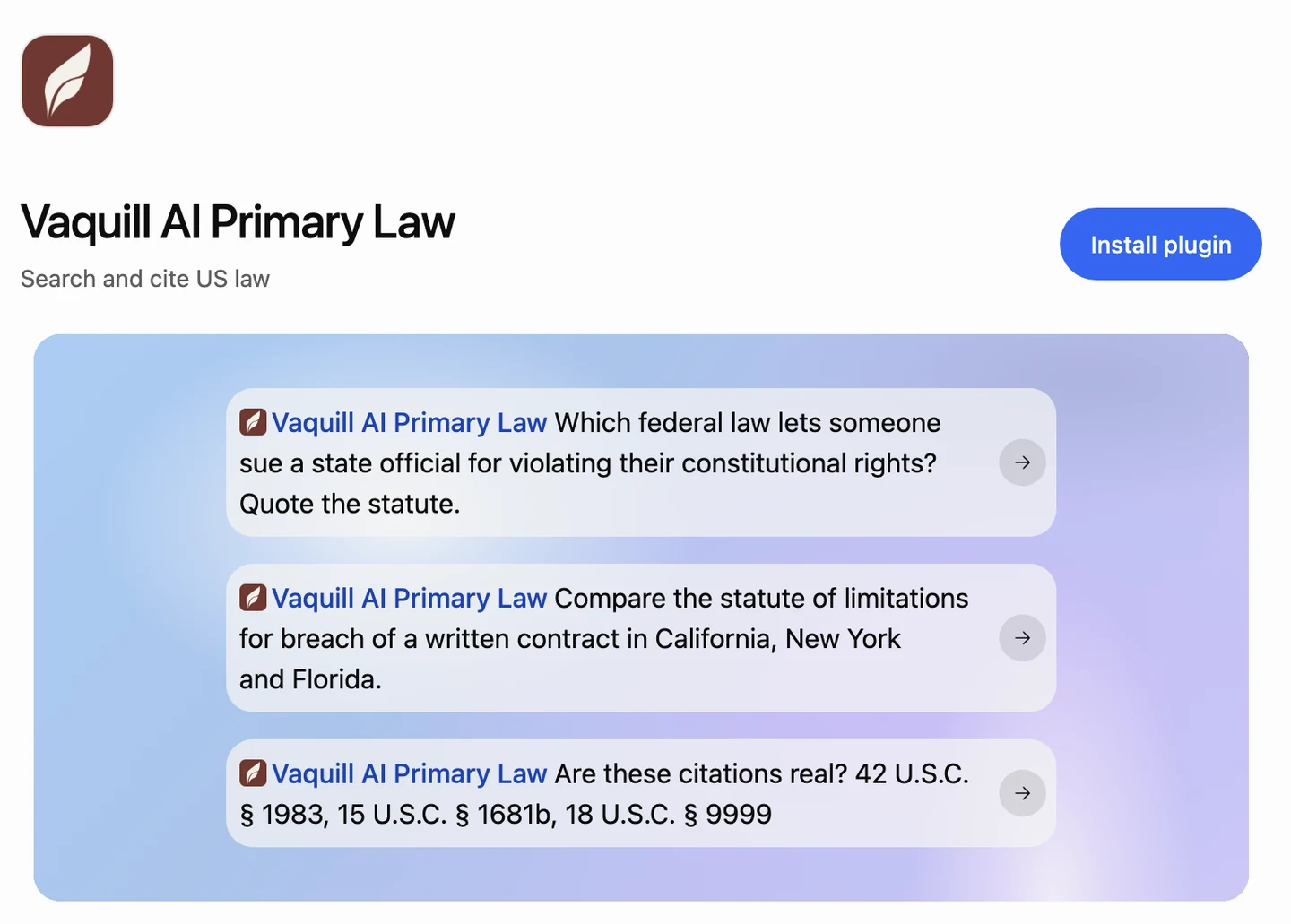
Screenshot of the live listing, 23 November 2026.
The three example prompts on the card:
- Which federal law lets someone sue a state official for violating their constitutional rights? Quote the statute.
- Compare the statute of limitations for breach of a written contract in California, New York and Florida.
- Are these citations real? 42 U.S.C. § 1983, 15 U.S.C. § 1681b, 18 U.S.C. § 9999.
All three are statute questions. None asks for an opinion.
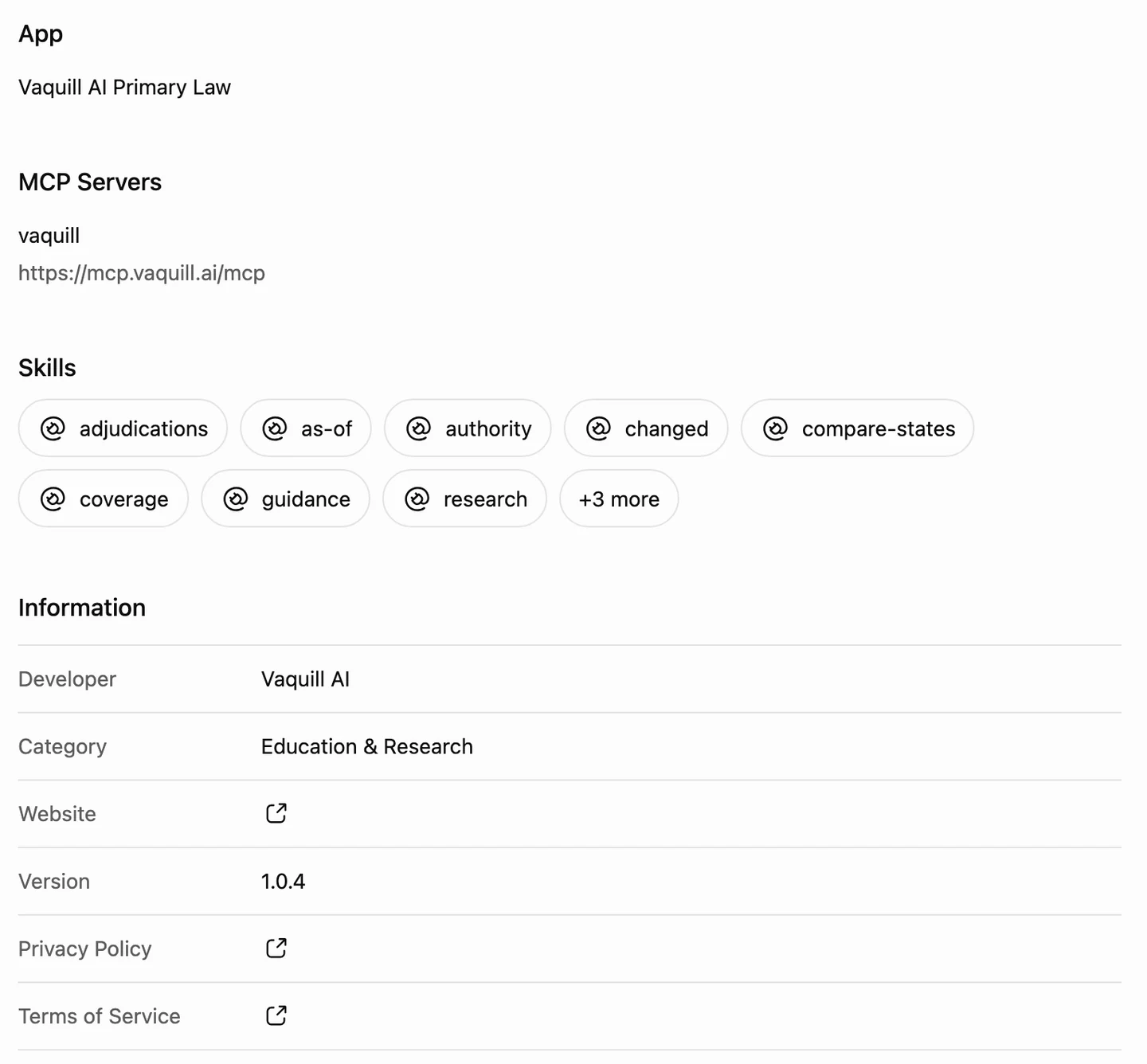
Screenshot of the live listing, 23 November 2026.
| Block | What it says |
|---|---|
| App | Vaquill AI Primary Law |
| MCP Servers | vaquill, at https://mcp.vaquill.ai/mcp |
| Skills | Chips named adjudications, as-of, authority, changed, compare-states, coverage, guidance, research, and "+3 more" |
| Information | Developer Vaquill AI. Category Education & Research. Version 1.0.4. Links to a website, a privacy policy and terms of service |
MCP is the Model Context Protocol, a standard way for an assistant to call outside tools. The server URL in the table is the address ChatGPT calls.
The listing also carries a longer written description. It was written before US case law was added to the server, so this guide does not repeat it. It covers statutes and regulations.
Add it (Try it)
Nothing in this section was run inside ChatGPT for this guide. The steps come from the listing screenshots and the ChatGPT and Codex docs page, read on 23 November 2026. Menus change, so follow your screen where it differs.
- Open the listing: Vaquill AI Primary Law in ChatGPT. A logged-out visitor sees a log-in button where a signed-in one sees Install plugin.
- Choose Install plugin. The docs say the endpoint uses OAuth 2.1, so you sign in with your account for the service in the browser. Leave any API key or header field empty.
- Ask a question. Start with one of the three prompts above.
- Make one real call. The docs say a connected status does not prove the server works. They suggest asking for the statutes coverage of California, and say that read costs no credits. Other calls are charged against a credit balance, so check your balance before a long session.
If you would rather add the server by hand as a remote MCP server, the docs give the same address, https://mcp.vaquill.ai/mcp, over Streamable HTTP. Codex and other terminal clients register it the way each client documents, then finish the browser sign-in. The MCP setup page lists the other clients.
Which tools deep research uses. The docs say research clients, including ChatGPT deep research, look for two tools named search and fetch. search returns records with an id, a title and a URL. fetch takes an id, a source URL or a citation such as 42 U.S.C. 1983 and returns the text.
Which plans can add it. OpenAI's help page on apps in ChatGPT says availability "depends on the app, your ChatGPT plan, region, workspace, role, model, and ChatGPT interface you use." The text read on 23 November 2026 did not say which plans can add a given app. If you use a workspace plan, an administrator may control which apps you can add. Check Settings in your own account.
What it covers
The docs list US statutes, regulations, court rules, constitutions, agency guidance and case law as served by the same MCP server. The counts on this site are 6M+ sections for statutes, regulations, court rules and related primary law, and, counted separately, 10.1M+ case records. The two are never added together.
Every result in the test below carried a source link to the publisher's own site, such as a legislature, a court or an agency.
Case law through this plugin: what a test returned
ChatGPT deep research reaches a server through search and fetch, so those two decide what it can find. They were run on 23 November 2026 with a case-law query.
Setup, stated plainly. The calls ran through the vaquill-mcp package in a Claude Code session. They did not run inside ChatGPT, and the hosted endpoint ChatGPT connects to was not called directly. Treat the result as a strong hint about the pair, not proof of what ChatGPT shows.
Query 1. search with Miranda v. Arizona, 384 U.S. 436. It returned ten results. None was a case record. They were state statutes, court rules, an executive order, an attorney general opinion, a federal statute section and an IRS document. The snippets of five of them quote or cite the case. Trimmed to id and title:
EXEC_2016-10302                 Law Day, U.S.A., 2016
STATE_CO_T16_A3_P4_S16-3-406    16-3-406. Custodial interrogation - admissibility ...
SRULES_MP_STYLEMANUAL_D1        Document 1. Supreme Court Style Manual
SRULES_AK_EVID_R412             Rule 412. Evidence Illegally Obtained
AGOP_WA_AGO_1974-0003           ARREST ... CONSTITUTIONAL RIGHTS OF ACCUSED PERSONS ...
USC_T10_C47_S801                Article 1. Definitions
SRULES_UT_URE_R410              Rule 410. Pleas, Plea Discussions, and Related Statements
IRS_WD_200048038                Miscellaneous Issues
SRULES_MA_MGEVID_R511           Section 511. Privilege against self-incrimination
STATE_NV_T5_C62C_S62C.013       Disclosure of rights required before initiating custodial ...
Query 2. search with Miranda v. Arizona opinion Supreme Court custodial interrogation warnings. Ten results again, none a case record: state statutes, attorney general opinions, an executive order and an IRS manual section.
Four more queries. The same day, search with a case name (Gideon v. Wainwright), a name and citation (Roe v. Wade 410 U.S. 113), a quoted case name with a word ("Chevron U.S.A. Inc. v. Natural Resources Defense Council" opinion) and a topical phrase (custodial interrogation Miranda warnings) also returned no case record. Across the six searches, 60 results, none was a court opinion.
fetch with the case citation. fetch with 384 U.S. 436 returned an error:
Could not resolve '384 U.S. 436' to a section. Pass an `id` from a `search` result,
or a citation such as '42 U.S.C. 1983'.
fetch with a statute citation. fetch with 42 U.S.C. 1983 returned the section. Trimmed:
{
  "id": "USC_T42_C21_S1983",
  "title": "Civil action for deprivation of rights",
  "text": "Every person who, under color of any statute, ordinance, regulation, custom, or usage, ...",
  "url": "https://uscode.house.gov/view.xhtml?req=granuleid:USC-prelim-title42-section1983&num=0&edition=prelim",
  "metadata": { "citation": "42 U.S.C. § 1983 (2026)", "corpusType": "USC", "state": "federal" }
}
What this supports. The generic pair reads sections of statutes, regulations, court rules and similar documents. A search for a case name returned statutes, rules and other documents, several of which cite the case, and no opinion. The tool descriptions the server gives a client say search covers "US primary law" and fetch returns "the full text of one US law section". The ChatGPT docs page describes search as returning records "across every US corpus", so for case opinions the result here differed from that wording. The same server's citation tool did match 384 U.S. 436 to a case record (next section), so case law is on the server. Whether ChatGPT calls those case tools was not tested.
Not verified on 23 November 2026. A deep research run inside ChatGPT. To check it, ask: "Find Miranda v. Arizona, 384 U.S. 436, and link the opinion." If the answer links statutes or rules that mention the case, you have seen the same behavior. Not run in ChatGPT for this guide.
One real check: two citations
Both calls ran on 23 November 2026, through the same local package.
A federal statute. 42 U.S.C. 1983 came back resolved: true, titled "Civil action for deprivation of rights", with a link to the section on the House's U.S. Code site.
A Supreme Court case. The citation 384 U.S. 436 came back resolved. One entry of results, trimmed:
{
  "status": "resolved",
  "case": {
    "caseName": "Miranda v. Arizona",
    "court": { "courtId": "US_FED_SCOTUS", "name": "Supreme Court of the United States" },
    "decisionDate": "1966-06-13",
    "citations": ["16 L. Ed. 2d 694", "86 S. Ct. 1602", "384 U.S. 436", "..."],
    "publicationStatus": "published"
  }
}
A section that is not held. 18 U.S.C. 9999, the third citation on the listing card, came back resolved: false with missReason: not_held. That means the corpus has no such section. It does not by itself prove the section never existed. Look at the published U.S. Code before you tell anyone a citation is invented.
resolved means the volume, reporter and page matched a record. It does not check the party names, a quotation or a pincite. For how to confirm the case behind a citation, see How to Find a Case by Its Citation. The other citation on the card, 15 U.S.C. § 1681b, was not run.
What it does not do
- It is not legal advice. It returns text and links. You still read the cited text.
- Case search is keyword-only. Every word must appear, up to three quoted phrases are allowed, and OR, NOT and wildcards are not supported.
- A citing list does not settle whether a case is still good law. It shows who cited the case, not whether a later court agreed. Read the later opinions.
- A resolved citation is not a checked quote.
- ChatGPT may share your chats. The default notice in ChatGPT's text for apps reads: "ChatGPT may share relevant chats and memories with this app to support interactions with it." That is OpenAI's standard wording, taken from the text ChatGPT's plugin pages carry, read on 23 November 2026. The app's use of that data is subject to its own terms and privacy policy, which the listing links.
Compared with the Claude directory listing
Claude has its own directory listing for the same server, with a different setup. See Add US Primary Law to Claude From the Connectors Directory. For a case-law walk-through in Claude, see Case Law MCP Server: Connect Claude to US Case Law. For the wider choice of legal connectors, see Use Claude for US Legal Research Over MCP.
What goes wrong
- The plugin is not in your account. OpenAI says availability depends on plan, region, workspace and role. Ask your administrator before assuming it is broken.
- A case question gets a statute answer. The test above shows why. The generic
searchfinds documents that mention a case. Ask for the opinion by citation and check what the link points to. - A miss is read as a fake.
not_heldmeans not in the corpus. - A trial-court order will not resolve by reporter citation. A reporter citation is held for about 96% of supreme-court cases, 82% of appellate cases and 45% of trial-court cases. Find those by court, date and docket number.
- Confidential text goes into a chat. Keep client names and privileged facts out of chats while the plugin is on.
A teammate asks how ChatGPT deep research can use a connector at all. What do the plugin's docs say research clients look for?
For US case law, statutes and regulations through one API key, see the US case law API.
FAQ
Is there a ChatGPT plugin for US legal research?
Yes. "Vaquill AI Primary Law" is listed in the ChatGPT directory, under Education & Research. It searches US law and returns links to the source.
Do I need an API key?
No. The docs say the endpoint uses OAuth 2.1 and that any API key or header field should stay empty.
Which tools does ChatGPT deep research use?
The docs say research clients look for tools named search and fetch, and the server provides both.
Does it return case law in ChatGPT?
Not shown here. In a test through a local package on 23 November 2026, the generic search and fetch returned no case records for a Miranda query. The same server's citation tool did match a Supreme Court citation to a case record. A deep research run inside ChatGPT was not verified.
Will ChatGPT share my chats with the plugin?
ChatGPT's notice says it may share relevant chats and memories with the app. The app's use of that data follows its own terms and privacy policy.
Does a resolved citation mean the case says what a brief claims?
No. Resolved means the volume, reporter and page matched a record. It does not check a name, a quotation or a pincite.
Which ChatGPT plans can add it?
OpenAI says availability depends on the app, plan, region, workspace, role, model and interface. Check Settings in your account.
New legal AI guides, weekly.
Further Reading
- Case Law MCP Server: Connect Claude to US Case Law
- How to Find a Case by Its Citation (and Confirm It Is the Right One)
- Legal Connectors for Claude: Add Vaquill AI Primary Law
- Court Opinions as JSON: The Fields and a Working Fetch
- How to Read a Case Citation, Piece by Piece (Real Example)
- How to Verify Case Citations: Four Checks, Four Failures

Co-Founder & CTO
Priyansh leads engineering and AI at Vaquill AI: the pipelines that pull statutes, regulations and court rules from every US jurisdiction's official publisher, and the REST API, MCP server and open dataset that serve them.