In-house teams do not have a reading problem. They have a queue problem. Sales needs an order form signed by Friday, procurement dropped four vendor MSAs in your lap, and none of them is worth reading line by line. The lawyers who keep up do not read faster. They triage: sort the paper by risk, go straight to the three or four clauses that actually move exposure, and check each against a position they already know they will take.
This checklist is that method, not a linear read. It sorts contracts into review tiers so you spend two minutes on a $6,000 tool and two hours on the data-heavy MSA, and for each high-risk clause it gives you the market position, the fallback, and the point where you stop and escalate. The goal is to clear routine paper defensibly and spend your judgment where the money and the risk actually are.
TL;DR
- Triage before you read. Risk-tier the queue by data sensitivity and deal size. A $6k tool with no personal data does not get the review a data-heavy MSA gets.
- Five clauses carry almost all the risk: limitation of liability, indemnity, termination/renewal, IP, and data. Read those first, every time.
- Know your accept / push / escalate line per clause before you open the file, so review is a comparison, not a fresh legal analysis each time.
- The liability cap is the whole ballgame. A mutual 12-month-fees cap with data-breach and IP carved out is the market center; an uncapped or one-sided cap is an escalate.
- AI vendors need a different read in 2026: training rights on your data, output ownership, model-improvement clauses, and sub-processor flow-down are the new risk clauses.
- Stop over-negotiating governing law. It rarely changes your outcome. Spend that time on data, indemnity, and the cap.
What is the market-center limitation-of-liability cap for a buyer-side in-house team?
Step 1: triage the queue into review tiers
Not every contract deserves the same review, and treating them equally is why the queue backs up. Sort first. Most of the value that leaks out of a legal team leaks from paper nobody triaged: World Commerce & Contracting, the trade body for contract professionals, puts the cost of poor contract management at roughly 9 percent of annual revenue, and the routine agreement that got a rubber stamp is where that number comes from.
Fast-path (2 to 5 minutes). Low dollar value, no personal data, standard vendor terms, month-to-month or short term. Check the cap, the term, and auto-renewal, and move on. A $6,000 project tool with no access to your data does not need a clause-by-clause read.
Standard (20 to 40 minutes). Meaningful spend, some business data, a real term. Run the full risk-clause pass below.
Deep (a real sit-down). Any of: personal or regulated data, a BAA-adjacent vendor, an AI vendor with rights to your content, high annual value, or a first-of-its-kind deal. These get the full pass plus the tier-specific clauses (data, AI, security exhibits).
The biggest speed lever in-house is tier assignment, not reading speed. Get the tier right and the routine 80 percent clears fast while the risky 20 percent gets real attention.
The same logic maps cleanly onto the contract types that hit an in-house queue every week.
| Contract type | Usual tier | Why |
|---|---|---|
| Click-through tool, no data, low dollar | Fast-path | No data, no leverage to negotiate, cap the risk and move |
| Standard vendor or SaaS order form | Standard | Real spend and business data, but a known shape |
| Data-heavy MSA, BAA, security addendum | Deep | Regulated data and breach exposure well above the fee cap |
| AI vendor touching your content | Deep | Training, output, and data-rights grants hide in the fine print |
| First-of-its-kind or high-value deal | Deep | No template to compare against, so every clause is live |
Before the risk clauses: the 60-second sanity check
Four things can void an otherwise perfect review, and none of them is a risk clause. Run them before you open the redline.
- The parties are the right legal entities. The contracting party is the entity that will actually pay or perform, spelled with its full legal name, not a trade name or a parent that is not on the hook. A signature from the wrong subsidiary is unenforceable against the one with the money.
- The signatory can bind the company. Confirm the person signing has authority. For anything material, that means an officer or a delegate named in a signing-authority matrix, not whoever forwarded the PDF.
- The scope lives somewhere concrete. Deliverables, SLAs, or a statement of work you can actually measure. "Services as described in Exhibit A" is fine only if Exhibit A exists and says something.
- Every date is logged. Effective date, initial term, renewal date, and notice deadline go into your calendar or CLM the moment you sign, not the week they expire.
Contract review checklist: the risk clauses in accept / push / escalate order
For each clause, decide against a known position. Here is the market center for a buyer-side in-house team, the point worth pushing, and the point to escalate. These are common positions from in-house practice, not a published survey, so your leverage, industry, and deal size shift them.
| Clause | Accept (market) | Push for | Escalate if |
|---|---|---|---|
| Limitation of liability | Mutual cap at 12 months' fees, with carve-outs | Higher multiple for data-heavy deals; explicit carve-outs | Uncapped against you, or cap swallows data-breach/IP |
| Indemnity | Mutual, IP + data-breach + third-party claims | Vendor defends, not just reimburses | One-way against you, or no IP indemnity |
| Termination | For cause with cure; you get convenience | Convenience right; pro-rata refund | Vendor-only convenience with no refund |
| Auto-renewal | 30-day notice window, capped uplift | 5-7% cap on increases in writing | 90-day notice with uncapped increase |
| IP / work product | You own deliverables; vendor keeps its tools | Effective present assignment, not "agree to assign" | Vendor claims your data or work product |
| Data / DPA | Compliant DPA, breach notice in defined hours | 48-hour breach clock; sub-processor list + objection | No DPA, or breach carved into the liability cap |
The liability cap: read it first, and know both sides
The limitation of liability is the single most important term in most agreements, so it gets read first. The market center is a mutual cap set at the fees paid in the prior 12 months, with a set of carve-outs sitting outside the cap: confidentiality breach, data breach, IP infringement indemnity, and gross negligence.
Two nuances that separate a real reviewer from a checklist. First, the cap level should scale with the risk, not the deal: a $9,000 vendor that holds your customer PII can cause harm far larger than 12 months of its fees, so on data-heavy deals you push for a higher multiple or a separate, larger data-breach cap. Second, know the vendor's move. When you ask to carve data breach fully out of the cap, a sophisticated vendor will counter with a super-cap (a separate, higher cap for data breach, say 2x to 5x annual fees) rather than uncapped liability. That is a reasonable middle, and knowing it is the counter keeps you from either accepting the base cap or dying on an uncapped hill.
Where the 12-month center breaks down: enterprise SaaS and regulated-data vendors should carry a higher multiple, security and infrastructure vendors often warrant a separate larger cap, professional-services deals turn on the scope of work, and low-value clickwrap you cannot negotiate at all, so the decision there is whether the risk is acceptable, not what the cap says.
In practice the exchange runs like this. You strike the one-way cap, make it mutual, and add a data-breach carve-out. The vendor's counsel counters with a 3x super-cap and asks you to drop the gross-negligence carve-out. You keep gross negligence, because it is standard and they know it, and accept the 3x. The mistake business teams make is reading the cap as "how much we might have to pay," when for a data vendor it is "the ceiling on what we can recover when they lose our records." The redline note that lands is plain: "Breach exposure here far exceeds 12 months of fees; we need data-breach liability at a meaningful multiple, carved out from the general cap."
Indemnity, termination, IP, data
Indemnity should be mutual and cover IP infringement and data breach at minimum, with the vendor obligated to defend, not just reimburse you later. A one-way indemnity running against you is the common vendor default and a push, not an accept.
Termination and renewal is where money leaks quietly. You want termination for convenience with a pro-rata refund of prepaid fees; the trap is a 90-day notice window on an auto-renew, which is how "we forgot to cancel" turns into another full year. See the contract renewal and auto-renew traps.
IP turns on one word: an effective present assignment ("hereby assigns") actually transfers ownership, while an "agrees to assign" is only a promise you may have to enforce later. For work product, get the present tense. See the IP clause breakdown.
Data is covered in the DPA layer: a compliant data processing agreement, a breach-notification clock in defined hours, a sub-processor list with an objection right, and (the recurring theme) breach liability that sits outside the cap.
Sample fallback language
Generic advice is easy to nod at and hard to use, so here is redline-ready language for the four clauses worth the fight.
- Data-breach super-cap: "Each party's aggregate liability shall not exceed the fees paid in the 12 months preceding the claim, except that Provider's liability for breach of its data-security or confidentiality obligations shall not exceed three times (3x) such fees."
- No AI training: "Provider shall not use Customer Data, including prompts and inputs, to train, fine-tune, or improve any machine-learning model, nor share Customer Data with any model provider for such purposes."
- Present assignment of IP: "Provider hereby irrevocably assigns to Customer all right, title, and interest in the Deliverables." The operative words are "hereby assigns," not "agrees to assign."
- Auto-renewal control: "Customer may cancel any renewal on 30 days' notice before the renewal date, and any fee increase shall not exceed 5% per renewal term."
AI vendors need a different read in 2026
The AI vendor is the new risk tier, and a standard SaaS review misses its clauses. When the vendor's product is a model that touches your content, read four things a normal contract review would skip.
Training rights. Does the vendor reserve any right to train or improve its models on your data or your prompts? The default answer you want is no, with an explicit contractual statement to that effect. A vague "to improve the services" clause is broad enough to cover model training, so pin it down.
Output ownership. Who owns what the AI generates from your inputs, and can the vendor reuse it? For anything you will rely on, you want clear ownership of outputs and no vendor reuse of your derived data.
Model-improvement and feedback clauses. These often grant the vendor a license to your usage data framed as "feedback." Read them as a data-rights grant, because that is what they are.
Sub-processor flow-down. AI vendors run on other AI vendors (model APIs, hosting, tooling). Confirm the sub-processor list is real, that your data terms flow down to them, and that you get notice and an objection right when the stack changes.
| AI-vendor clause | Accept | Push for | Escalate if |
|---|---|---|---|
| Training on your data | Explicit "no training on customer data" | The commitment in the contract, not just a policy page | Any right to train or improve models on your data or prompts |
| Output ownership | You own outputs of your inputs | No vendor reuse of your derived data | Vendor claims rights in the outputs |
| Feedback / model improvement | Narrow, de-identified, opt-out | Aggregated and de-identified only | Broad license to your usage data framed as "feedback" |
| Sub-processor flow-down | Real list, notice, objection right | Data terms bind the model providers too | No list, or terms that do not flow down |
This is exactly why the AI vendor lands in the deep tier. The risk hides in the data and IP grants buried in "improve the services" language, well away from the commercial terms you would normally scan.
What is over-negotiated (spend your leverage here, not there)
A sharp in-house lawyer knows what not to fight about. Governing law and venue draw endless redlines and rarely change your real-world outcome for a routine commercial deal, so do not spend an hour there. The same goes for most notice mechanics and counterparts boilerplate.
Spend the leverage you save on the things that decide the deal: the liability cap and its carve-outs, the data and AI grants, the indemnity, and the termination economics. If you are trading redlines, trade a governing-law concession for a data-breach carve-out, not the reverse.
Red flags, as the scenarios they actually are
Abstract red flags do not stick. These do.
The $9,000 vendor with your customer database. Its liability cap is 12 months of fees, so $9,000. It holds your customer PII. If it leaks the database, your maximum recovery is $9,000 against a breach that could cost you seven figures. That mismatch, not the raw cap number, is the escalate.
The auto-renew you cannot stop in time. The renewal clause requires 90 days' written notice before the anniversary. Nobody calendared it. You notice in month 11, and you are locked in for another year at a price the vendor was free to raise. The fix is a shorter notice window and a calendared reminder, negotiated at signing.
The "improve the services" AI clause. A drafting tool reserves the right to use your data to "improve the services." Your legal team's confidential drafts are now, arguably, training data. The clause looks like boilerplate and functions like a data-rights grant.
Running the checklist at volume
Triage and delta-checking are exactly what AI does well, because the routine question on inbound paper is not "what does this say" but "where does it deviate from our standard." Compare the agreement to your playbook, surface the clauses outside your accept range, and route only those to a lawyer.
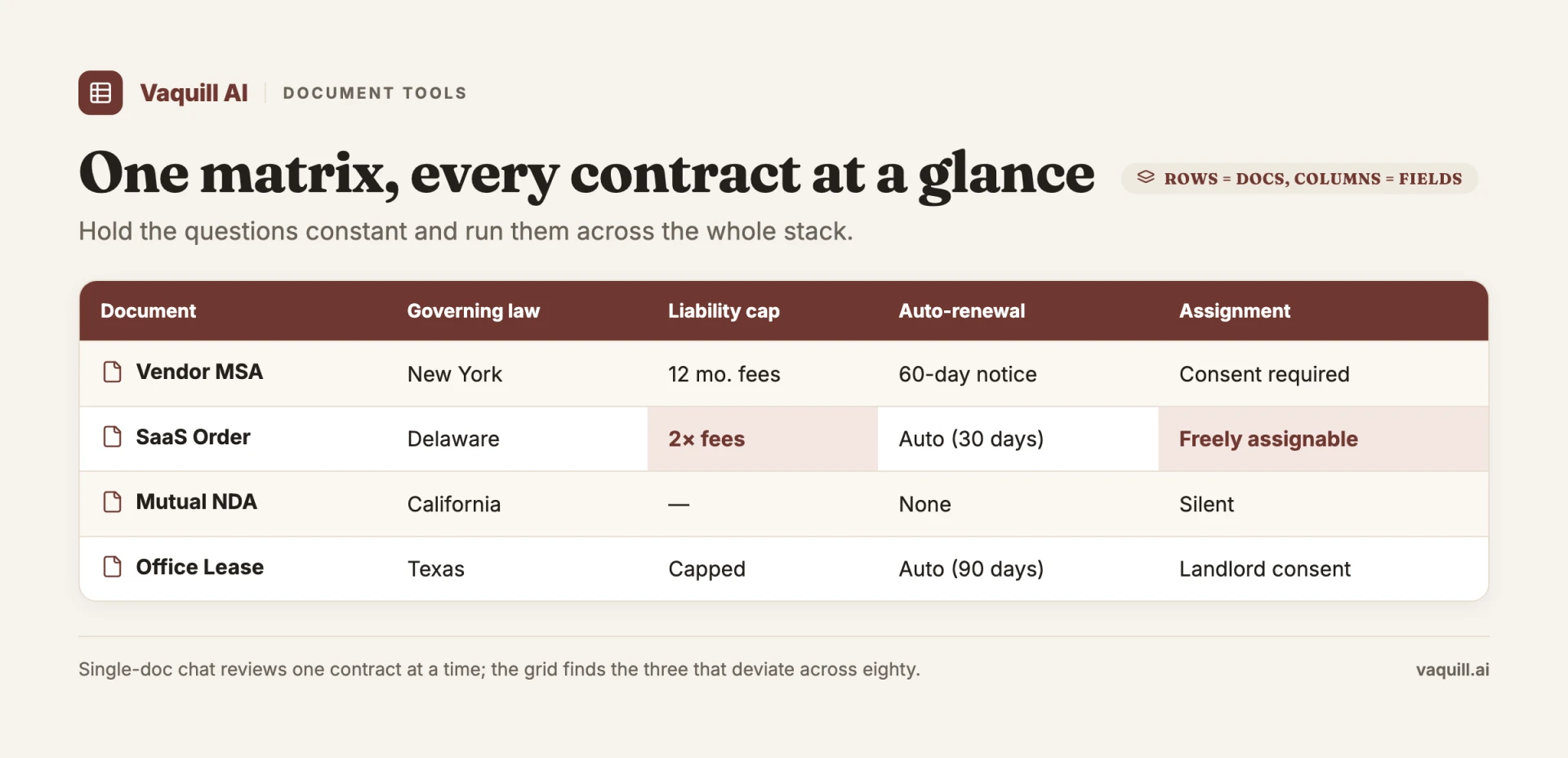
The boundary is worth stating plainly. Extraction, playbook comparison, red-flag pattern matching, and volume triage are the machine's half; contextual risk calls, negotiation leverage, regulatory judgment, and the final sign-off stay with the lawyer. A tool that promises to remove the second half is selling something you should not buy.
In Vaquill AI, that runs as a structured review against your own positions, flagging the liability, indemnity, termination, data, and AI-grant clauses that fall outside standard, with the language quoted so you redline in one pass. For the fuller workflow, see the in-house contract review playbook.
FAQ
What should I check first when reviewing a contract? The limitation of liability clause and its carve-outs, then indemnity, termination and auto-renewal, IP ownership, and data. Those five carry almost all the risk, so reviewing them first means the important work is done even if the queue forces you to move on.
How do I review contracts faster without missing risk? Triage by risk tier before you read. A low-dollar tool with no personal data gets a two-minute check; a data-heavy, AI, or high-value deal gets a full pass. Reading everything at the same depth is what makes the queue unmanageable.
What is a reasonable limitation of liability cap? The market center is a mutual cap at the fees paid in the prior 12 months, with confidentiality breach, data breach, IP indemnity, and gross negligence carved out above it. On data-heavy deals, push for a higher multiple or a separate data-breach super-cap.
What contract clauses are most negotiated? Limitation of liability, indemnification, termination and auto-renewal, IP ownership, and data protection, plus AI-specific training and output-ownership terms for AI vendors. Governing law and boilerplate draw redlines but rarely change the outcome.
What should I check in an AI vendor contract? Whether the vendor can train on your data (you want an explicit no), who owns the AI outputs, how "model improvement" or "feedback" clauses grant data rights, and whether your data terms flow down to the vendor's own sub-processors and model providers.
Which contract terms are not worth negotiating hard? Governing law and venue, notice mechanics, and most boilerplate rarely change your real-world outcome on a routine commercial deal. Save that leverage for the liability cap, data and AI grants, indemnity, and termination economics.
How long should a contract review take? It depends on the tier, not the page count. A low-dollar tool with no personal data should clear in a few minutes; a standard commercial deal runs 20 to 40 minutes; a data-heavy MSA, BAA, or AI vendor is an hour or more, longer with exhibits and a security addendum. Reviewing everything at MSA depth is what makes the queue unmanageable.
What is the difference between a contract review checklist and a playbook? A checklist tells you which clauses to read. A playbook tells you what position to take on each one: your accept range, your fallback, and the point where you escalate. This page is both, which is the point. A checklist without positions turns every contract into a fresh legal analysis; positions let you review by comparison instead.
Who should be involved in reviewing a contract? Legal owns the risk clauses, but the business owns the deal. Procurement or the business owner confirms scope, pricing, and that the vendor is actually needed; security or IT weighs in on data and access; finance checks payment terms. Legal's job is to route the clauses outside standard to the right desk, not to negotiate a $6,000 tool alone.
For more, see the in-house contract review playbook, how to review a SaaS agreement, and the limitation of liability clause breakdown.
New legal AI guides, weekly.
Further Reading
The In-House Contract Review Playbook for 2026
Read postHow to Review a SaaS Agreement: An In-House Playbook
Read postNDA vs Confidentiality Agreement: Are They the Same Thing?
Read postNDA vs Non-Compete vs Non-Solicit: Which Restrictive Covenant Do You Need?
Read postAI NDA Review Software: 9 Tools Compared (Pricing + What They Flag)
Read postWhat Vaquill AI Can Actually Do: Agentic Workflows, Verification Depth, and Open Benchmarks
Read post
Co-Founder & CEO · Attorney
Arshita leads product and strategy at Vaquill AI, the US primary law data API. As an attorney, she decides which law we carry, how each section is sourced and cited, and what legal AI and compliance teams need from the data.