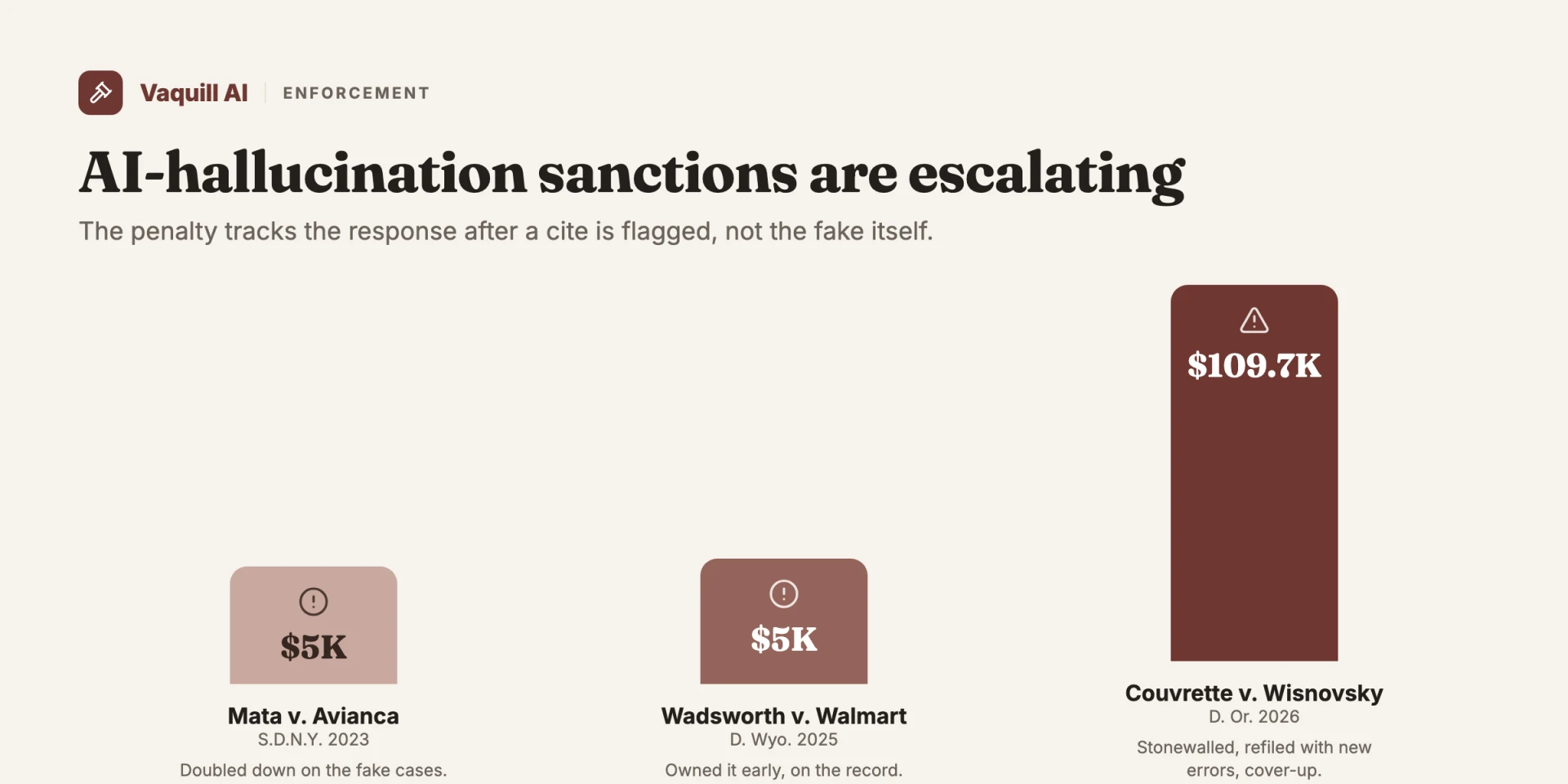
The penalty tracks the response after a cite is flagged, not the fabrication itself.
The Nebraska AI license suspension is the case where a state supreme court took away a lawyer's ability to practice over AI-fabricated citations. On April 16, 2026, the Nebraska Supreme Court suspended Omaha attorney Greg Lake after his divorce-appeal brief came back with 57 of 63 citations defective and he first denied using AI. It is the clearest sign yet that AI discipline for an attorney now reaches the license, well past the usual fine.
TL;DR
- On April 16, 2026, the Nebraska Supreme Court suspended Omaha lawyer W. Gregory (Greg) Lake from practice pending a full disciplinary hearing, after he filed a divorce appeal brief with 57 defective citations out of 63, including three cases that do not exist in any jurisdiction and about 20 more "hallucinated" cites, then initially denied using AI when the court and opposing counsel pressed him.
- Most coverage calls it an "indefinite" suspension; the order itself runs until a court-appointed referee completes fact-finding and recommends a final sanction, so it functions as an interim measure. On the public discipline record we can review, it appears to be the first time a state supreme court suspended a lawyer's practice directly on an AI-hallucination fact pattern. The prior reference point is the November 2023 Crabill matter in Colorado: a one year and one day (366-day) suspension, at least 90 days actively served with the remainder stayed during a two-year probation. Nebraska reached the state-high-court bench directly rather than through a stipulated agreement.
- Bar discipline is no longer a footnote on monetary sanctions. Lawyers are spending career capital, not just $5,000 Rule 11 checks, and reciprocity rules mean a Nebraska suspension can travel to every other jurisdiction the lawyer is admitted in.
- ABA Formal Opinion 512 (July 29, 2024) is the framework Nebraska and every other state is reading these cases against. Competence, candor, supervision: there is no "the AI did it" defense.
What tipped Greg Lake's Nebraska matter from a monetary sanction toward a license suspension?
For solos and small-firm lawyers reading from a practice-risk seat, Nebraska is the turning point at which AI-hallucination misconduct stopped being a sanctions story and became a discipline story.
Litigation insurance, partner reputation, and reciprocal-discipline exposure all sit on the disciplinary side, not the Rule 11 side, and the gap between the two costs is wider than most have priced in.
Part of our legal AI verification and hallucination guide series.
For related verification and sanctions coverage, see AI Hallucinations in Legal Research: How to Avoid Sanctions and How to Verify AI Legal Citations Before You File (ABA 512 Checklist).
What happened in Nebraska
In February 2026, lawyer Greg Lake of Omaha argued a marital-dissolution appeal in the Nebraska Supreme Court for his client Jason Regan. The justices were not interested in the merits. They wanted to know why the appellant's brief was full of citations that did not exist.
The numbers were stark: 57 of 63 citations were defective. Three were outright inventions, cases that exist in no jurisdiction, including a fictitious "Kennedy v. Kennedy (2019)" that a thirty-second Westlaw check would have flagged.
About twenty more were "reference hallucinations," real cases cited for propositions they did not stand for, or with garbled reporters. The court warned that AI "can be a benefit to the legal community, but it must be used with caution and humility," and treated the defective brief as a failure of both competence and candor.
When opposing counsel raised the issue, Lake denied using AI at all. At oral argument he blamed a wrong draft and a laptop that had cracked on his anniversary trip. The court found the explanation not credible. The denial held for weeks.
Two days before the suspension order, he reversed course and submitted an affidavit conceding he had used a generative AI tool to draft the brief, had not verified the output, and had failed to be forthright with the court. He called it a "grave error of judgment."
On April 16, 2026, the court suspended Lake from practice pending a full disciplinary hearing. A court-appointed referee will conduct fact-finding on mitigation and aggravation and recommend the final suspension length. Press accounts describe the order as an "indefinite" suspension; in form it runs until that referee process concludes.
The Nebraska Counsel for Discipline prosecutes the formal charges under the court's authority. The interim suspension is the court's signal that the candor failure made waiting to act untenable.
Why "license suspension" is a different category from a Rule 11 sanction
Through 2023 and most of 2024, every reported AI-hallucination consequence sat in the sanctions lane. Mata v. Avianca was a $5,000 Rule 11 fine. Wadsworth v. Walmart was $3,000 plus smaller checks for co-signers. A California appellate panel hit a lawyer with $10,000. Painful, embarrassing, billable to insurance in many cases. Not career-ending.
License suspension is a different animal. Court-imposed sanctions sit inside the litigation; bar discipline is a separate proceeding that runs through the state regulator (in Nebraska, the Counsel for Discipline) and ends with the state supreme court, which holds the license.
A monetary sanction touches a checkbook. A suspension touches a career: the lawyer cannot bill, cannot appear, cannot represent clients, cannot collect fees during the suspension. In a solo practice, a 90-day suspension is a 90-day income blackout plus a permanent line on the public record.
Suspensions also travel. Most US jurisdictions have reciprocal discipline rules: a suspension in the home state triggers a near-automatic reciprocal proceeding elsewhere, with the receiving state imposing substantially similar discipline absent a narrow set of defenses.
A 90-day Nebraska suspension can become a 90-day Iowa suspension on top. A Rule 11 fine is paid; a suspension is served, often in multiple jurisdictions.
The pattern is not new. The escalation is.
If you read the conduct in Lake's matter, you have read it before. A lawyer used a general-purpose generative AI tool to find authority, skipped any verification layer (no Westlaw, Lexis, or citator), and the brief went out.
Opposing counsel did the verification the filer skipped. The court asked questions. The lawyer's first reaction was to deflect.
How does opposing counsel catch this in practice? A junior associate reads the brief with a citator open on a second monitor and pastes each cite as they go. Fabrications fail in three predictable ways: the volume does not match the reporter, the parallel cite returns an unrelated case, or the citation does not resolve.
By the third "no result," the associate flags the brief to the partner. That phone call is the upstream event behind every Rule 11 motion in this category. The Charlotin hallucination tracker has crossed 480 known incidents worldwide, with several hundred in US courts; the fact pattern across them is stable.
What is escalating is the institutional response, and the reason Nebraska escalated where Mata did not is worth pinning down. Mata was a Rule 11 matter, a $5,000 fine and a referral to bar counsel that the New York regulator did not, on the public record, convert into a formal license proceeding.
Crabill in Colorado was the first AI-related attorney suspension, entered November 22, 2023 (one year and one day, at least 90 days served, the rest stayed during probation). The Nebraska sequence reached the same outcome through the high court directly, on the strength of the candor failure layered on the underlying citations.
A first-time hallucination with prompt correction and a clean record still produces a fine. A first-time hallucination layered with a denial-then-admission sequence is now producing a license consequence.
What the Nebraska Counsel for Discipline cares about
Bar regulators are reading the conduct against the state's adopted version of the ABA Model Rules of Professional Conduct. The relevant rules are short and mean exactly what they say.
Rule 1.1 (Competence). Under ABA Formal Opinion 512, competence includes a reasonable understanding of the capabilities and limitations of any generative AI tool the lawyer uses. The lawyer does not need to be a machine-learning engineer. The lawyer does need to know that a general-purpose chatbot is a language model, not a retrieval system, and that its citations require independent verification.
Rule 3.3 (Candor toward the tribunal). A fabricated citation, once detected, must be corrected. Doubling down (the Mata pattern, the Nebraska pattern) converts a competence problem into a candor problem, which is what regulators escalate on.
Rule 5.1 and 5.3 (Supervision). If the AI-generated text came in through a paralegal or junior associate, the signing lawyer is still on the hook. "My intern used ChatGPT" is the Crabill defense, and it did not work.
Rule 8.4 (Misconduct). The catch-all. Initial denials, like Lake's, are graded here.
Put those four rules side by side and the Nebraska disposition is not surprising. It is the conservative reading of the existing rules applied to the existing facts.
Where Nebraska lands on aggravation/mitigation analysis
State referees work from the ABA Standards for Imposing Lawyer Sanctions, layered with state case law: duty violated (candor and competence), mental state (knowing, given the initial denial), injury (wasted court time and appellee resources), and aggravators/mitigators. Against that frame:
First incident, no prior discipline, full acceptance: roughly 30 to 90 days, often with most stayed during probation. Crabill is the canonical reference.
Add a candor failure (denial, blaming staff, doubling down) and the range climbs to the six-month-to-one-year band. Add prior discipline or client harm and disbarment is in scope.
These are working estimates from the public record. Reciprocal discipline elsewhere layers on top.
Three data points worth tracking
The hallucination tracker maintained by researcher Damien Charlotin is the closest thing the bar has to a real database here. As of mid-2026, it counts roughly 480 known cases worldwide and several hundred in US courts, across 130-plus lawyers. Most are still monetary; a growing share are referrals to bar counsel.
Free public case-law databases sit underneath a lot of the detection work. Opposing counsel and clerks who suspect a citation reach for a free, instant lookup before Westlaw. The detection step is cheap. The filing step that did not include the same lookup is the gap.
ABA Formal Opinion 512, issued July 29, 2024, is the only ABA-level ethics guidance on generative AI in practice. Every state regulator we have seen reach an AI-hallucination disposition since then has cited 512 or its state analogue. It is becoming the operating manual for the disciplinary side, the way Mata became the operating manual for the sanctions side.
Two states have so far produced license-level consequences directly tied to AI-hallucination misconduct on the public discipline record we can find: Colorado (Crabill, November 22, 2023) and Nebraska (Lake, April 16, 2026).
Disciplinary referrals are pending in additional states where Rule 11 sanctions have already been entered and bar counsel notified. Whether those convert into suspensions will depend on each state's referee process and on whether the lawyer's response shows a candor failure layered on top of the underlying mistake.
What solos and small-firm lawyers should actually do
This is the part most posts on AI sanctions skip past with platitudes about "exercising judgment." The judgment is fine. The workflow is what is missing.
Verify every AI-assisted citation before the brief leaves the building. A general-purpose chatbot is not a retrieval system; treat its citations as leads, not authorities. Open each one in a real citator (Westlaw KeyCite, Lexis Shepard's, or a citator grounded on a real case-law corpus). If a citation does not resolve, it does not go in.
Name who owns verification, and record the sign-off. In a solo practice, the verifier is the lawyer; in a two-or-three-lawyer firm, the verifier is whichever lawyer did not draft. The mechanism: a one-line attestation in the matter file ("I, [name], verified each cite in [brief] in KeyCite on [date]; all resolved to the case and proposition stated"). In a disciplinary proceeding, that timestamped log is one of the strongest mitigators a lawyer can produce.
Use a workbench that grounds research on a real corpus. The Stanford HAI study put hallucination rates at 58 to 88% on raw LLMs and 17 to 33% on purpose-built legal AI. Neither number is zero. The substrate matters. (For mechanics, see how AI legal research works.)
Disclose AI use where the rule or order requires it. A handful of federal judges have standing orders requiring disclosure of AI-assisted drafting. State court rules are catching up. When disclosure is required and missed, both the Rule 11 calculus and the bar-discipline calculus worsen materially.
Have one written policy, signed by everyone in the firm. The supervision rules (5.1, 5.3) live here. The policy needs to say which tools are approved, what verification is required, and what happens when something slips. The firms producing AI-hallucination filings in 2026 do not have this document.
Audit the office-control failure mode. The recurring failure is not a partner typing into ChatGPT at midnight. It is a supervising lawyer signing a brief drafted by a junior or contract lawyer who did the AI lookup, while treating verification as the drafter's job. Under Rule 5.1, it is not. A simple control: any brief with cited authority gets a verifier name on the cover sheet, and the verifier signs the attestation above.
Reciprocity also reshapes settlement leverage. A lawyer admitted in three states is negotiating three disciplinary outcomes, not one; the malpractice carrier wants the exposure modeled all three ways before any consent disposition.
"I exercised reasonable care" is no longer the answer the referee wants. "Here is the log, here is the policy, here is the verifier sign-off" is.
Where this goes next
Nebraska is, to our reading of the public discipline record, the first suspension entered by a state supreme court directly on the AI-hallucination fact pattern. The disciplinary case mix in this category is starting to tilt from "predominantly monetary" toward "monetary plus regulator referral" as the default response.
The referrals that quietly close are the ones where the lawyer corrected the record fast, owned the conduct, and produced a verification process. The referrals that escalate are the ones with the candor aggravator.
For a solo or small-firm reader, the takeaway is narrow. The bar-discipline cost of skipping verification is no longer a footnote on the sanctions cost. It is a separate, larger cost with reciprocity, public-record, and insurance consequences.
The workflow change that prevents both: verify before you file, log the verification, ground the research on an auditable corpus.
FAQ
What is the Nebraska AI license suspension?
It is the April 16, 2026 order in which the Nebraska Supreme Court suspended Omaha attorney Greg Lake from practice after his divorce-appeal brief contained 57 defective citations out of 63, including three cases that do not exist. Lake first denied using AI, then admitted it in an affidavit calling it a "grave error of judgment." A court-appointed referee will recommend the final length, so the order runs until that process concludes.
Was the Nebraska case the first lawyer suspended for using AI?
Not the first ever. The Colorado discipline of Zachariah Crabill in November 2023 (one year and one day, at least 90 days served) is generally cited as the first AI-related attorney suspension. Nebraska appears to be the first time a state supreme court suspended a lawyer's practice directly on an AI-hallucination fact pattern rather than through a stipulated agreement.
Can a lawyer be suspended for using AI?
Yes. Using AI is not itself misconduct. Filing fabricated citations without verifying them breaches the duty of competence (Model Rule 1.1), and denying or concealing the AI use breaches the duty of candor (Rule 3.3). When those stack, as in Nebraska, the result can be suspension, not just a fine. See our AI hallucinations and sanctions breakdown.
What is the difference between a sanction and a license suspension for AI errors?
A court sanction (often a Rule 11 fine like the $5,000 in Mata v. Avianca) sits inside the litigation and touches the checkbook. A license suspension is a separate bar-discipline proceeding run through the state regulator and the state supreme court; it stops the lawyer from practicing, and reciprocity rules can carry it into other states where the lawyer is admitted.
What did Greg Lake do wrong?
He filed an appellate brief drafted with a generative AI tool, did not verify the citations, and submitted it with 57 of 63 citations defective. When the court and opposing counsel raised it, he denied using AI and blamed a wrong draft and a broken laptop, then reversed and admitted it. The denial-then-admission sequence is what pushed the matter from a sanction toward a suspension.
Which ethics rules apply to AI use by attorneys?
The core rules are Model Rule 1.1 (competence, including a reasonable grasp of an AI tool's limits), Rule 3.3 (candor to the tribunal), Rules 5.1 and 5.3 (supervising other lawyers and staff), and Rule 8.4 (misconduct). ABA Formal Opinion 512 (July 29, 2024) ties all of these to generative AI. We cover how much weight it carries in are ABA Formal Opinions binding.
Does using a legal-specific AI tool remove the duty to verify?
No. Stanford HAI research found hallucination rates of 58 to 88% on general-purpose LLMs and 17 to 33% on purpose-built legal AI in 2024 testing. A grounded tool lowers the rate and speeds verification, but the duty to read the cited opinion stays with the lawyer. For the mechanics, see how AI legal research works.
How do I avoid an AI hallucination sanction or suspension?
Treat every AI-produced citation as a lead, not authority. Open each one in a real citator or primary source before filing, name who owns verification, and keep a dated sign-off in the matter file. Have one written AI policy signed by everyone in the firm. The pre-filing verification checklist walks through the steps, and the hallucination tracker shows how often this still happens.
This is the gap a workbench is supposed to close. Vaquill AI grounds its legal research on a real corpus and surfaces citations a reviewer can click and open, which is the verification step the Nebraska brief skipped. If you have not yet written down a citation-verification workflow for your firm, the pre-filing checklist tied to ABA Formal Opinion 512 is a working starting point worth running by your malpractice carrier this quarter.
New legal AI guides, weekly.
Further Reading
Oregon AI Sanction: $110K Against 2 Lawyers for Fake Cases
Read postHow to Find and Cite California Law
Read postHow to Find and Cite Kansas Law
Read postHow to Find and Cite Georgia Law
Read postCFPB API: Circulars, Supervisory Guidance, and Enforcement Actions
Read postCFR Annual Editions API: Point-in-Time Regulations with corpusType=CFR_ANNUAL
Read post
Co-Founder & CEO · Attorney
Arshita leads product and strategy at Vaquill, building the legal AI suite that solo, small-firm, and in-house US lawyers use to run a matter end to end.