TL;DR
A federal magistrate judge in Oregon sanctioned two lawyers a combined $110,204.38 for filing briefs with AI-fabricated cases, the largest AI-hallucination penalty in any US court to date. The case is Couvrette v. Wisnovsky, No. 1:21-cv-00157-CL (D. Or.).
- Who paid what: Stephen Brigandi, the San Diego pro hac vice counsel, was hit with $95,998.72 ($15,500 in monetary sanctions plus $80,498.72 in the defendants' attorney fees). Tim Murphy, the Portland local counsel, was assessed $14,205.66.
- What they filed: three summary-judgment briefs containing 15 nonexistent cases and 8 fabricated quotations, calibrated at $500 per fake case and $1,000 per fake quotation.
- The rule basis: Rule 11(b) for Brigandi, plus the District of Oregon's Local Rules (LR 83-7 for the fake authority, LR 83-3 for Murphy's failure to supervise as local counsel).
- Why it scaled: counsel chose procedural resistance after notice, not the fabrications themselves. Brigandi refiled by Notice of Errata instead of withdrawing, and the refile still misstated the law. Judge Mark D. Clarke called it an attempted cover-up.
- The fallout: the underlying winery suit was dismissed with prejudice and the Clerk was directed to notify the Oregon State Bar. The previous Oregon-court ceiling was $10,000.
What combined AI-hallucination sanction did the two lawyers draw in Couvrette v. Wisnovsky?
For litigators running generative AI in 2026, the lesson is procedural. Courts grade the seventy-two hours after a citation gets flagged, and that is where six-figure sanctions get built.
Part of our legal AI verification and hallucination guide series.
For related verification / hallucination coverage, see AI Hallucinations in Legal Research: How to Avoid Sanctions and Damien Charlotin's Hallucination Tracker, Read Like a Risk Manager.
The case in one paragraph
Couvrette was a family fight over a Jacksonville, Oregon winery. The plaintiff, Joanne Couvrette, sued her two brothers over control of the Valley View Winery and tasting room, alleging issues around ownership, tenancy, and elder abuse.
The plaintiff brought in Stephen Brigandi, a San Diego lawyer and former in-house counsel at Jack in the Box, who agreed to work without fee on a personal connection (his son was dating the plaintiff's daughter). Brigandi was not licensed in Oregon, so a Portland lawyer, Tim Murphy, was retained as local counsel for the pro hac vice admission.
The merits never got decided. The fight collapsed into a sanctions proceeding after defense lawyers started checking Brigandi's brief.
Before Couvrette, the most expensive AI-hallucination sanction in any US court was a $10,000 penalty entered by the Oregon Court of Appeals in the William Ghiorso matter, with Mata v. Avianca ($5,000) and Wadsworth v. Walmart (about the same aggregate) below it. Couvrette moved the ceiling by an order of magnitude.
The procedural posture
The vehicle was cross-motions for summary judgment. Brigandi filed three briefs. Across the three filings, the defense identified fifteen citations to cases that did not exist anywhere in Westlaw, Lexis, or any reporter, plus eight quotations attributed to real cases that the real opinions did not contain. The defense laid the problem out in its summary-judgment papers and a motion for sanctions, putting Plaintiffs on notice.
Rather than withdraw the briefs or file a clean acknowledgement, Brigandi filed a Notice of Errata, then a second one, that stripped some fabrications without acknowledging the scope of the problem or fixing the surrounding text. The court found the refiled version still misstated the law. Judge Clarke later wrote that "rather than a correction, Mr. Brigandi attempted a cover-up," and that "he failed at both."
Murphy, the local counsel, told the court he did a cursory review of the initial motion three days after it was filed, never reviewed the later briefing, and had no idea the filings contained fake authority. The court read that as a willful violation of Local Rule 83-3, the duty to meaningfully participate as local counsel of record, rather than an excuse. Two orders followed: December 12, 2025 (conduct sanctionable under Rule 11(b) and the Local Rules, claims dismissed with prejudice), and March 23, 2026 (Murphy's dollar figure).
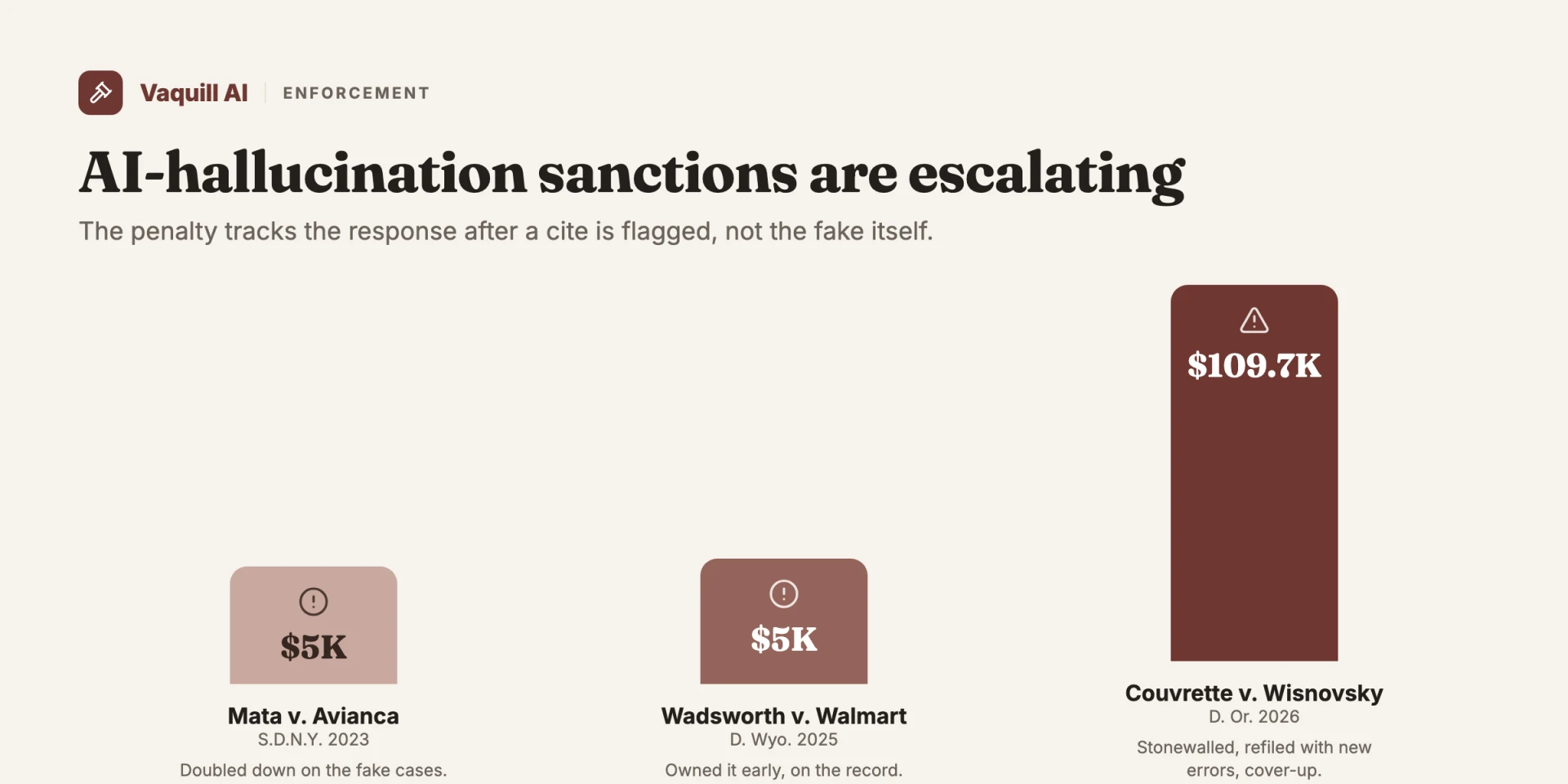
The penalty tracks the response after a cite is flagged, not the fabrication itself.
The inflection point: how the lawyer responded
Four orders line up as one curve. Steven Schwartz in Mata v. Avianca, 1:22-cv-01461 (S.D.N.Y. 2023), drew $5,000 under Rule 11 from Judge P. Kevin Castel; Castel found subjective bad faith because Schwartz went back to ChatGPT after being flagged, asked the model to "confirm" the cases, and filed the model's reassurance with the court.
Three Morgan and Morgan lawyers in Wadsworth v. Walmart, 2:23-cv-118 (D. Wyo. 2025), drew a combined $5,000 plus a firm-level sanction for nine non-existent cases; the low number tracks the early, full, on-the-record acknowledgement. Zachariah Crabill drew a two-year Colorado suspension because, on the morning of the hearing, he blamed an unnamed intern.
Then Couvrette: Brigandi refiled by Notice of Errata rather than withdrawing, the refile still misstated the law, and Murphy argued he was never expected to serve as "a check on, or guarantor of, Mr. Brigandi's legal work," a position the court rejected as a willful failure to participate. Clarke called the response an "attempted cover-up." The number landed at $110,204.38.
The aggravator across all four is the response, not the model output.
Same-week acknowledgement, clean withdrawal, and a credible explanation lands in the warning-to-$5,000 band. Refiles that still misstate the law, silence on the show cause docket, or blame-shifted-to-staff multiplies that by something between five and twenty. Couvrette is the proof-of-concept opinion for the scaling rule, not a one-off about an unlucky lawyer.
Clarke wrote Couvrette as a deterrence opinion. The court named the incentive structure directly: "attorneys weigh risks and rewards for a living. With a known price tag, an attorney could decide that the risk of paying $500 per non-existent case or $1,000 per fabricated quotation is outweighed by the potential reward" of outsourcing the work to a chatbot. The number had to be large enough to break the cost-benefit math.
What the seventy-two hours actually look like inside a firm
When opposing counsel sends the cite-check letter on a Thursday afternoon, the first day belongs to verification: pull the brief, pull the research log, run every citation through Westlaw or Lexis. The instinct that backfires is to reopen the chatbot and ask it to verify the cites it invented. Schwartz did exactly that in Mata, and the single move turned the sanction inquiry into a bad-faith finding.
A short factual acknowledgement to opposing counsel goes out the same day, to timestamp the firm's awareness on the record, not to concede anything substantive. Inside twenty-four hours, the supervising partner (not the associate who used the model) drafts a corrective filing that names which cites do not exist, names which cites were misquoted, identifies the workflow step where the model output entered the brief, and proposes either withdrawal or a clean substitute.
Before seventy-two hours, the corrective hits the docket. If a show cause has already issued, the corrective gets filed in that posture, signaling contrition rather than resistance.
A twelve-lawyer plaintiff firm we are aware of ran exactly this playbook in 2025. An associate filed a motion in limine with two non-existent ChatGPT-generated citations. Opposing counsel sent a Thursday-afternoon letter.
The first call was to the managing partner, not the associate's supervising lawyer (the matter is now firm-level, not case-level). The partner pulled the brief that night, opened the firm's required research log, confirmed the cites came from ChatGPT, and filed a notice of correction by Friday morning naming the cites, naming the tool, and offering a substitute memo.
No sanction issued. Total firm cost: about $9,000 in partner time. Couvrette is the same incident handled the other way.
The supervisory layer should worry every in-house counsel hiring outside firms. Murphy's posture in Couvrette (local counsel, did not write the brief, asserted authorship was the relevant duty) is what a local-counsel arrangement is supposed to make impossible.
The common assumption in multi-jurisdiction matters that local counsel is procedural and the lead lawyer owns the substance is wrong on the law in most states. Local counsel signs the filings, certifies them under Rule 11, and is on the hook for what those filings contain.
The engagement letter between the firms should name AI use as a topic, require disclosure of which model touched which draft, and assign a specific person to re-cite-check before any filing goes out under the local counsel's bar number.
How the $110,204.38 figure was built
Two orders produced the number. The first, dated December 12, 2025, dismissed the plaintiff's claims with prejudice, found the conduct sanctionable under Rule 11(b) and the Local Rules, and set Brigandi's penalty. The second, dated March 23, 2026, set Murphy's share (the ABA Journal and the local Oregon press picked it up in April).
Brigandi was hit with $95,998.72. That breaks into $15,500 in monetary sanctions paid to the court, calibrated at $500 per non-existent case (15 of them) and $1,000 per fabricated quotation (8 of them), plus $80,498.72 in defendants' attorney fees, which is 85% of the court-approved fee bill of $94,704.38, ordered paid personally for forcing the other side to litigate around fabricated citations.
Murphy, the local counsel, was assessed $14,205.66, the remaining 15% of that same fee bill, payable to opposing counsel. The theory was local-counsel supervision: by signing the pro hac vice application Murphy attested he understood his duties under LR 83-3, and the court found his decision to exercise no oversight a willful violation. Combined: $14,205.66 plus $80,498.72 plus $15,500 equals $110,204.38. The "$110,000" shorthand in the headlines is just rounding.
Dismissal of the underlying suit with prejudice meant the plaintiff lost on the conduct, not the merits, which matters for leverage in any related state-court proceeding because the dismissed federal claims are now preclusive.
The Clerk was directed to notify the Oregon State Bar, the procedural trigger for a disciplinary inquiry rather than the discipline itself. The bar matter is open. Brigandi is California-barred, which means the California State Bar will see the referral too, and reciprocal discipline doctrines mean a finding by one bar tends to travel.
How this fits the broader trend
Couvrette is the high-water mark in a quarter the legal-tech press has begun calling the start of a sanctions wave. ComplexDiscovery's tally of Q1 2026 put the aggregate AI-hallucination penalty at roughly $145,000 across three matters: $110,204.38 in Couvrette, $30,000 in Whiting v. City of Athens, No. 25-5425 (6th Cir.), where two attorneys each drew $15,000 in fines plus fees, and $10,000 against William Ghiorso in the Oregon Court of Appeals. Three matters, three jurisdictions, one quarter.
Damien Charlotin's public hallucination tracker now lists several hundred US incidents and adds rows roughly weekly. Three patterns hold across the dataset: the dominant tool is general-purpose ChatGPT on a personal phone, the dominant filing surface is litigation motions where case law is load-bearing, and the dominant filer is a solo or small firm under twenty lawyers (pro se litigants are a close second). Couvrette fits all three.
In-house counsel hiring outside firms should read the trend as a procurement issue: the probability that a small-firm brief in 2026 contains an AI-fabricated citation is non-trivial, the probability that the firm has a written verification protocol is, in conversations with risk leads at GC roundtables this spring, roughly half, and the gap between those two facts is what an outside-counsel guideline exists to close.
A sharper position than "verify your cites"
Most trade press coverage of Couvrette lands on "verify your AI citations" and stops. That advice is correct, and useless. No lawyer who has ever signed a brief believes they personally would file fifteen fake cases, so an injunction not to do it changes nothing.
Courts grade the response, not the original mistake. The error is recoverable up to a window of about seventy-two hours; outside the window, refiles that still misstate the law, silence on the show cause docket, blame-shifted to interns or staff, or denials that AI use occurred turn a $5,000 problem into a $110,000 problem.
Against the consensus framing: the safest post-flag move in practice is withdrawal rather than correction, even when correction looks like the more proportionate choice. Correction works only when handled fast and disclosed in detail.
Most firms cannot move fast enough on a holiday weekend or a partner-out-of-office Tuesday to make correction credible, and a half-credible correction reads worse to the court than a clean withdrawal-and-restart. Pick the move you can actually execute on the day, not the move that looks elegant on a whiteboard.
The instinct that backfires most often is the one that says "just clean it up quietly." That is the Couvrette instinct.
Three duties to write into the firm policy this quarter
Verification before filing. ABA Formal Opinion 512, issued July 29, 2024, is the operating manual. It maps the existing Model Rules onto generative AI without inventing new duties: competence (Rule 1.1) requires a reasonable understanding of the tool's capabilities and limitations, candor toward the tribunal (Rule 3.3) covers what gets filed, supervision (Rules 5.1 and 5.3) covers nonlawyer assistance including AI as an assistant.
The opinion does not require lawyers to become AI experts. It does require them to verify factual and citation output against authoritative sources before signing a brief. A general-purpose chatbot is not an authoritative source. A statute database with current-as-of dates and a case-law platform grounded in primary sources, with citations a reviewer can click and open, is. We covered that distinction in legal AI that avoids hallucinating cases and the related verification checklist for ABA 512.
Disclosure to client and to court. Formal Opinion 512 also covers Rule 1.4 (communication) and Rule 1.6 (confidentiality). The moment AI is used on a matter, the engagement letter should say so, the client should know in plain language that a model was involved in drafting, and the firm should have a record of which tool, which model version, and which step of the workflow it touched.
Retrofitting that disclosure at a sanctions hearing reads to the court as an aggravator, not a neutral fact.
Pick the right post-flag move and execute it on the record. Three moves exist and they are not interchangeable. Withdrawal pulls the offending filing off the docket and starts over (the cleanest move when the brief is shot through with fabrications). Correction leaves the filing in place and substitutes text section by section with a transparent notice naming every change (appropriate when the model affected a discrete portion). Show cause response is what gets filed when the court has already issued an order to show cause, and it should treat the show cause posture as the venue for full acknowledgement, not as the venue to argue the misconduct away.
The playbook rules out three moves by name: do not ask the chatbot to confirm the cases (Mata), do not blame the intern (Crabill), do not edit and refile silently (Couvrette). Every six-figure or career-ending sanction in the dataset turns on one of those three.
A firm-level commitment that puts those duties in writing, with a designated partner who owns the post-confrontation playbook the way a designated partner owns the conflicts check, is what the 2026 trend line is begging firms to adopt. The ones that do it before their first incident, rather than after, are the ones whose name does not appear in next quarter's sanctions tally.
FAQ
What was the Oregon AI sanction in Couvrette v. Wisnovsky? A federal magistrate judge in the District of Oregon sanctioned two lawyers a combined $110,204.38 for filing summary-judgment briefs that cited 15 nonexistent cases and 8 fabricated quotations generated with AI. It is the largest AI-hallucination penalty in any US court to date. The underlying winery dispute was dismissed with prejudice.
How much was each lawyer fined for the AI fake cases? Stephen Brigandi, the San Diego pro hac vice counsel, was ordered to pay $95,998.72: $15,500 in monetary sanctions to the court plus $80,498.72 in the defendants' attorney fees. Tim Murphy, the Portland local counsel, was assessed $14,205.66 for failing to supervise the filings as local counsel of record.
How did the court calculate the $15,500 sanction? Judge Mark D. Clarke set a per-item price: $500 for each of the 15 nonexistent cases ($7,500) and $1,000 for each of the 8 fabricated quotations ($8,000). The order framed the amount as deterrence, large enough that a lawyer cannot treat fabricated authority as a cheap shortcut.
What rule did the lawyers violate? Brigandi was sanctioned under Federal Rule of Civil Procedure 11(b) and the District of Oregon's Local Rules (LR 83-7 covers the duty to verify legal authority). Murphy was sanctioned under Local Rule 83-3 for a willful failure to meaningfully participate as local counsel.
Why was the Oregon sanction so much larger than earlier AI cases? The penalty scaled because of what counsel did after the fake cases were flagged, not the fabrications alone. Instead of withdrawing the briefs, Brigandi filed Notices of Errata that the court read as an attempted cover-up, and the refiled version still misstated the law. Earlier cases like Mata v. Avianca ($5,000) drew far less because the conduct after notice was less aggressive.
Can a lawyer be sanctioned for using ChatGPT in a brief? Using AI is not itself sanctionable. Filing unverified AI output is. ABA Formal Opinion 512 (July 29, 2024) requires lawyers to verify AI-generated citations and quotations against authoritative sources before signing a filing. Every six-figure sanction in this wave traces back to a filer who skipped that step.
What should a lawyer do if opposing counsel flags an AI citation? Verify every cite on day one, send a same-day factual acknowledgement to opposing counsel, and get a corrective filing or a clean withdrawal on the docket within about seventy-two hours. Do not ask the chatbot to confirm the cases, do not blame staff, and do not edit and refile silently. Speed and candor are what keep a flagged cite from becoming a six-figure sanction.
The cheaper guardrail is research that does not invent the cite in the first place. Vaquill AI grounds its legal research on a real corpus and returns citations a reviewer can click and open, which is the verification step every filer in this sanctions wave skipped.
New legal AI guides, weekly.
Further Reading
Nebraska's First AI Hallucination License Suspension: What It Signals
Read postHow to Find and Cite California Law
Read postHow to Find and Cite Kansas Law
Read postHow to Find and Cite Georgia Law
Read postCFPB API: Circulars, Supervisory Guidance, and Enforcement Actions
Read postCFR Annual Editions API: Point-in-Time Regulations with corpusType=CFR_ANNUAL
Read post
Co-Founder & CEO · Attorney
Arshita leads product and strategy at Vaquill, building the legal AI suite that solo, small-firm, and in-house US lawyers use to run a matter end to end.