The short answer
Indemnification clause enforceability by state turns on three things: whether the state demands express-negligence language to indemnify a party for its own fault, whether an anti-indemnity statute (construction in most states, oil and gas in producing states) voids part of the clause, and which public-policy carve-outs (gross negligence, willful misconduct, fraud) no state will let you contract around. The same "indemnify and hold harmless" paragraph is fully enforceable in Delaware, partly enforceable in California, and void as written in Texas construction work. The text survives a copy-paste; the obligation often does not.
The same paragraph, fifty different answers
A general counsel I worked with kept one clause in a Word template and pasted it into every vendor agreement. The clause was clean, broad, copied originally from a New York commercial lease. It worked fine until the company sued a contractor in Houston, in a roughly $14M services dispute. A Texas court told them the clause did not say what they thought it said. The express-negligence problem, the gross-negligence carve-out, and the construction anti-indemnity statute hit the same paragraph at once. The indemnitor's insurer denied additional-insured coverage on a contractual-liability exclusion, the indemnitee's own policy fought the tender, and the case went to summary judgment with most of the indemnification ground gone. The company recovered roughly a third of what the clause promised on its face.
The single most common drafting failure in U.S. commercial contracts is treating "indemnify and hold harmless" as a portable phrase that means the same thing in every state. It does not.
The doctrine turns on three axes, and the fifty jurisdictions sort into roughly four buckets along those axes. Below: the statutes, the leading cases, the carve-outs you cannot contract around, and the drafting mistakes that show up when a clause has to do real work. Statute citations here were checked against state code text and the published 50-state surveys (Saxe Doernberger & Vita; Matthiesen, Wickert & Lehrer) in June 2026; confirm the current text before a clause closes.
TL;DR
- Indemnification caps are not uniform across the United States. The same clause is enforceable in Delaware, partly enforceable in California, and may be void as written in Texas or Louisiana.
- Three axes drive the variance: the express-negligence rule (a handful of states require magic words to indemnify a party for its own negligence), anti-indemnity statutes (40+ states in construction, a smaller set in oil and gas), and public-policy carve-outs (gross negligence, willful misconduct, and fraud are non-indemnifiable in most jurisdictions).
- The express-negligence rule, in its strict form, lives in Texas (Ethyl Corp.) and Tennessee (Houghland). New York ("unmistakably clear"), Pennsylvania, Colorado, and Wyoming ("clear and unequivocal") demand magic-words-style language that operates similarly in practice.
- Construction contracts face anti-indemnity statutes in roughly 45 states. The strictness ranges from total bans on indemnifying the indemnitee's own negligence (sole or partial) to "intermediate" statutes that void only sole-negligence indemnity and permit comparative-fault allocation.
- "Hold harmless" and "indemnify" are treated as a single obligation in some states and as two independent obligations in others. That difference changes pleading, damages, and the duty to defend.
- A clause that fails one of these tests usually fails silently. The party finds out at summary judgment.
The same indemnify and hold harmless paragraph, copy-pasted across states, is fully enforceable in which one?
Part of our all-50-states legal reference series.
The three axes states actually vary on
Before the table, the doctrine. Most jurisdictional differences collapse to three questions.
1. Does the state require express negligence language?
The express-negligence rule: if a party wants to be indemnified for the consequences of its own negligence, the contract must say so in unmistakable terms. "All claims arising out of the work" is not enough; the indemnitor must be put on notice it is assuming the indemnitee's fault.
Texas is the loudest example. In Ethyl Corp. v. Daniel Construction Co., 725 S.W.2d 705 (Tex. 1987), the Texas Supreme Court adopted the rule and has policed it strictly since. Tennessee applies it through Houghland v. Security Alarms & Services, Inc., 755 S.W.2d 769 (Tenn. 1988). Wyoming requires "clear and unequivocal" language, which in practice reads like express negligence. New York gets to the same place through Hooper Associates, Ltd. v. AGS Computers, Inc., 74 N.Y.2d 487 (1989), requiring "unmistakably clear" language for own-fault indemnification.
2. Is there an anti-indemnity statute for this industry?
Construction is the big one. Roughly 45 states void or limit indemnification in construction contracts where the indemnitee would be held harmless for its own negligence (the exact count varies by source, depending on whether design-professional-only and residential-only statutes are included). The statutes break into three strengths:
- Strict (total ban on indemnifying the indemnitee's negligence): California (Cal. Civ. Code § 2782), Texas (the Construction Anti-Indemnity Act at Tex. Ins. Code ch. 151, plus the design-contract limits at Tex. Civ. Prac. & Rem. Code ch. 130), New York (N.Y. Gen. Oblig. Law § 5-322.1), Illinois (740 ILCS 35), Massachusetts (Mass. Gen. Laws ch. 149, § 29C).
- Intermediate (no sole-negligence indemnity; comparative fault permitted): Florida (Fla. Stat. § 725.06), Colorado (Colo. Rev. Stat. § 13-21-111.5), Washington (Wash. Rev. Code § 4.24.115), Arizona (Ariz. Rev. Stat. § 32-1159), Georgia (O.C.G.A. § 13-8-2).
- Limited or none: Maine, Vermont, Wisconsin leave common-law rules to do the work.
Oil and gas adds another layer in producing states. Louisiana's Oilfield Anti-Indemnity Act (La. Rev. Stat. § 9:2780) voids indemnity for the indemnitee's fault in oilfield contracts; Texas has a parallel at Tex. Civ. Prac. & Rem. Code ch. 127; New Mexico (N.M. Stat. § 56-7-2) and Wyoming (Wyo. Stat. § 30-1-131) run their own. Healthcare and residential leases pick up similar limits in a few states, but construction and oilfield are where most of the case law lives.
3. What public-policy carve-outs apply no matter what the contract says?
Across nearly every state, you cannot indemnify a party for:
- Intentional misconduct or willful and wanton conduct. Void in essentially every state that has reached the question.
- Fraud. Same.
- Gross negligence. Void in most states, including California (City of Santa Barbara v. Superior Court, 41 Cal. 4th 747 (2007)) and New York (Kalisch-Jarcho, Inc. v. City of New York, 58 N.Y.2d 377 (1983), applied widely to indemnity). Delaware leaves more room for sophisticated parties; the safe working assumption elsewhere is that gross negligence is off the table.
- Punitive damages, in California and New York against the indemnitee's own conduct. Florida and Texas are more permissive but not unlimited.
- Criminal acts and statutory penalties. Non-indemnifiable across the board.
These carve-outs are mandatory. A clause that purports to indemnify for "any and all claims, including those arising from indemnitee's own gross negligence or willful misconduct" does not get the indemnitee any of that ground. Courts sever the offending language and enforce the rest, or strike the whole clause depending on severability.
The buckets, with states
Sorting by enforcement posture rather than alphabet:
Bucket A: Strict express-negligence states
Texas, Louisiana, Tennessee, Wyoming. Magic words required. "Indemnify against all claims arising out of the performance of the work" will not pick up the indemnitee's own negligence here. Include an express negligence clause that names the indemnitee's negligence in conspicuous text.
Bucket B: Strict construction anti-indemnity states
California, Texas, New York, Illinois, Massachusetts, New Jersey, Ohio, Michigan, Connecticut, Maryland, Virginia, North Carolina. In construction, no indemnifying the upstream party for its own negligence. Some have construction-management or design-professional carve-outs. Pennsylvania belongs here in effect but gets there by common law: the Perry v. Payne, 217 Pa. 252 (1907) "clear and unequivocal" rule, not a general construction statute. Its only on-point statute, 68 P.S. § 491, reaches design professionals, so PA is grouped in Bucket D below.
Bucket C: Intermediate / comparative-fault states
Florida, Colorado, Washington, Arizona, Minnesota, Missouri, Utah, Oregon, New Mexico, South Carolina, Tennessee, Alaska, Iowa. Sole-negligence indemnification void; comparative-fault allocation survives. Tennessee also applies an express-negligence rule on top of its comparative-fault statute, so it sits in two axes at once. A separate group of states (Georgia, Illinois, Indiana, Kansas, Massachusetts, Minnesota, Mississippi, Nebraska, New Jersey) goes further and voids indemnity for the indemnitee's concurrent or partial fault, not just sole fault; treat those as the strictest construction bucket.
Bucket D: Permissive / freedom-of-contract states
Alabama, Maine, Pennsylvania, Vermont, Wisconsin, and (outside oil and gas) Wyoming have no general construction anti-indemnity statute and rely on common-law clear-intent rules with the standard public-policy carve-outs. Several states with a construction statute are otherwise permissive in non-construction contracts: Delaware, Arkansas, Kentucky, Oklahoma, Rhode Island, North Dakota, West Virginia, New Hampshire, South Dakota. Delaware is friendly to sophisticated-party allocations and frequently shows up as the chosen-law jurisdiction for that reason. Its construction statute (6 Del. Code § 2704) still voids own-negligence indemnity in building contracts.
The 50-state table
A working reference. "Yes" in the anti-indemnity column means the state has a statute that voids at least some indemnification of the indemnitee's own negligence in construction; "Strict" means a sole-negligence ban; "Intermediate" allows comparative-fault allocation.
| State | Construction anti-indemnity statute | Strictness | Express-negligence rule | Notable carve-outs |
|---|---|---|---|---|
| Alabama | No general statute | N/A | No (strict-construction rule) | Public-policy limits apply |
| Alaska | Alaska Stat. § 45.45.900 | Intermediate | No | Comparative fault permitted |
| Arizona | Ariz. Rev. Stat. § 32-1159 | Intermediate | No | Public works exceptions |
| Arkansas | Ark. Code § 4-56-104 | Strict | No | Construction only |
| California | Cal. Civ. Code § 2782 | Strict | Implied (clear and explicit) | Type I/II/III analysis under MacDonald & Kruse |
| Colorado | Colo. Rev. Stat. § 13-21-111.5 | Intermediate | "Clear and unequivocal" required | Comparative fault model |
| Connecticut | Conn. Gen. Stat. § 52-572k | Strict | No | Construction only |
| Delaware | 6 Del. Code § 2704 | Strict (construction) | No | Otherwise permissive |
| Florida | Fla. Stat. § 725.06 | Intermediate | No | Monetary limit + specific consideration required |
| Georgia | O.C.G.A. § 13-8-2(b) | Strict (broad) | No | Voids own-negligence indemnity, sole or partial |
| Hawaii | Haw. Rev. Stat. § 431:10-222 | Strict | No | Construction only |
| Idaho | Idaho Code § 29-114 | Strict | No | Construction only |
| Illinois | 740 ILCS 35 | Strict | No | Construction Contract Indemnification for Negligence Act |
| Indiana | Ind. Code § 26-2-5 | Strict | No | Construction only |
| Iowa | Iowa Code § 537A.5 | Strict | No | Construction only |
| Kansas | Kan. Stat. § 16-121 | Strict | No | Construction only |
| Kentucky | Ky. Rev. Stat. § 371.180 | Strict | No | Construction only |
| Louisiana | La. Rev. Stat. § 9:2780.1 (general); § 9:2780 (oilfield) | Strict | Yes (oilfield); strict construction | Oilfield Indemnity Act |
| Maine | No general statute | N/A | No | Common-law rules |
| Maryland | Md. Code, Cts. & Jud. Proc. § 5-401 | Strict | No | Construction only |
| Massachusetts | Mass. Gen. Laws ch. 149, § 29C | Strict | No | Sole-negligence ban |
| Michigan | Mich. Comp. Laws § 691.991 | Strict | No | Construction only |
| Minnesota | Minn. Stat. § 337.02 | Intermediate | No | Comparative fault |
| Mississippi | Miss. Code § 31-5-41 | Strict | No | Construction only |
| Missouri | Mo. Rev. Stat. § 434.100 | Intermediate | No | Comparative fault |
| Montana | Mont. Code § 28-2-2111 | Strict | No | Construction only |
| Nebraska | Neb. Rev. Stat. § 25-21,187 | Strict | No | Construction only |
| Nevada | Nev. Rev. Stat. § 40.693 | Strict (broad) | No | Residential construction; voids own-negligence indemnity |
| New Hampshire | N.H. Rev. Stat. § 338-A:2 | Strict | No | Construction only |
| New Jersey | N.J. Stat. § 2A:40A-1 | Strict | No | Sole-negligence ban |
| New Mexico | N.M. Stat. § 56-7-1 (general); § 56-7-2 (oilfield) | Intermediate | No | Oilfield + construction |
| New York | N.Y. Gen. Oblig. Law § 5-322.1 | Strict | "Unmistakably clear" (Hooper) | Sole-negligence ban; broad case-law gloss |
| North Carolina | N.C. Gen. Stat. § 22B-1 | Strict | No | Construction only |
| North Dakota | N.D. Cent. Code § 9-08-02.1 | Strict | No | Construction only |
| Ohio | Ohio Rev. Code § 2305.31 | Strict | No | Construction only |
| Oklahoma | Okla. Stat. tit. 15, § 221 | Strict | No | Construction only |
| Oregon | Or. Rev. Stat. § 30.140 | Intermediate | No | Comparative fault |
| Pennsylvania | 68 P.S. § 491 (design professionals only) + common law (Perry v. Payne) | Common-law rule | "Clear and unequivocal" | No general construction statute |
| Rhode Island | R.I. Gen. Laws § 6-34-1 | Strict | No | Construction only |
| South Carolina | S.C. Code § 32-2-10 | Intermediate | No | Comparative fault |
| South Dakota | S.D. Codified Laws § 56-3-16 to § 56-3-18 | Strict | No | Construction only |
| Tennessee | Tenn. Code § 62-6-123 | Intermediate | Yes (Houghland) | Comparative fault + express-negligence rule |
| Texas | Tex. Ins. Code ch. 151 (Construction Anti-Indemnity Act); Tex. Civ. Prac. & Rem. Code ch. 130 (design); ch. 127 (oilfield) | Strict (broad) | Yes (Ethyl Corp.) | Multiple overlapping statutes |
| Utah | Utah Code § 13-8-1 | Intermediate | No | Comparative fault |
| Vermont | No general statute | N/A | No | Common-law rules |
| Virginia | Va. Code § 11-4.1 | Strict | No | Construction only; complete ban |
| Washington | Wash. Rev. Code § 4.24.115 | Intermediate | No | Comparative fault |
| West Virginia | W. Va. Code § 55-8-14 | Strict | No | Construction only |
| Wisconsin | No general statute | N/A | No | Common-law rules |
| Wyoming | Wyo. Stat. § 30-1-131 (oilfield only) | Strict (oilfield) | "Clear and unequivocal" | No general construction statute; common law governs |
A live caveat: statutes change, and the "strictness" label compresses real nuance. Pennsylvania has no general construction anti-indemnity statute, so practitioners lean on the Perry v. Payne clear-and-unequivocal rule and the design-professional limit at 68 P.S. § 491. Texas reworked its construction anti-indemnity regime when it enacted the Insurance Code ch. 151 Construction Anti-Indemnity Act, which now sits alongside the older design-contract provisions in Civil Practice and Remedies Code ch. 130. Florida's specific-consideration and monetary-limit requirements under § 725.06 have been litigated heavily. Always confirm the current text before a clause closes. The Cornell Legal Information Institute is the fastest free source for federal and many state code provisions; for state-specific construction rules, the Saxe Doernberger & Vita 50-state anti-indemnity survey tracks each statute and its scope.
Drafting failures that show up at summary judgment
The map above tells you what the rules are. The hard part is recognizing the pattern in a clause already in your inbox.
Single-paragraph clauses that fail express-negligence
"Contractor shall indemnify Owner from and against all claims, damages, losses and expenses arising out of or resulting from performance of the Work" looks comprehensive. In Texas, it indemnifies Owner for Contractor's negligence and nothing else. To pick up Owner's own negligence, the clause must say so, conspicuously. The standard fix is a second sentence: "INCLUDING CLAIMS CAUSED BY THE NEGLIGENCE OF OWNER, IN WHOLE OR IN PART," in bolded or capitalized text. The Dresser Industries, Inc. v. Page Petroleum, Inc., 853 S.W.2d 505 (Tex. 1993), conspicuousness requirement is a separate test on top of express-negligence and is enforced.
"Hold harmless" treated as separate from "indemnify"
In most states, "indemnify and hold harmless" reads as one obligation: pay for the loss. In California and a few others, "hold harmless" creates an independent duty to refrain from suing the protected party, which can be invoked even when indemnification fails. New York treats the duty to defend as severable from the duty to indemnify and triggered at a different time. Drafters who want a duty to defend should name it explicitly: "duty to defend is independent of and broader than the duty to indemnify."
Caps tied to insurance limits instead of statute
A frequent vendor clause: "Indemnification shall not exceed the limits of Contractor's general liability insurance." Read literally, the cap floats with whatever the insurer covers, which collapses the day the insurer denies coverage on a policy exclusion. Better: a stated dollar cap or multiple of contract value, with insurance as a funding source, not the cap.
Forgetting the additional-insured endorsement
In construction and vendor contracts, the indemnification clause and the AI endorsement do related but different work. The endorsement gives the indemnitee direct rights against the indemnitor's insurer; the clause gives a contractual right against the indemnitor. Anti-indemnity statutes in some states (Texas under Tex. Ins. Code ch. 151) limit AI coverage in parallel with the underlying indemnity. A clause that survives the indemnity-side analysis can still fail ch. 151 if the endorsement reaches too far. Read both.
Survival and notice traps
A clause that does not say it survives termination usually does. A clause that does not specify notice and tender procedures invites a fight about whether the indemnitor's defense rights were preserved. Fix: a survival sentence, a notice-period sentence, and a sentence allocating control of the defense.
Where the litigation is going
A few signals worth watching, from someone who reads indemnity cases for sport.
Additional-insured endorsements are the new frontline. The interesting fights over the last few years have moved from the indemnification clause itself to the AI endorsement. Texas's § 151, the Deepwater Horizon line in the Fifth Circuit, and the California Court of Appeal's treatment of Aluma Systems Concrete Construction v. Nibbi Bros. (2016) all push toward the same point: courts are increasingly willing to read indemnity and AI coverage in lockstep, which means an over-broad indemnity provision now drags the endorsement down with it. The drafting reflex of "we'll cover any indemnity gap with insurance" is getting weaker as a strategy.
Choice-of-law clauses do less work than drafters think. A New York choice-of-law clause in a Texas construction contract does not get you out of the Texas Construction Anti-Indemnity Act (Tex. Ins. Code ch. 151). Anti-indemnity statutes are read as public-policy provisions of the forum state, and courts in every strict-construction bucket above have applied the statute notwithstanding a foreign choice-of-law clause. If the work is in Texas, you are drafting to Texas law on indemnification whether the contract says so or not.
The "comparative-fault" middle is the most stable place to draft from. If you are drafting one clause meant to function across several states, the intermediate model (no sole-negligence indemnity; comparative-fault permitted) is the broadest clause that survives in the most jurisdictions without rewrites. It is not optimal anywhere. It is enforceable almost everywhere.
Gross-negligence carve-outs are getting more aggressive. Plaintiffs in commercial disputes have figured out that pleading gross negligence does double duty: it gets past contractual liability limits, and it knocks out indemnity. The result is more motion practice on whether ordinary negligence allegations cross the line. Drafters should expect the gross-negligence carve-out to be tested, not respected.
A defensible multi-state sample clause
Strip the fluff. A clause that survives in most of the country and is easy to localize on top of:
Indemnification. To the fullest extent permitted by law, Contractor shall indemnify, defend, and hold harmless Owner and Owner's officers, directors, employees, and agents from and against all third-party claims, damages, losses, and expenses (including reasonable lawyers' fees) arising out of or resulting from the performance of the Work, INCLUDING CLAIMS CAUSED BY THE NEGLIGENCE OF OWNER, IN WHOLE OR IN PART, BUT ONLY TO THE EXTENT PERMITTED BY APPLICABLE LAW. Contractor's obligations under this Section do not extend to claims arising from Owner's gross negligence, willful misconduct, or fraud. Duty to defend. The duty to defend is independent of and broader than the duty to indemnify and is triggered upon written tender. Cap. Contractor's aggregate liability under this Section shall not exceed the greater of two times the Contract Price or $5,000,000; Contractor's insurance is a funding source for these obligations and does not cap them. Survival. This Section survives termination of the Agreement.
Walk it: line one creates the third-party-claim obligation that survives in every state. The capitalized sentence does double duty as express-negligence language for Texas, Louisiana, Tennessee, and Wyoming and as "unmistakably clear" language for New York; the "to the extent permitted by applicable law" tail saves it from anti-indemnity-statute strikes in strict-construction states. The gross-negligence carve-out is the public-policy concession every state will require anyway. The duty-to-defend sentence is what California, New York, and Florida courts read separately. The cap defangs the floating-insurance trap. The survival sentence kills the post-termination motion.
For oilfield work in Louisiana, Texas, Wyoming, or New Mexico, this clause needs an additional oilfield-statute carve-out and usually a mutual-indemnity restructure. For construction work in California, Texas, New York, or any strict bucket-B state, the express-negligence language has to come out and be replaced with a tight, sole-fault-of-Contractor formulation.
The leading cases a drafter should know
Four decisions do most of the work in the strict-construction states. Each is the authority a court reaches for when a clause has to be tested:
- Ethyl Corp. v. Daniel Construction Co., 725 S.W.2d 705 (Tex. 1987). Adopted Texas's express-negligence rule: to shift the indemnitee's own negligence, the contract must say so within its four corners. A clause that only references "all claims arising out of the work" picks up the contractor's fault and nothing more.
- Dresser Industries, Inc. v. Page Petroleum, Inc., 853 S.W.2d 505 (Tex. 1993). Layered a conspicuousness (fair-notice) requirement on top of express negligence, and extended both to releases, not just indemnities. The magic words still fail if they are buried in unconspicuous type.
- Hooper Associates, Ltd. v. AGS Computers, Inc., 74 N.Y.2d 487 (1989). New York will not read an indemnity to reach the indemnitee's own conduct unless that intent is "unmistakably clear." Appellate Division panels still apply it narrowly, so older New York clauses do not get the benefit of the doubt.
- Aluma Systems Concrete Construction of California v. Nibbi Bros., Inc. (Cal. Ct. App. 2016). A reminder that the allegations in the underlying suit do not control an indemnity claim; fault can be reapportioned later, which is why California drafters tie the obligation to comparative fault rather than to who got named.
For the gross-negligence carve-out, City of Santa Barbara v. Superior Court, 41 Cal. 4th 747 (2007) (California) and Kalisch-Jarcho, Inc. v. City of New York, 58 N.Y.2d 377 (1983) (New York) are the standard authorities that a release or indemnity cannot exempt a party from its own gross negligence or willful conduct.
The negotiating tactic that follows from this: when a counterparty pushes for broad mutual indemnification, the cleanest concession is to drop to the intermediate-bucket fallback and trade the express-negligence language for a tighter cap and a defined duty-to-defend trigger. It is the version the most courts will enforce as written.
A practical drafting checklist
- Identify the governing law before you write a word. The clause that survives in Delaware will not survive in Texas without rework.
- Check for an applicable anti-indemnity statute (construction, oilfield, residential lease, sometimes healthcare). Draft to the statute, not to the template.
- Decide whether the clause must indemnify the indemnitee for its own negligence. If yes, in an express-negligence state, write the magic words. If no, say so explicitly.
- Carve out, conspicuously, the public-policy exceptions (intentional misconduct, fraud, gross negligence). Severability protects the rest if a court strikes the offending language.
- Separate the duty to defend from the duty to indemnify. Name both. Specify triggers, who controls counsel, and consent to settle.
- Set the cap explicitly. Insurance is a funding source, not a cap.
- Add notice, tender, and survival sentences. Saves a year of motion practice.
- Pressure-test against the AI endorsement if one exists. The two have to live together.
FAQ
Does indemnification mean the same thing in every state?
No. The clause text is portable but the obligation is not. The same paragraph is fully enforceable in Delaware, partly enforceable in California, and void as written for construction work in Texas. Three variables drive the difference: whether the state requires express-negligence language, whether an anti-indemnity statute applies, and which public-policy carve-outs the state will not let you waive.
What is an anti-indemnity statute?
It is a state law that voids part or all of an agreement to indemnify a party for its own negligence, most often in construction contracts. Roughly 45 states have one for construction; a smaller group (Texas, Louisiana, New Mexico, Wyoming) has a separate oilfield version. "Strict" or sole-negligence statutes bar indemnity for the indemnitee's own fault; "intermediate" statutes still allow comparative-fault allocation.
Which states require express-negligence language?
Texas (Ethyl Corp. v. Daniel Construction Co.) is the strictest. Tennessee (Houghland) applies a similar rule. New York demands "unmistakably clear" language under Hooper, and Pennsylvania, Colorado, and Wyoming require "clear and unequivocal" wording that works the same way in practice. In those states, a general "all claims arising out of the work" clause will not reach the indemnitee's own negligence.
Can you indemnify someone for gross negligence?
In most states, no. Gross negligence, willful misconduct, fraud, and criminal acts are non-indemnifiable as a matter of public policy. California (City of Santa Barbara v. Superior Court) and New York (Kalisch-Jarcho v. City of New York) both void releases and indemnities that reach a party's own gross negligence. A clause that tries to cover it usually has that language severed and the rest enforced.
What is the difference between "indemnify" and "hold harmless"?
In most states they read as one obligation: pay for the loss. A handful, including California, treat "hold harmless" as a separate defensive right not to be sued, which can survive even when indemnification fails. New York treats the duty to defend as severable from the duty to indemnify and triggered at a different time. If you want a standalone duty to defend, name it explicitly.
Does a choice-of-law clause get around an anti-indemnity statute?
Usually not. Courts treat anti-indemnity statutes as public-policy provisions of the forum where the work is performed. A New York choice-of-law clause in a Texas construction contract will not escape the Texas Construction Anti-Indemnity Act. If the project is in a strict-construction state, you are drafting to that state's law on indemnity regardless of the governing-law clause.
How many states have construction anti-indemnity statutes?
Around 45, though sources count slightly differently depending on whether they include design-professional-only statutes and residential-only statutes. A handful (Alabama, Maine, Pennsylvania, Vermont, Wisconsin, and Wyoming outside oil and gas) have no general construction statute and rely on common-law clear-intent rules instead.
Should an indemnity cap be tied to insurance limits?
No. A cap that floats with the indemnitor's insurance collapses the moment the insurer denies coverage on an exclusion. Set a stated dollar figure or a multiple of contract value, and treat insurance as a funding source for the obligation rather than the ceiling on it.
Closing thought
Indemnification looks uniform on the page and behaves differently in court because the doctrine is mostly judge-made on top of a thin layer of statute. Each state's appellate courts have spent decades sanding the same set of clauses against the same fact patterns. The map looks chaotic at first and turns out to be navigable once you know the three axes. Most failures are not creative; they are the same four drafting mistakes recurring across industries.
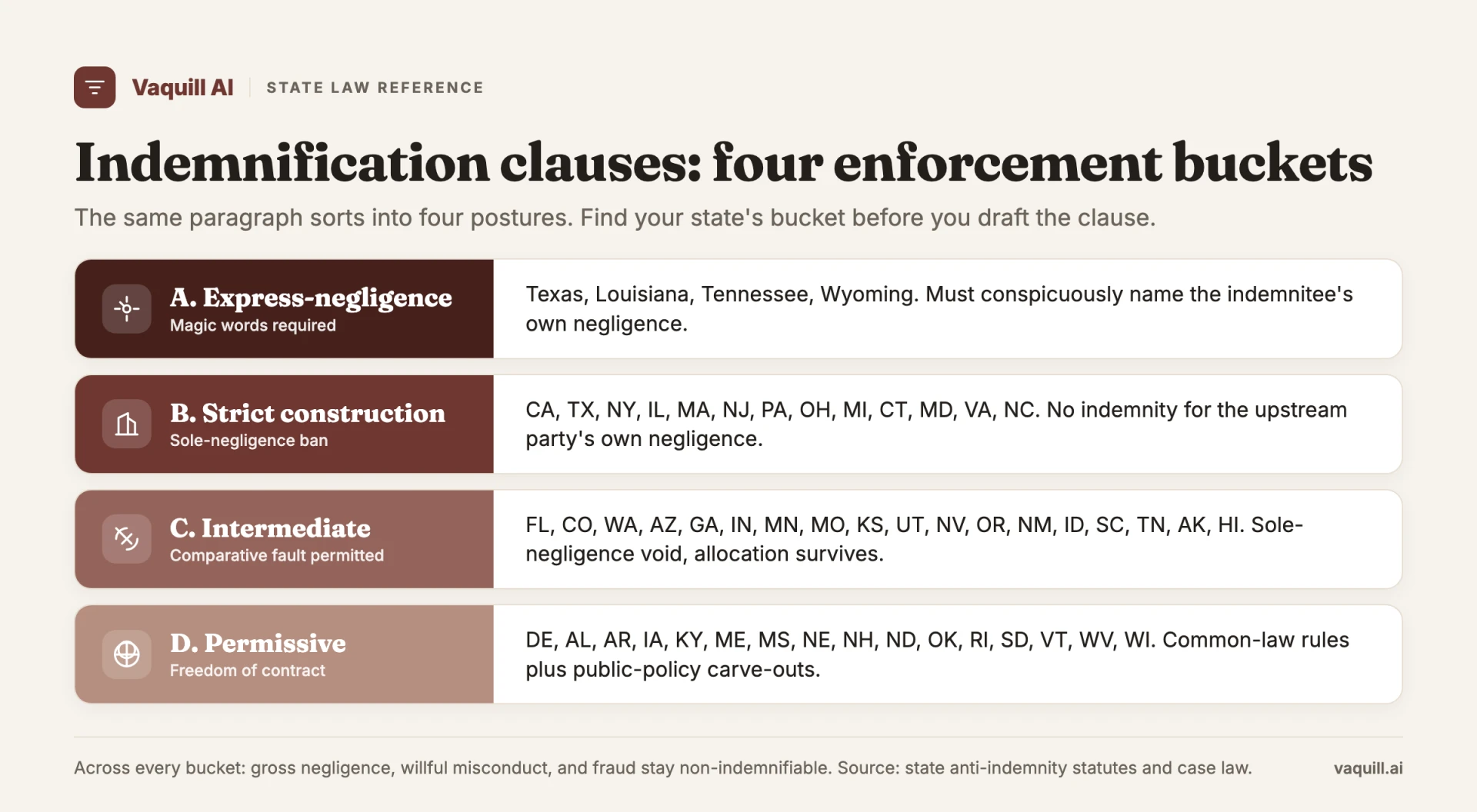
Same clause, four postures: express-negligence, strict construction, intermediate comparative-fault, and permissive states.
For related state-by-state coverage, see Choice-of-Law Clauses That Quietly Fail: A State-by-State Breakdown, Liquidated Damages Enforceability by State, Attorneys' Fees Provisions by State, and Jury Trial Waivers Enforceability by State. All of these sit in our 50-state legal reference series.
We build Vaquill AI, a legal research suite that pulls state anti-indemnity statutes and the leading cases by jurisdiction while you redline, so you can confirm a clause against current code text before it closes instead of finding out at summary judgment. Check the statute yourself either way: the citations in this post were verified against state code and published 50-state surveys in June 2026, and statutes change.
New legal AI guides, weekly.
Further Reading
Choice-of-Law Clauses That Quietly Fail: A State-by-State Breakdown
Read postLiquidated Damages Enforceability by State
Read postStatute of Limitations by State (2026): Personal Injury, Breach of Contract, and Negligence
Read postJury Trial Waiver by State: Are They Enforceable? (2026)
Read postNon-Compete Enforceability by State: A 2026 Map
Read post50 State Legal Research With AI: What All-States Coverage Really Means
Read post
Co-Founder & CEO · Attorney
Arshita leads product and strategy at Vaquill, building the legal AI suite that solo, small-firm, and in-house US lawyers use to run a matter end to end.