Non-compete enforceability in 2026 is governed by state law, not the federal government. The FTC's nationwide ban was vacated in Ryan v. FTC (N.D. Tex. Aug. 20, 2024), the agency dropped its appeals in September 2025, and the rule was formally removed from the Code of Federal Regulations on February 12, 2026. There is no federal floor.
The 50 states sort into five buckets. Four ban non-competes outright (California, Oklahoma, North Dakota, Minnesota); six are highly restrictive with income or garden-leave thresholds (Colorado, Illinois, Massachusetts, Washington, D.C., Oregon); most sit in a reasonableness-based middle; and Florida, Georgia, Alabama, and South Carolina are the most employer-friendly.
The 50-state table and the binding authority for each bucket are below.
The federal answer that wasn't
In late summer 2024 a GC called me on a Tuesday: should they rip the non-compete clause out of every offer letter going out that week? The FTC rule was supposed to take effect on September 4.
By the next morning it wasn't taking effect at all, and they had to put the clause back in for some states and leave it out in others. That panic on a single email is what this map is for.
For about four months in 2024, the question "is this non-compete enforceable" had a clean federal answer: no, mostly. The FTC's final rule, announced April 23, 2024 and published in the Federal Register on May 7, 2024 (89 FR 38342), would have voided nearly every existing employee non-compete on September 4, 2024.
Then a single district judge in Dallas vacated it. Ryan, LLC v. FTC, No. 3:24-cv-00986-E, 2024 WL 3879954 (N.D. Tex. Aug. 20, 2024) (Brown, J.), set the rule aside nationwide under 5 U.S.C. § 706, holding the Commission lacked substantive rulemaking authority over unfair methods of competition.
The FTC appealed, then walked it back. On September 5, 2025 the Commission voted to dismiss its appeals in Ryan and the related Properties of the Villages v. FTC and to accept the vacatur. On February 12, 2026 it published a final rule formally removing the Non-Compete Clause Rule from the Code of Federal Regulations: 16 CFR Part 910 is now "Removed and Reserved" (91 FR 6507, FTC Doc. 2026-02866), effective that day. The categorical federal ban is dead.
What replaced it is narrower. After a January 2026 workshop the FTC said it would not pursue a nationwide rule and would instead challenge specific non-competes it views as anticompetitive under Section 5 of the FTC Act, one employer at a time. That is enforcement risk for outlier agreements, not a floor that voids the ordinary covenant. State law still decides the typical case.
So the operative law in 2026 is what it has always been: state law, fifty different answers. This piece maps every state into one of five enforceability buckets, gives the binding statute or controlling case for each, and notes the drafting moves that matter.
It is built for the lawyer who needs a defensible answer in twenty minutes, not a treatise reader.
TL;DR
- The FTC non-compete rule is dead at the federal level. It was vacated in Ryan v. FTC (N.D. Tex. Aug. 20, 2024), the FTC dropped its appeals in September 2025, and the rule was removed from the CFR effective February 12, 2026 (91 FR 6507). State law controls.
- Four states ban: California, Oklahoma, North Dakota, and Minnesota (Minnesota new for agreements on/after July 1, 2023). Washington joins them as a near-total ban on June 30, 2027.
- Six jurisdictions are highly restrictive (income-threshold or garden-leave regimes): Colorado, Illinois, Massachusetts, Washington, D.C., and Oregon.
- Most states sit in a moderate, reasonableness-based middle (Texas, New York, Pennsylvania, Virginia, North Carolina, and others), with income-threshold and notice-period add-ons spreading.
- New for 2026: Virginia ties enforceability to severance on a without-cause firing (eff. July 1, 2026), and Tennessee adds a $70,000 income floor plus a tiered duration test (eff. July 1, 2026).
- Florida, Georgia, Alabama, and South Carolina remain the most employer-friendly.
- Maine, Rhode Island, Maryland, New Hampshire, and Nevada carved out low-wage workers but otherwise enforce reasonable agreements.
- Use the bucket as your first question on every engagement. The protectable interest is the second.
Part of our all-50-states legal reference series.
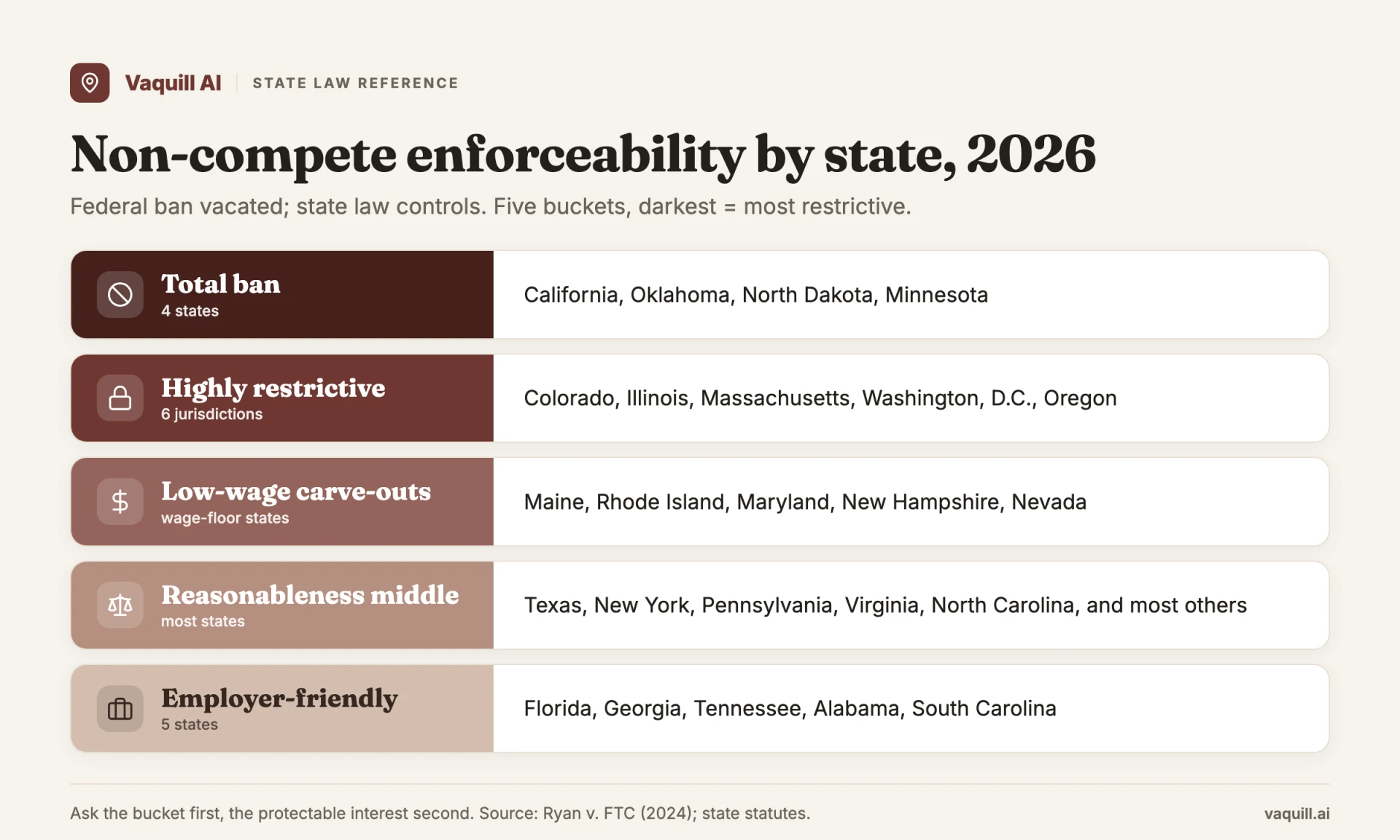
Every state sorts into one of five enforceability buckets, darkest = most restrictive.
As of 2026, does a federal FTC rule ban non-competes nationwide?
Non-compete enforceability by state: the 50-state table
Quick reference. "Bucket" maps to the five tiers explained below. Every dollar threshold is indexed, so confirm the current number at signing. Where a row says "verify with current state law," treat it as a pointer to check, not a settled cite.
| State | Enforceable? | Key authority | 2026 note |
|---|---|---|---|
| Alabama | Yes (permissive) | Ala. Code § 8-1-190 | Employees in a "uniquely essential" position |
| Alaska | Yes (reasonableness) | Data Mgmt. v. Greene, 757 P.2d 62 (1988) | Court may blue-pencil |
| Arizona | Yes (reasonableness) | Common law | Verify with current state law |
| Arkansas | Yes (reasonableness) | Ark. Code § 4-75-101 | Verify with current state law |
| California | No (ban) | Cal. Bus. & Prof. Code § 16600 | § 16600.5 reaches out-of-state employers |
| Colorado | Restricted (threshold) | Colo. Rev. Stat. § 8-2-113 | Non-compete floor ~$130,014, indexed |
| Connecticut | Yes (reasonableness) | Common law; sector statutes | Flat-ban bill (SB 1216) pending |
| Delaware | Yes (reasonableness) | Common law | Verify with current state law |
| D.C. | Restricted (threshold) | D.C. Code § 32-581.01 | Floor ~$150,000 ($250,000 medical) |
| Florida | Yes (permissive) | Fla. Stat. § 542.335 | Most employer-friendly; courts must blue-pencil |
| Georgia | Yes (permissive) | O.C.G.A. § 13-8-50 | Two-year presumption; blue-pencil allowed |
| Hawaii | Yes, except tech | Haw. Rev. Stat. § 480-4(d) | Tech-worker covenants void |
| Idaho | Yes (reasonableness) | Common law | Verify with current state law |
| Illinois | Restricted (threshold) | 820 ILCS 90 | Void below $75,000 (non-solicit $45,000) |
| Indiana | Yes (reasonableness) | Common law; physician statute | Verify with current state law |
| Iowa | Yes (reasonableness) | Common law | Flat-ban bill failed in 2025 |
| Kansas | Yes (reasonableness) | Common law | Verify with current state law |
| Kentucky | Yes (reasonableness) | Common law | Verify with current state law |
| Louisiana | Yes (narrow) | La. Rev. Stat. § 23:921 | Parish-by-parish geographic specificity |
| Maine | Carve-out | 26 M.R.S. § 599-A | Void at or below 400% of poverty level |
| Maryland | Carve-out | Md. Code, Lab. & Empl. § 3-716 | Void below ~$46,800 or $15/hr; healthcare ban |
| Massachusetts | Restricted (garden leave) | Mass. Gen. Laws ch. 149 § 24L | 12-month max; 50% garden-leave pay |
| Michigan | Yes (reasonableness) | Mich. Comp. Laws § 445.774a | Verify with current state law |
| Minnesota | No (ban) | Minn. Stat. § 181.988 | Voids agreements on/after July 1, 2023 |
| Mississippi | Yes (reasonableness) | Common law | Verify with current state law |
| Missouri | Yes (reasonableness) | Common law | Verify with current state law |
| Montana | Yes (narrow) | Mont. Code §§ 28-2-703 to 705 | Statute disfavors restraints; healthcare limits eff. Jan. 1, 2026 |
| Nebraska | Yes (narrow) | Common law | No blue-pencil; strict |
| Nevada | Carve-out | Nev. Rev. Stat. § 613.195 | Void against hourly workers |
| New Hampshire | Carve-out | N.H. Rev. Stat. § 275:70-a | Void below 200% of state minimum wage |
| New Jersey | Yes (reasonableness) | Common law | Reform bill pending |
| New Mexico | Yes, except healthcare | N.M. Stat. § 24A-4-2 | Healthcare covenants void |
| New York | Yes (reasonableness) | BDO Seidman v. Hirshberg, 93 N.Y.2d 382 (1999) | 2023 ban vetoed; narrower bill pending |
| North Carolina | Yes (strict) | Hartman v. W.H. Odell, 117 N.C. App. 307 (1994) | No blue-pencil |
| North Dakota | No (ban) | N.D. Cent. Code § 9-08-06 | Sale-of-business carve-out only |
| Ohio | Yes (reasonableness) | Common law | Court may modify |
| Oklahoma | No (ban) | Okla. Stat. tit. 15 §§ 217, 219A | Non-solicit of established customers allowed |
| Oregon | Restricted (threshold) | Or. Rev. Stat. § 653.295 | 12-month max; income floor; 2-week notice |
| Pennsylvania | Yes (reasonableness) | Hess v. Gebhard, 808 A.2d 912 (2002) | Healthcare non-competes over 1 yr void (Act 74) |
| Rhode Island | Carve-out | R.I. Gen. Laws § 28-59-1 | Void for low-wage, non-exempt, under-18 |
| South Carolina | Yes (permissive) | Rental Uniform Serv. v. Dudley, 278 S.C. 674 (1983) | No blue-pencil |
| South Dakota | Yes (reasonableness) | S.D. Codified Laws § 53-9-11 | One-year max |
| Tennessee | Yes (threshold, new) | Tenn. HB 1034 (eff. July 1, 2026) | $70,000 floor; tiered duration test |
| Texas | Yes (reasonableness) | Tex. Bus. & Com. Code §§ 15.50-15.52 | Explicit reformation authority |
| Utah | Yes (reasonableness) | Utah Code § 34-51-201 | One-year max |
| Vermont | Yes (reasonableness) | Common law | Verify with current state law |
| Virginia | Yes (threshold + new rule) | Va. Code § 40.1-28.7:8 | Severance rule on without-cause firing (eff. July 1, 2026) |
| Washington | Restricted, ban coming | Rev. Code Wash. § 49.62.010 | Near-total ban (ESHB 1155) eff. June 30, 2027 |
| West Virginia | Yes (reasonableness) | Common law | Verify with current state law |
| Wisconsin | Yes (strict) | Wis. Stat. § 103.465 | Entire covenant void if any part unreasonable |
| Wyoming | Yes (reasonableness) | Common law | Verify with current state law |
The five buckets, with the binding authority
Bucket 1: Outright (or near-outright) ban
Four states will not enforce a post-employment non-compete against an ordinary employee. Statutory carve-outs (sale-of-business, partnership dissolution) are narrow.
- California: Cal. Bus. & Prof. Code § 16600 (void); § 16600.1 (Feb. 14, 2024 employer notice mandate); § 16600.5 (extraterritorial reach, codifying Edwards v. Arthur Andersen, 44 Cal. 4th 937 (2008)). California now reaches out-of-state employers trying to enforce against California residents.
- Oklahoma: Okla. Stat. tit. 15 §§ 217, 219A. Void except sale-of-business; § 219A permits only non-solicitation of established customers.
- North Dakota: N.D. Cent. Code § 9-08-06. Sale-of-business and partnership-dissolution carve-outs only; reaffirmed in Warner & Co. v. Solberg, 2001 ND 156.
- Minnesota: Minn. Stat. § 181.988 (eff. July 1, 2023). Voids covenants entered on or after that date. Pre-July 2023 agreements live or die under the older reasonableness rule.
Bucket 2: Highly restrictive (thresholds, notice, mandatory consideration)
Enforcement is technically available but the statute makes it expensive enough that many employers stop drafting.
- Colorado: Colo. Rev. Stat. § 8-2-113 (H.B. 22-1317, eff. Aug. 10, 2022). Void unless "highly compensated" ($130,014 non-compete, $78,008.40 non-solicit, indexed 2026 figures). Noncompliance penalty: actual damages plus $5,000 per worker.
- Illinois: 820 ILCS 90/1 (Freedom to Work Act, amended Jan. 1, 2022). Non-competes void below $75,000; non-solicits below $45,000. Reliable Fire Equipment Co. v. Arredondo, 2011 IL 111871, is the common-law backdrop.
- Massachusetts: Mass. Gen. Laws ch. 149 § 24L (eff. Oct. 1, 2018). 12-month max; garden-leave pay of at least 50% of base salary or "other mutually-agreed consideration." Right-to-counsel notice required.
- Washington: Rev. Code Wash. § 49.62.010 (eff. Jan. 1, 2020). 2026 threshold: $123,394 employees, $308,485 contractors. 18-month presumption. Out-of-state choice-of-law clauses void for Washington workers. This regime is on the way out: ESHB 1155, signed March 23, 2026, replaces the income-threshold rule with a near-total ban effective June 30, 2027, voiding almost all covenants retroactively. Treat Washington as a Bucket 1 ban for anything that will still be in force on that date.
- D.C.: D.C. Code § 32-581.01 (as amended eff. Oct. 1, 2022). Void below $150,000 ($250,000 for "medical specialists").
- Oregon: Or. Rev. Stat. § 653.295. 12-month max. Salaried-exempt and above the statute's indexed salary floor (about $113,000 in 2026, adjusted annually; verify the current figure). Two weeks' written notice pre-start required.
Bucket 3: Moderate, reasonableness-based
Largest bucket. Enforces covenants reasonable in time, geography, and scope against a protectable interest with valid consideration.
- Texas: Tex. Bus. & Com. Code §§ 15.50-15.52. Must be ancillary to an otherwise enforceable agreement. Marsh USA Inc. v. Cook, 354 S.W.3d 764 (Tex. 2011), controls on consideration. Explicit reformation authority.
- New York: No general statute. BDO Seidman v. Hirshberg, 93 N.Y.2d 382 (1999), four-part test controls. The 2023 statutory ban (S3100A) was vetoed by Governor Hochul in December 2023; a narrower bill is pending in 2025-26.
- Pennsylvania: Common-law reasonableness from Hess v. Gebhard & Co., 808 A.2d 912 (Pa. 2002). Act 74 of 2024 (35 P.S. § 449.31) voids healthcare non-competes longer than one year.
- Virginia: Va. Code § 40.1-28.7:8. Void for "low-wage employees" (~$76,000 annualized in 2026). Above the threshold: Omniplex World Servs. v. US Investigations Servs., 270 Va. 246 (2005). New for 2026 (SB 170, agreements entered or amended on/after July 1, 2026): if the employer fires a covered employee without cause, the non-compete is unenforceable unless the employer pays "severance benefits or other monetary payment" disclosed at signing. The statute does not define "cause" or set a minimum payment, so verify with current state law before relying on a specific dollar figure.
- North Carolina: Hartman v. W.H. Odell & Assocs., 117 N.C. App. 307 (1994). Refuses to blue-pencil; an overbroad covenant is unenforceable in full.
Also here with their own quirks: Alaska (Data Mgmt. v. Greene, 757 P.2d 62 (Alaska 1988)), Arizona, Arkansas, Connecticut, Delaware, Hawaii (Haw. Rev. Stat. § 480-4(d) bans tech-worker covenants), Idaho, Indiana, Iowa, Kansas, Kentucky, Louisiana (La. Rev. Stat. § 23:921, parish-by-parish specificity), Michigan, Mississippi, Missouri, Montana, Nebraska, New Jersey, New Mexico (N.M. Stat. § 24A-4-2 bans healthcare), Ohio, South Dakota, Utah (§ 34-51-201, one-year max), Vermont, West Virginia, Wisconsin (Wis. Stat. § 103.465 voids the entire covenant if any portion is unreasonable), Wyoming.
Bucket 4: Permissive, freedom-of-contract leaning
- Florida: Fla. Stat. § 542.335. The most employer-friendly statute in the country. Up to six months presumed reasonable; up to two years against a former employee presumed reasonable. Courts must construe in favor of enforcement and must blue-pencil. White v. Mederi Caretenders Visiting Servs., 226 So. 3d 774 (Fla. 2017).
- Georgia: O.C.G.A. § 13-8-50 (Restrictive Covenants Act, eff. May 11, 2011, after constitutional amendment). Authorizes blue-pencil; two-year presumption.
- Tennessee: Long governed by common law (Vantage Tech. v. Cross, 17 S.W.3d 637 (Tenn. Ct. App. 1999)) plus a physician statute (Tenn. Code § 63-1-148). New for 2026: HB 1034 (eff. July 1, 2026) bars non-competes against any employee earning under $70,000 annually and sets rebuttable-reasonableness presumptions on duration (two years or less for ordinary employment). Above the threshold Tennessee stays employer-friendly, but the wage floor is now the first gate.
- Alabama: Ala. Code § 8-1-190 (Restrictive Covenants Act, eff. Jan. 1, 2016, replacing § 8-1-1). Covenants against employees in a "position uniquely essential."
- South Carolina: Rental Uniform Service of Florence v. Dudley, 278 S.C. 674 (1983). Five-factor test; no blue-pencil; routine enforcement of well-drafted covenants.
Bucket 5: Special carve-outs
Reasonableness-test states where the legislature carved specific categories out.
- Maine: 26 M.R.S. § 599-A. Void at or below 400% of federal poverty level.
- Rhode Island: R.I. Gen. Laws § 28-59-1 (eff. Jan. 2020). Void for low-wage (250% of poverty), non-exempt, students/interns, workers under 18.
- Maryland: Md. Code, Lab. & Empl. § 3-716. Void at $46,800 or 15 dollars/hour or below (2024 amendment, indexed). Healthcare ban added 2024.
- New Hampshire: N.H. Rev. Stat. § 275:70-a. Void for low-wage (200% of state minimum wage).
- Nevada: Nev. Rev. Stat. § 613.195 (A.B. 47 (2021)). Voids covenants against hourly workers; limits geography to what the employee actually served.
The 2024-2026 trend lines
The direction of travel is not subtle. Three patterns are doing most of the work.
Bans are spreading, and 2026 picked up the pace. Minnesota was the headline labor-side win in 2023. Washington went further in 2026: ESHB 1155 (signed March 23, 2026) flips the state from an income-threshold regime to a near-total ban effective June 30, 2027, the first state to ban after already having a threshold law on the books.
New York's full ban passed both chambers in 2023; Governor Hochul vetoed it that December because it lacked a senior-executive carve-out, and a narrower bill is pending. Connecticut's SB 1216 has been kicking around for two sessions. Iowa's flat-ban bill went nowhere in 2025.
The signal: legislatures with strong labor presence and no significant finance or biotech lobby pass a flat ban. The others end up at an income-threshold compromise, then sometimes tighten it into a ban once the threshold normalizes the idea.
Income thresholds are the working compromise. The Massachusetts model (garden leave plus low-wage carve-out) is the template. Colorado, Illinois, Washington, D.C., Oregon, Virginia, Maine, Maryland, Rhode Island, New Hampshire, Nevada, and now Tennessee (a $70,000 floor from July 1, 2026) run some version.
Thresholds range from 200% of state minimum wage to $250,000 for D.C. medical specialists; the structural move is identical. Expect more states to follow. It is the politically achievable version of a ban.
Garden leave and notice requirements are quietly the most important development. Massachusetts requires garden-leave pay of at least 50% of base salary. Oregon requires two weeks' written notice. Colorado requires statutory disclosures pre-acceptance.
The burden is shifting onto the employer in real dollars or real procedural friction. For a drafter, this means a non-compete is becoming a budget line item, not a free contract clause.
In practice, the employers I see actually budgeting for this land somewhere between 50% of base for the restricted period (the Massachusetts floor) and a flat severance equal to two or three months of total comp. The ones who try to skip it lose at the preliminary-injunction stage and never make it to the merits.
Healthcare is sui generis. Pennsylvania's Act 74 of 2024, New Mexico's § 24A-4-2, Maryland's healthcare ban, Indiana's 2023 amendment, and the long-standing Tennessee, Texas, and Massachusetts physician-specific statutes converge: you cannot restrict a doctor's practice the way you can a sales rep's.
The 20-minute playbook
When the question lands on your desk and the partner wants an answer by lunch:
- Locate the state bucket. California, Oklahoma, North Dakota, Minnesota: stop drafting.
- Confirm the wage threshold. In Colorado, Illinois, Washington, D.C., Oregon, Virginia, Maine, Maryland, Rhode Island, New Hampshire, Nevada, and Tennessee (from July 1, 2026) this is the gate. Below it, the covenant is void regardless of how you draft it.
- Name the protectable interest in one sentence. Trade secret, customer goodwill, specialized training. If you cannot name it, you do not have one.
- Price the restriction. Garden leave (Massachusetts floor: 50% base for the restricted period) or severance. If the employer will not pay, the covenant will not survive an injunction hearing.
- Pick non-solicit or non-compete. Non-solicit is the lower-risk, lower-reward instrument and lives in many of the same Bucket 1 states that ban non-competes outright (Oklahoma's § 219A is the textbook example).
The common drafting mistake I keep seeing in opposing-counsel letters is the kitchen-sink covenant copied across state lines: 24 months, nationwide, all-activities, no consideration recital, no garden leave.
In a Bucket 3 court it gets reformed or struck. In Bucket 2 it gets struck on the threshold issue before anyone reads the geographic scope. In Bucket 1 it never had a chance.
A drafting checklist by bucket
Bucket 1: the answer is no. Do not draft a non-compete. Use a properly-scoped non-solicitation (where the state allows it, as Oklahoma does in § 219A) and a real trade-secrets program under the state UTSA or the federal DTSA.
Spend the time on the trade-secrets program. That is what is actually enforceable.
Bucket 2: drafting is half a litigation strategy. Hit the threshold, hit the notice deadline, hit the consideration requirement, and do not assume any are optional.
In Massachusetts, the garden-leave provision is what people skip and what gets the covenant thrown out. In Colorado, it is the pre-acceptance disclosure. In Washington, the salary check and the choice-of-law clause.
Bucket 3: the standard moves are well-known. Short duration (12 months is a strong default, 24 months litigated hard everywhere), narrow geography tied to where the employee actually worked, narrow activity scope tied to what the employee actually did.
Texas, Pennsylvania, and the more careful side of New York reward narrow tailoring with predictable enforcement.
Bucket 4: the standard advice flips. You can be more aggressive, but Florida's § 542.335 and Georgia's RCA both come with required disclosures and definitional moves you have to get right. Drafting at the ceiling without the statutory framing is how a Bucket 4 state becomes a Bucket 3 result.
Bucket 5: the threshold check is the gatekeeper. Confirm the employee is above the wage/category cutoff before you sign anything. Then draft to the moderate-state reasonableness standard.
Two questions in any state, in any bucket, before drafting:
- Is the protectable interest real? If you cannot name the trade secret, the specific customer relationship, or the goodwill in one sentence, you do not have a protectable interest. You have a retention tool, and courts are getting better at sniffing that out.
- Will you actually litigate this? A non-compete you will not enforce is worse than no non-compete. It signals to the next employer that you are bluffable. Decide, and price the restriction (salary, equity, garden leave, severance) accordingly.
What an injunction hearing actually looks like
The Massachusetts pattern is the cleanest illustration of why drafters lose the procedural reality. Automile Holdings, LLC v. McGovern, 483 Mass. 797 (2020), set the modern outer bound; since then, Suffolk Superior has worked through a steady stream of preliminary-injunction motions where the employer drafted before § 24L's October 1, 2018 effective date but tried to enforce after, or drafted after and skipped the garden-leave recital.
The pattern is consistent: motion within 30 days of departure, hearing within 60, denial within 90 on a single sentence. No garden leave on the face of the agreement, no irreparable harm the court will credit.
The employer settles for a 6-month customer non-solicit and walks away from the non-compete. None of that requires a published opinion. It requires reading docket sheets.
The docket question (has this judge ever granted a non-compete PI under the current statute) is the one to answer first in any Bucket 2 jurisdiction.
FAQ
Are non-competes enforceable in 2026? It depends on the state. There is no federal ban: the FTC rule was vacated and removed from the Code of Federal Regulations in February 2026. Four states (California, Oklahoma, North Dakota, Minnesota) void almost all employee non-competes, Washington joins them in 2027, and the rest enforce reasonable covenants, many only above an income threshold.
Did the FTC non-compete ban take effect? No. The rule was set to take effect September 4, 2024, but a federal court vacated it nationwide on August 20, 2024 (Ryan v. FTC). The FTC dropped its appeals in September 2025 and formally removed the rule from the CFR effective February 12, 2026 (91 FR 6507). No employer was ever required to comply.
Which states ban non-competes entirely? California, Oklahoma, North Dakota, and Minnesota will not enforce a standard employee non-compete. Washington enacted a near-total ban (ESHB 1155) that takes effect June 30, 2027 and voids most existing covenants. Narrow carve-outs (sale of a business, partnership dissolution) survive in the ban states.
Is a non-compete enforceable if you are laid off or fired without cause? In most states a court still weighs the covenant on reasonableness regardless of who ended the job, though some judges are less sympathetic to enforcement after a layoff. Virginia is the outlier: starting July 1, 2026, a without-cause firing makes the non-compete unenforceable unless the employer pays severance disclosed at signing. Check your state and the agreement's wording.
What is the income threshold for a non-compete to be enforceable? It varies by state and is indexed yearly. Examples: Colorado (non-compete floor about $130,014), Illinois ($75,000), D.C. ($150,000, higher for medical specialists), and Washington ($123,394 for employees in 2026, until the 2027 ban). Tennessee adds a $70,000 floor effective July 1, 2026. Below the line, the covenant is void no matter how it is drafted.
How long can a non-compete last? Most enforcing states cap or presume reasonable a duration of 12 to 24 months. Massachusetts caps employee non-competes at 12 months; Oregon and Utah at one year; Florida presumes up to two years reasonable against a former employee. Twenty-four months and beyond is litigated hard everywhere.
Can a court rewrite an overbroad non-compete? Some states "blue-pencil" (Florida and Georgia require it; Texas, Alabama, and others allow reformation). Others refuse: North Carolina and Wisconsin void the entire covenant if any part is unreasonable, which is why a single overbroad term can sink the whole clause there.
Are non-solicitation agreements treated the same as non-competes? No. A non-solicit (no poaching customers or coworkers) is the lower-risk instrument and survives in several states that ban non-competes outright, such as Oklahoma. It protects less but enforces more reliably, so it is often the right fallback in ban and high-threshold states.
Closing
The federal answer that was almost the story of 2024 is a footnote. The 2026 law of non-competes is what it has been for two centuries: state common law and state statutes, with legislatures slowly tightening the screws and courts slowly trimming the edges.
Your state's bucket tells you whether to draft at all, what to limit, and what you must budget to litigate. The protectable-interest question tells you whether you are drafting a contract or building a paper tiger.
A federal ban could return only through new rulemaking or an act of Congress, neither of which is on the table in 2026. Until one is, fifty answers it is.
For the deep dives behind the high-stakes states, see California's Section 16600 ban, Colorado's HB 22-1317 threshold, Massachusetts's garden-leave statute, Florida's pro-enforcement § 542.335, and the New York and Texas reasonableness tests.
When a non-compete will not hold, the trade-secret and confidentiality program does the work instead, so pair this with NDA Enforceability by State in 2026. For more cross-jurisdiction drafting traps, see Choice-of-Law Clauses That Quietly Fail: A State-by-State Breakdown and Jury-Trial Waivers: Enforceable in All 50 States?.
For more on pulling the underlying state statute text before drafting, see the US primary law API.
Once you know the bucket and the threshold, drafting to it is the next step. Vaquill AI handles the drafting, with playbooks that hold your preferred and fallback positions consistent across all five buckets so a covenant written for a Bucket 3 state does not get copied verbatim into a Bucket 1 one.
New legal AI guides, weekly.
Further Reading
Jury Trial Waiver by State: Are They Enforceable? (2026)
Read post50 State Legal Research With AI: What All-States Coverage Really Means
Read postChoice-of-Law Clauses That Quietly Fail: A State-by-State Breakdown
Read postIndemnification Caps by State: How 50 Jurisdictions Read the Same Clause
Read postStatute of Limitations by State (2026): Personal Injury, Breach of Contract, and Negligence
Read postLiquidated Damages Enforceability by State
Read post
Co-Founder & CEO · Attorney
Arshita leads product and strategy at Vaquill, building the legal AI suite that solo, small-firm, and in-house US lawyers use to run a matter end to end.