Short answer: Attorney fee clauses are enforceable in almost every state, because the default American Rule (each side pays its own fees) yields to a clear contract term. The catch is reciprocity. Seven states (California, Florida, Hawaii, Montana, Oregon, Utah, and Washington) have statutes that rewrite a one-way "only the licensor recovers" clause into a mutual one by operation of law, so the clause can boomerang onto the party that drafted it. A few more states reach a narrower version of the same result for leases and consumer contracts. The 50-state table and drafting checklist below show where a one-way clause holds and where it flips.
The clause everyone copies and nobody re-reads
A general counsel forwarded me a draft master services agreement last spring with a 312-word prevailing-party fee provision lifted, near as I could tell, from a 2009 Florida real estate purchase agreement. The licensor was a Delaware company. The licensee was a California LLC with a New York choice-of-law clause.
The clause itself was strictly one-way: licensor recovers fees, licensee does not. The deal lawyer wanted to know if the clause "worked." The honest answer is that it worked in maybe twelve states, got silently rewritten in five, and was unenforceable as drafted in two more. The clause was the boilerplate. The boilerplate was the problem.
The redline took twenty minutes. I struck "Licensor shall be entitled to recover" and replaced it with "the Prevailing Party shall be entitled to recover," then added a defined-term block: "Prevailing Party" means the party obtaining a final, non-appealable judgment on the merits or a settlement materially resolving the disputed claim in its favor. "Reasonable" follows the lodestar method as articulated in the controlling jurisdiction. Costs of enforcement, including any action to determine or collect such fees, are recoverable.
The counterparty's lawyer pushed back on the lodestar reference (they had been quietly hoping for an undefined "reasonable" they could litigate later). We compromised on a 1.5x lodestar cap. That tradeoff, between an undefined "reasonable" and a defined cap, is the negotiation I see play out three or four times a quarter on commercial deals worth fighting over.
This is what an attorneys' fees clause looks like now: a single sentence carrying fifty different consequences, mostly because the drafter assumed the American Rule was a uniform default and that contract language could override it the same way everywhere. It is not, and it cannot.
The single rule that matters most for multi-state deals: if any counterparty sits in California, Washington, Oregon, Montana, Utah, Florida, or Hawaii, the one-way fee clause is structurally unstable, and the choice-of-law clause will not save it. Those are the seven full reciprocity states, the set every drafter should commit to memory.
TL;DR
- The American Rule (each side pays its own fees) is the default in 49 states and federal court, anchored in Alyeska Pipeline Service Co. v. Wilderness Society, 421 U.S. 240 (1975). Alaska is the lone outlier with a procedural loser-pays rule. Contractual fee-shifting is the standard workaround everywhere else.
- Seven states have full reciprocity statutes that convert a one-way prevailing-party clause into a mutual one across most contract types: California (Cal. Civ. Code § 1717), Florida (Fla. Stat. § 57.105(7)), Hawaii (Haw. Rev. Stat. § 607-14), Montana (Mont. Code § 28-3-704), Oregon (Or. Rev. Stat. § 20.096), Utah (Utah Code § 78B-5-826), and Washington (Rev. Code Wash. § 4.84.330).
- A second tier reciprocates only for specific contract types: Connecticut (consumer contracts and leases, § 42-150bb), New York (residential leases, Real Prop. Law § 234), and Colorado (residential leases, § 38-12-801). Several other states reach mutuality through common law.
- States also diverge on reasonableness review (almost universally lodestar), carve-outs for fraud, bad faith, or statutory consumer-protection claims, and whether fees-on-fees are recoverable.
- The 50-state table below is the drafting cheat sheet. The four common failure modes (aggressive one-way drafting in reciprocity jurisdictions, undefined "reasonable," stacking with liquidated damages, and fees-on-fees) get their own section.
How many states have full reciprocity statutes that convert a one-way prevailing-party fee clause into a mutual one?
Part of our all-50-states legal reference series. The fee clause rarely travels alone, so see also our state-by-state guides to choice-of-law clauses, liquidated damages, and indemnification caps.
The American Rule and what it actually does
The federal baseline comes from Alyeska Pipeline Service Co. v. Wilderness Society, 421 U.S. 240 (1975). The Supreme Court held that absent statutory authorization or a contractual provision, each party bears its own attorney's fees.
The Court rejected a broad equitable "private attorney general" theory, leaving Congress (and state legislatures, and contracting parties) to write the exceptions. Every state except Alaska follows the American Rule as its default, and Alaska's loser-pays Rule 82 is procedural and capped, not a true English-style shift.
The Court returned to the doctrine in Lackey v. Stinnie, No. 23-621 (U.S. Feb. 25, 2025), which held that a plaintiff who obtains only a preliminary injunction, without a final judgment on the merits, is not a "prevailing party" under 42 U.S.C. § 1988(b). The holding is statutory, but it bleeds into contract drafting because most prevailing-party clauses use the same federal-law term of art without defining it.
That is the baseline. Contractual fee-shifting is the workaround, and the rest of this piece is about how states treat that workaround.
The reciprocity rule: Cal. Civ. Code § 1717
If a corporate lawyer drafts only one section of this piece into permanent memory, it should be this one. Cal. Civ. Code § 1717 reads, in substance, that in any action on a contract where the contract specifically provides that fees shall be awarded "either to one of the parties or to the prevailing party," the party who actually prevails on the contract is entitled to reasonable fees.
The mechanical effect is that a one-way fee clause in a California-governed contract is read as mutual.
Two recent California appellate decisions sharpen the point:
- A 2024 California Court of Appeal decision affirmed a roughly $1.55 million fee award where a defendant prevailed on a contract-based affirmative defense involving the unlicensed-contractor bar. The court treated the defense win as an action "on the contract" within § 1717. Drafters who assumed only an affirmative recovery triggered fee-shifting were wrong.
- A 2025 California Court of Appeal decision held that § 1717 does not let a defendant collect fees against a consumer plaintiff who pursued Song-Beverly and Magnuson-Moss Warranty Act claims, because those statutes are one-way pro-consumer by design. Counsel pull the exact captions before relying on them; recent California Court of Appeal decisions in this area get cited fast.
The drafting consequence: if your client wants a one-way clause and California law might apply, the choice-of-law clause has to be airtight, and even then a California court will frequently treat § 1717 as a fundamental policy that overrides the chosen law for any California-resident counterparty.
Six other states have parallel full-reciprocity statutes: Montana (Mont. Code § 28-3-704), Oregon (Or. Rev. Stat. § 20.096), Hawaii on assumpsit contracts (Haw. Rev. Stat. § 607-14), Utah (Utah Code § 78B-5-826), Washington (Rev. Code Wash. § 4.84.330), and Florida (Fla. Stat. § 57.105(7)). That is the canonical group of seven. A separate, narrower tier reciprocates only for specific contract types: Connecticut for consumer contracts and leases (Conn. Gen. Stat. § 42-150bb), New York for residential leases (N.Y. Real Prop. Law § 234), and Colorado for residential leases (Colo. Rev. Stat. § 38-12-801). New York and New Jersey also reach reciprocity outcomes through common law in some commercial cases, but not by statute.
The four doctrinal axes
States vary on four things. The drafting moves follow from these four.
1. Reciprocity statutes. Seven states flip one-way clauses to mutual ones by statute: California (§ 1717), Florida (§ 57.105(7)), Montana (§ 28-3-704), Oregon (§ 20.096), Utah (§ 78B-5-826), and Washington (§ 4.84.330) across most contract types, plus Hawaii (§ 607-14) for assumpsit actions. Drafters who want a one-way clause need to know whether any of these states' laws can attach. Oklahoma's 12 Okla. Stat. § 936 looks similar but is different: it awards fees to the prevailing party in suits on labor, services, and accounts, yet it does not convert a one-way contract clause into a mutual one.
2. Common-law reciprocity. New York courts have read one-way clauses narrowly, occasionally rewriting them under contra proferentem and unconscionability theories. New Jersey applies a similar judicial gloss. Florida adds its own statutory layer. The pattern: in heavy commercial-litigation states, one-way clauses survive scrutiny only when the consideration is obvious and the parties are clearly sophisticated.
3. Permissive, freedom-of-contract jurisdictions. Texas, Delaware, and Massachusetts (with limits) enforce fee-shifting clauses as written, including aggressive one-way clauses, subject to a reasonableness check. Texas Civil Practice and Remedies Code § 38.001 is the headline statute; Delaware's Court of Chancery enforces fee provisions in commercial agreements with very little second-guessing. ATP Tour, Inc. v. Deutscher Tennis Bund, 91 A.3d 554 (Del. 2014), upheld a fee-shifting bylaw provision in the corporate-governance context.
4. Lodestar reasonableness review. Nearly every state applies a lodestar (hours times reasonable rate) reasonableness check at the fee-award stage, even when the contract supposedly fixes the amount. Perdue v. Kenny A. ex rel. Winn, 559 U.S. 542 (2010), is the federal touchstone.
State-court application varies on whether contingency, novelty, and result enhance the lodestar, but the floor is the same: a court will not award fees the court considers unreasonable, even if the contract says it must.
The 50-state table
The columns below ask three questions for each state: is there a statute that converts one-way clauses to mutual; does common law do the same; and how aggressive is reasonableness review.
Methodology note. The table is a high-level drafting aid keyed to the named statutes and the dominant common-law approach in each jurisdiction as of mid-2026. It is not a substitute for pulling the cited code section and the most recent appellate decision in the state of contract performance. "Lodestar" in the third column means a court will reduce the contractual amount to a reasonable lodestar figure if the contract amount is materially higher than market; it does not mean the contract is unenforceable.
| State | Reciprocity statute | Common-law approach | Reasonableness review |
|---|---|---|---|
| Alabama | None | Enforces as written | Lodestar |
| Alaska | Rule 82 (loser-pays default) | Schedule-based | Capped by rule |
| Arizona | A.R.S. § 12-341.01 (court discretion) | Mutualizes in practice | Lodestar |
| Arkansas | None | Enforces as written | Lodestar |
| California | Cal. Civ. Code § 1717 (mandatory mutual) | N/A (statute controls) | Strict lodestar |
| Colorado | § 38-12-801 (residential leases only) | Enforces; allows fees-on-fees | Lodestar (broad) |
| Connecticut | § 42-150bb (consumer contracts, leases) | Enforces; aligns with arbitration clause | Lodestar |
| Delaware | None | Enforces aggressively (Chancery) | Light review |
| Florida | Fla. Stat. § 57.105(7) (mutualizes one-way clauses by statute) | Layered statutory regime | Lodestar |
| Georgia | O.C.G.A. § 13-1-11 (notes/guaranties only) | Otherwise enforces | Statutory cap on notes |
| Hawaii | Haw. Rev. Stat. § 607-14 (assumpsit actions only) | Otherwise enforces | Statutory cap (25% of judgment in assumpsit) |
| Idaho | I.C. § 12-120 (commercial transactions) | Enforces | Lodestar |
| Illinois | None | Strictly construes one-way clauses | Lodestar |
| Indiana | None | Enforces | Lodestar |
| Iowa | None | Enforces | Lodestar |
| Kansas | None | Enforces | Lodestar |
| Kentucky | None | Enforces | Lodestar |
| Louisiana | La. C.C. art. 2000 (limits) | Enforces; civil-law overlay | Lodestar |
| Maine | None | Enforces | Lodestar |
| Maryland | None | Enforces; narrow construction | Lodestar |
| Massachusetts | None | Enforces; some consumer carve-outs | Lodestar |
| Michigan | None | Enforces | Lodestar |
| Minnesota | None | Enforces | Lodestar |
| Mississippi | None | Enforces | Lodestar |
| Missouri | None | Enforces | Lodestar |
| Montana | Mont. Code § 28-3-704 (mutualizes) | N/A (statute) | Lodestar |
| Nebraska | None | Disfavors fee-shifting; strict construction | Lodestar |
| Nevada | None | Enforces | Lodestar |
| New Hampshire | None | Enforces | Lodestar |
| New Jersey | None | Common-law reciprocity tendencies | Lodestar |
| New Mexico | None | Enforces | Lodestar |
| New York | § 234 (residential leases only) | Strictly construes; occasional reciprocity gloss | Lodestar |
| North Carolina | N.C. Gen. Stat. § 6-21.2 (notes/guaranties) | Restrictive elsewhere | Lodestar |
| North Dakota | None | Enforces | Lodestar |
| Ohio | None | Enforces in commercial context | Lodestar |
| Oklahoma | § 936 (one-way prevailing-party in labor, services, account suits; does not convert clauses) | Otherwise enforces | Lodestar |
| Oregon | Or. Rev. Stat. § 20.096 (mutualizes) | N/A (statute) | Lodestar |
| Pennsylvania | None | Strictly construes | Lodestar |
| Rhode Island | None | Enforces | Lodestar |
| South Carolina | None | Enforces | Lodestar |
| South Dakota | None | Enforces | Lodestar |
| Tennessee | None | Enforces | Lodestar |
| Texas | Tex. Civ. Prac. & Rem. Code § 38.001 | Enforces; broad recovery | Lodestar (broad) |
| Utah | Utah Code § 78B-5-826 (mutualizes) | N/A (statute) | Lodestar |
| Vermont | None | Enforces | Lodestar |
| Virginia | None | Enforces; strict construction | Lodestar |
| Washington | Rev. Code Wash. § 4.84.330 (mutualizes) | N/A (statute) | Lodestar |
| West Virginia | None | Enforces | Lodestar |
| Wisconsin | None | Enforces | Lodestar |
| Wyoming | None | Enforces | Lodestar |
| D.C. | None | Enforces | Lodestar |
Two table entries deserve quick footnotes. Utah's § 78B-5-826 reciprocates fee provisions in any civil action based on contract. Washington's § 4.84.330 is the second most-cited mutualization statute after California's § 1717, and it explicitly overrides contrary contract language.
The full-reciprocity set is seven states: California, Florida, Hawaii, Montana, Oregon, Utah, and Washington. Drafters who carry a "CA, MT, OR" mental shortcut are working from a 2005 outline. Oklahoma (§ 936) and the limited-reciprocity states (Connecticut, New York, Colorado for leases) sit one tier down: they shift or reciprocate fees only in narrower categories, so the table flags them but they are not the same risk as the seven.
What to do when the deal spans states
The choice-of-law clause is the first lever, but it is not as strong a lever as drafters wish it were. California courts treat § 1717 as a fundamental policy under Nedlloyd Lines B.V. v. Superior Court, 3 Cal. 4th 459 (1992), and routinely refuse to enforce out-of-state law against a California resident on the fee question.
Washington courts apply § 4.84.330 in a similar register. So picking Delaware law in a contract with a California licensee is a partial defense, not a complete one: a California court will often apply California's reciprocity rule regardless.
My working position when a deal spans multiple states:
- If any counterparty is in CA, WA, OR, MT, UT, FL, or HI, draft the clause mutual from day one. Those are the seven full reciprocity states. Trying to choose around the statute is rarely worth the litigation cost, and the one-way clause is the kind of detail an arbitrator will note before reaching the merits.
- In freedom-of-contract jurisdictions (TX, DE, MA), the choice-of-law clause does the work it is supposed to do. A Delaware-governed commercial agreement with a one-way fee clause between two sophisticated counterparties is enforceable as written.
- When the parties are sophisticated and the choice of governing law is itself negotiated, treat the fee-shifting question as a separate negotiation point. A Delaware or New York choice of law plus a clearly mutual fee clause plus a defined "prevailing party" and defined "reasonable" is the default I land on in most cross-border commercial deals.
- For consumer-facing contracts, assume one-way pro-consumer statutes will override the contract, including in California, Massachusetts, and the more active state consumer-protection regimes. Drafting a one-way pro-business fee clause is mostly performative.
The mistake I see most often is the deal lawyer who runs the choice-of-law analysis as if it answered the fee question. It does not. The fee question is a second-order analysis that runs on top of the choice-of-law result, and the reciprocity statutes are the reason.
The fee question is a second-order analysis that runs on top of the choice-of-law result.
Reciprocity statutes persist for a structural reason worth understanding. State legislatures (California most aggressively) treat asymmetric fee clauses as inherent overreach in the contracts where they show up most often: residential leases, adhesion-style consumer financing, small-business franchise agreements, and increasingly SaaS terms of service.
The legislative theory is that mutuality is a forced fairness floor in any contract a court will police. Litigators exploit the statutes by characterizing whatever defense they prevailed on as an action "on the contract," which after the California construction-defect decision noted above clearly includes affirmative defenses.
The cross-border SaaS MSA is where I see this break drafters most often: a Delaware-governed MSA with California enterprise customers, a one-way fee clause, and a counterparty who wins on a contract-based affirmative defense to a usage dispute. The result is a § 1717 fee award against the licensor for a defense win the licensor never thought would trigger fees.
The four enforcement failure modes
These are what actually break a fee clause in practice.
1. One-way drafting that gets rewritten or voided. A licensor-only fee clause in a contract governed by California, Utah, Washington, Oregon, Montana, Florida, or Hawaii law is read as mutual whether the parties want it to be or not.
In a transaction where the drafter's client is the more litigation-prone party, the one-way clause that was supposed to deter the counterparty becomes a symmetric weapon. Several public-company disputes in the past two years turned on exactly this: the drafter went one-way for leverage and discovered, on summary judgment, that the same clause now applied to the counterparty's affirmative defense win.
2. "Reasonable" left undefined. Most fee clauses say "reasonable attorneys' fees." Most do not define "reasonable." The court then applies lodestar. The lodestar number is almost always lower than what the prevailing party actually paid, particularly for in-house augmented teams or AmLaw 100 rates.
If the deal is one where the parties expect to pay hourly rates well above market median, the contract should say so: name the firm tier, name the rate band, or attach a lodestar multiplier ceiling. A 2024 Connecticut Appellate decision, Golden v. WorldQuant Predictive Technologies, LLC, illustrated the cost of leaving the term undefined inside an arbitration clause; the arbitrator's discretion to award fees became the litigation, not the merits.
3. Stacking with liquidated damages. A clause that combines a liquidated-damages number with a fee-shifting provision is at risk of being recharacterized as a penalty in jurisdictions that scrutinize liquidated damages closely (New York, Illinois, and Texas all apply variants of the rule against penalty clauses).
The fee-shifting piece survives; the liquidated-damages piece sometimes does not, and a court that sees the combination as oppressive will sometimes use the fee clause as evidence of overreach.
4. Fees-on-fees, overstated. Recovery of the fees incurred to recover fees ("fees-on-fees") is permitted in Colorado after Munras v. Kabod Coffee, 2025 COA 71, where the Colorado Court of Appeals surveyed national authority and held that broad contractual language permits the recovery. California and several other states reach the same outcome under § 1717 when the contractual language is broad.
But many states default the other way unless the contract specifically allows it. A clause that says "fees and costs of any action to enforce this agreement, including any action to recover such fees" is the safe formulation. A clause that says only "fees and costs" usually is not.
Recent appellate authority worth tracking
A few decisions from the last 18 months are reshaping the drafting defaults:
- Lackey v. Stinnie, No. 23-621 (U.S. Feb. 25, 2025): a plaintiff who obtains a preliminary injunction but never a final judgment is not a "prevailing party" under 42 U.S.C. § 1988(b). The 7-2 opinion is statutory, but contracts using "prevailing party" without defining it are now exposed to the same interpretive risk: counsel who win a TRO and then settle may never qualify under the unmodified term.
- 1046 Munras Properties, L.P. v. Kabod Coffee, 2025 COA 71: the first published Colorado decision allowing fees-on-fees recovery under a broad contractual fee provision. The lease awarded fees "in any action or proceeding" to enforce or interpret the contract, and the court read that to cover the litigation to recover the fees themselves. Recent appellate authority elsewhere has reached similar results where contractual language is broad enough.
- Recent California appellate authority on § 1717 (including a 2024 construction-defect decision affirming a seven-figure fee award where a defendant prevailed on a licensure-based affirmative defense) confirms that § 1717's reach extends to defense wins "on the contract," not just affirmative recoveries.
- Recent California consumer-protection authority confirms that § 1717's reciprocity does not let a defendant pry fees out of a Magnuson-Moss or Song-Beverly plaintiff; the one-way pro-consumer statute controls.
- Recent Connecticut appellate authority emphasizes that ambiguity between an arbitration clause and a fee clause becomes its own litigation. Align the two carefully.
The drafting checklist
A defensible 2026 attorneys' fees clause in a commercial contract reads, roughly, as follows. Each line is there because a state took the previous version apart.
- Mutual reciprocal language. Draft mutual unless you have a specific commercial reason for asymmetry and a choice-of-law clause that genuinely shields you. In the seven full reciprocity states (CA, FL, HI, MT, OR, UT, WA), the one-way clause is not going to hold.
- Define "prevailing party." Specify "the party that obtains a final, non-appealable judgment on the merits, or a settlement that materially resolves the disputed claim in its favor." Lackey v. Stinnie is why.
- Define "reasonable." Either reference the lodestar method directly, or name an acceptable rate band, or specify a cap as a percentage of damages.
- Carve out fraud and willful breach. A fee clause that operates even where the recovering party has acted in bad faith is the kind of clause courts use as evidence of overreach when the rest of the agreement comes under scrutiny.
- Allow fees-on-fees expressly. Use language like "including any action or proceeding to enforce, collect, or determine the amount of such fees." Otherwise you are guessing whether your state follows Munras or its opposite.
- Address arbitration alignment. If there is an arbitration clause, mirror the fee provisions and specify whether the arbitrator or a court determines the award. Golden v. WorldQuant is the cautionary tale.
- Carve out statutory consumer claims where the contract will reach consumer counterparties. § 1717's reciprocity does not override a one-way pro-consumer statute, and a court will not let you contract around it.
For a deadline draft, the minimum viable clause is two moves: make it mutual, and define both "prevailing party" and "reasonable." Everything else is risk management on top of those two moves.
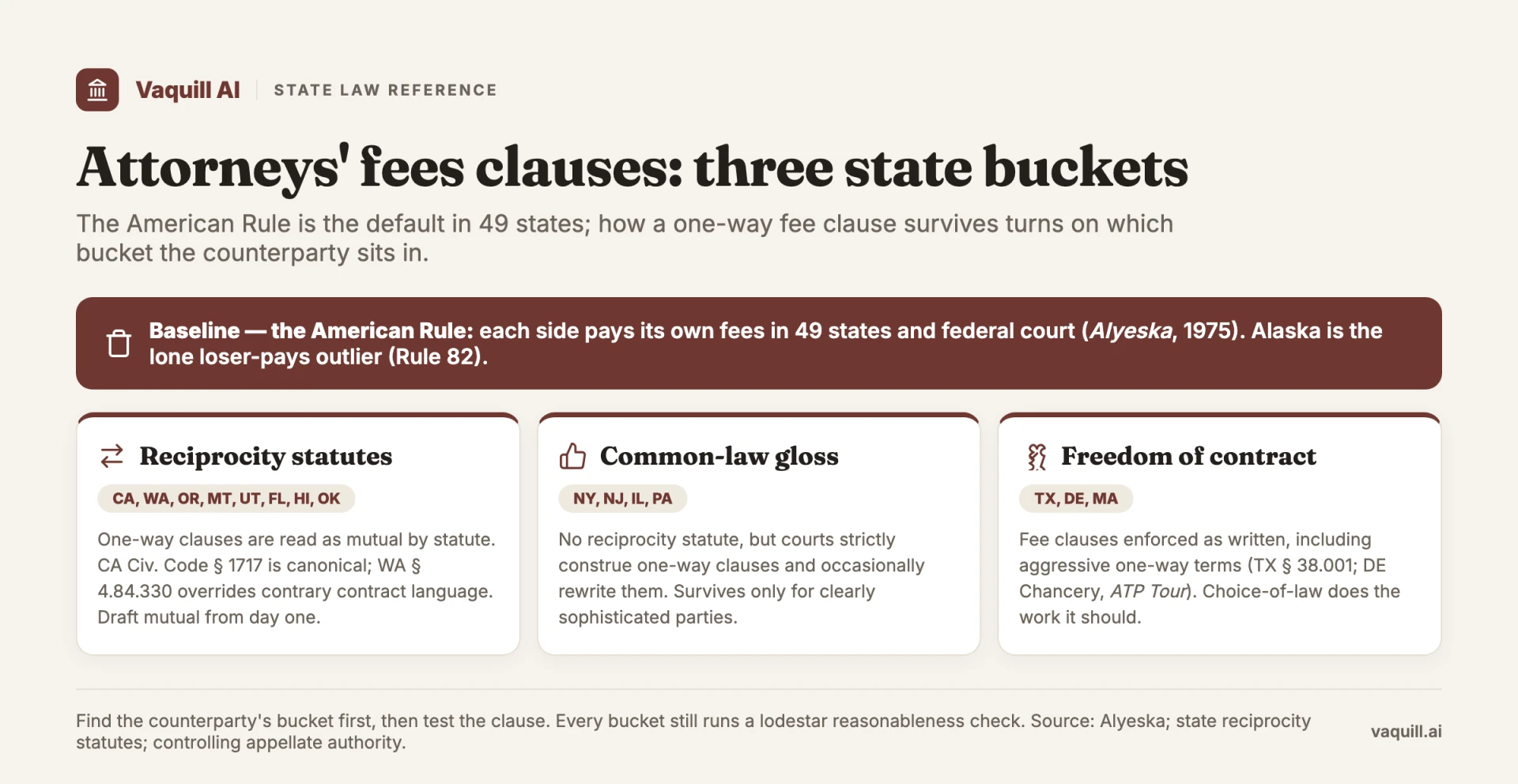
Three buckets decide whether a one-way fee clause survives: statutory reciprocity (CA, WA, OR, MT, UT, FL, HI), common-law gloss (NY, NJ, IL, PA), and freedom of contract (TX, DE, MA).
FAQ
Are attorney fee clauses enforceable? Yes, in almost every state. The American Rule (each side pays its own fees) is only a default, and a clear contract term that shifts fees to the prevailing party overrides it. The exceptions are clauses that are unconscionable, that violate a one-way pro-consumer statute, or that try to be one-way in a state whose reciprocity statute rewrites them as mutual.
What is the American Rule? The American Rule is the baseline that each party pays its own attorney's fees regardless of who wins, absent a statute or contract that says otherwise. The Supreme Court restated it in Alyeska Pipeline Service Co. v. Wilderness Society, 421 U.S. 240 (1975). Alaska is the one state that departs from it, using a scheduled loser-pays rule (Civil Rule 82).
Which states convert one-way attorney fee clauses to mutual? Seven states do it by statute across most contract types: California (Cal. Civ. Code § 1717), Florida (Fla. Stat. § 57.105(7)), Hawaii (Haw. Rev. Stat. § 607-14), Montana (Mont. Code § 28-3-704), Oregon (Or. Rev. Stat. § 20.096), Utah (Utah Code § 78B-5-826), and Washington (Rev. Code Wash. § 4.84.330). A narrower group reciprocates only for leases or consumer contracts: Connecticut (§ 42-150bb), New York (Real Prop. Law § 234), and Colorado (§ 38-12-801).
What does "prevailing party" mean in a fee clause? It means the party that wins the dispute, but the test varies. Some states treat any net recovery as prevailing; others ask who won the "main issue." After Lackey v. Stinnie (U.S. Feb. 25, 2025), a party that only obtains a preliminary injunction and never a final judgment may not qualify, so define the term in the contract instead of relying on the default.
Can a choice-of-law clause defeat a state reciprocity statute? Often no. California treats § 1717 as a fundamental policy under Nedlloyd Lines B.V. v. Superior Court, 3 Cal. 4th 459 (1992), and will apply its reciprocity rule to a California-resident counterparty even when the contract picks another state's law. Washington applies § 4.84.330 in a similar way. Picking Delaware or New York law is a partial defense, not a complete one.
Does Texas enforce one-way attorney fee clauses? Texas is a freedom-of-contract state. It enforces fee-shifting clauses, including one-way clauses, as written, subject to a reasonableness check, with Tex. Civ. Prac. & Rem. Code § 38.001 as the headline statute. Delaware and Massachusetts (with consumer limits) take a similar approach.
What is "reasonable" in an attorney fee clause? Almost every state reduces a contractual fee to a reasonable amount using the lodestar method (hours worked times a reasonable hourly rate), even when the contract states a fixed figure. Perdue v. Kenny A. ex rel. Winn, 559 U.S. 542 (2010), is the federal touchstone. If you expect above-market rates, name the rate band or a lodestar multiplier cap in the clause.
Can you recover the fees spent recovering fees? These "fees-on-fees" are recoverable only when the contract clearly allows them in many states. Colorado allowed them under broad contractual language in 1046 Munras Properties, L.P. v. Kabod Coffee, 2025 COA 71, and California reaches the same result under § 1717. The safe drafting move is language covering "any action to enforce, collect, or determine the amount of such fees."
How Vaquill AI helps
Checking a fee clause against the right state's statute and the most recent appellate decision is exactly the kind of lookup that eats an afternoon. Vaquill AI is a legal AI suite for in-house teams that pulls the controlling statute text (US Code, CFR, and all 52 state and territory codes) and surfaces the relevant case law so you can verify a clause without leaving the draft. If you want to pressure-test the fee provision in front of you, start with Vaquill AI and run the clause against the governing state.
Closing
The American Rule has been the federal default since Arcambel v. Wiseman, 3 U.S. 306 (1796), and the Alyeska opinion in 1975 made the rule explicit. Fifty states now run fifty different sets of exceptions on top of it, with the most active being the reciprocity statutes that quietly convert one-way clauses to mutual ones.
The drafter who treats an attorneys' fees clause as boilerplate is taking a position on each of those fifty regimes by default. The drafter who reads the clause as state-specific, who knows when § 1717 will attach, who defines "prevailing party" and "reasonable," and who carves out the consumer-statute edge cases is doing the work the boilerplate was supposed to be doing.
For more on programmatic access to state contract statutes, see the US primary law API.
New legal AI guides, weekly.
Further Reading
Liquidated Damages Enforceability by State
Read postNDA Enforceability by State: A 2026 Reference for Corporate Counsel
Read postTrade Secrets Enforceability by State: The 2026 50-State Reference
Read postChoice-of-Law Clauses That Quietly Fail: A State-by-State Breakdown
Read postDrafting the Schedule of Exceptions in an M&A Deal
Read postDrag-Along Provisions in Venture Deals: A 2026 Drafting Guide
Read post
Co-Founder & CEO · Attorney
Arshita leads product and strategy at Vaquill, building the legal AI suite that solo, small-firm, and in-house US lawyers use to run a matter end to end.