
Short answer: A data provider's quality claim is worth what you can re-run. So we drew random samples from our US case law database, counted what is present on each record, counted the text defects our detectors raise across every row, and wrote down the method. Case name, court and decision date are present on 100.0% of sampled cases (after rounding). A reporter citation is on 79.8% of cases overall, and on 96.1% of supreme court cases. Margin numbers are the most common text defect, on 2.2% of opinions. Disposition is on only 4.3% of cases. The rest of this post is the evidence, and the places where the data is thin.
Written and checked on 23 November 2026 against the data quality page in the API docs, plus live reads of the API. This is general information, not legal advice; check the cited opinion before relying on it.
TL;DR
- Identity fields are complete. Court, decision date and case name were present on 100.0% of 20,000 random visible cases. The date is known to the day on 99.4%.
- Completeness depends on the court. A reporter citation is served on 96.1% of supreme court cases, 82.3% of appellate and 45.3% of trial court cases.
- Opinion text is present on 99.9% of 20,000 random visible opinions. The flags that withhold text add up to under 0.3% of stored opinions.
- The most common text defect is margin numbers, flagged on 2.2% of opinions. The rarest flags are 0.002% and 0.001%.
- The citation graph is dense for most opinions. 68.4% of sampled opinions cite at least one held opinion, with a median of 3 and a mean of 7.0 outgoing citations.
- A record that fails a check carries a quality flag, and changes and withdrawals are listed on a feed, so a pipeline can react to them.
- Limits are stated. Recency varies by court, disposition is sparse, and we have not yet published an accuracy rate against the courts' own documents.
A record, as of 23 November 2026
The fields this post measures are all on the case record. This is 556 U.S. 662 (Ashcroft v. Iqbal) resolved on 23 November 2026, trimmed to the fields discussed below:
{
  "caseId": "USCASE_5AA489D9BAE94574B1C6",
  "caseName": "Ashcroft v. Iqbal",
  "court": { "courtId": "US_FED_SCOTUS", "level": "supreme" },
  "decisionDate": "2009-05-18",
  "decisionDatePrecision": "day",
  "publicationStatus": "published",
  "citations": ["173 L. Ed. 2d 868", "129 S. Ct. 1937", "556 U.S. 662"],
  "citedByCount": 158305,
  "outcome": null,
  "firstSeenAt": null,
  "sourcePublishedDate": null,
  "citeable": "unknown"
}
Three things to read off it.
A supreme court case has a reporter citation, a day-precision date and a publication status.
outcome is null, which is the common case: disposition is on a minority of cases, as shown below.
firstSeenAt and sourcePublishedDate are null too, so a provenance field can be empty and a pipeline should handle that.
A resolved status means the citation matched a case in the data. It does not check a party name, a quote or a pincite.
Why publish a measurement instead of an example
A common way to show data quality is a side-by-side of one decision: the raw text on the left, the cleaned text on the right. That is fine as an illustration. It cannot tell a pipeline builder how often the field they need is empty.
A builder needs different answers. How many cases have a docket number I can join on? How many opinions are empty, a caption, or an error page? If I walk citations, how often do I land on a case that is held? What changes underneath me tomorrow, and how will I know?
None of those is answered by a hand-picked case. Each is a rate over a population, so each needs a sample, a date and a method.
| What a quality page usually shows | What a pipeline needs |
|---|---|
| A few chosen decisions, before and after | A rate per field over a random sample |
| A round total of opinions | The total per court level, with the date it was counted |
| "High fidelity" | The named defects, how each is detected and how often it fires |
| "Up to date" | Recency stated per court |
| A claim of accuracy | A statement of what was and was not measured |
Method
All figures were measured on 2026-11-22 against the production database, in a read-only session.
- Visible records. A record is visible when search and list routes serve it. Every rate is over visible records, which is what an API user can reach.
- Samples. 20,000 visible cases, 20,000 visible opinions and 20,000 visible dockets. Rows were drawn by page sampling with a fixed seed, then shuffled.
- Whole-table counts. Where a count is exact over every row, we say so. Flag counts are exact.
- Clustering. Page sampling is clustered, so a sample is not a perfectly independent draw. We treat a rate as accurate to about a point. A court level with fewer than 100 sampled cases is shown as a direction only.
- Moving data. Counts move as collectors run, so a figure taken later will differ.
We also ran an independent recount of text defects over the 20,000 sampled opinions, separate from the detectors, as a cross-check.
Scale and shape
The database holds decisions from federal, state, territorial, tribal and military courts. Live totals and the list of courts are on the coverage page, because totals move.
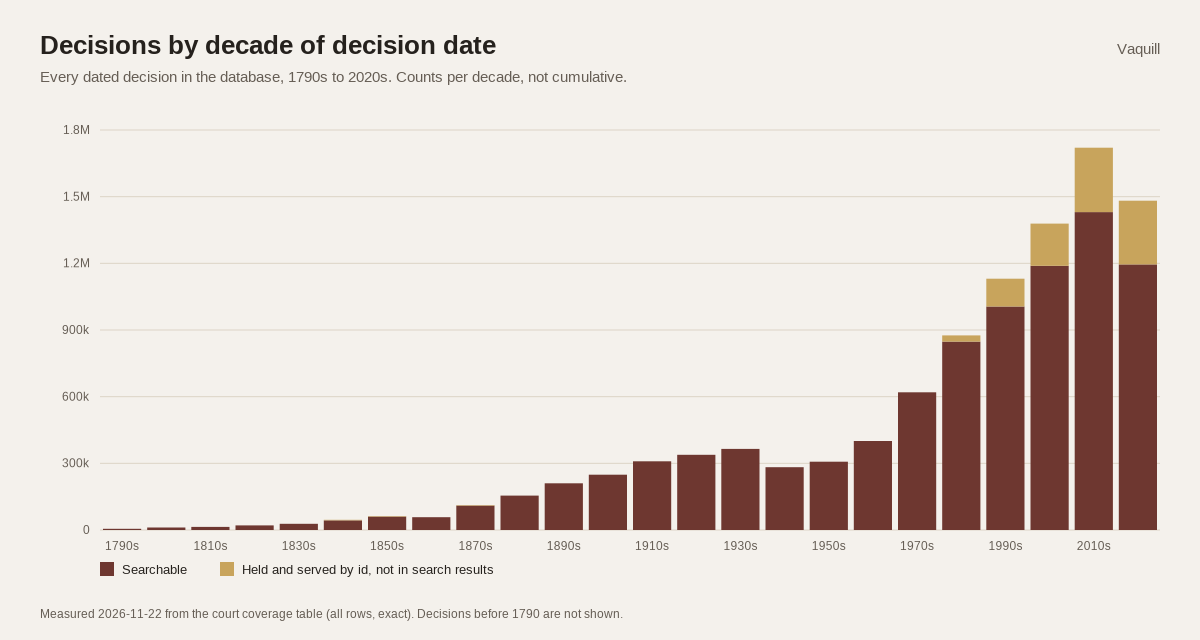
The chart splits every dated decision into those that search returns and those that are held and served by id.
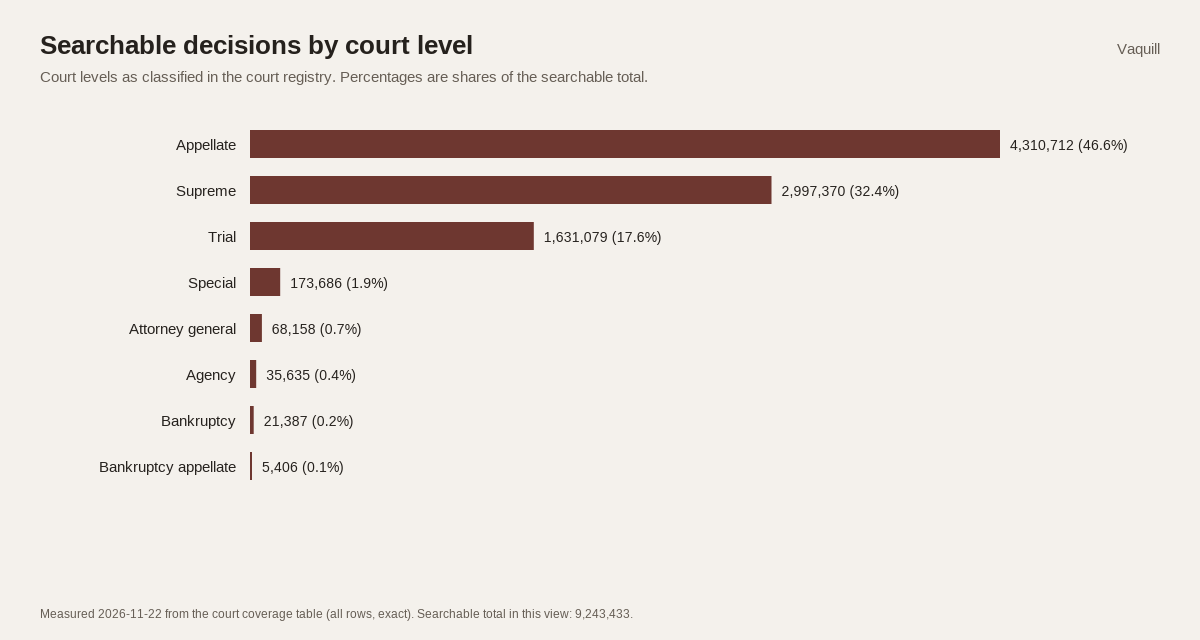
This chart counts searchable decisions only, so its total is a different measure from the case-record count on the coverage page and should not be compared with it. By court level, appellate and supreme courts hold most of the searchable decisions. Trial court decisions are 17.6% of what search returns, and the remainder is split across special courts, attorney general opinions, agencies and bankruptcy courts.
Field completeness, by court level
This is the central chart, because it carries a point averages hide: completeness depends on who wrote the decision.
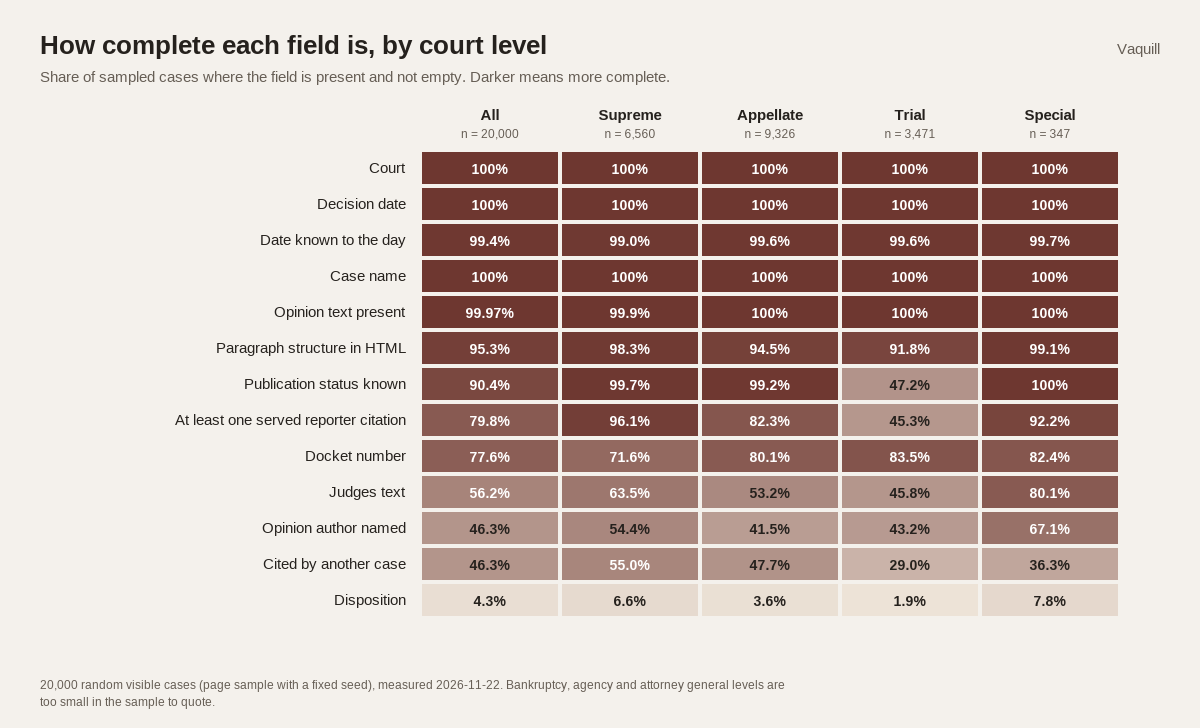
Rates over 20,000 random visible cases:
| Field | All | Supreme | Appellate | Trial |
|---|---|---|---|---|
| Court | 100.0% | 100.0% | 100.0% | 100.0% |
| Decision date | 100.0% | 100.0% | 100.0% | 100.0% |
| Date known to the day | 99.4% | 99.0% | 99.6% | 99.6% |
| Case name | 100.0% | 100.0% | 100.0% | 100.0% |
| Full case name | 71.8% | 88.2% | 67.3% | 50.9% |
| Docket number | 77.6% | 71.6% | 80.1% | 83.5% |
| Reporter citation served | 79.8% | 96.1% | 82.3% | 45.3% |
| Judges text | 56.2% | 63.5% | 53.2% | 45.8% |
| Opinion author | 46.3% | 54.4% | 41.5% | 43.2% |
| Counsel | 49.8% | 61.6% | 45.5% | 39.3% |
| Publication status known | 90.4% | 99.7% | 99.2% | 47.2% |
| Cited by another case | 46.3% | 55.0% | 47.7% | 29.0% |
Three readings of the table.
The identity fields are present everywhere we looked. Court, date and name are the fields every join and every citation depends on, and each rounds to 100.0% in the sample.
Citations track the court. A supreme court publishes a reporter citation for nearly every opinion: 96.1% here. A trial court usually does not: 45.3%.
The publication status column follows the same pattern, known for 99.7% of supreme court cases and 47.2% of trial court cases.
The practical result is that a district-court slip opinion often has no reporter citation in the data, so it will not resolve by citation.
On 23 November 2026, resolving 678 F. Supp. 3d 443, the reporter citation for the 2023 S.D.N.Y. sanctions opinion in Mata v. Avianca, returned not_found.
not_found means the data holds no case with that citation. It does not mean the case is fake.
For trial-court decisions, plan to look a case up by court, date, docket number or name instead of by reporter citation.
Descriptive fields are sparse by nature. Headmatter is present on 21.6% of cases, a summary on 13.4%, a posture on 7.1% and a syllabus on 2.5%. They exist where a court or a reporter wrote them. We store them when they exist and do not invent them when they do not.
Opinion text is the other half of a case, and is measured on its own sample. Of 20,000 random visible opinions, 99.9% have text. The median opinion is about 5,300 characters or about 900 words, and 90% are under about 26,700 characters. 95.3% of sampled cases carry paragraph structure in the text, so a reader or an extractor can split them.
Dockets are measured separately, over 20,000 random visible dockets: docket number 90.8%, case name 99.4%, date filed 74.5%, date terminated 57.6%.
Text integrity
Text can be present and still wrong.
We run detectors for specific defects, and a record that fails a check carries a qualityFlags entry, with a code, a severity and the detector version.
Codes are stable: a code is never renamed.
A block flag withholds the text and sets bodyUnavailable.
A warn flag serves the text and tells you.
An info flag says the text is usable and worth a look.
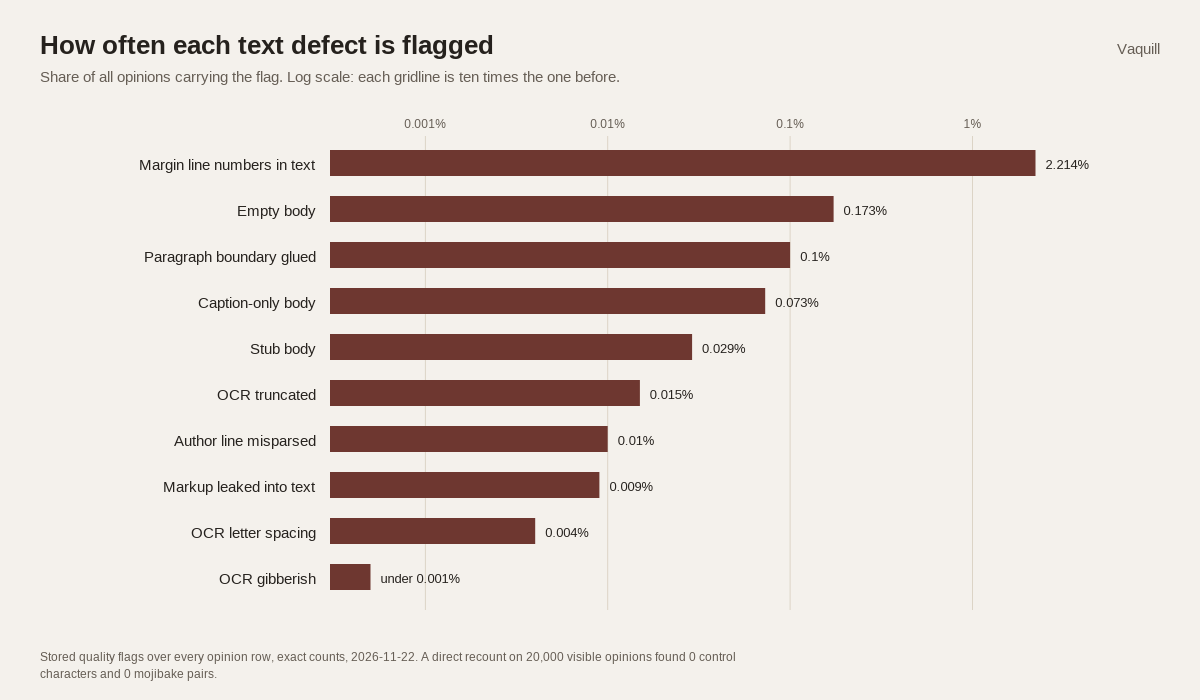
Flag counts are exact, over every stored opinion:
| Flag | Severity | Share of opinions |
|---|---|---|
Margin numbers in the text (pleading_line_numbers) | warn | 2.2% |
| Empty body | block | 0.17% |
| Block boundaries glued together | warn | 0.10% |
| Caption-only body | block | 0.07% |
| Stub body | block | 0.03% |
| OCR text cut off | warn | 0.015% |
| Error page stored as text | block | 0.015% |
| Shifted glyphs | block, warn | 0.013% |
| Stray control characters from OCR | warn | 0.002% |
| OCR gibberish | warn | 0.001% |
The block flags together add up to under 0.3% of stored opinions. That is a sum, so it is an upper bound: an opinion can carry more than one flag.
Our independent recount agrees from the other direction. In 20,000 sampled opinions there were no raw control characters in the text or the html, and no mojibake pairs of the kind that appear when text is decoded with the wrong character set. Three opinions held a Unicode replacement character, 0.015%.
OCR is disclosed. 47.9% of sampled opinions are marked textFromOcr.
That is a property of the source, and it is exposed on every opinion, so a pipeline can route OCR text through its own checks.
The honest takeaway from this section is the 2.2%. Margin numbers from line-numbered pleadings are the single most common defect, they are detected, and they are flagged, so you can filter or clean them.
The citation graph
A case is more useful with its neighbours. The graph links opinions to the opinions they cite, inside the corpus.
| Measure | Value | Sample |
|---|---|---|
| Opinions with at least one outgoing citation to a held opinion | 68.4% | 20,000 opinions |
| Outgoing citations per opinion | mean 7.0, median 3, 90th percentile 19 | 20,000 opinions |
| Cases cited by at least one other case | 46.3% | 20,000 cases |
| Cases with two or more reporter citations | 39.0% | 20,000 cases |
| Reporters seen across those citations | 466 | 20,000 cases |
citedByCount is the number of distinct other cases that cite one of a case's opinions.
It counts only citations that resolve to a case we hold, so it is a floor for the true number, and it grows as coverage grows.
As a plausibility check, the ten most cited cases in the database are all US Supreme Court decisions on the doctrines you would expect: civil pleading, summary judgment, ineffective assistance, habeas, section 1983 and Miranda.
Ashcroft v. Iqbal and Bell Atlantic v. Twombly head the list.
On 23 November 2026, citedByCount was 158,305 for Iqbal (556 U.S. 662) and 155,075 for Twombly (550 U.S. 544).
Parallel citations are a union. A citation added from one source is never removed or replaced by another, so a case's citation list only grows.
Provenance and change tracking
Quality over time depends on knowing where a value came from.
Each field has a ranked source order, so a weaker source cannot overwrite a stronger one. A stronger source replaces a body only when its text is at least as long, so a re-collect cannot quietly shorten an opinion.
These response fields let you see a record's history:
| Field | What it tells you |
|---|---|
decisionDatePrecision | Whether the date is known to the day, month or year |
firstSeenAt | When we first collected the record, when a collector found it |
sourcePublishedDate | The source's own publication date, when it differs |
addedAt, updatedAt | When the record entered and when it last changed here |
citeable | Whether a recorded court rule lets a lawyer cite this kind of decision. Guidance, not advice |
qualityFlags | The checks the record failed |
GET /us/cases/changes lists records added, changed or withdrawn since a cursor, with upsert and removed events.
A pipeline that keeps a local copy can stay in step, and can drop a record when it is withdrawn.
The change feed page has the shape.
What you can check yourself
Everything above can be re-run on a small scale with the public API.
- Call
POST /us/cases/searchwith acourtLeveland a broad query, and take the cases returned. - For each case, check which of the fields above are present, and read
qualityFlags. - Fetch the opinion with
GET /us/opinions/{opinionId}and compare the text with the court's own copy. - Read
GET /us/cases/{caseId}/citationsfor a landmark case and checkcitedByCountagainst what you expect.
If a record disagrees with its source, send us the caseId.
You join federal district-court decisions to a list of reporter citations and find that about half the cases have none. What is the right reading?
Limits, stated plainly
A quality page that lists no limits is a sales page. These are ours, as of 2026-11-22.
- Accuracy against the court's document is not yet published. The figures here measure completeness, integrity and traceability. A hand-checked gold set for the correctness comparison is built, and no result from it is published.
- Recency varies by court. A court that issues few published opinions looks old on a newest-decision measure. The coverage page is the place to read each court.
- Disposition and outcome are sparse. A raw disposition is on 4.3% of cases, and
outcomeis computed from it, so an outcome filter reaches a minority of decisions. - Docket numbers are present on 77.6% of cases, and on fewer attorney general opinions.
- Judge links are partial. An opinion author is linked to a judge record on 12.5% of opinions.
The numbers in this post will move. Collectors keep adding decisions, and text repairs change the counts, so the dated figures above are a snapshot and the coverage page is the live source. If you build on this data and your own sample disagrees with a number here, we want to hear it.
FAQ
How complete is the US case law data?
It depends on the field and the court. Court, decision date and case name are present on 100.0% of 20,000 sampled cases, and opinion text on 99.9% of 20,000 sampled opinions. Descriptive fields are sparser: a raw disposition is on 4.3% of cases and an opinion author on 46.3%.
Why do some trial-court cases have no reporter citation?
Trial courts usually do not publish a reporter citation. In the sample, one is served for 45.3% of trial-court cases, 82.3% of appellate and 96.1% of supreme-court cases. A missing citation does not make a case less real, so look a trial-court decision up by court, date, docket number or name.
What is a quality flag?
A flag is a record of a check the opinion failed. It has a code, a severity (info, warn or block) and a detector version. A block flag withholds the text and sets bodyUnavailable; a warn flag serves the text and tells you.
Does 99.9% text completeness mean the text matches the court's original?
No. These figures measure completeness, integrity and traceability. A hand-checked comparison against each court's own document is built, and no result from it is published yet.
How was the sample drawn?
20,000 visible cases, 20,000 visible opinions and 20,000 visible dockets, drawn by page sampling with a fixed seed and then shuffled, on 2026-11-22. Page sampling is clustered, so treat a rate as accurate to about a point.
What does citedByCount count?
The number of distinct other cases that cite one of the case's opinions. It counts only citations that resolve to a case the data holds, so it is a floor for the true count.
How do I keep a stored copy current?
Read the change feed with a cursor. It lists upsert and removed events, so a local copy can update a record or drop one that was withdrawn.
For US case law, statutes and regulations through one API key, see the US case law API.
New legal AI guides, weekly.
Further Reading
- Case Law MCP Server: Connect Claude to US Case Law
- Court Opinions as JSON: The Fields and a Working Fetch
- How to Find a Case by Its Citation (and Confirm It Is the Right One)
- Legal Connectors for Claude: Add Vaquill AI Primary Law
- ChatGPT Legal Research Plugin: Vaquill AI Primary Law
- How to Read a Case Citation, Piece by Piece (Real Example)

Co-Founder & CTO
Priyansh leads engineering and AI at Vaquill AI: the pipelines that pull statutes, regulations and court rules from every US jurisdiction's official publisher, and the REST API, MCP server and open dataset that serve them.