To negotiate a DPA, fight only the eight clauses where vendors actually move (sub-processor notice, audit rights, breach timeline, transfer mechanism, liability cap, data residency, deletion, and return-or-delete on exit), and walk in with three written positions for each: Best Case, Acceptable, and Walk-Away. Sign the vendor's template on everything else. The rest of this post is the ladder for all eight, a worked redline, and the GDPR anchors behind each ask.
The vendor's DPA lands in your inbox Tuesday afternoon with a sales note that says "this is our standard, no redlines accepted." By Friday, you are negotiating breach notification timelines on a Slack thread with a procurement lead who has never heard the word "controller" used as a noun.
The in-house counsel who win these negotiations do not win on raw legal skill. They walked in with a written playbook, benchmarked fallback positions on the eight clauses that actually move, and a willingness to lose the other thirty-five.
The most common in-house mistake I see is treating every clause as equally winnable. You spend three cycles fighting "personnel training" language while quietly accepting MSA-cap parity on data-breach liability. The trade was bad before you started.
A real playbook says ahead of time: on these eight, we fight; on the rest, we sign vendor template language and move on. The companion piece, the DPA review field guide, covers what to look for on a first read; this post covers what to do next.
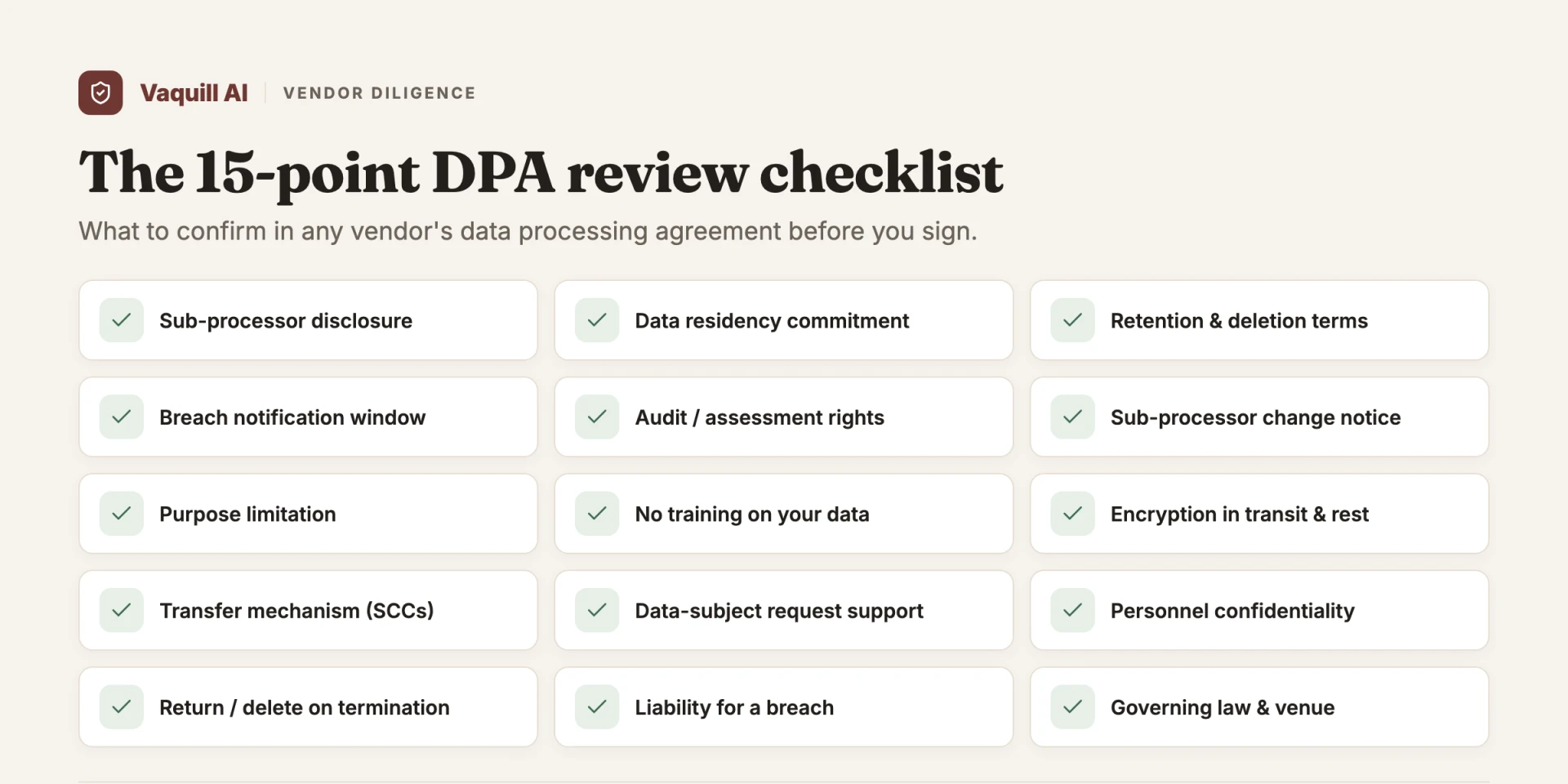
The 15 clauses to confirm in any vendor's data processing agreement before signing.
TL;DR
Part of our in-house counsel guide series.
- DPA negotiation in 2026 has eight high-leverage clauses where vendors actually move: sub-processor notification, audit rights, breach notification timeline, cross-border transfer mechanism, liability cap carve-out, data residency, retention and deletion, and termination return-or-delete. Most of the rest tracks GDPR Article 28's mandatory minima; it is negotiable in theory but rarely worth the cycles in practice.
- For each of the eight, walk in with three written positions: Best Case, Acceptable, Walk-Away. If you do not have the Walk-Away pre-committed, you do not have leverage; you have a wish list.
- The EU-US Data Privacy Framework (effective July 10, 2023) survived its first General Court annulment challenge in September 2025 (Latombe), but a Schrems III challenge has been publicly signaled. SCCs under Commission Implementing Decision 2021/914 remain the operational backbone for transfers no matter what happens next.
- The recent enforcement wave (Meta DPC €1.2B in 2023, LinkedIn €310M, Uber €290M, TikTok €530M, Google CNIL €325M, SHEIN €150M) shows the regulators' priorities clearly. Most of the largest fines involved cross-border transfers. Negotiate the transfer mechanism accordingly.
In a DPA breach-notification clause, which word does this playbook say is load-bearing?
Why this needs a playbook
A 200-person company signs 80 to 140 DPAs across the portfolio. Without a standardized negotiation position, each lawyer reinvents the redlines from a half-remembered last deal. Eighty vendors with "without undue delay" breach notification means no Sunday-night call you can make where someone is contractually on the hook for defined hours.
Sub-processor management is the operational killer. A vendor with 14 sub-processors onboards a new analytics tool with access to your end-user data. Three months later that sub-processor is in a regulator filing. With notice-only and no objection rights, you find out by reading the trade press.
IBM's 2024 Cost of a Data Breach Report put the average US breach at $9.36 million. The DPA decides whether that number lands on your P&L or the vendor's, and a playbook anchored to that number reads differently than one anchored to legacy "12-month-fees" thinking.
Pre-negotiation prep
Five questions, answered in writing, before the redlines start.
Data classification. Business-contact data sits at one risk tier. Customer PII at another. Regulated data (PHI, financial account, biometric, children's) at a third. A marketing-automation vendor for ungated content gets template terms; a vendor with access to PHI gets every clause fought.
Controller versus processor. For most SaaS deals, your company is the controller and the vendor is the processor. Resale flows, embedded analytics, AI-training data, and platform-of-platforms situations flip this. Get the answer in writing before you start the redline: the Article 28 cascade collapses if this is wrong.
Jurisdictional coverage. EEA users means GDPR. California consumers means CCPA as amended by CPRA. UK users means UK GDPR with its own transfer regime. The DPA has to satisfy every jurisdiction with a user, not just headquarters.
Sub-processor sensitivity. Will the vendor route data to an LLM provider, an offshore support team, or a hyperscaler region you do not control? LLM sub-processors require explicit zero-retention and no-training language. Offshore support triggers data residency.
BAA needed. If any PHI flows, you need a HIPAA Business Associate Agreement, not just a DPA. Knowing this before kickoff prevents three weeks of wasted negotiation on a vendor that cannot sign a BAA at all.
The eight clauses with three-level fallback positions
The structure on every one of these: what you ask for in the opening redline, what you can live with after one or two cycles, and the point at which you tell the business they need a different vendor.
Here is the whole ladder on one screen. Take the table into the call; the detail below it is the reasoning.
| Clause | Best Case (open here) | Acceptable (land here) | Walk-Away |
|---|---|---|---|
| Sub-processor notice | 30-day prior written consent | 14-day notice + object + partial termination | Notice-only, no objection; or object = terminate whole MSA |
| Audit rights | Annual on-site audit, 30 days' notice | SOC 2 Type II auto + written-questions + audit on cause | SOC 2 "on request," no extra rights |
| Breach timeline | 24h of becoming aware | 72h of becoming aware (not "confirmed") | "Without undue delay," no defined hours |
| Transfer mechanism | DPF on active list + SCCs as fallback | SCCs only, correct module, real annexes | None named, "applicable law," or Privacy Shield |
| Liability cap | Uncapped for DPA breach / Security Incident | 2x-5x fees super-cap, $1M-$10M floor, stacked | MSA-cap parity on data breach |
| Data residency | US-only, named region, terminate on change | US-only, no named region, written rep | "Globally distributed," no commitment |
| Retention/deletion | Delete in 30 days + certification | Delete in 60 days, cert on request | "Industry-standard," or analytics carve-out |
| Return-or-delete | 30-day extraction, your format, no fee | 30-day extraction, named format, capped fee | No provision, or vendor deletes immediately |
1. Sub-processor notification and change notice
- Best Case. 30-day prior written consent for any new sub-processor with access to personal data. The vendor cannot onboard until you sign.
- Acceptable. 14-day prior notification with right to object. If you object, the vendor does not onboard or you can terminate the affected service without penalty, pro-rata refund of pre-paid fees.
- Walk-Away. No objection rights, or objection that requires you to terminate the entire master agreement. A vendor that will not give you objection-with-partial-termination is telling you sub-processor management is not in their operational vocabulary.
The change-notice window is the part counsel skip. "Prior" notice means before the new sub-processor touches data, with enough lead time to actually object. A 14-day clock that starts when the vendor posts a change to a webpage you have to remember to check is not notice; insist on email to a named contact. For legal AI specifically, the sub-processor list is where the LLM providers hide, so read it line by line. The post on legal AI vendors with signed DPAs and US/EU hosting walks through what real vendor lists disclose about notice windows.
2. Audit rights
- Best Case. On-site audit by customer or designee, annual, with 30 days' notice. Cost on the customer unless the audit finds material non-compliance.
- Acceptable. SOC 2 Type II annual report furnished automatically, plus a written-questions right exercisable annually and on cause, plus a third-party audit right exercisable on a material security incident or regulator demand. That contingency framing is the unlock; most vendor counsel signs it within one cycle.
- Walk-Away. SOC 2 Type II "available on request" with no supplementary rights. A 2018 posture; if the vendor will not move off it for regulated data, the operational maturity is not there.
The written-questions right is where you actually do the diligence. Send the same standardized set to every vendor so answers compare across the portfolio. The vendor security questionnaire lays out the 47 questions worth asking, and the audit clause is what makes them contractually answerable.
3. Breach notification timeline
- Best Case. 24 hours of becoming aware of a Security Incident, with the full GDPR Article 33(3) disclosure set provided as it becomes available.
- Acceptable. 72 hours of becoming aware, matching GDPR Article 33's own clock on the controller. Important word: "aware," not "confirmed." Vendors will try to switch the word because confirmation hands them unilateral control of when the timer starts. Hold the line on "aware."
- Walk-Away. "Without undue delay" with no defined hours. California Civil Code §1798.82 already requires notice to affected consumers "in the most expedient time possible," and a vendor with no defined hours puts your company in violation by default.
4. Cross-border transfer mechanism
- Best Case. EU-US Data Privacy Framework certification (verified on the active list at dataprivacyframework.gov) plus SCCs under Commission Implementing Decision (EU) 2021/914 as a fallback, plus a vendor-completed transfer impact assessment for sensitive flows.
- Acceptable. SCCs only, with the correct module specified (Module 2 for C-to-P, Module 3 for P-to-P), importer and exporter annexes filled out with real information rather than "see Order Form."
- Walk-Away. No transfer mechanism named, "we comply with applicable law," or a Privacy Shield reference. After Schrems II (Case C-311/18, CJEU July 16, 2020), any vendor still hand-waving on transfers has not done the work.
5. Liability cap carve-out for data breach
- Best Case. Uncapped liability for the vendor's DPA breach or sub-processor failure leading to a Security Incident. Carve-out from the general MSA limitation.
- Acceptable. A super-cap of 2x to 5x annual fees for DPA breach and Security Incident liability, with a fixed floor of $1M to $10M depending on data sensitivity, carved out from the general MSA cap so it stacks on top.
- Walk-Away. MSA-cap parity on data breach. A vendor you pay $80,000 a year is then exposed for $80,000 if they lose your customer database. Not a serious number. For regulated-data deals, MSA-cap parity is a walk.
6. Data residency
- Best Case. US-only processing with a named region or regions (e.g., AWS us-east-1 and us-west-2), with vendor obligation to provide written notice and a right to terminate without penalty if the region changes.
- Acceptable. US-only processing without a specific region, with a contractual representation that data does not leave the US.
- Walk-Away. "Globally distributed processing" with no residency commitment. The clause that produces customer escalations 18 months later, when a healthcare customer realizes their PHI sat on a Frankfurt node for 90 days because the vendor scaled overnight.
7. Retention and deletion
- Best Case. Deletion within 30 days of termination, with written certification, plus backup-media deletion on a defined schedule (60 to 90 days).
- Acceptable. Deletion within 60 days, written certification on request, backup deletion on the vendor's standard schedule with an outside date in the DPA.
- Walk-Away. "Industry-standard retention" with no defined dates, or a retention carve-out for "analytics and product improvement." The analytics carve-out quietly retains your customer data forever under a different label.
8. Termination return-or-delete
- Best Case. 30-day extraction window, customer choice of format (CSV plus JSON or vendor-native), no fee, with vendor obligation to preserve readable state during the window.
- Acceptable. 30-day extraction with a named format and a one-time extraction fee capped at a specific dollar amount.
- Walk-Away. No termination provisions, or a vendor right to delete immediately. GDPR Article 28(3)(g) requires deletion or return at the controller's election; if the contract does not let you choose, it does not satisfy Article 28.
The Schrems II / Data Privacy Framework reality in 2026
Most in-house counsel are still working the transfer clause from 2021 playbooks. The current state, as of mid-2026:
The EU-US Data Privacy Framework took effect July 10, 2023, under Commission Implementing Decision (EU) 2023/1795. Vendors self-certify with the US Department of Commerce and appear on a public active list at dataprivacyframework.gov. The DPF survived an annulment action in the European General Court in 2025 (the Latombe case), with the court holding that on the date of adoption, the US ensured an adequate level of protection.
A further challenge is publicly being prepared. NOYB and Max Schrems have signaled a potential Schrems III action focused on post-2023 changes to US law and executive practice. The General Court's reasoning left the opening: it assessed the DPF only as it stood on July 10, 2023, so anything after that date is fair game.
Refusing to sign anything until the next CJEU decision is not a defensible posture to a business that needs to ship.
The contractual move is to name both: DPF certification verified on the active list, with SCCs under 2021/914 as an automatic fallback if the DPF is invalidated, suspended, or the vendor's certification lapses. Some vendors will try "DPF or SCCs at vendor's discretion." That hands the vendor a unilateral choice; you want both, with automatic failover.
Negotiation tactics that actually work
A few patterns that move vendor counsel. None are clever; all are about leverage.
Escalation path inside the vendor. Your first counterparty is a deal desk or contracts paralegal with template authority and a quota. The clauses you need moved require their general counsel to engage.
Ask for the GC by name early: "I have eight redlines, four of which need a brief call with your GC; can we get 30 minutes on the calendar." Most vendor deals stall because the customer never asks. Once the GCs are talking, the deal usually closes within two weeks.
Reciprocal commitments. Vendors say no to uncapped liability because it is a category position. They will sometimes say yes if you reciprocate on something that costs you nothing: a 30-day cure period for material breach, a written reference, a no-shop on a small RFP.
Competitor benchmarking. When the vendor says "no one in our category does better," you say "Vendor X gives us 3x super-cap on data breach and 24-hour notification, here is the redacted language." Their deal desk escalates; their GC has to decide whether they want to lose to Vendor X on paper terms. Most of the time, they move.
Competitor benchmarking is the single most underused tactic in DPA negotiation.
Cyber insurance backstop. When liability is the deadlock, the deal sometimes closes on the vendor showing proof of $10M to $50M of cyber liability coverage with you as additional insured. This shifts the conversation from contract liability (vendor GC owns it) to insurance (vendor risk team owns it), and risk teams are usually more flexible.
One redline cycle. Open with your full best-case redline, mark which clauses you will walk on, get to acceptable in one cycle. Redline four times and you train the vendor to keep negotiating: you lose the next deal too.
A sample fallback ladder from a real mid-market SaaS deal in 2026, on breach notification:
- Opening (us): "Vendor shall notify Customer within 24 hours of becoming aware of any Security Incident affecting Personal Data, including the Article 33(3) information set as it becomes available."
- Vendor first response: "Vendor shall notify Customer without undue delay following confirmation."
- Our counter: "within 72 hours of becoming aware (not confirming), with the Article 33(3) elements provided as they become available."
- Vendor concession: signed on 72 hours of becoming aware, declined the Article 33(3) callout.
- What landed: 72 hours of becoming aware. We lost the Article 33(3) checklist but kept the trigger we needed for our own GDPR clock.
That is what a one-cycle win looks like. We gave up the secondary ask. We kept the primary one. Sales closed.
Recent enforcement: what regulators are punishing
The public enforcement record (per the EDPB and the CMS GDPR Enforcement Tracker) tells you which DPA clauses matter most.
The Irish DPC's €1.2 billion fine against Meta Platforms Ireland in May 2023, for unlawful US transfers under SCCs without adequate supplementary measures, remains the largest GDPR fine to date. The lesson is the bundle: transfer mechanism plus transfer impact assessment plus supplementary measures all belong in the DPA. Writing only the first part does not insulate anyone.
Other widely reported actions: the Dutch DPA's roughly €290 million fine against Uber for transferring European drivers' data to the US without an adequate mechanism; the Irish DPC's €310 million fine against LinkedIn for unlawful processing for behavioral analysis and targeted advertising; a reported €530 million action against TikTok for unlawful transfers of EEA user data to China; and France's CNIL imposing fines in the €150 million to €325 million range on Google and SHEIN in cookie and advertising-tech matters.
Cross-border transfer, sub-processor management, and lawful-basis flowdowns are where most of the money is going.
CCPA enforcement under the California Privacy Protection Agency is smaller in absolute numbers but increasingly active on service-provider contract language. State AG offices in Texas, Connecticut, and Colorado have opened privacy investigations that turn on DPA-style contractual representations.
Negotiate the transfer mechanism and the sub-processor clause like the regulators care, because they do. If the deal hits the news, it will hit on one of those two.
FAQ
How do you negotiate a data processing agreement?
Pick the clauses that move and ignore the rest. Most of a DPA repeats GDPR Article 28's mandatory minima, so fighting those wastes cycles. Concentrate redlines on the eight high-leverage clauses (sub-processor notice, audit rights, breach timeline, transfer mechanism, liability cap, data residency, deletion, and return-or-delete), and bring a written Best Case, Acceptable, and Walk-Away position for each. Open with your full redline, mark what you will walk on, and aim to land in one cycle.
What are the most important clauses in a DPA to negotiate?
The liability cap carve-out and the breach notification timeline carry the most risk, with sub-processor notice and the cross-border transfer mechanism close behind. The liability clause decides whether a breach lands on your P&L or the vendor's, and the transfer mechanism is where most of the largest GDPR fines have been imposed. Audit rights, data residency, retention/deletion, and return-or-delete round out the eight worth fighting.
Can you redline a vendor's "standard" DPA?
Yes. "No redlines accepted" is a deal-desk default, not a real position. The clauses you need moved almost always require the vendor's general counsel to engage, so ask for the GC by name early and bring the two or three changes that actually matter. Once the GCs are talking, most deals close within two weeks.
What breach notification timeline should a DPA require?
Ask for 24 hours of becoming aware; accept 72 hours of becoming aware. The load-bearing word is "aware," not "confirmed," because confirmation hands the vendor unilateral control of when the clock starts. "Without undue delay" with no defined hours is a walk for any deal involving regulated or consumer data.
Should DPA liability be capped at the same level as the master agreement?
No, not for a data breach. MSA-cap parity means a vendor you pay $80,000 a year is exposed for $80,000 if they lose your customer database, which does not cover regulatory fines, class actions, and remediation. Push for an uncapped carve-out, or a 2x to 5x super-cap with a fixed floor that stacks on top of the general MSA cap.
Are SCCs or the Data Privacy Framework the right transfer mechanism in 2026?
Name both. Require Data Privacy Framework certification verified on the active list at dataprivacyframework.gov, with SCCs under Commission Implementing Decision (EU) 2021/914 as an automatic fallback if the DPF is invalidated, suspended, or the vendor's certification lapses. Do not accept "DPF or SCCs at vendor's discretion," which hands the vendor a unilateral choice.
What is the difference between a DPA and a BAA?
A DPA governs controller-to-processor obligations under privacy laws like GDPR and CCPA. A Business Associate Agreement is the HIPAA-specific contract required whenever protected health information flows to a vendor. If any PHI is involved you need a BAA, and confirming the vendor can sign one before kickoff prevents weeks of wasted negotiation.
How long should a DPA negotiation take?
A clean one-cycle negotiation closes in two to three weeks once the right people are on it. The delay is almost never the legal substance; it is the escalation path. Open with the full redline, flag the two to four clauses that need the vendor's GC, and request a short call rather than trading documents four times.
Closing
DPA negotiation is the work that decides whether the next regulator letter lands on the vendor's risk team or yours.
A written playbook with three-level fallback positions on the eight high-leverage clauses, anchored to GDPR Articles 28, 32, 33, and 37 and to the recent enforcement record, lets the lawyer signing vendor 119 of 140 fight the same fights as the lawyer who signed vendor 3. Build it once, reuse it 140 times.
Vaquill AI is built for exactly this: saved negotiation playbooks hold your three-level fallback positions so every vendor DPA gets fought the same way, and Document Matrix runs the eight-clause check across the whole stack at once.
Want your DPA fallback positions saved once and reused on every vendor? Start a free Vaquill AI trial, or see how negotiation playbooks work.
New legal AI guides, weekly.
Further Reading
DPA Review Field Guide for In-House Counsel
Read postAI Contract Negotiation (2026): How In-House Teams Negotiate Faster
Read postWhat Vaquill AI Can Actually Do: Agentic Workflows, Verification Depth, and Open Benchmarks
Read postLegal AI in Microsoft Word: Contract Review, Redlining, and Research in a Word Add-In
Read postLegal AI Word Add-Ins Compared: 14 Tools, Features, and Pricing (2026)
Read postHow to Build a Litigation Chronology From Documents With AI
Read post
Co-Founder & CEO · Attorney
Arshita leads product and strategy at Vaquill, building the legal AI suite that solo, small-firm, and in-house US lawyers use to run a matter end to end.