Perplexity is useful to a lawyer as a starting point and dangerous as a finish line. It is a research and answer engine: it searches the live web, writes a summary, and footnotes the pages it pulled from. The cleanest way to classify it is as discovery-layer search, not authority-layer research. It helps you find and frame public information fast. It does not give you authority you can file, because its citations point to web pages, not to controlling reporters or codes. It can also surface law that is wrong, out of date, or from the wrong jurisdiction, with the same confident tone either way. Treat it as a faster Google with footnotes, never as a citation you can file. This is general information, not legal advice. Last updated: June 2026.
TL;DR
- Perplexity is discovery-layer search, not authority-layer research. It retrieves and cites real web pages, so for public topics it genuinely helps you orient. The cited interface is also why lawyers mistake it for cite-ready work.
- Its citations point to web pages, not primary law. A footnote to a blog or a news article is not the same as the statute, the regulation, or the reporter that controls.
- Having sources is not the same as being right. Perplexity can pull an outdated rule, the wrong state, or a secondary summary that misstates the holding, and present it cleanly.
- A cite from Perplexity is a lead, not authority. Verify every proposition against the primary source before you rely on it, and never quote its footnote as your cite.
- Confidential facts in a query leave your control. On standard tiers your inputs can be used to train models unless you opt out, so do not paste client matters.
- Use it for the front of the research, then leave. Background reading, finding starting sources, plain-English explainers: yes. Citing law in a brief: no.
Per this post, what do Perplexity's footnotes actually point to?
What Perplexity actually is
Perplexity is an answer engine. You ask a question in plain language. It runs a web search, reads the top results, and writes a synthesized answer. Numbered footnotes link back to the pages it used. Pro and Enterprise plans add more search depth and access to larger models, per Perplexity's own product pages (checked June 2026).
This is a real difference from a plain chatbot. A general model like ChatGPT or Claude predicts text from memory, which is why it invents citations. Perplexity grounds its answer in pages it actually fetched. For public, general questions, that grounding is a genuine advantage.
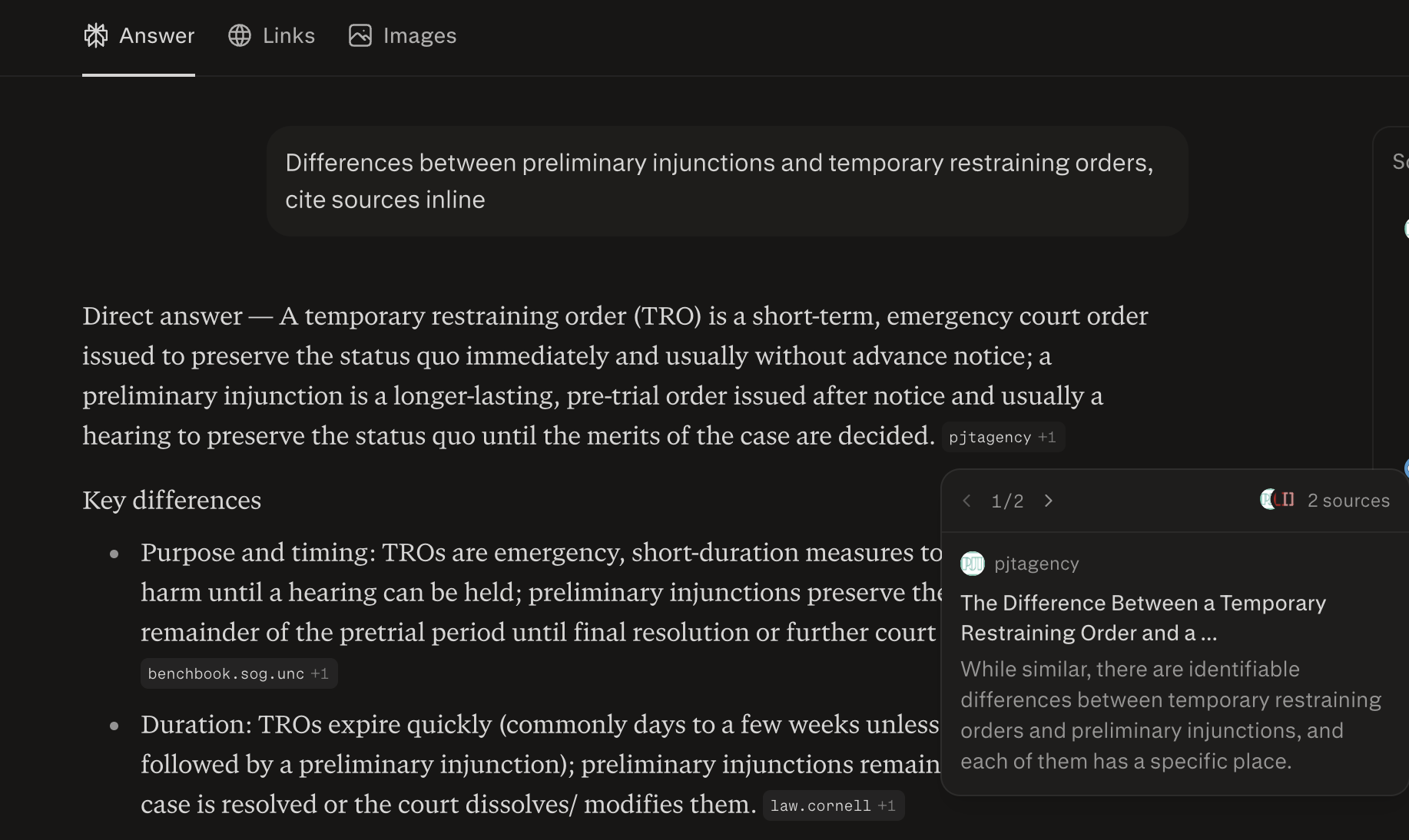
The trap is what those footnotes point to. A footnote can be a law firm blog, a Wikipedia entry, a news write-up, or a marketing page. None of those is the statute or the opinion itself. For a lawyer, the source you can file is the primary one, and that is the layer Perplexity skips.
Where Perplexity helps a lawyer
These are the tasks where the verification burden is low and the speed is worth it.
- Background research on a public topic. Getting oriented in an unfamiliar area or building a mental map before you do real research.
- Finding starting sources. It surfaces articles, agency pages, and explainers fast. Treat each one as a lead to chase, not an answer.
- Plain-English explainers. Asking what a doctrine means or how a process generally works, so you can frame the question you will then research properly.
- Drafting on facts and law you supply. Like any model, it can structure a memo or rewrite a passage when you provide the substance and verify the output.
Where Perplexity fails a lawyer
The failure modes cluster around exactly the work that ends up in front of a court or a client.
Citations point to web pages, not authority
A footnote to a secondary source is not a cite you can file. The page might summarize the law correctly, or it might not. Either way, the controlling text is the statute or the opinion, and you still have to go read it. The footnote saves you a search step; it does not give you authority.
It can surface wrong or outdated law
The web is full of stale and regional content. Perplexity can pull a rule that changed last year, a holding that was later reversed, or a standard that is true in one state and wrong in another. It will write all of it in the same calm, sourced-looking voice.
It does not know your jurisdiction
Ask a bare question and you may get an answer blended across states and federal law. The footnotes look tidy, but a link does not tell you whether the source is authoritative, current, or applies where your matter lives. That judgment is yours to make, and Perplexity will not make it for you.
Sources create false confidence
The deeper risk is psychological. The interface nudges you to read "has sources" as "is correct." As one practitioner put it, a cited answer is not the same thing as a defensible answer (Stephen Smith, 2026). Search tools find. Lawyers decide.
This is where the discovery-versus-authority frame earns its keep. Discovery-layer tools help you locate public information. Authority-layer research is where you stand behind a proposition with controlling primary law. Lawyers confuse the two because the footnoted interface makes a secondary source look cite-ready. The footnote signals rigor, so the brain skips the check on whether the source is primary, current, and on point. Keep the layers separate on purpose: orient in discovery, then move to authority before you rely on anything.
Good fit vs poor fit
| Task | Fit | Why |
|---|---|---|
| Background research on a public topic | Good | Fast orientation, low stakes, easy to verify later |
| Finding starting sources to chase | Good | Surfaces threads to pull; you verify each one |
| Plain-English explainers of a concept | Good | Helps you frame the real question |
| Citing law in a brief or memo | Poor | Footnotes are web pages, not authority you can file |
| Jurisdiction-specific authority | Poor | Blends states and years; does not know your forum |
| Confidential matter facts in the query | Poor | Inputs can leave your control and train models |
| Confirming a holding or statutory text | Poor | You must read the primary source regardless |
A quick test: what Perplexity returns and what you still verify
Two sample queries show the pattern. Run them yourself and the gap between discovery and authority gets concrete.
Query one: "What is the statute of limitations for breach of written contract in California?" Perplexity will usually answer four years and footnote a mix: a couple of law firm blogs, maybe an explainer site, and sometimes a link to the code section itself. The four-year answer happens to be right today. The sources are the problem. A blog is not authority, and the one statute link may be a stale mirror, not the current official text.
What you still verify here: open California Code of Civil Procedure section 337 in the official code. Confirm the four-year period and its current language. Then check that nothing in your facts (a tolling agreement, a different contract type) changes the analysis. Cite section 337, never the blog Perplexity surfaced.
Query two: "Are non-compete agreements enforceable?" This is the dangerous shape. Perplexity will write a confident national summary, footnoted to news articles and firm explainers, blending the FTC's rulemaking saga with state-by-state rules. The answer reads clean and is useless as authority, because enforceability turns entirely on your jurisdiction and the current state of any federal action.
What you still verify here: pin the jurisdiction yourself, then check that state's actual statute and recent case law, plus the live status of any federal rule, against primary sources. Perplexity gave you a map of the topic. It did not tell you the law where your matter sits.
The lesson holds across queries. Perplexity is reliable at returning real sources and a plausible synthesis. It is unreliable at three things a lawyer cannot skip: jurisdiction, currency, and whether the source is primary authority. Those three checks are the whole job, and they live in the authority layer, not the answer box.
How its data handling works
Confidentiality is the other reason to be careful. Perplexity's consumer tiers (Free, Pro, Max) carry an AI data retention toggle in account settings. It is on by default. So your queries can be used to improve its models unless you turn it off (per Perplexity's settings and help docs, checked June 2026). The toggle is partial: it governs future data, not anything already used. Enterprise Pro is the business contract. There Perplexity states it does not train on your data and offers zero data retention. Confirm the current terms yourself, since vendor policies change.
That pattern rhymes with the other tools, with one wrinkle. ChatGPT consumer tiers may train on inputs unless you opt out, while OpenAI Team and Enterprise do not by default. Claude's consumer tiers train on chats by default after an August 2025 change unless you opt out, while Anthropic's commercial tiers do not. Perplexity adds a second exposure path the chat tools do not: your query also becomes a live web search and routes to third-party model hosts. So the consumer-versus-business split applies, plus an extra surface.
For a lawyer, the practical rule is simple. Do not paste client names, facts, or matter details into a consumer Perplexity account. Strip or anonymize anything identifying, or keep the query generic and public. The full confidentiality deep-dive, including the third-party routing and the opt-out mechanics, is in is Perplexity private for legal work. For where your inputs travel across any tool, see where your legal AI data actually goes.
ABA Formal Opinion 512 ties this back to your duties: understand how the tool handles data, get informed client consent before entering confidences, and verify every output. We walk through it in plain English in the ABA Formal Opinion 512 guide. Check your state bar too, since some have their own guidance.
Use it safely as a lawyer: a checklist
- Keep the query public and generic. No client names, no matter facts, nothing privileged. If you would not post it on a forum, do not paste it here.
- Treat every footnote as a lead, not a cite. Open the source. Confirm it is the primary authority and that it is current.
- Verify every legal proposition against the primary source. The statute, the regulation, or the opinion itself, never the Perplexity summary.
- Confirm the jurisdiction. State the forum in your query, then re-check that the authority actually applies there.
- Never paste its footnote into your document as your authority. Cite the primary source you verified yourself.
- Use it at the front of the work and leave. Orientation, starting sources, framing. Hand the real research to a grounded tool or do it against primary law.
Several practitioner write-ups land in the same place: Perplexity is strong for orientation and synthesis, and unsuitable for filing-ready work without independent verification (Spellbook, 2026).
The verdict
Perplexity is a strong starting point and a terrible finish line. It is the best of the general tools for the discovery layer, because it actually retrieves and footnotes instead of guessing. But discovery is not authority. Its footnotes point to the open web, it does not know your jurisdiction, and it can serve stale or wrong law with total composure. The honest mental model is a faster Google with footnotes. Use it to get smart enough to ask the right question, then move to the authority layer and verify the answer against primary law before you file a word.
The authority layer is where a purpose-built tool earns its keep: retrieval over real US opinions and statutes, so each citation links back to a source you can open and read. Vaquill AI is a legal AI suite for in-house counsel built on that layer. Our public API is statutes-only (US Code, CFR, and 50-state codes), and case-law research lives inside the product. For a fuller roundup, see our best legal AI tools for in-house counsel. For the other general assistants, see our guides on ChatGPT for lawyers and Claude for legal work.
FAQ
Is Perplexity good for legal research? It is good for the front of legal research, not the whole job. It helps you orient on public topics and find starting sources fast. It is not a substitute for primary-law research, because its citations point to web pages, not to the statutes, regulations, or reporters that control.
Can I cite a source Perplexity gives me? Not the Perplexity footnote itself. Treat it as a lead. Open the page, find the primary authority behind it, confirm that authority is current and applies to your jurisdiction, then cite the primary source you verified yourself.
Does Perplexity hallucinate like ChatGPT? Less often on the existence of sources, because it retrieves real pages instead of inventing them. But it can still summarize a source wrong, pull outdated or out-of-jurisdiction law, and present it confidently. Verify the substance, not just that a link exists.
Is Perplexity confidential enough for client matters? Not on standard tiers by default. Your inputs can be used to improve its models unless you opt out, so do not paste client facts. Its Enterprise tier advertises stronger data governance, but confirm the current terms and your duties under ABA Formal Opinion 512 before trusting it with anything sensitive.
Perplexity vs ChatGPT or Claude for lawyers? Perplexity is the better orientation tool because it cites the web pages it read. ChatGPT and Claude are better drafting assistants when you supply the facts and law. None of the three is a source of authority you can file. See our ChatGPT for lawyers and Claude for legal work guides for the drafting side.
Does Perplexity access Westlaw or LexisNexis? No. It searches the public web. It does not have access to subscription legal databases, so its citations require verification against primary legal sources before you can use them.
What is the single biggest risk for a lawyer using Perplexity? Confusing discovery-layer search with authority-layer research. The footnoted interface makes a secondary source look cite-ready, so a sourced answer feels verified when it is not. A link does not tell you whether the source is primary, current, or right for your forum. That judgment stays with you.
How should a lawyer use Perplexity safely? Keep queries public and generic, use it only to orient and find leads, verify every proposition against the primary source, confirm the jurisdiction, and never paste its footnote into a document as your cite. Use it at the front of the work, then leave.
New legal AI guides, weekly.
Further Reading

Co-Founder & CEO · Attorney
Arshita leads product and strategy at Vaquill, building the legal AI suite that solo, small-firm, and in-house US lawyers use to run a matter end to end.