Spellbook does not publish a price. You book a demo to get a quote, and the number depends on your seat count and tier. The reported figure is roughly $500 per user per month (about $6,000 per user per year), almost always on an annual commitment. That is the figure our pricing benchmark uses, not Spellbook's posted rate card.
If your team drafts and reviews contracts inside Microsoft Word all week, Spellbook is a strong fit and the seat price is defensible. If you also need legal research, citation checks, or a place to keep the matter after signature, the Word-only design is the constraint to budget around. The full breakdown follows.
TL;DR
- Spellbook is sales-gated. Its own pricing page lists no dollar figure and routes you to a demo (spellbook.com/pricing, checked June 2026). You get the number only after a quote.
- Reported price: roughly $500 per user per month. That is about $6,000 per user per year, the figure our pricing benchmark uses. Lower third-party tier estimates exist but conflict and stay unverified.
- Annual commitment is standard. Monthly billing reportedly adds about 20 percent, and a minimum commitment can apply before a real pilot (Bind, May 2026).
- It is Word-only. Spellbook lives in a Microsoft Word add-in. No research engine, no citation check, no matter management, no public API.
- The real cost is fit, not the sticker. A contract-heavy deal team gets clear value. A general in-house team pays for one job and still needs other tools.
What is the reported per-seat price for Spellbook?
For the full grid across nine tools, see the legal AI pricing benchmark.
How Spellbook prices
Spellbook prices per seat, by the number of team members on the license, and it does not post the number. Its pricing page says so plainly: "Pricing is determined by the number of team members on a license. Book a demo to talk through your team's needs and we will provide customized pricing" (spellbook.com/pricing, checked June 2026).
That means there is no rate card to read off a page. You request a demo, talk through your team size and use case, then get a quote at the end. The page does confirm a 7-day free trial.
Because the price is gated, the figures circulating online come from pricing trackers and buyer reports, not from Spellbook. The reported number we use is roughly $500 per user per month, on an annual commitment. Here is how that compares with the official page and the conflicting low estimates, all checked June 2026.
| Source | Reported per-seat price | Confidence |
|---|---|---|
| Our pricing benchmark (buyer-reported) | ~$500/user/mo base | MEDIUM |
| Official Spellbook pricing page | No number listed | HIGH (no price) |
| Low third-party tier estimates (Bind, AI Vortex) | Materially below the buyer-reported base | LOW (unverified, conflicting) |
How these figures were sourced
The number we lead with, roughly $500 per user per month, is buyer-reported and is the figure our cross-tool pricing benchmark carries. It rates MEDIUM, since it reflects real buyer accounts rather than a posted rate card.
The official Spellbook pricing page (checked June 2026) lists no dollar figure at all. So the strongest source confirms only that the price is gated, not what it is.
Some third-party trackers publish materially lower tiered estimates (Bind, May 22, 2026; AI Vortex, May 19, 2026). We could not verify those, and they conflict with each other and with buyer accounts. So we treat them as LOW-confidence and use ~$500 per user per month instead.
What is included in a Spellbook seat
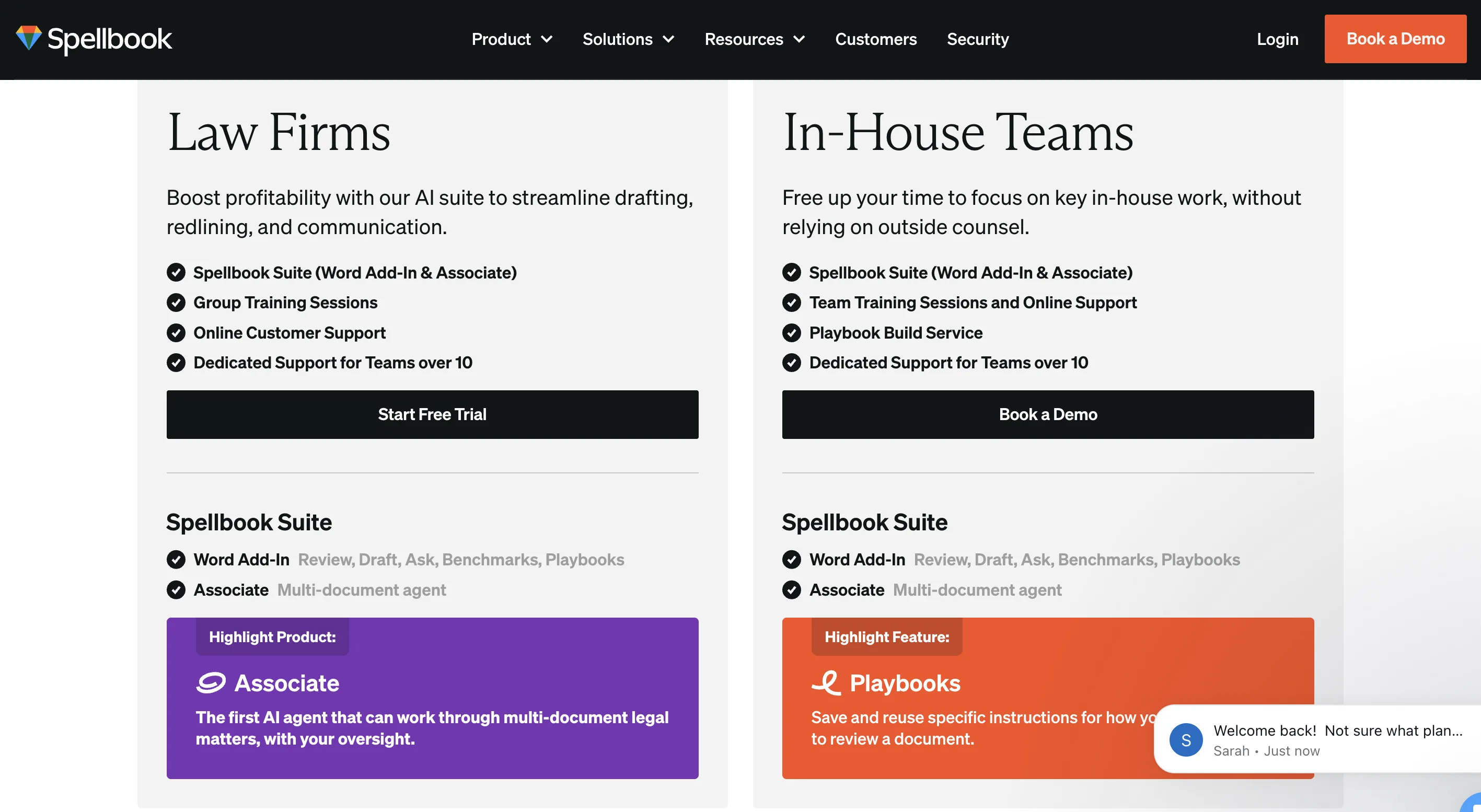
A Spellbook seat is contract drafting and review inside Word. Here is what that covers, based on Spellbook's own product pages (spellbook.com, checked June 2026).
- The Word add-in. A side panel next to your document that drafts clauses, suggests redlines on track changes, and answers questions about the contract you have open.
- Playbooks. You encode your clause standards, and Spellbook flags where a draft deviates from them.
- Benchmarks. Clause-level market data, so you can see how a term compares to common practice.
- Spellbook Associate. A multi-document agent for larger drafting and review tasks across files, sold within the Spellbook Suite.
That is a tight, deep product for one job. The catch is the boundary of that job, which the next section covers.
The Word-only constraint and what it means for your budget
Spellbook only runs inside Microsoft Word. That single design choice shapes the whole budget question.
If your team already drafts in Word, the add-in is frictionless. There is no new app to learn, and the AI sits where the work already happens. For a deal team, that is the selling point.
But the seat does one job. It does not do legal research, it does not check citations, and it does not store or organize matters after the contract is signed. There is no public API to wire it into other systems.
Here is the call I would make. At about $500 a seat and Word-only, Spellbook is a drafting tool you bolt onto Word, not a department platform. So you still pay for research, citation checking, and matter storage somewhere else. The honest budget line is "Spellbook plus the rest of the stack," never the Spellbook quote on its own. Any team comparing it to a full suite should add those other subscriptions back in first.
The hidden costs behind the seat price
The quoted seat is the start of the bill, not the end. Four costs hide behind it, all reported by named trackers in 2026.
- Annual commitment. The standard contract is yearly. Monthly billing is reportedly available at about a 20 percent uplift (Bind and AI Vortex, May 2026). So the cheap-looking monthly number is the expensive one.
- Minimum commitment. A minimum term is reportedly required before you can really pilot it, in the range of 6 months (Bind, May 2026). A short test is not always on the table.
- Seat minimums. Team and larger plans reportedly start at a floor near 10 seats (AI Vortex, May 2026). A five-person team that buys ten seats pays for five empty chairs.
- Renewal uplift. Trackers report customers seeing materially higher quotes at renewal after a late-2025 price change (Bind, May 2026). Year-2 is where an affordable Year-1 quote can catch up.
None of these is exotic. They are the standard levers of a sales-gated contract. My view: the seat minimum is the one that hurts most, because it bills you for chairs no one sits in. Price every one of these in before the demo, not after you have signed.
How to budget and negotiate a Spellbook quote
Treat the demo as a negotiation, because the price is set in it. Get these in writing before you sign.
- The all-in per-seat number for your exact seat count. Not a tier name, the dollar figure for the seats you will actually use.
- The minimum committed quantity. If the order form says 10 licensed users and you have 5 lawyers, you are paying for 10. Push to match it to headcount.
- The term and the cancellation window. Annual auto-renew is the default. Ask for the term length and how to exit before it renews.
- A written renewal cap. Ask for a cap in the 5 to 7 percent range, in the order form, not the email thread. This is the line that protects Year-2.
Fight hardest on the seat minimum, and treat it as a deal-breaker. It costs you the most, and it is the line most often set above your real headcount. Get the licensed-user count matched to the lawyers who will log in, in writing. If they will not move it, walk. The per-seat rate is the easy concession, so spend it last. Reps discount the seat or add months for an annual signature, because the term protects their renewal. Trade a longer term for a lower seat price, never for a seat floor you cannot fill.
One more lever. Convert the quote to cost per active lawyer per year before you compare it to anything. Multiply the seat by the seat minimum, not your headcount, then divide by the lawyers who will actually log in. The worked scenario below shows why that number bites.
A five-lawyer team against the seat minimum
Take a five-lawyer in-house team quoted the reported rate. Say the seat lands at $500 per user per month on a 10-seat minimum and an annual commit. Here is the math the sticker hides.
| Line item | Value |
|---|---|
| Reported per-seat rate | ~$500/mo (buyer-reported) |
| Seats you must buy | 10 (typical floor) |
| Lawyers who log in | 5 |
| Annual license | ~$60,000 (10 x $500 x 12) |
| Cost per active lawyer | ~$12,000/yr |
| Empty-seat waste | ~$30,000/yr (5 unused seats) |
The seat rate looks like $500. The real number per working lawyer is about $1,000 a month, because half the seats sit empty. The seat minimum, not the rate, is what doubles your cost here. These figures use the buyer-reported rate, not a posted Spellbook price. The pricing benchmark runs the same math across nine tools.
The real cost of a Word-add-in stack
Here is the analysis most buyers skip. A Word-add-in drafting tool is one line item. But a working in-house team also pays for legal research, citation and authority checking, and matter document storage somewhere. Those costs do not vanish because Spellbook does not include them. They just land on other invoices.
So the fair number is not the Spellbook quote. It is the whole stack a five-lawyer team actually runs for a year. The table below is illustrative. The non-Spellbook ranges are common market bands, not quotes, and are marked illustrative on purpose.
| Stack line item | Illustrative annual cost (5 lawyers) | Note |
|---|---|---|
| Spellbook drafting (Word add-in) | ~$60,000 | 10-seat minimum x ~$500/mo (buyer-reported) |
| Legal research subscription | ~$15,000 to $30,000 (illustrative) | Per-seat research platform, 5 seats |
| Citation / authority checking | ~$5,000 to $10,000 (illustrative) | Verify a case is still good law |
| Matter / document storage | ~$3,000 to $6,000 (illustrative) | Keep the contract after signature |
| Combined stack total | ~$83,000 to $106,000 (illustrative) | Spellbook plus the rest |
| Effective per active lawyer | ~$16,600 to $21,200/yr (illustrative) | Combined total divided by 5 |
The illustrative ranges are market-typical bands, not vendor quotes, and your real numbers will differ. The point is the structure, not the cents. Spellbook is roughly half to two-thirds of this stack, and the rest is the work it does not do.
This is the comparison error to avoid. When you put Spellbook's quote next to an all-in-one suite, you are comparing a part to a whole. Add the research, citation, and storage lines back in first. Otherwise the add-in looks cheaper than it is, because three of its costs are sitting on other bills. Run the all-in number on both sides, then decide.
Who Spellbook fits, and who needs more
Price is half the call. Fit is the other half, and Spellbook fits a specific shape of team.
Spellbook fits Word-heavy drafting teams. Deal counsel and small-to-mid in-house contract teams who live in Microsoft Word all week get clear value. The redlines, playbooks, and benchmarks are polished, and the seat price clears its bar fast when contract review is most of the job. If that is your week, Spellbook is a reasonable buy at the reported rate.
It does not fit teams that need the rest of the stack. If your work spans legal research, citation checks across cases and statutes, or keeping the matter organized long after signature, a Word add-in covers one slice and leaves the rest. A litigation shop, a cross-border team, or a general in-house department buying one tool will find the boundary quickly.
For the wider field, see the best Spellbook alternatives for who each rival fits and the honest Spellbook review for the feature-level verdict.
This is where a suite changes the math. If your team needs drafting plus research plus a home for the matter, paying for one tool that does all three can beat stacking a Word add-in next to two other subscriptions. The suite tier sells exactly that trade at flat, published, self-serve per-seat pricing. What it gives up is the deeper Word-native drafting surface Spellbook is built around, which is the whole reason a transactional desk buys Spellbook in the first place.
FAQ
How much does Spellbook cost per user? Spellbook does not publish a price, so there is no official per-user figure. The reported rate is roughly $500 per user per month, about $6,000 per user per year, on an annual commitment. Some third-party trackers list lower tiers, but those are unverified and conflict, so we use the buyer-reported $500 figure.
Does Spellbook publish its pricing? No. Its pricing page lists no dollar amount and routes you to book a demo for a custom quote based on your team size (spellbook.com/pricing, checked June 2026). Any specific number you see online is a tracker's estimate, not Spellbook's rate card.
Is Spellbook billed monthly or annually? Annual commitment is the standard contract. Monthly billing is reportedly available at about a 20 percent uplift, so the monthly option costs more over a year (Bind, May 2026). Read the term and renewal lines on the order form before you sign.
Is there a seat minimum or a minimum commitment? Trackers report a seat floor near 10 on team and larger plans, plus a minimum term around 6 months (AI Vortex and Bind, May 2026). A five-person team on a 10-seat minimum pays for five empty chairs, so price the floor, not your headcount.
Does Spellbook offer a free trial? Yes. The pricing page confirms a 7-day free trial for legal teams (spellbook.com/pricing, checked June 2026). That is a short window, so plan a focused test of your real contract workflow rather than a casual look.
Why did Spellbook pricing go up? Trackers report a material price increase in late 2025, with some customers seeing higher quotes at renewal (Bind, May 2026). This is reported by third parties, not confirmed by a Spellbook rate card, so verify your own renewal quote.
Is Spellbook worth the price? For a team that drafts and reviews contracts in Microsoft Word all week, yes, the seat clears its bar quickly. For a general in-house team that also needs research, citation checks, or matter management, the Word-only design means you pay for one job and still need other tools.
What is the cheapest way to get Spellbook? Sign annual rather than monthly, since monthly reportedly adds about 20 percent (Bind, May 2026). Keep your seat count to the lawyers who will log in. Pricing is gated near a reported $500 per user per month, so request a written quote for your exact seat count.
Last updated and corrections
Last updated: June 2026. Spellbook publishes no rate card, so the ~$500 per user per month here is buyer-reported, and lower third-party tier estimates are flagged as unverified. Spotted a quote your firm actually received, or a stale number? Email contact@vaquill.ai and we will verify and update.
New legal AI guides, weekly.
Further Reading
GC AI Pricing 2026: What It Actually Costs Per Seat
Read postIronclad Pricing 2026: CLM Cost Ranges and the AI Add-On
Read postIvo Pricing 2026: What AI Contract Review Costs Per User
Read postLegalOn Pricing 2026: Base Cost Plus Modules, Explained
Read postLegal AI Pricing Benchmark (2026): What 10 Tools Actually Cost
Read postAI NDA Review Software: 9 Tools Compared (Pricing + What They Flag)
Read post
Co-Founder & CEO · Attorney
Arshita leads product and strategy at Vaquill, building the legal AI suite that solo, small-firm, and in-house US lawyers use to run a matter end to end.