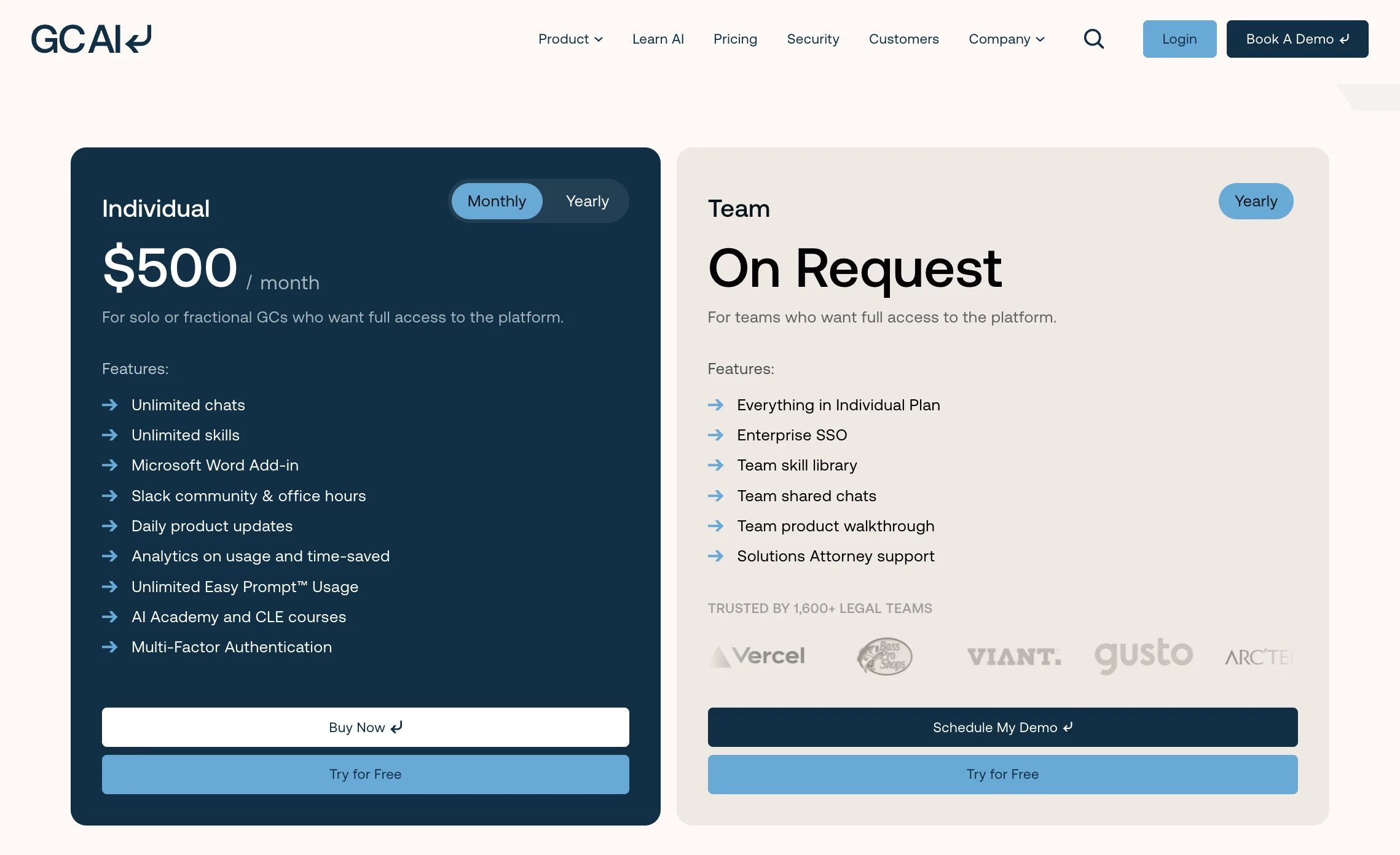
GC AI is transparent until you need a second seat. The Individual plan is published at $500 per seat per month, or $5,000 a year on annual billing (gc.ai/pricing, checked September 2026). Add a teammate and you fall into the quote-based Team tier, where the number lives behind a demo.
The one-line verdict: for a solo GC, the published $500 seat is honest and worth it. For a 5-to-10-person team, the quote-gate at seat two is where the leverage, and the markup, sit.
TL;DR
- The Individual plan is published at $500 per seat per month, or $5,000 per year (gc.ai/pricing, Sep 2026). Annual billing saves about $1,000 a year, roughly 17 percent.
- The Individual plan has no seat minimum and a 14-day free trial, no credit card (gc.ai/pricing, Sep 2026). That is rare in this category.
- The jump from transparent to "call us" happens at seat two. The Team tier is quote-based, reported near $7,000 per user per year (Spellbook estimate, checked September 2026). Treat that as an estimate, not a quote.
- Enterprise is custom pricing. You email sales@gc.ai for custom integrations, managed onboarding, and dedicated support (gc.ai/pricing, Sep 2026).
- The hidden costs sit in the Team and Enterprise tiers: annual-only billing, onboarding, and a renewal you cannot benchmark against a public list.
- GC AI publishes one of the few real per-seat prices in legal AI. See the legal AI pricing benchmark for the full nine-tool grid.
What is the published GC AI Individual plan price?
Part of our legal AI pricing benchmark hub. For the product itself, not the price, read our honest GC AI review.
What GC AI actually charges
GC AI sells three tiers. One has a published price. Two do not.
The Individual plan is the only number you can read off a page. It runs $500 per seat per month, or $5,000 a year on annual billing, which saves about $1,000 (gc.ai/pricing, checked September 2026). That single seat is the whole public rate card.
The Team and Enterprise tiers are quote-based. You book a demo, talk to a Solutions Attorney, and learn the number at the end. Neither price appears on the site.
Here is the rate card as it stands, with a confidence tag on each row.
| Tier | Pricing model | Price | Free trial | Seat minimum | Source (confidence) |
|---|---|---|---|---|---|
| Individual | Per seat, published | $500/mo or $5,000/yr | 14-day, no card | None | gc.ai/pricing (HIGH) |
| Team | Per seat, quote-based | "On request"; reported ~$7,000/user/yr | Yes (length not published) | Reported near 10 users | Spellbook (REPORTED) |
| Enterprise | Custom contract | Custom, contact sales@gc.ai | Demo first | Quote | gc.ai/pricing (quote-based) |
A note on confidence. The Individual row is a vendor page, so it is fact. The Team row rests on a single third-party guide naming a figure GC AI never posts. Read it as a rough band, not a quote. The Enterprise row has no public number at all.
How $500 compares to the rest of the market
Most legal AI vendors hide the price. GC AI does not, at least for the entry seat, and that alone puts it ahead of its peers on transparency. Here is how the published $500 sits next to the tools in-house teams usually shortlist. Every competitor figure below is reported, not posted.
- Harvey: no published price. Third-party reporting puts the seat at $1,200 to $2,000+ per user per month, with a base seat near $1,200 and a LexisNexis-bundled seat near $2,400, on a roughly 25-seat minimum (AI Vortex, eesel AI, and The Crossing, checked 2026). The smallest realistic contract runs near $360,000 a year (25 seats times about $1,200 times 12). For the full matchup on fit and cost, see GC AI vs Harvey.
- Legora: no published price. One competitor guide reports $300 to $800 per seat per month on a 10-seat minimum (Spellbook estimate, checked September 2026).
- Spellbook: no published price either. One pricing blog estimates a base near $500 per seat per month, quote-based.
GC AI's $500 sits well below Harvey per seat, which now starts near $1,200 a seat with a 25-seat floor, and roughly even with Spellbook. GC AI also carries no seat minimum, where Harvey's is around 25. The difference is that you can read it. The rivals never let you past the front door, while GC AI lets you in alone, then locks the team gate. That is the trade you are buying. For the full sourced grid across nine tools, see the legal AI pricing benchmark.
What is included per tier
The price gap between tiers is mostly about admin, security, and support, not the core AI.
Individual ($500 per seat per month). The full AI workbench for one lawyer: unlimited chats, unlimited skills, the Microsoft Word add-in, usage analytics, Easy Prompt, AI Academy courses, multi-factor authentication, and Slack community access (gc.ai/pricing and docs.gc.ai, checked September 2026). For one lawyer, the feature set is close to complete.
Team (quote-based). Adds enterprise SSO, a shared skill library, shared chats, a product walkthrough, and Solutions Attorney support, billed annually (gc.ai/pricing, Sep 2026). The draw is shared playbooks and SSO, which matter once more than two lawyers use it.
Enterprise (custom). Adds custom integrations, managed onboarding, change-management help, ROI forecasting, and dedicated support (gc.ai/pricing, Sep 2026). This is the tier for a larger department with a procurement process.
The core AI barely changes across tiers. What you buy at the top end is SSO, shared libraries, and a human to help you roll it out.
The hidden costs
The $500 seat is honest, but the full bill has lines that do not show on the pricing page. Here is where the cost hides.
Annual billing on the higher tiers. The Team tier is billed yearly, per the pricing page. So a "monthly" mental model understates the commitment. You are signing a year, not a month, once you leave Individual.
Onboarding and change management. Enterprise lists "managed onboarding" and "change management" as features. Those are services, and services carry a cost or a longer contract. GC AI publishes no number, so ask for it before you sign.
The Team-tier number itself. One third-party guide reports Team near $7,000 per user per year (Spellbook estimate, checked September 2026). That sits above the $5,000 Individual rate. Read that twice. Adding a teammate may raise your per-seat price, not lower it. The volume discount you expect runs backward here. Confirm your actual quote, since that figure is not posted.
Renewal you cannot benchmark. A quote-based tier renews at a private number, with no list price to anchor against. The uplift is whatever the contract allows. Get a written cap before year two.
How to budget and negotiate as a in-house team
If you run a one-to-ten-person legal team, here is how to think about the GC AI bill before you talk to sales.
Start from the seat you can see. The $5,000 Individual seat is the only price you can budget against with certainty. For one or two lawyers, run the free trial first. You do not need a quote to start.
Do the simple math. Five lawyers on published Individual seats is $25,000 a year. The reported Team rate would push the same five seats to about $35,000. Here is the spread at two common team sizes.
| Team size | Individual, published ($5,000/yr) | Team, reported estimate (~$7,000/yr) | Annual gap |
|---|---|---|---|
| 5 seats | $25,000/yr | ~$35,000/yr (estimate) | ~$10,000 |
| 10 seats | $50,000/yr | ~$70,000/yr (estimate) | ~$20,000 |
The Individual column is published fact (gc.ai/pricing, Sep 2026). The Team column is a third-party estimate, not a quote, so the gap is directional. The shape is what matters: the team tier likely costs more per seat, not less. That premium is the price of leaving self-serve. Confirm your real Team number before you model anything.
Ask for the Team number in writing first. Get the all-in per-seat price for your exact head count, the billing term, and the renewal cap before the demo. A vendor that answers up front is easier to trust than one that saves the number for last.
Buy the tier whose extras you will use. SSO and a shared skill library are real value for a team of five. They may not justify the jump from $5,000 to a reported $7,000 if only one or two lawyers touch the shared parts.
Convert everything to cost per active lawyer per year. Multiply the seat price by the seats you must buy, then divide by the lawyers who will log in. That one number beats any tier name.
Questions to ask GC AI sales before the demo
A quote-based tier rewards the buyer who asks first. Walk in with these in writing, not in the chat after a slide deck.
- Renewal-uplift cap. What is the maximum annual increase, and will you write a 5 to 7 percent cap into the order form?
- Overage policy. Does anything meter? If a heavy contract month runs hot, what costs extra, and at what rate?
- Seat true-up rules. If we add a lawyer mid-term, do we pay a prorated seat or true up at renewal? Can we drop a seat?
- Data retention and DPA. Where does our document data live, how long is it kept, and can we sign your DPA before any pilot?
- SSO cost. Is enterprise SSO included in the Team price, or is it a separate line?
- Solutions Attorney time. Is that support included, or capped at a number of hours per month before it bills?
A rep who answers all six up front is telling you the rest of the deal will be clean. One who deflects is telling you the opposite.
A procurement-risk note for in-house teams
The seat price is not the only cost a legal team carries. Three more sit in your own calendar.
Security review takes weeks, so start it early. GC AI handles your contract data, so most companies route it through a security review and a DPA first. Run that during the trial, not after, or the 14-day window closes before procurement clears.
AI-vendor policy review is now standard. Many in-house teams keep an AI-use policy that any new vendor must clear. Budget the internal time to map GC AI against it, including how prompts and outputs are stored.
Shared playbooks carry a training cost. The Team tier's shared library only pays off once lawyers build and maintain it. That setup is real internal hours, not an invoice line, and easy to forget at budget time.
Who GC AI fits, and who should look elsewhere
Price is half the call. Fit is the other half.
A solo GC who lives in Microsoft Word should just buy the Individual seat. If your week is NDAs, DPAs, and vendor MSAs, the Word add-in earns the $500, and you never touch the quote-gate. The price is honest and you can read it. For the deep product call, see our GC AI review.
A 5-to-10-person team should walk into the Team quote with eyes open. That is where the leverage and the markup live, since the reported rate runs above the Individual seat. Get the number, the renewal cap, and the SSO line in writing before you commit. A in-house team that also wants research and matter management may find the price-to-job ratio off.
Weigh it carefully if your work turns on deep case-law research. GC AI is built around the contract week. It ships research over 13M-plus US opinions, but that sits behind a paid add-on on the Individual plan, so price the add-on in if primary research depth carries your week. On integration there is no longer a gap to plan around: the GC AI API became publicly available on July 29, 2026 with multi-turn support (gc.ai).
For the ranked field at this price point, see the best legal AI tools for in-house counsel. For how GC AI's rate sits next to Harvey, Legora, and CoCounsel, read the Harvey, Legora, and CoCounsel pricing reality.
What the $500 seat is actually competing with
Not another seat, most of the time. For most in-house teams the real alternative is outside counsel at $400 to $900 an hour, and one avoided hour a month covers the seat twice over. That is the comparison worth running, and it is why the Individual plan clears its own price for a solo or fractional GC carrying a whole legal function.
Price the tier against your actual week rather than against the cheapest seat on the market.
FAQ
How much does GC AI cost per seat? GC AI's Individual plan is $500 per seat per month, or $5,000 per year if you pay annually (gc.ai/pricing, checked September 2026). The annual route saves about $1,000 a year. Team and Enterprise tiers are quote-based, so you get those numbers from a demo.
Does GC AI publish its pricing? Only the Individual tier. GC AI posts $500 per seat per month on its pricing page, which makes it one of the few legal AI tools that shows a real per-seat number. The Team and Enterprise tiers are "on request" and "custom," so you learn those prices after a sales call.
How much does the GC AI Team plan cost? GC AI lists the Team tier as "on request" and does not publish a price. One third-party guide reports it near $7,000 per user per year, billed annually (Spellbook, checked September 2026). Treat that as a single reported estimate, not a quote. Confirm your real number with sales.
Is there a free trial? Yes. GC AI offers a 14-day free trial with no credit card required and no seat minimum on the Individual plan (gc.ai/pricing, Sep 2026). That lets one or two lawyers test the product before any contract.
Is there a seat minimum? The Individual plan has no seat minimum, so you can buy a single seat. The Team tier reportedly triggers volume features around ten users, but GC AI does not publish a hard minimum, so confirm it in your quote (Spellbook, checked September 2026).
Is GC AI worth $500 a month? For a contract-heavy in-house lawyer who lives in Microsoft Word, the $500 seat is fair, and the published price is rare. For a solo GC with a lighter load, or a team that also wants research, the rate runs high. See our GC AI review for the full call.
What is included in the GC AI Individual plan? Unlimited chats, unlimited skills, the Microsoft Word add-in, usage analytics, Easy Prompt, AI Academy courses, multi-factor authentication, and Slack community access (gc.ai/pricing and docs.gc.ai, Sep 2026). The Team tier adds SSO, a shared skill library, shared chats, and Solutions Attorney support.
Are there cheaper alternatives to GC AI? Some self-serve suites publish lower per-seat prices, and most carry a free trial, but the entry points are closer than the headline numbers suggest once you account for what is bundled. GC AI's own $5,000 annual Individual plan has no seat minimum, which is the cheapest honest way to test it. See the legal AI pricing benchmark for sourced per-seat comparisons across the category.
Sources
All checked September 2026. The first two are published vendor sources, stated as fact. The rest are third-party estimates for the quote-based tiers, treated as rough bands.
- GC AI pricing page: the published $500 Individual seat, the 14-day trial, and the Team and Enterprise feature lists.
- GC AI documentation: the published $5,000 annual Individual price.
- Spellbook's GC AI pricing breakdown: the sole source for the reported ~$7,000 Team estimate, plus the Legora figure. Note that Spellbook sells into an overlapping market, so read its estimate accordingly.
- eesel AI's Harvey pricing breakdown: the reported Harvey range used for market context.
Last updated: September 2026. The Individual monthly and annual prices are from GC AI's own published pages. The Team and Enterprise figures are quote-based, so they are hedged, and the ~$7,000 Team figure rests on one third-party estimate that GC AI has not confirmed. Spotted a number your team was actually quoted? Email contact@vaquill.ai and we will verify and update.
New legal AI guides, weekly.
Further Reading
Ironclad Pricing 2026: CLM Cost Ranges and the AI Add-On
Read postIvo Pricing 2026: What AI Contract Review Costs Per User
Read postLegalOn Pricing 2026: Base Cost Plus Modules, Explained
Read postSpellbook Pricing 2026: Per-Seat Cost and Total Cost of Ownership
Read postLegal AI Pricing Benchmark (2026): What 10 Tools Actually Cost
Read postAI NDA Review Software: 9 Tools Compared (Pricing + What They Flag)
Read post
Co-Founder & CEO · Attorney
Arshita leads product and strategy at Vaquill, building the legal AI suite that solo, small-firm, and in-house US lawyers use to run a matter end to end.