
A 409A valuation is an independent appraisal of a private company's common stock that sets the floor for option strike prices under IRC Section 409A. Price the option at or above that fair market value and the grant is exempt from 409A. Price it below, and the optionee, not the company, eats a 20% additional tax plus interest. This playbook covers the safe harbor methods, the 12-month rule, the refresh triggers counsel keep missing, and the penalties for getting it wrong.
A venture-backed company closes a $40M Series C in March, runs a secondary tender at $18 a share in May, and grants 1.2 million options in June off a January 409A that valued common at $3.40. The grantees love the strike price. The auditors will not.
If the IRS pulls the thread, neither will the optionees, because the fix is a personal tax problem on their return.
That is the shape of a 409A failure. Not a missing appraisal: an appraisal that became wrong and nobody refreshed.
TL;DR
- IRC § 409A taxes nonqualified deferred compensation if a stock right is granted with an exercise price below the fair market value of the underlying common stock on the grant date. The penalty hits the optionee, not the company: ordinary income inclusion on vest, a 20% additional tax, plus interest at the underpayment rate plus 1%.
- The safe harbor lives in Treasury Regulation § 1.409A-1(b)(5)(iv)(B), which lists three presumption-of-reasonableness methods. For venture-backed companies the only one anyone uses in practice is the independent appraisal method, and the resulting valuation is presumed reasonable for 12 months absent a material event.
- The two refresh rules that get missed: the 12-month staleness ceiling and the material-event trigger. Tender offers are the single most common missed trigger.
- The 409A is one of four valuations of the same equity (409A, audit ASC 718, IRC § 422 for ISO limits, gift and estate). Corporate counsel who treats them as separate workstreams is the reason restatements happen.
- If a board is granting options off a stale 409A, that is a board-level issue, not an HR ticket.
Which material event is the single most commonly missed trigger for refreshing a 409A valuation?
Part of our corporate and transactional lawyer playbooks.
Why § 409A is a counsel problem, not a finance problem
§ 409A entered the Code in 2004 as a reaction to executive compensation abuses at Enron, aimed at the nonqualified deferred comp toolkit. It caught startup stock options anyway.
A stock option priced below fair market value on the grant date is mechanically deferred compensation: the optionee is being promised value (the spread) that vests over time.
The final 409A regulations made the rule explicit in April 2007. A stock right on service-recipient common stock is exempt from § 409A only if the exercise price equals or exceeds FMV on grant.
If it does not, the consequences hit the service provider, not the company:
- Ordinary income inclusion of the vested spread as it vests, regardless of exercise.
- A 20% additional federal tax on that included amount.
- Interest at the underpayment rate plus 1%, from the year the deferral arose.
California piles on with a 5% additional state tax. A failure on a $2M vested spread can produce six-figure personal liability for an employee who never saw a dollar of cash.
The company will not be sued by the IRS. It will be sued by the optionee.
The strongest argument for treating 409A as in-house counsel's job, not the CFO's, is that the failure mode is third-party harm. The corporate function that owns third-party risk is legal. Counsel owns the standard.
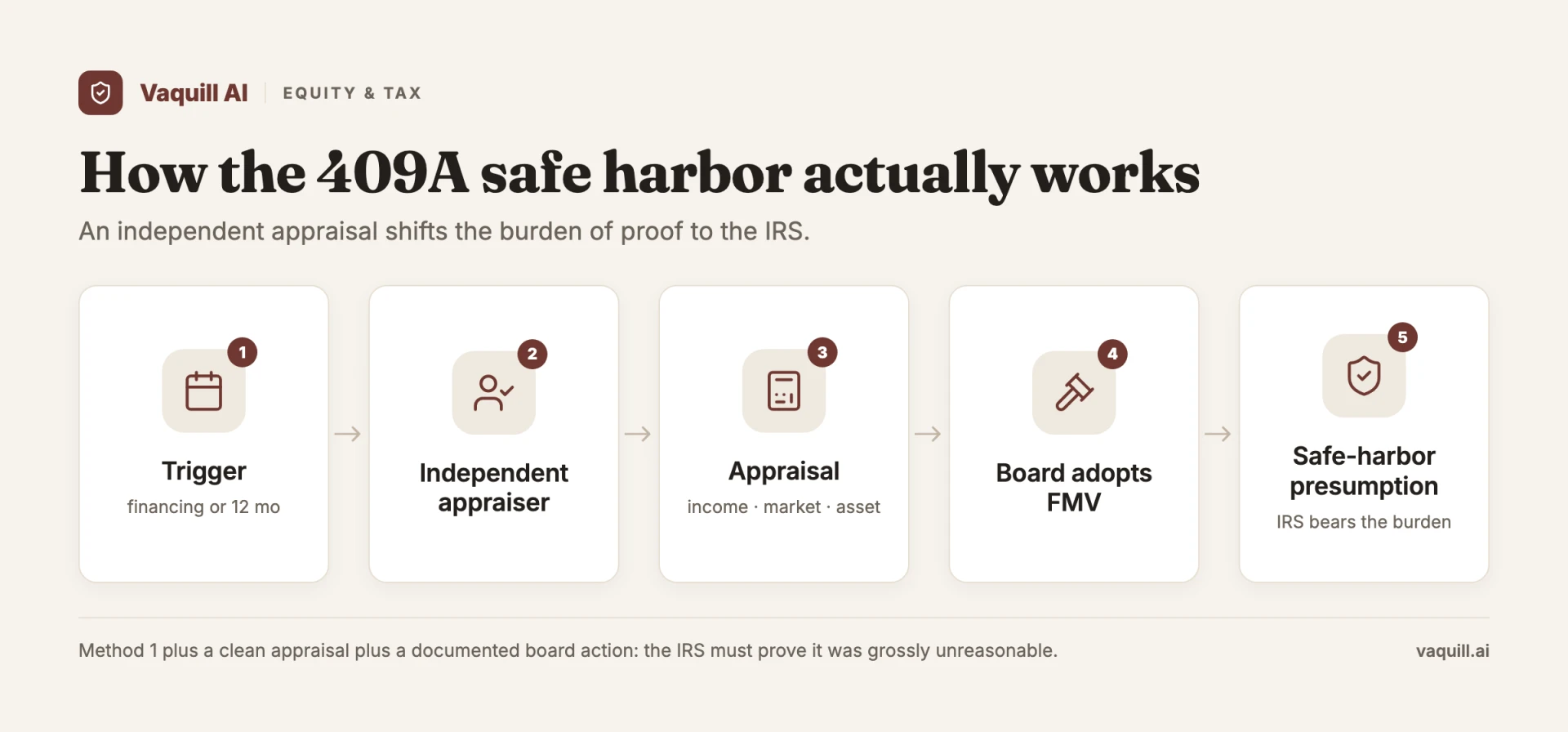
The 409A safe harbor: an independent appraisal shifts the burden to the IRS.
What the safe harbor actually says
Treasury Regulation § 1.409A-1(b)(5)(iv)(B)(2) gives stock-right grantors a presumption of reasonableness if the company uses one of three enumerated valuation methods.
The presumption is rebuttable, but the IRS bears the burden of showing the valuation method or its application was grossly unreasonable. That is the point of the safe harbor.
The three presumption methods:
- Independent appraisal presumption. A valuation by a qualified independent appraiser as of a date no more than 12 months before the grant date, absent a material event. The only method venture-backed companies use at scale.
- Generally applicable formula valuation. A formula-based valuation that would qualify as fair market value under the § 83 nonlapse-restriction rules, used consistently for all transfers of that class of stock, not just compensatory ones. Narrow in practice, since the same formula has to govern repurchases and other transfers too.
- Illiquid-startup presumption. For a corporation with no material trade or business conducted for ten years or more and no publicly traded stock, a written valuation made reasonably and in good faith, evidenced by a written report that considers the standard factors (asset value, cash flows, market multiples, control premiums, marketability discounts, recent arm's-length transactions). The appraiser must have significant knowledge, experience, education, or training, and the method fails if a change-in-control or IPO is reasonably anticipated within 90 or 180 days.
Outside those three, the general rule still applies: any reasonable application of a reasonable valuation method is allowed, but it carries no presumption. That is the standard you fall back into when you blow the 12-month window or skip the appraisal, and the burden flips back onto the company.
Every venture-backed company uses method 1 because of the burden-shifting. A clean appraisal plus a documented board review moves the IRS challenge from "show your work" to "prove the appraisal was grossly unreasonable." Much of the operative 409A detail sits in IRS notices and rulings rather than the Code, which is why IRS published guidance is worth querying directly.
Method 3 is used by pre-seed companies with no investors, no revenue, and no realistic path to $5,000 of appraiser fees. The written report still needs to address every factor the regulation lists, and "the CFO wrote a memo" rarely survives the company's first audit.
The no-presumption fallback is what you land in when the safe harbor lapses.
The independent appraisal in practice
For the 90%-plus of venture-backed cap tables on method 1, the question is not "should we get a 409A," it is "from whom, how often, and how do we use it."
The market has settled. High-volume providers are Carta Valuations, Aranca, Trinity (Andersen), and Vantage Point, with a long tail of regional firms and the Big Four for pre-IPO companies.
Pricing: roughly $1,500 to $5,000 per appraisal seed-to-Series-B on a high-volume platform, $5,000 to $20,000 for mid-stage standalone engagements, into the high five figures pre-IPO. The cheap end is productized service against a templated data room.
The expensive end exists because by the time real M&A diligence touches the report, you want a partner with their name on the letterhead.
A clean engagement produces a 30 to 60 page report: enterprise value from comparable-company and comparable-transaction analysis, an option-pricing model or hybrid method to allocate across cap table classes, a common-share fair market value with an as-of date, and methodology the board can adopt as the basis for the strike price.
The board action is what counsel owns. The appraisal is a recommendation; the board sets the strike.
Counsel writes the resolution, attaches the appraisal as an exhibit, and creates the paper trail that, three years later when an auditor asks why options were granted at $3.40, points to a board action adopting a qualified independent appraisal of $3.40 as of a specific date.
How the appraiser actually builds the number
Counsel does not run the model. Counsel signs the board resolution adopting its output. Reading the report well means knowing the two-step move every 409A makes: value the whole company, then carve out the common.
Step one, enterprise value. Three approaches, weighted by stage.
- Market approach. Comparable public companies and comparable transactions, or a backsolve off the most recent priced round. The backsolve treats your own Series C as the arm's-length data point and reverse-engineers total equity value from the price a real investor actually paid. It is the dominant approach for a venture-backed company with a recent round, and the one auditors trust most.
- Income approach. A discounted cash flow. Only credible once there are cash flows to discount, so it shows up at Series B and later, backed by revenue and a defensible three-year forecast.
- Asset approach. Net asset value, book assets minus liabilities. Reserved for pre-revenue, pre-financing shells where nothing else carries signal.
Step two, allocate to the common. Total equity value is not common value. Preferred stock sits ahead with liquidation preferences, participation, and conversion rights, so the common is a residual. The allocation method decides how thin that residual is.
- Option-Pricing Method (OPM). Treats each share class as a call option on enterprise value using Black-Scholes, with volatility pulled from comps and a time-to-exit assumption. The workhorse for early and mid stage.
- Probability-Weighted Expected Return Method (PWERM). Models discrete exit scenarios, IPO, sale, dissolution, and weights each. Used once an exit is visible, typically inside 18 months.
- Hybrid. OPM for the stay-private case, PWERM for the near-term exit, blended. The standard pre-IPO.
- Current Value Method. Values as if the company liquidated today. Rare for a going concern.
Then the discount. Private common is illiquid, so the appraiser applies a discount for lack of marketability (DLOM), commonly in the 25% to 35% range for an early-stage company years from any exit. A larger DLOM means a lower common FMV, which means a lower strike. It is also the single most negotiated and most audit-scrutinized input in the report, so it is the first number counsel should be able to explain.
Two things worth knowing before you adopt a report. The old "common is 10 to 20 percent of the preferred price" rule of thumb is dead. The ratio swings widely with stage, the preference stack, and time to exit, and no auditor accepts it as a shortcut. And the forecast is a trap: the projection you hand the appraiser has to be the projection you hand the board and the auditor.
The two refresh rules
The independent appraisal presumption has two breaking points. Counsel who only watches the first misses the second every time.
The 12-month staleness rule. The appraisal is presumed reasonable for grants within 12 months of the valuation date. On day 366 the presumption is gone, and you are back to the no-presumption rule, arguing facts and circumstances.
The standing rule: no grants off a 409A more than 11 months old, refresh ordered in month 10. A fresh appraisal runs anywhere from a few business days on a high-volume platform to two to four weeks for a standalone engagement, so a month-10 order lands the new report well inside the window.
The material-event trigger. Anything that would reasonably be expected to materially affect the value of the stock. The examples are non-exhaustive and they are exactly the things that happen in a venture-backed company's year:
- A new priced equity round at a step-up or step-down.
- A convertible note or SAFE with a cap that reprices the implied common value.
- A signed term sheet or acquisition LOI.
- A regulatory event (FDA approval for a therapeutic; loss of a key government contract).
- The departure of a founder or key executive.
- A material change in expected financial performance.
- A secondary transaction or tender offer.
The tender is the single most missed trigger. Counsel runs a tender at $18 a share to give employees liquidity, treats the secondary as a one-off, and three months later signs option grants off a 409A that values common at $3.40.
The auditors will look at the secondary, look at the grant date, and ask whether the company refreshed. The honest answer is usually no.
Two observations on tenders. First, even an "investor-funded" tender at above-409A pricing is a transaction in the company's common stock that a reasonable buyer of an option would notice. The buyer's sophistication does not make the price irrelevant.
Second, the appraiser will not always mark common to the tender price. There are real arguments for a discount: one-off transaction, liquidity vehicle not price discovery, strategic motivations. Those arguments belong in the appraiser's report, not in the company's decision not to refresh at all.
The mistake matrix
Recurring failure modes at the in-house counsel level, ranked roughly by frequency:
| Mistake | What actually happens | Fix |
|---|---|---|
| Stale 409A on grant date | Grants on day 367 off a 12-month-old appraisal. Presumption gone. | Calendar refresh at month 10. No grants off an 11+ month appraisal. |
| Missed tender trigger | Secondary at $18 in May; June grants off a January 409A at $3.40. | Treat any tender, however structured, as a presumptive refresh trigger. |
| Missed financing trigger | Series C closes; grants continue off the pre-money 409A for a quarter. | Order the refresh the day the term sheet signs, not the day the round closes. |
| Audit misalignment | 409A common FMV differs materially from the ASC 718 grant-date fair value used for expense. | Coordinate 409A and audit valuation in the same engagement. Same OPM allocation. |
| ISO misalignment | The $100K IRC § 422(d) limit computed off the wrong FMV; ISOs convert silently to NSOs. | Pull the § 422 first-exercisable schedule quarterly against the current 409A. |
| Conflating valuations | "We have a 409A, so we're good for the audit." | Four valuations: 409A, ASC 718, IRC § 422, gift and estate. Different standards. |
| Board action missing | Appraisal exists but no board minutes adopting it as the basis for the strike. | Resolution at the next regular board meeting attaches the appraisal as an exhibit. |
The single most important entry is not stale 409A or missed tender. It is audit misalignment.
The four valuations of the same equity
In-house counsel is responsible for keeping straight at least four different fair-value numbers for the same common stock:
409A (tax). Treasury Reg § 1.409A-1(b)(5)(iv)(B). Sets the exercise price of new option grants at or above common FMV. In practice the independent appraisal. Refresh: 12 months or material event.
ASC 718 (audit). The FASB stock compensation standard governs the expense the company books on the income statement. Fair-value measurement at grant date, recognized over the service period.
The audit standard tolerates somewhat different judgments than the tax safe harbor. Two engagements often produce materially different numbers, and that delta is what the auditor will spend an hour on at the audit committee.
IRC § 422 (ISO limit). IRC § 422(d) limits ISOs first exercisable in any calendar year to $100,000 of FMV on the grant date. If the FMV used to test the limit is wrong, options that should have qualified as ISOs overshoot the cap and convert silently to NSOs.
The employee finds out at exercise, when they expected long-term capital gain on a qualifying disposition and instead get ordinary income.
Gift and estate (founders). Founder transfers to a trust are valued under chapter 14 of the Code, not § 409A or ASC 718. The discounts available (DLOM, minority) are real. The 409A is a starting reference, not the answer.
When in-house counsel treats the 409A as the only valuation that matters, audit and equity admin teams end up holding bags.
The fix is mechanical: brief the appraiser once for an engagement covering 409A and ASC 718 in parallel, with a single OPM, single comparable set, single waterfall, and a memo articulating where the standards diverge and why.
What "good" looks like
A working 409A process:
- A standing engagement with one qualified appraiser, refreshed at month 10 by default.
- A material-event checklist circulated quarterly to finance, BD, and HR. Every priced round, term sheet, tender, and LOI is a presumptive trigger.
- An ASC 718 engagement run by the same appraiser, with a written reconciliation memo for any material delta from 409A common FMV.
- Equity admin (Carta, Pulley, Shareworks) configured to block grants off an appraisal more than 11 months old.
- Board resolutions adopting the appraisal as the basis for strike pricing, with the report attached.
- Quarterly review of the IRC § 422(d) first-exercisable schedule against the current 409A.
- A standing tender-offer protocol: secondaries over a threshold trigger a refresh by default; deviation requires a memo.
None of that is exotic. It is calendar discipline and one good appraiser. The companies that get it wrong let the 409A live as a calendar item with nobody owning it.
Where the regulators are heading
The SEC's continued scrutiny of late-stage private company secondary markets is the signal worth tracking. As tender offers and structured secondaries become a regular liquidity tool, the gap between the secondary clearing price and the 409A common FMV has become a recurring audit comment.
The market is moving toward earlier refreshes around tenders, not because the regulation changed, but because the auditors are asking sharper questions. § 409A has been on the books for over two decades; the easy excuses carry no weight in a 2026 audit.
A small POV
409A is structurally an in-house counsel problem because the harm runs from the company to the employee, and the document creating the harm is a grant the company signed.
Companies that route 409A through finance treat it as a calendaring task. Companies that route it through counsel treat it as a fiduciary one. The latter make fewer mistakes.
Three things to take to your board:
- The 12-month rule is a ceiling, not a target. Refresh at month 10.
- Every tender is a presumptive refresh trigger, even if the appraiser ultimately discounts the tender price.
- The 409A, audit fair value, and IRC § 422 check are three different exercises on the same equity. Coordinate them.
FAQ
What is a 409A valuation?
A 409A valuation is an independent appraisal of a private company's common stock fair market value, named after IRC Section 409A. It sets the minimum legal strike price for employee stock options. Granting at or above that value keeps the option exempt from 409A; granting below it triggers tax on the optionee.
How long is a 409A valuation valid?
Up to 12 months, but only absent a material event. Under Treasury Reg § 1.409A-1(b)(5)(iv)(B), the independent appraisal presumption applies to grants made within 12 months of the valuation date, and any material change in value cuts that window short. Best practice is to refresh at month 10 rather than ride it to day 365.
What triggers a new 409A valuation?
A new priced round, a convertible note or SAFE that reprices implied common value, a signed term sheet or acquisition LOI, a secondary sale or tender offer, a regulatory event, the departure of a key executive, or a material change in expected financial performance. The tender offer is the most commonly missed trigger.
What is the safe harbor in a 409A valuation?
The safe harbor is a presumption that the valuation is reasonable, which shifts the burden to the IRS to prove it was grossly unreasonable. The regulation lists three qualifying methods; for venture-backed companies the relevant one is a valuation by a qualified independent appraiser.
What happens if a 409A valuation is wrong or stale?
If options are granted below fair market value, the optionee owes ordinary income tax on the vested spread as it vests, a 20% additional federal tax under § 409A(a)(1)(B), and interest at the underpayment rate plus 1 percentage point. California adds a 5% state tax. The company is not penalized directly but usually ends up the defendant.
How much does a 409A valuation cost?
Roughly $1,500 to $5,000 per appraisal from seed to Series B on a high-volume platform, $5,000 to $20,000 for mid-stage standalone engagements, and into the high five figures pre-IPO where a named partner signs the report.
Who performs a 409A valuation?
A qualified independent appraiser. High-volume providers include Carta Valuations, Aranca, Trinity (Andersen), and Vantage Point, with the Big Four for pre-IPO companies. The board, not the appraiser, formally sets the strike price by adopting the appraisal.
How is a 409A valuation calculated?
In two steps. The appraiser values the whole company using a market, income, or asset approach, often a backsolve off the last priced round, then allocates that value across share classes with an option-pricing or scenario-weighted model. A discount for lack of marketability, commonly 25% to 35%, is applied to reach the common stock fair market value. That common FMV becomes the minimum legal strike price.
Why is the 409A valuation lower than the price investors paid?
Investors buy preferred stock, which carries liquidation preferences, participation, and conversion rights that sit ahead of common. Employee options are on common, a residual junior to all of that, then discounted further for illiquidity. A 409A common FMV well below the preferred round price is normal and expected, not a red flag.
Is a 409A valuation the same as the audit (ASC 718) valuation?
No. The 409A sets the tax strike price; ASC 718 sets the stock-compensation expense the company books. The standards tolerate different judgments and can produce materially different numbers, which is why counsel should brief one appraiser to run both in parallel.
For related financing and entity coverage, see SAFE vs Convertible Note vs Priced Round, the term sheet review checklist for corporate counsel, and Delaware vs California vs New York Incorporation in 2026.
This is the kind of standing review counsel can run inside an in-house workbench like Vaquill AI, where Document Matrix bulk extraction maps every grant, board resolution, and appraisal date against the § 409A and IRC § 422(d) checks in one pass, and compliance checks run against the tax and securities rules.
Want to keep your 409A and equity-grant review in one place? Start a free Vaquill AI trial, or see how compliance checks work.
New legal AI guides, weekly.
Further Reading
- SAFE vs Convertible Note vs Priced Round: A 2026 Practitioner's Guide
- Delaware vs California vs New York Incorporation in 2026
- Legal AI for Corporate Counsel: Deals, Diligence, and Entity Work in 2026
- M&A Due Diligence: The Legal Workstream Checklist for 2026
- Drafting the Schedule of Exceptions in an M&A Deal
- AI and Corporate Law in 2026: What AI-Powered Legal Intelligence Actually Does

Co-Founder & CEO · Attorney
Arshita leads product and strategy at Vaquill AI, the US primary law data API. As an attorney, she decides which law we carry, how each section is sourced and cited, and what legal AI and compliance teams need from the data.