A mid-market SaaS company signs a letter of intent to buy a competitor on a Thursday. By Monday, the acquirer's two-lawyer team has a data room with 340 customer contracts, 60 vendor agreements, 19 leases, an option ledger, and three boxes of minute books scanned out of order.
The deal signs in six weeks. Nobody is hiring three associates for a sprint that ends in a month, and the outside-counsel quote for "full contract review" came back at a number the CFO will not approve.
This is the gap legal AI for corporate counsel was built to close. Not the demo-day fantasy of a robot lawyer, but the unglamorous reality of a deal team that is a good week behind from the day the LOI is signed.
What changed between 2024 and 2026 is not the tools. Clause-extraction diligence platforms have existed for a decade, but they lived with the M&A specialists at large firms, priced for matters with seven-figure fee budgets.
The shift is that playbook-driven review and cross-contract extraction now run inside a working in-house lawyer's stack, in Microsoft Word, at a seat price a two-person department can approve without a procurement fight.
So the real question in 2026 is not whether to use it. It is knowing the line between the work AI should own and the work that ends your career if you hand it over.
Short answer: legal AI for corporate counsel earns its keep on high-volume, checkable work, first-pass NDA and MSA redlines against your playbook, and clause extraction across hundreds of diligence contracts at once. It is a finder, not a decider. Hand it the extraction; keep deal economics, cap-table modeling, and risk calls for yourself. Roughly 44% of general counsel now report using AI, up from 28% a year earlier (FTI Consulting and Relativity, The General Counsel Report 2025, May 2025), so the laggard's risk is real.
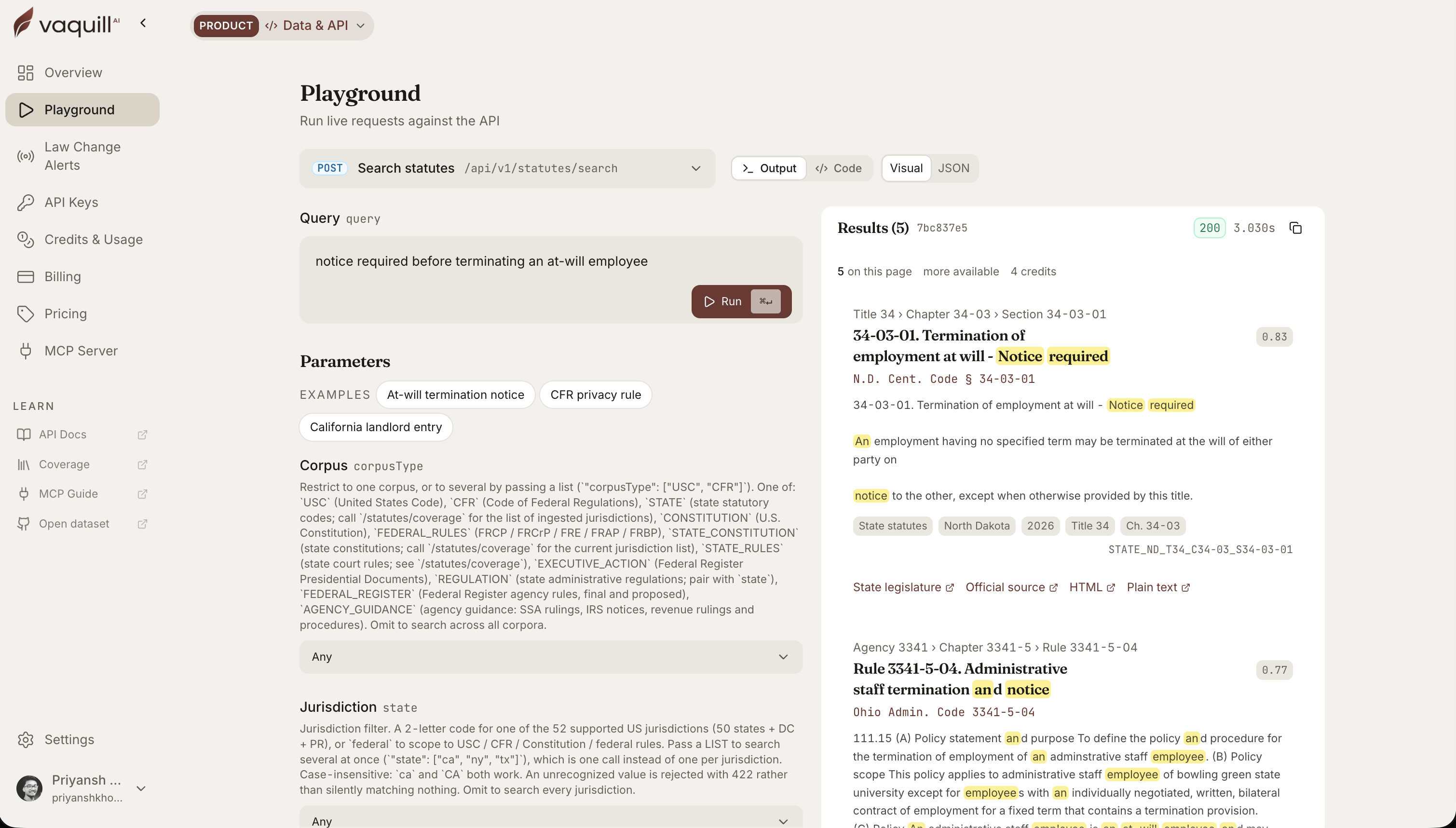 The same corpus behind this article, queried live. Every result carries its citation and a link to the official source.
Vaquill AI's Document Matrix pulls the same fields (change of control, assignment, MFN) across hundreds of diligence contracts at once.
TL;DR
- Corporate AI earns its keep on volume and extraction: first-pass redlines on NDAs and MSAs against your playbook, and pulling specific terms (change of control, assignment, exclusivity, MFN) across hundreds of diligence contracts at once.
- The win on a deal is consistency, not speed. A human reviewer's accuracy degrades by contract 80; a model's does not. The value is a clean, complete extract, not a slightly faster one.
- AI is a finder, not a decider. It surfaces the change-of-control clause; whether that clause kills the deal economics is your call, and it should never be the model's.
- Term sheets and financing docs are the wrong place to start. The risk lives in interaction effects (liquidation stack times anti-dilution times the option pool), which extraction tools read clause by clause and miss.
- Entity and governance work rewards AI for assembly (board books, consent packages, a defects list) and punishes it for judgment (whether a defect is a real problem).
- Confirm every flagged provision against the source clause before it enters a disclosure schedule or a deal memo. The output is a draft of your attention, not a substitute for it.
What share of general counsel now report using AI?
This is the corporate-deal companion to our broader guide on legal AI for in-house counsel.
What AI for corporate legal departments actually does well (and badly)
The fastest way to use any corporate counsel AI tool safely is to sort the task before you start it. Two questions decide everything: can the output be checked against a source clause, and does the call require business leverage or cap-table math? The first kind belongs to the model. The second stays with you.
| Corporate task | AI fit | Why |
|---|---|---|
| First-pass NDA / MSA redline vs your playbook | Strong | Output is checkable line by line against your standard |
| Clause extraction across a diligence data room | Strong | Models hold equal attention at contract 200; humans do not |
| Board books, consent packages, defects lists | Strong | High-volume document assembly off a template |
| "Is this change-of-control clause a deal problem?" | Weak | Judgment on deal economics and posture, not in the document |
| Term sheet and financing risk | Weak | Risk lives in interaction effects, not single clauses |
| Whether a minute-book defect is fatal | Weak | Materiality call that depends on state code and deal posture |
Adoption has crossed the line where this matters to your budget, not just your curiosity. About 44% of general counsel now report active AI use, up from 28% a year earlier and 20% in 2023 (FTI Consulting and Relativity, The General Counsel Report 2025, May 2025). The rest of this guide is where those two-thirds of confident teams point the tool, and where the careful ones keep their hands on the wheel.
Where the volume actually is: NDAs and MSAs
Ask any corporate team to log a week and the same five documents dominate: NDAs, DPAs, MSAs, vendor renewals, and employment offers. The mutual NDA is the one everyone underestimates.
It is short, it feels trivial, and a team of two will process forty in a quarter while telling itself NDAs are not real legal work. They are. They are just legal work that got commoditized, which is exactly the work a model should own.
The mechanism that matters is the playbook, not the chatbot. A general-purpose model asked to "review this NDA" gives you a competent, generic markup that ignores how your company actually negotiates.
A playbook-driven review encodes your positions: confidentiality term capped at three years, no residuals clause, no assignment without consent, your venue, your carve-outs for independently developed information. The model runs the counterparty's draft against that standard and produces a first-pass redline in your house style, in real Word track changes, before a lawyer has read a word.
The honest accounting, and these are observed workflow estimates, not lab numbers: a routine vendor MSA that took the better part of a day now turns in roughly half an hour of human time, because the lawyer edits a draft instead of building one.
The first thirty minutes (find the assignment clause, check the cap, locate the indemnity, write the obvious comments) is what a model does well and you do slowly. The last thirty minutes, deciding whether to fight the cap given who the counterparty is and how badly the business wants the deal, is still yours.
What goes wrong is treating the playbook as set-and-forget. The first time the model accepts a one-sided indemnity because your playbook never said to push back, you learn the gap was in your standard, not the tool.
The teams that win treat every override as a note to update the playbook. This is the same encoding-your-positions logic behind a term sheet review checklist for corporate counsel: write down what you actually do, then make the tool do it consistently.
Due diligence: where legal AI for corporate counsel earns its keep
If there is one corporate use case where AI changes the work rather than just speeding it up, it is diligence at volume. The reason is not raw speed. It is that humans get worse as the pile grows and machines do not.
This is the workstream the mature M&A extraction tools were built for (Kira and Luminance), and where newer Word-native players like Spellbook and Thomson Reuters CoCounsel push the same capability down to in-house teams that never had a Kira budget.
Before any of this works, you meet the data room as it actually is, not as the tool's marketing imagines it. The first pass on a real room never returns a clean matrix.
It returns a mess that tells you about the target: three copies of the same MSA with different signature dates and no master, a "fully executed" agreement missing its Exhibit A pricing schedule, an amendment chain where Amendment 3 cites a Section 7 that Amendment 1 already deleted, OCR so bad a scanned 1990s lease reads "ass1gnment" and never matches your search, the same counterparty entered four ways (Acme Inc., Acme, Inc., Acme Incorporated, ACME INC).
The first hour is not legal work. It is reconciling that the model found 340 documents and you have 280 actual agreements.
Skip it, trust the raw extract, and you are building a disclosure schedule on duplicates and orphaned exhibits. The tool that handles a dirty room well is earning its seat; the one that assumes clean inputs is a demo.
Once the room is reconciled, the volume advantage is real. A human reviewer is sharp at contract 10, competent at contract 80, and tired at contract 200, and the consent clause buried in section 14.3 of the 190th vendor agreement gets a skim and a pass.
That is not a discipline problem, it is a biology problem, and it is where deals get hurt: the contract you skimmed is the one that lets the target's biggest customer walk on a change of control.
A model does not get tired. It pulls the same fields from every document with equal attention (change-of-control and assignment language, term and renewal, exclusivity and MFN, indemnity caps, termination rights, consent triggers) and lays them out as a matrix: every contract down the left, every provision across the top, the actual clause text in each cell.
That cross-contract view is the core of how a document matrix turns a folder of PDFs into something you can reason about, and on most deals it is the work AI repays fastest.
Two things separate teams that get value from this from teams that get burned.
First, treat the model as a finder, never a decider. The right question is "show me every contract with a change-of-control provision and quote the clause." The wrong question is "which of these contracts are a problem."
The first is extraction, which models are good at. The second is judgment about deal economics, relationships, and negotiating posture, which the model knows nothing about. Ask the second and trust the answer, and you are outsourcing the actual job.
Second, verify against the source clause before anything reaches a disclosure schedule. The failure mode is rarely a missed clause; it is the confident near-miss.
One that bit a team I know: the model flagged a change-of-control consent correctly from the base agreement, but Amendment 2 had narrowed that consent to a sale of substantially all assets, not a stock deal. The structure on the table was a stock deal.
The flag was right about the base contract and wrong about the live document, and it would have produced a consent letter nobody needed if the reviewer had trusted the extract instead of pulling the amendment chain.
So every flagged provision gets confirmed against the underlying text before it informs the deal. The model gives you a ranked list of where to look, not the answer.
Run that way, the math changes. The two-lawyer team that could not review 340 contracts in six weeks triages all of them in days, spends real review time on the 40 the matrix flags as non-standard, and walks into negotiation knowing which consents they need and which reps they cannot give clean.
That is a different workstream, laid out in our M&A due diligence legal workstream checklist for 2026.
Term sheets and financing: where extraction tools fail
Here is the part most "AI for deals" content gets wrong: a term sheet is the worst place to lean on a clause-extraction model, even though it looks like an easy one. Term sheets and financing documents do not carry their risk in individual clauses. They carry it in interaction effects.
A 1x non-participating liquidation preference is fine. A full-ratchet anti-dilution provision is aggressive but survivable. A 20% option pool refresh sized into the pre-money is standard.
Each clause read alone looks reasonable, and a model reading clause by clause will call each one market. The damage is in how they compound, and no single clause says so. Extraction reads the clauses; the harm lives between them.
Make it concrete. Founders own 60% after a Series A at $10 a share. The Series B term sheet asks three things that each read as market: full-ratchet anti-dilution, a fresh 15% option pool carved into the pre-money, and a price of $8 because the round is a modest step down.
Run them together. The pool refresh comes out of the pre-money, so it dilutes existing common before new money arrives, not everyone pro rata. The $8 price trips the full ratchet, repricing the entire Series A as if it had come in at $8, issuing those investors fresh shares and diluting common again.
Each provision alone costs a couple of points. Stacked, they move 12 to 15 points of fully diluted ownership off the common in one round, and the term sheet still reads "market" line by line.
A clause-extraction tool confirms every term is standard and never sees the founders cut in half, because it never built the cap table forward. The same blind spot extends downstream to the option-grant strike the round sets up, which the 409A valuation playbook for corporate counsel walks in full.
This does not mean keep AI away from term sheets. Use it for the boring omissions it catches well: a missing pro-rata right, a pay-to-play with broken conversion mechanics, a no-shop with no fiduciary out, an inconsistency between the term sheet and the stock purchase agreement that follows.
Those are extraction problems, and the model beats a rushed human on them. What it cannot do is model the cap table three rounds forward and see the founders walking into a stack that wipes them out in a soft exit. That takes holding the whole structure in your head, still the lawyer's part.
Entity and governance work: assembly versus judgment
Entity and governance work splits along the same fault line. On the assembly side, AI removes real time sinks.
Compiling a board book from a dozen department submissions, drafting routine written consents off a template, generating the secretary's certificate package for a closing, building the schedule of subsidiaries and good-standing checklist across a multi-entity structure: high-volume, low-judgment document production, the work that eats a corporate paralegal's week and a small team's evenings.
Legal AI for general counsel has crossed from pilot to standing infrastructure on exactly these tasks, where the output is a draft a human edits, not a decision a human trusts.
On the judgment side, the same tool is a liability. Deciding whether a missing board approval in a target's minute book is a curable formality or a fatal defect in the chain of title to the company's IP is not assembly.
It is judgment, informed by which state's corporate code governs, what the bylaws require, and how a buyer's counsel will argue it.
A model can build the defects list (every consent that should exist and does not, every annual meeting with no recorded minutes). It cannot tell you which defect is a real problem, because "real problem" is a function of materiality, deal posture, and risk tolerance that lives outside the document.
The same split runs through every corporate use case, and it gives you two tests for any task before you hand it over. Can the answer be checked against a source clause? If yes, the model can produce it.
Does it require business leverage, cap-table modeling, or a call on risk appetite? If yes, it stays with you. As the in-house org chart reorganizes around AI, the lawyers who win push assembly and extraction to the tool aggressively and hold judgment close.
The operating guardrails before anything goes in writing
The thesis is only safe if it runs on a short, boring discipline. Five checks turn "we use AI on deals" into a defensible workflow:
- Source-clause verification. No flagged provision enters a disclosure schedule or a rep until a human reads it against the underlying contract. The model points; you confirm.
- Confidentiality and privilege. Know where the data room sits and who can see it. A target's contracts and a board's draft minutes are among the most sensitive documents a company holds, which constrains the tools and deployment you can use.
- Playbook ownership. One named person owns the redline standard and updates it whenever a lawyer overrides the model. A playbook nobody maintains drifts from your real positions within a quarter.
- Audit trail. Keep a record of what the model extracted, what a human changed, and why. When buyer's counsel questions a schedule, "the AI flagged it" is not an answer; the trail is.
- Human signoff. Every output that leaves the building, a redline to a counterparty, a schedule on an agreement, a board consent, carries a lawyer's name, not the tool's.
None of this is novel. It is the standard of care corporate counsel already owe; the checklist just names where the model fits.
The single principle underneath all five: the model produces a draft of your attention, and you are still accountable for the answer. That is what makes the volume safe.
Letting AI run the first pass on forty NDAs, extract change-of-control across 340 contracts, and assemble the board book is the smart move precisely because none of those outputs are final. They are inputs to a lawyer's review, ranked so scarce attention lands where it matters.
The counsel who internalizes that runs a two-person team at the throughput of five. The one who lets a flagged-but-unverified provision reach a disclosure schedule learns that a model's confidence and its correctness are not the same number.
Used the first way, legal AI for corporate counsel is not a threat to the craft; it is how a in-house team keeps pace with deal volume built for a department twice its size.
FAQ
What is the best AI for corporate counsel? There is no single best tool; the right pick depends on whether your bottleneck is contract review or full M&A diligence. Word-native review tools (Spellbook, Thomson Reuters CoCounsel) suit teams living in MSAs and NDAs. Dedicated extraction platforms (Kira, Luminance) suit deal-heavy work. The honest filter is whether the tool gives you checkable clause-level output, not a confident summary you cannot trace.
Can AI replace corporate counsel? No. AI is a finder, not a decider. It can extract a change-of-control clause from 340 contracts and draft a first-pass redline, but it cannot decide whether that clause kills the deal economics or model a cap table three rounds forward. Those calls require business leverage and risk judgment that lives outside the document.
How do corporate counsel AI tools handle M&A due diligence? They pull the same fields (change of control, assignment, exclusivity, MFN, indemnity caps) from every contract in a data room and lay them out as a matrix, with the actual clause text in each cell. A two-lawyer team can triage hundreds of contracts in days instead of weeks, then spend real review time on the handful flagged as non-standard. Every flag still gets confirmed against the source clause before it reaches a disclosure schedule.
Is it safe to use AI on confidential deal documents? Only with deployment controls. A target's contracts and a board's draft minutes are among the most sensitive documents a company holds, so you need to know where the data room sits, who can see it, and whether the tool trains on your inputs. Confidentiality and privilege constraints, not features, should drive which tool you pick.
What corporate tasks should AI not touch? Anything where the risk lives between clauses rather than in one clause. Term sheets and financing documents are the clearest example: each provision can read as market while the stack quietly moves 12 to 15 points of ownership off the common. Materiality calls on governance defects fall in the same bucket.
How much time does AI actually save corporate lawyers? On routine work, a fair amount; on judgment work, almost none. A routine vendor MSA that took most of a day can turn in roughly half an hour of human time, because the lawyer edits a draft instead of building one (observed workflow estimate, not a lab figure). The saved time is the mechanical first pass; the negotiation call is unchanged.
Do I need a separate tool, or can general-purpose AI do it? General-purpose models give you a competent but generic markup that ignores how your company actually negotiates. The value in a corporate counsel AI tool is the playbook: your confidentiality term, your venue, your carve-outs, applied consistently in real Word track changes. Without an encoded standard, you are back to editing generic output by hand.
See it on your next deal
If you run a lean corporate or in-house team, the test is simple: take the contract pile from your next deal and watch what a playbook-driven first pass plus a cross-contract matrix does to your week. You can try it in Vaquill AI. Bring a real data room, the dirty one. That is the only honest demo.
New legal AI guides, weekly.
Further Reading
The 409A Valuation Playbook for Corporate Counsel
Read postDelaware vs California vs New York Incorporation in 2026
Read postDrafting the Schedule of Exceptions in an M&A Deal
Read postM&A Due Diligence: The Legal Workstream Checklist for 2026
Read postSAFE vs Convertible Note vs Priced Round: A 2026 Practitioner's Guide
Read postAI and Corporate Law in 2026: What AI-Powered Legal Intelligence Actually Does
Read post
Product & Content
Legal AI suite for US working lawyers: research, drafting, document comparison, document matrix, matters, and citation-verified answers, in one tool.