
The first founder call after a term sheet arrives runs roughly the same way every time. A Stripe-style intro email, a 4-page document attached, and a request to "get back by Thursday." It is Tuesday morning.
The lead is good (well-known seed firm, partner from a top-10 list), the cap is fine, the pre-money looks reasonable, and the founder wants to sign before the partner's calendar shifts. The protective-provisions list is a single sentence pointing at Exhibit A. The board paragraph mentions a "mutually agreed independent." The drag-along is two lines.
Inside those two lines is the term that drives more late-stage founder regret than any other: a preferred-majority drag with no minimum-proceeds floor, accepted without redline at Series A, becomes the mechanism a later-stage investor uses to force a sub-reserve sale four or five years on. That is the clause the checklist is really for.
Two and a half days. That is the working budget on a typical term sheet review in 2026. Inside that budget, the lawyer's job is not to redline every clause.
It is to flag the six that materially move ownership, control, and exit economics, explain the rest in plain language, and let the founder negotiate from a position of actually knowing what they are giving away.
Most term-sheet writeups online stop at "here's a glossary." This one is different in three ways. It orders the 24 provisions by negotiation budget (where to spend the founder's leverage, not just what each clause does).
It calls the six that are worth fighting hardest on, in order, with the trade-offs counsel actually proposes when the lead pushes back. And it reads against the NVCA's October 2, 2025 model document update, the one that changed three of the six (drag-along, tranched financing mechanics, outbound investment compliance) for any term sheet papering after Q4 2025.
Run this in 30 minutes against any vanilla Series A term sheet; the redline writes itself.
Short answer: A term sheet review checklist is the set of provisions counsel checks before redlining a VC term sheet. The startup term sheet checklist below covers 24 provisions in 6 buckets (economics, control, founder protections, exit and follow-on, operating, closing) and names the 6 worth fighting hardest on: liquidation preference, board composition, anti-dilution, protective provisions, drag-along, and the expenses cap. Read it against the NVCA Model Legal Documents (October 2, 2025 update) before you sign.
TL;DR
- The 24 provisions. Economics (6), control (5), founder protections (4), exit and follow-on (4), operating (3), closing mechanics (2). All sourced from the NVCA Model Legal Documents (October 2, 2025 update), Cooley GO templates, and Scott Kupor's published a16z term-sheet teardowns.
- The 6 to fight hardest on. Liquidation preference (1x non-participating, no multiple), board composition (founder majority at Series A if possible), anti-dilution (broad-based weighted average, never full ratchet), protective provisions (material decisions only), drag-along (board plus founder approval plus minimum proceeds), expenses cap ($50K to $100K, not open-ended).
- The 2026 market backdrop. Post-money SAFEs are roughly 90% of all SAFEs per Carta's Q4 2025 data, 93% of pre-priced deals are SAFEs vs. 7% convertible notes, and the NVCA's October 2025 update formalized tranched-financing mechanics in the SPA for the first time.
- The new clause you will see redlined. AI-use indemnification. It started showing up in 2025 around customer contracts and is now drifting into reps and warranties on Series A stock purchase agreements.
What is the market-standard liquidation preference on a clean 2026 Series A?
Part of our corporate and transactional lawyer playbooks.
Why a checklist, and why now
Two structural reasons the checklist matters more in 2026 than in 2021.
First, the documents got faster but the consequences did not get smaller. Post-money SAFEs paper a seed round in a week and disguise the dilution math until the Series A converts.
Tranched Series A deals, formally supported in the NVCA's October 2025 SPA for the first time, let an investor split a $15M commitment into three $5M milestone-gated tranches and pull the second and third if the company misses on growth or hiring targets. The form is sleek; the downside lives in the back half.
Second, the market shifted. Carta's State of Pre-Seed reports through 2025 show post-money SAFEs (cap only, no discount) at roughly 61% of all SAFEs, with the broader post-money family at close to 90% of the SAFE market.
Carta also reported that in Q4 2025, 93% of pre-priced deals were SAFEs by count, with convertible notes at 7% (roughly 89% vs. 11% by dollars). Median post-money SAFE caps were around $10M for $250K to $1M rounds and $15M for $1M to $2.5M rounds.
The follow-on Series A is then often priced on the NVCA model documents, where 1x non-participating preferred remains the default and full-ratchet anti-dilution has crept back into structured and distressed rounds.
The job has not changed. The volume and pace have. A checklist is how a deal lawyer covers 24 provisions in two days without missing one.
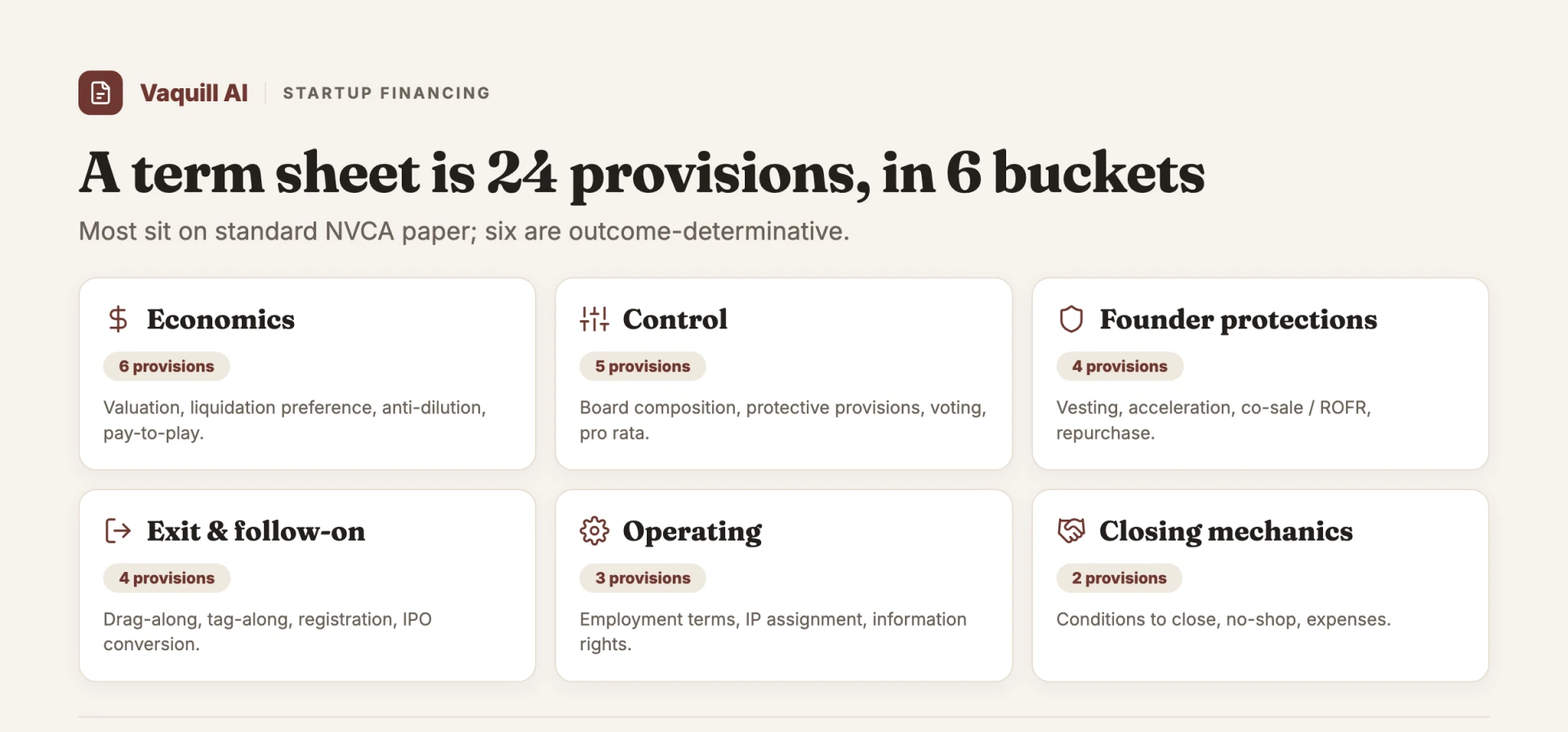
A term sheet is 24 provisions across six buckets; six of them decide the outcome.
The 24 provisions, in 6 buckets
The list is opinionated and ordered. Each bucket is what it sounds like; each provision has a short read on what it does and what the market is on it in 2026.
Items 10, 14, 19, 20, 21, and 22 are usually overlawyered (they sit on standard NVCA paper and almost nobody rewrites them). Items 2, 5, 7, 8, 16, and 24 are outcome-determinative and worth the negotiation budget.
Before the bucket-by-bucket read, here is the quick-reference table. The market-standard and red-flag columns are typical 2026 norms on a clean Series A, illustrative rather than universal; your lead, stage, and round heat all move them.
| Provision | Market-standard (typical) | Red flag | What to push for |
|---|---|---|---|
| Liquidation preference | 1x non-participating | 2x+, or participating with no cap | Hold 1x non-participating; cap participation at 3x if forced |
| Board composition | 2/2/1 at Series A | Preferred-majority board | Founder majority, or name the independent jointly |
| Anti-dilution | Broad-based weighted average | Full ratchet | Broad-based; if full ratchet, treat as a structured-round signal |
| Protective provisions | 10 to 14 structural matters | Operating-level consent (hires, budgets, small contracts) | Material decisions only; lift the consent thresholds |
| Drag-along | Dual-class consent + board approval + floor | Preferred-alone trigger, no floor | Add a 1x minimum-proceeds floor and a fiduciary-out |
| Expenses cap | $50K to $75K | Uncapped | Name a cap in the term sheet, not the definitive docs |
Economics (6)
-
Pre-money valuation. The headline number. The negotiation reference, not the negotiation. A $20M pre-money for $5M is a 20% post-money sale; the rest of the term sheet decides who actually keeps what at exit.
-
Liquidation preference. 1x non-participating is the NVCA default and the market standard in 2026. Participating preferred (the "double dip") is rare on a clean Series A and signals trouble on later rounds. Multiples above 1x belong in down rounds and structured recaps, not first-money-in. The waterfall math is the part founders underweight; we work an exit example in the liquidation preference math guide.
-
Participation rights. Linked to the preference. Non-participating = preferred picks the larger of preference or pro-rata; participating = preferred takes preference and then pro-rates the rest. A capped-participating fallback (e.g., 3x cap) is the negotiated middle when an investor will not give up participation.
-
Conversion. Each share of preferred converts to common at the conversion price, automatically at QPO or majority preferred vote. The drafting is mostly mechanical; the math matters when anti-dilution adjustments stack.
-
Anti-dilution. Broad-based weighted average is standard. Narrow-based weighted average tilts the math harder against the company; full ratchet reprices every existing preferred share at the new-round price and is the most aggressive form. If full ratchet appears on a Series A from a lead, it is a market signal worth asking about: structured rounds and distressed companies see it, clean leads usually do not.
-
Pay-to-play. If a preferred holder does not participate pro rata in the next down round, their preferred converts to common (or loses certain rights). NVCA has model language; it is back in 2024 to 2026 paper because down rounds are real again.
Control (5)
-
Board composition. The single most-fought clause after liquidation preference. A 2/2/1 (two common, two preferred, one independent) board on a $5M Series A is canonical. The independent is the swing seat; "mutually agreed independent" sounds neutral and almost never is in practice. Founder majority at Series A is the harder, more valuable fight.
-
Protective provisions. The list of matters requiring preferred consent: charter amendments, senior or pari passu issuances, mergers, asset sales, dividend payments, option pool increases above a threshold, indebtedness above a threshold. NVCA's standard list runs 10 to 14 items; the negotiation is the threshold and the carve-outs, not the existence.
-
Voting rights. Preferred votes on an as-converted basis with common, except where protective provisions or class votes apply. Standard. Watch for separate-class votes layered on top of protective provisions; those compound control.
-
Information rights. Quarterly and annual financials, budget, cap table. Limited to "major investors" (commonly $500K plus check). Mostly standard, occasionally over-asked.
-
Pro rata rights. Investor's right to participate in future rounds to maintain percentage ownership. Standard for major investors. Side-letter MFNs that grant pro rata to a smaller check on the back of a larger investor's terms is the pattern to watch.
Founder protections (4)
-
Founder vesting. Almost always reset at the Series A: 4 years, 1-year cliff, monthly thereafter. The negotiation is credit for time served and acceleration triggers.
-
Founder acceleration. Single-trigger (acceleration on change of control alone) is rare and worth pushing for on a fraction of unvested shares; double-trigger (change of control plus involuntary termination within 12 months) is standard and what most boards approve. Acceleration of 50% of unvested shares on double-trigger is a defensible ask on Series A.
-
Co-sale / right of first refusal on founder shares. The investor can buy or join in any proposed founder sale. Standard, governed by the NVCA Right of First Refusal and Co-Sale Agreement. Push back on permitted-transfer carve-outs (estate planning, family trusts) if missing.
-
Founder repurchase rights. The company's right to repurchase unvested shares at cost on termination. Standard. The lawyer's job is to confirm the price (cost, not FMV) and the trigger (any termination, not "for cause").
Exit and follow-on (4)
-
Drag-along. The clause that lets a majority force a sale on the minority. NVCA's October 2025 Voting Agreement update tightened the drag mechanics in light of Delaware fiduciary case law. Standard 2026 form: majority preferred plus majority common plus board approval, with a minimum-proceeds floor (often 1x the original purchase price across all classes). Drag triggered by preferred alone is a red flag. The full drafting walkthrough is in the drag-along provisions guide.
-
Tag-along. Co-sale. Often paired with the ROFR in the same agreement. Largely mechanical; for the carve-outs and drafting, see the right of first refusal guide.
-
Registration rights. Demand, S-3, piggyback. Long, dense, and rarely exercised. Run it against the NVCA Investor Rights Agreement and resist exotic asks (multiple demands, short lockup windows, expense reimbursement above NVCA defaults).
-
Conversion at IPO. Mandatory conversion of preferred to common at a qualified public offering. Standard. Check the QPO threshold (gross proceeds, share price); investors sometimes try to set it high enough to give them a veto on a smaller IPO path.
Operating (3)
-
Founder employment terms. At-will, base salary, target bonus, severance, post-termination IP and non-compete obligations. The Series A term sheet usually points at a separate agreement; the actual exposure lives there.
-
Confidentiality and IP assignment. Every employee and contractor on a PIIA (proprietary information and inventions assignment). A clean chain of assignment is table stakes at Series A; gaps surface in M&A diligence three years later.
-
Indemnification of directors. Standard for the investor directors. Run against the company's charter and bylaws to ensure consistency; D&O insurance is the practical backstop.
Closing mechanics (2)
-
Exclusivity / no-shop. 30 to 45 days standard. Stops the company from shopping the round once the term sheet is signed. Push back on anything longer; a 60-day exclusive in a hot round is unusual.
-
Expenses. Investor's legal and diligence costs paid by the company, capped at a number. Standard cap is $50K to $75K for a vanilla Series A; $100K appears on larger or more complex deals. Uncapped is a no. Investor-counsel diligence retainers above $100K usually mean the term sheet itself needs more diligence.
The 6 to fight hardest on
If the founder gives you 90 minutes, this is where the time goes.
1. Liquidation preference. Hold the line at 1x non-participating. On a $200M exit with $20M raised across two preferred rounds, the economic gap between 1x non-participating and 1x participating is roughly $20M coming out of the common stack. A 1.5x or 2x preference compounds the same way.
If the lead insists on participation, negotiate a cap (3x is the common ceiling) or trade participation for a lower pre-money. What actually happens in the room: a founder who has never seen a waterfall model agrees to "1x participating" because the lead frames it as "still just 1x"; counsel runs the $200M exit number on a one-page model the same call, the founder pushes back, and the lead drops to 1x non-participating in the redline.
The math does the negotiating.
2. Board composition. A 2/2/1 board on a Series A is the canonical answer; the independent seat decides everything. Founder-majority boards at Series A (3/2 common-favoring) are rare on lead-driven deals but achievable on club deals or in hot rounds, and when achievable they are worth meaningful pre-money concessions.
The board controls the CEO, the option pool, and the M&A vote. Scott Kupor's a16z explainer "The Economics of Term Sheets" walks through the same point: protective provisions plus board control are the governance half of the deal, and founders routinely trade one without understanding the other.
3. Anti-dilution. Broad-based weighted average is the default. Full ratchet is a red flag on a first lead in any market. If the investor will only do full ratchet, it is a structured-round signal: ask for a lower pre-money instead, or walk.
Narrow-based weighted average tilts the math against the company by excluding outstanding options from the share count; broad-based is what NVCA models, what Cooley GO templates default to, and what the market expects.
4. Protective provisions. Negotiate the list and the threshold. The NVCA default list is reasonable; what creeps in is micromanagement (consent for budgets, hires, individual contracts above $500K).
Push protective provisions toward material structural decisions (charter, M&A, senior issuances, dissolution) and away from operating consent rights. A founder who needs preferred consent to sign a $750K customer contract has effectively given the investor a CEO veto.
5. Drag-along. The NVCA's October 2, 2025 Voting Agreement update revised drag mechanics in light of recent Delaware case law on stockholder-level governance (the post-Moelis line). The defensible 2026 form: majority preferred + majority common + board approval + a minimum-proceeds floor of at least 1x original purchase price across all classes, and an express fiduciary-out for board approval.
Drag triggered by preferred alone, with no minimum-proceeds floor and no founder vote, is the structural risk most often raised in Series A redlines. What usually happens in the room: the investor offers "preferred-majority drag, board approval, no floor"; the founder's counsel counters "dual-class consent, board approval, 1x floor"; both sides settle on dual-class consent with a 1x floor and a clean fiduciary-out.
The compromise is workable; conceding both the floor and the dual-class consent in the same redline is not.
6. Expenses cap. Boring but real. An uncapped expense reimbursement on a $5M Series A with a slow investor counsel can eat $150K to $200K out of the round.
Cap it at $50K to $75K, named in the term sheet itself; do not leave it to the definitive agreements. If the investor's counsel runs over, that is the investor's problem.
What the October 2025 NVCA update actually changed
The NVCA released its 2025 model document update on October 2. Three changes matter for term-sheet review.
Tranched financings are now formally supported. Before October 2025, the standard NVCA Stock Purchase Agreement did not contemplate milestone-gated tranches; deals that wanted them papered around the model. The updated SPA includes an Annex framework for defining milestones and the mechanics of subsequent tranche closings.
The practical effect: tranched term sheets will become more common because the paper is now standardized. If a term sheet proposes a tranched structure, the milestone definitions are now the central negotiation. Ambiguous milestones ("achieve $X ARR" with no measurement period, "complete a hire of a VP" with no role definition) give the investor an unwritten right not to fund.
Drag-along mechanics tightened. Updated Voting Agreement language addresses post-Moelis Delaware case law on stockholder-level governance and director fiduciary duties. The cleaner 2026 drag includes board approval, dual-class consent, and an express fiduciary-out. Term sheets that point at "drag-along on standard terms" should now be read against the October 2025 Voting Agreement, not the prior form.
Outbound investment and bulk-data compliance. The 2025 update incorporates references to the Outbound Investment Security Program (Treasury rules implementing E.O. 14105, effective January 2, 2025) and to the bulk-data security regulations under E.O. 14117.
Companies with PRC investor exposure, or with US sensitive personal data at scale, will see new representations and covenants in the SPA. For term-sheet review, the practical question is whether any of the proposed investors is a "covered foreign person" and whether the company holds "covered data" under the Justice Department's bulk-data rule.
The AI-use clause you will see this year
A new line item is drifting into Series A stock purchase agreements: a rep and a covenant about the company's use of generative AI. Three shapes are common.
- A rep that the company's AI use does not infringe third-party IP and does not violate any privacy or AI-specific law (EU AI Act, Colorado AI Act, NYC Local Law 144 where applicable).
- A covenant to maintain an AI inventory and an AI-use policy approved by the board.
- An indemnification carve-out treating AI-related IP claims as a special indemnity, sometimes outside the general liability cap.
This started on the customer side in 2025, with vendor reps about training data and indemnities for AI output IP claims, and is now drifting onto the investor side. The drafting trap to watch: an unqualified rep that "the Company's products do not incorporate any AI output that infringes third-party intellectual property rights." That rep is unknowable at signing for any company shipping LLM-powered features, because the upstream model provider's training data is opaque.
The preferred fallback is a knowledge-qualified rep ("to the Company's knowledge, the Company's AI use does not infringe...") plus a discrete carve-out for IP claims arising from third-party foundation models, with the indemnity narrowed to the company's own fine-tunes and training data.
A target that fine-tuned on customer support transcripts in 2024 without DPA consent, or that runs an AI resume screener in NYC without a Local Law 144 audit, has problems an unqualified rep brings forward immediately. Surface them to the founder before signing.
The 30-minute review pass before the redline
The last pass before the redline goes back to investor counsel. The checklist version:
- Pre-money math. Run the post-money cap table. Convert any SAFEs and notes at the cap and discount, top up the pool to the target, and confirm the implied dilution matches what the founder thinks they are signing.
- Liquidation waterfall at three exit prices. Model the proceeds at 1x, 3x, and 10x the post-money on the proposed preference and participation terms. Show the founder the dollar number, not the percentage.
- Board count. Confirm seats, who picks the independent, and the protective provisions list. Three items only.
- Anti-dilution flavor. Broad-based weighted average? Yes. Anything else? Flag.
- Drag-along mechanic. Read against the October 2025 NVCA Voting Agreement. Confirm board approval, dual-class consent, minimum-proceeds floor, fiduciary-out.
- Expenses cap and exclusivity. Confirm numbers and dates. A 60-day no-shop is not standard.
- AI rep, if proposed. Stress-test it against actual company practice. If the company cannot make the rep at signing, kill it or qualify it now.
Thirty minutes if the term sheet is on a recognizable form, forty-five if it is a fund-bespoke template. Anything longer is either a bad term sheet or a deal worth a longer call before the redline.
The deals that go sideways three years later are almost always traceable to one of those seven items. The lawyer who runs the checklist every time is the lawyer the founder calls back at Series B.
FAQ
What is a term sheet review checklist? It is the ordered set of provisions counsel checks before redlining a VC term sheet, so nothing outcome-determinative gets signed by default. A working startup term sheet checklist covers the 24 provisions above and flags the 6 that move ownership, control, and exit economics: liquidation preference, board composition, anti-dilution, protective provisions, drag-along, and the expenses cap.
How long should a term sheet review take? About 30 minutes for a term sheet on a recognizable NVCA-style form, closer to 45 for a fund-bespoke template. The longer pass usually means either a non-standard term sheet or a deal worth a full call before the redline goes back to investor counsel.
What are the most important terms in a VC term sheet? Liquidation preference and board composition decide the most, followed by anti-dilution, protective provisions, and drag-along. Pre-money valuation is the headline number, but the rest of the term sheet decides who keeps what at exit, so a high valuation paired with participating preferred or a preferred-majority board can be the worse deal.
What is a normal liquidation preference for a Series A? 1x non-participating is the NVCA default and the typical clean Series A standard in 2026. Participating preferred or any multiple above 1x is uncommon on first-money-in and usually signals a structured or distressed round.
What is a red flag in a term sheet? Full-ratchet anti-dilution from a first lead, a drag-along triggered by preferred alone with no minimum-proceeds floor, participating preferred with no cap, a preferred-majority board, and an uncapped expense reimbursement. Any one of them is worth a direct question before signing.
What changed in the NVCA's October 2025 model documents? Three things matter for term-sheet review: tranched (milestone-gated) financings are now formally supported in the Stock Purchase Agreement, the Voting Agreement drag-along mechanics were tightened around recent Delaware case law, and the documents now reference the Outbound Investment Security Program and bulk-data security rules. Term sheets pointing at "standard" drag or tranche terms should be read against the new forms.
Should a founder negotiate every term on a term sheet? No. Spend the negotiation budget on the six high-leverage clauses and accept the standard NVCA language on the rest. A founder who redlines registration rights and information rights while conceding the drag-along floor has spent leverage in the wrong place.
Is a term sheet legally binding? Mostly no. Valuation, preference, and board terms are non-binding indications of the deal, but the exclusivity (no-shop) and confidentiality provisions are usually binding from signing, which is why the no-shop length is worth checking before you sign.
For related coverage on instrument choice and the dilution math behind it, see SAFE vs. Convertible Note vs. Priced Round: A 2026 Practitioner's Guide and The 409A Valuation Playbook for Corporate Counsel.
Vaquill AI runs this end to end: draft the redline, then run the 30-minute checklist above against a stack of term sheets, SAFEs, and side letters from one financing in a single pass with the Document Matrix.
New legal AI guides, weekly.
Further Reading
- Right of First Refusal (ROFR) Drafting in Venture Deals: A 2026 Guide
- Liquidation Preference Math in Venture Deals: A 2026 Walkthrough
- Drag-Along Provisions in Venture Deals: A 2026 Drafting Guide
- Delaware vs California vs New York Incorporation in 2026
- The 409A Valuation Playbook for Corporate Counsel
- Legal AI for Corporate Counsel: Deals, Diligence, and Entity Work in 2026

Co-Founder & CEO · Attorney
Arshita leads product and strategy at Vaquill AI, the US primary law data API. As an attorney, she decides which law we carry, how each section is sourced and cited, and what legal AI and compliance teams need from the data.