A few years ago, due diligence on a mid-market acquisition meant a windowless room, a stack of bankers boxes, and three junior associates billing past midnight to confirm that yes, the target had assigned its IP correctly and no, there was no change-of-control trap waiting in the lease.
The room is gone now. The boxes are a data room. And the associates, if the firm is any good, are no longer reading every page. Software reads the pages. The associates read the software.
That shift is the entire story of AI and corporate law in 2026, and it is more interesting than the headlines suggest. The headline version says AI is coming for transactional lawyers.
The real version is narrower and more useful: AI has already won the mechanical layer of corporate practice, extraction, triage, first-pass markup, the boring document plumbing, and it has barely touched the layer that actually pays, which is judgment about what a deal means and which risks are worth taking.
If you run a corporate or transactional practice, the question is no longer whether to adopt. The adoption already happened around you. The question is what you are actually buying when you buy it.
TL;DR
- Corporate AI adoption roughly doubled in a year. ACC and Everlaw's 2025 survey of 657 in-house professionals found generative AI use jumped from 23% in 2024 to 52% in 2025.
- The savings haven't fully landed. In that same survey, 64% expect AI to reduce reliance on outside counsel and half expect lower outside-counsel costs, yet roughly 60% report no noticeable savings yet. Adoption is ahead of payoff.
- AI owns the mechanical layer. Clause extraction, diligence triage, CLM metadata, first-pass redlines. This is genuinely solved enough to deploy.
- AI does not own the allocative layer. Which risk to accept, which carve-out to fight for, what posture to take. That is still a lawyer's call, and the law (ABA Formal Opinion 512) treats it that way.
- Diligence is a reconciliation problem, not a search problem. This is where single-document chat breaks and a multi-document grid wins.
- Buy AI for leverage on volume, not as a substitute for the call. The floor drops to near zero. The premium on judgment goes up, not down.
How much did generative AI use in corporate legal change in twelve months?
Part of our corporate and transactional lawyer playbooks.
The number that actually matters
Most AI-and-law statistics are vendor marketing dressed as research. This one isn't. The Association of Corporate Counsel and Everlaw surveyed 657 in-house legal professionals across 30 countries in 2025, and the finding worth tattooing on the wall is the adoption curve: generative AI use in corporate legal more than doubled in twelve months, from 23% in 2024 to 52% in 2025.
That is a fast curve for a profession that still faxes things. But the more honest number is the one underneath it. In the same survey, 64% of respondents expected AI to reduce their reliance on outside counsel and half expected lower outside-counsel spend, yet roughly 60% reported no noticeable cost savings yet.
Hold those two facts together, because the gap between them is the whole 2026 story. Adoption is real. The payoff is lagging.
That is not a sign the technology failed. It is a sign that buyers are still figuring out which layer of their practice AI is actually good at, and they are pointing it at the wrong layer often enough that the savings leak out.
The ACC number is not an outlier. Clio's 2025 Legal Trends Report found 79% of legal professionals now use AI in some form, and firms with wide AI adoption were nearly three times more likely to report revenue growth. Two surveys, two methods, the same direction: corporate legal has moved from experimenting to using.
The mechanical layer: solved enough to ship
Start with where AI genuinely earns its keep, because it is not subtle and it is not in dispute.
Diligence triage. Point a model at a 2,000-document data room and ask it to surface every assignment clause, every change-of-control provision, every most-favored-nation term, every contract that expires inside the deal window. A first-year used to do this with a highlighter and a prayer. The model does it in an afternoon, and it does not get tired on document 1,400.
Clause extraction. Pull the indemnification cap, the governing-law clause, the termination-for-convenience window, the survival period, into a structured field you can actually sort and compare. This is the capability that quietly replaced Ctrl+F, and it is the foundation everything else sits on. We covered the mechanics of this for review specifically in our guide to AI contract review.
First-pass redlines. Feed the model your playbook, your fallback positions on liability, your non-negotiables, and it will mark up an incoming NDA or vendor MSA against them. Not perfectly. But well enough that a lawyer is editing instead of starting from a blank page.
CLM metadata. Contract lifecycle management platforms now auto-tag renewal dates, counterparties, and obligations on ingest. The pitch is a self-maintaining contract repository that tells you what you signed and when it lapses.
Every one of these is a reading-and-extraction task. That is not an accident. Reading and extraction is exactly what large language models are good at, and corporate practice is drowning in both.
The reason adoption doubled is that this layer was always the most tedious, most leverageable, and most obviously automatable part of the job.
| Layer | What AI does | Who decides |
|---|---|---|
| Mechanical (extraction, triage, first-pass markup) | Reads every page, surfaces every clause, tags every metadata field | The tool, with light human review |
| Allocative (which risk to accept, which carve-out to fight for) | Surfaces the facts the decision rests on | The lawyer, every time |
The allocative layer: still human, and the law says so
Here is where the headlines fall apart.
Extraction tells you the indemnification cap is $2 million. It does not tell you whether $2 million is acceptable given that the target's largest customer represents 40% of revenue and the contract has a 90-day termination-for-convenience clause that the AI dutifully extracted but did not connect to anything.
The model can read every word. It cannot decide what the words are worth to your client.
That is the allocative layer: which risk to accept, which carve-out to fight for, where to spend negotiating capital, what posture the deal actually calls for. It is the part clients pay real money for, and it is exactly the part current AI does not do.
Not because the engineers are lazy. Because deciding is a different kind of problem than reading, and dressing up a clause-spotter as a deal-maker is the central category error of the 2026 hype cycle.
The law has already drawn this line. The cautionary tale everyone cites is Mata v. Avianca from 2023, where lawyers filed a brief full of cases ChatGPT had invented and got sanctioned for it.
The lesson people take from it is "AI hallucinates," which is true but shallow. The deeper lesson is that the duty to verify, to exercise judgment over the output, never transferred to the machine.
The ABA made that explicit in Formal Opinion 512 in July 2024: your competence and supervision obligations extend to generative AI output. You own the work product. The tool is an associate who never sleeps and occasionally lies with total confidence, and you supervise it exactly as much as that description implies.
So the framing that actually holds up is this. AI compresses the document-handling floor of corporate practice toward zero. When the floor drops, the premium does not vanish. It moves up the stack, to the judgment that was always the point.
The lawyer who treats AI as a way to do more reading is missing it. The lawyer who treats it as a way to spend more time on the call that only they can make is using it correctly.
What most people get wrong
Three mistakes show up over and over, and each one is a buyer pointing AI at the wrong layer.
Mistake one: conflating extraction with judgment. A clause-spotter is sold, and sometimes bought, as a deal advisor. It is not. It surfaces the change-of-control provision flawlessly and has no opinion on whether you should accept it. Treat extraction as input to a decision, never as the decision.
Mistake two: believing CLM "AI" closes the loop. Contract lifecycle platforms market AI as the thing that finally makes the repository self-managing. In practice, a large share of CLM implementations still stall on the same boring rocks they always did: dirty legacy data, inconsistent templates, and processes nobody follows.
The AI layer is only as good as the data underneath it, and most repositories are a graveyard of PDFs scanned crooked in 2014. We mapped the current vendors, Ironclad, DocuSign CLM, ContractWorks and the rest, in our 2026 CLM breakdown. The tools are real. The "AI closes the loop" promise mostly isn't, not yet.
Mistake three: treating diligence as a search problem. This is the subtle one, and it is where most general-purpose AI tools quietly fail corporate work. If you think diligence is "find the relevant clauses," single-document chat looks fine. You upload a contract, you ask about it, you get an answer.
But real diligence is a reconciliation problem. The representations in the purchase agreement have to square with what the actual customer contracts say, which have to square with the disclosure schedules, which have to square with the cap table. The risk almost never lives in one document. It lives in the contradiction between documents.
Single-document chat cannot see that contradiction because it only ever holds one document in view at a time. What you need is a grid: dozens of documents down one axis, the dimensions you care about across the other, every cell extracted and sitting next to every other cell so the inconsistency jumps out.
That structure is what a document matrix does, and it is the single biggest reason corporate diligence needs purpose-built tooling rather than a chatbot with a file-upload button. The grid is where "these forty NDAs are identical except three have a survival period nobody flagged" becomes visible in one glance.
What the output actually looks like
Skip the recipe. Here is a real slice of what extraction produces across a set of target customer contracts, the kind of grid that turns a 2,000-document data room into a few rows worth arguing about.
| Contract | Change-of-control clause | Termination for convenience | Liability cap | Flag |
|---|---|---|---|---|
| MSA, Acme Corp (top customer) | Consent required on assignment | 90 days, either party | Fees paid in prior 12 months | Top customer can walk post-close on 90 days' notice |
| MSA, Beta LLC | Silent on change of control | None | Fees paid in prior 36 months | Cap is 3x the others; renegotiate |
| Reseller, Gamma Inc | Auto-terminates on assignment | 30 days, counterparty only | Uncapped for IP indemnity | Deal-blocker: assignment kills the contract |
The model populates every cell. It does not tell you that the Acme row is the one that should change your purchase-price assumptions, because the largest customer leaving on 90 days' notice is a revenue question, not a clause question. That judgment is yours. The grid just makes sure you are looking at the right three rows instead of reading 2,000 documents to find them.
The market is consolidating around this distinction
You can see the same line being drawn in how the market is buying and building.
Thomson Reuters bought Casetext for $650 million in 2023, folding an AI-native research and drafting layer into a legacy data empire. The AI-native incumbents, Harvey, Legora, CoCounsel, raised and sold hard into exactly the diligence-and-drafting use case, with pricing aimed squarely at large firms with large budgets.

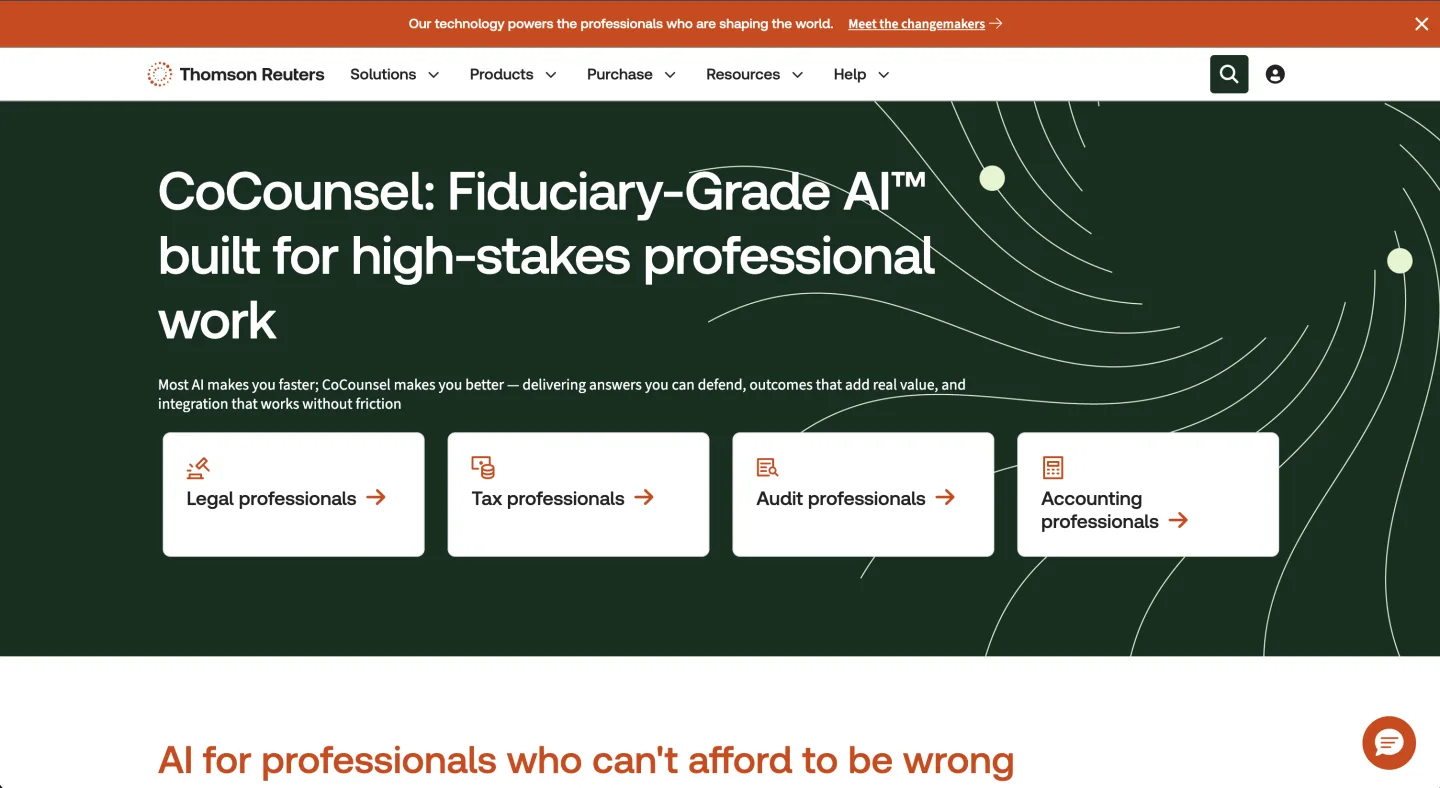
The consolidation tells you the mechanical layer is now table stakes; everyone has clause extraction, so the competition has moved to workflow, integration, and trust.
It also tells you something about cost. The premium AI suites are priced for AmLaw economics. A solo or a fifteen-lawyer corporate boutique does not need, and cannot justify, a per-seat number built for a firm with a thousand associates.
That mismatch is real, and it is why the more interesting 2026 question for most firms is not "Harvey or CoCounsel" but "what can I get for what I can actually spend."
One technical point separates the tools that hold up from the ones that embarrass you in a filing. Grounding. A model that generates an answer from its training is the one that invents cases. A model that retrieves the actual source and answers from it, retrieval-augmented generation, can show you the clause it relied on so you can verify it.
For corporate work, where the source documents are the data room and the answer is only as good as the citation behind it, grounding is not a nice-to-have. It is the difference between a tool you can put in front of a client and one you cannot. We wrote up why grounding rather than training is the thing that matters if you want the mechanics.
A note on statutes, which corporate lawyers actually live in
Transactional practice is statute-and-regulation-heavy in a way litigation often isn't. Merger disclosure runs through SEC Regulation M-A. Confidential treatment of filed material runs through provisions like 17 C.F.R. § 240.24b-2. The item requirements for merger disclosures live in places like 17 C.F.R. § 229.1011.
These are not cases you argue; they are rules you comply with, and the text changes more often than anyone enjoys tracking.
This is the one place a programmatic statutes layer genuinely earns its spot in a corporate stack: pulling the current text of a U.S. Code section, a CFR provision, or a state code clause on demand, version-aware, instead of trusting a half-remembered citation.
Honest scope is the useful scope: a statutes-only API does exactly this and only this, statutes and legislation across the U.S. Code, the CFR, and all fifty state codes. It is deliberately not a case-law or deal-judgment engine, because those are not things an API should pretend to decide for you.
Entity management and governance: the quieter half of the job
Diligence and contract review get the headlines, but a lot of corporate practice is housekeeping: keeping the entity org chart current, tracking who can sign what, calendaring annual filings, and making sure the board minutes match the resolutions that were actually passed. AI for corporate lawyers shows up here too, and the wins are smaller but more reliable than the deal-side hype.
Entity management. Cap tables, subsidiary charts, and signing authorities drift the moment a deal closes or a director resigns. Extraction tooling can read a stack of formation documents, bylaws, and stockholder agreements and reconcile them into one structured view, the same grid logic that works for diligence applied to the entity itself. It still needs a human to confirm the source documents are complete; a tidy chart built on a missing side letter is worse than no chart.
Governance documents. First drafts of routine board consents, written resolutions, and standard committee charters are now playbook-driven generation tasks. The lawyer edits the posture, the AI handles the boilerplate. This is the same first-pass-redline pattern, pointed at governance instead of commercial contracts.
Board oversight of AI itself. The newer governance question is not how lawyers use AI but how boards supervise the company's use of it. The National Law Review's 2026 predictions flag AI governance and oversight as a rising board-level duty, and corporate counsel are increasingly the people drafting the AI-use policies, vendor-diligence checklists, and risk disclosures that go with it. That is net-new corporate work the technology created rather than removed.
How to actually deploy this
If you are sizing up AI for a corporate practice in 2026, three rules will save you most of the pain other buyers walked into.
Buy for leverage, not substitution. The win is compressing the document-handling floor so your people spend their hours on judgment. If your business case rests on replacing the judgment itself, you have bought the wrong thing and you will end up in the 60% reporting no savings.
Match the tool to the layer. Use extraction and matrix tooling for diligence and triage. Use playbook-driven markup for first-pass redlines. Use grounded research for the law underneath the deal. Do not ask a single chat box to do all three; that is how reconciliation problems become search problems and risks slip through.
Keep a human on the allocative call, in writing. Not because the AI is dumb, but because Opinion 512 and your malpractice carrier both expect it, and because the call was always where your value lived. Verify the citations before they go in a filing. Read the software; do not just trust it.
The associates left the windowless room. The judgment didn't go with them.
If anything, now that the boxes are gone and the reading is cheap, the judgment is the only thing left that anyone is actually paying for.
FAQ
How is AI used in corporate law? Mostly for reading and extraction at scale: M&A due diligence triage across a data room, clause extraction into sortable fields, first-pass redlines against a playbook, CLM and entity metadata, and first drafts of routine governance documents. It also helps pull current statute and regulation text on demand. It does not decide which risks to accept; that stays with the lawyer.
Will AI replace corporate lawyers? No, but it changes the work. AI compresses the document-handling floor toward zero, so the premium moves up to judgment: deal posture, risk allocation, negotiation, and client counsel. The real risk is not replacement but falling behind lawyers who use the leverage. See legal AI for corporate counsel for how the role shifts.
How does AI help with M&A due diligence? It reads every document in the data room and surfaces the clauses that matter (change of control, assignment, termination, liability caps) into a grid you can reconcile across contracts. Practitioner reports put first-pass review that took two to three weeks of associate time at roughly 24 to 48 hours with AI plus attorney review. The M&A due diligence checklist shows where it fits in the workstream.
Is it ethical for lawyers to use AI in corporate work? Yes, with supervision. ABA Formal Opinion 512 (July 2024) confirms that competence, confidentiality, and supervision duties extend to generative AI output. You own the work product and must verify it, which is why lawyers were sanctioned in Mata v. Avianca (2023) for filing AI-invented cases.
Can AI review a term sheet or contract on its own? It can produce a strong first pass: flag off-market terms, compare against your standards, and draft markups. It cannot make the call on which positions to concede, so a lawyer still owns the final review. Our term sheet review checklist and AI contract review guide cover the workflow.
What AI tools do corporate lawyers use in 2026? The AI-native suites (Harvey, Legora, CoCounsel) target large-firm diligence and drafting budgets, while CLM platforms (Ironclad, DocuSign CLM, ContractWorks) add extraction on the contract-management side. Pricing is built for AmLaw economics, so smaller corporate teams should match the tool to the layer rather than buy the biggest suite.
Does AI hallucinate in legal work, and how do you prevent it? Yes. Models that generate from training data can invent citations. The fix is grounding: tools using retrieval-augmented generation answer from the actual source document and show the clause they relied on, so you can verify it. See why grounding beats training.
For related diligence and drafting coverage, see M&A Due Diligence: The Legal Workstream Checklist for 2026 and Drafting the Schedule of Exceptions in an M&A Deal.
For more on grounded statute and regulation workflows, see the US primary law API.
New legal AI guides, weekly.
Further Reading
Can AI Interpret Statutes? How Statutory Interpretation Works With AI
Read postLegal AI Tools for Solo Practitioners: 7 Picks That Fit a One-Person Firm
Read postPersonal Injury AI in 2026: What It Actually Does for Plaintiff Lawyers
Read post7 Ways AI Helps Personal Injury Lawyers Win Cases Faster
Read postAI Law Search Engine vs Keyword Search: Find Case Law Faster
Read postWhat Is NDA Triage? How Lawyers Sort Inbound NDAs in Minutes With AI
Read post
Product & Content
Legal AI suite for US working lawyers: research, drafting, document comparison, document matrix, matters, and citation-verified answers, in one tool.