
The schedule rarely breaks in the first draft. It breaks at 11 p.m. on Wednesday when the reps article gets renumbered for a new cybersecurity rep and nobody updates cross-references. Or two years later when the buyer's litigation counsel finds the entry that pointed at "the Project Falcon data room" rather than the actual document. Or in mediation when the seller argues a disclosure under Section 3.14 also satisfies Section 3.18 and the schedule said nothing of the kind.
The reps in a private-company purchase agreement read like absolute statements. The schedule of exceptions, sometimes called the disclosure schedule or disclosure letter, turns the absolutes into something the seller can stand behind.
The ABA Private Target M&A Deal Points Study confirms what deal counsel already know: every reviewed agreement carries a schedule, and sandbagging incidence keeps drifting toward pro-sandbagging. The schedule is where the entire allocation of pre-closing risk actually lives.
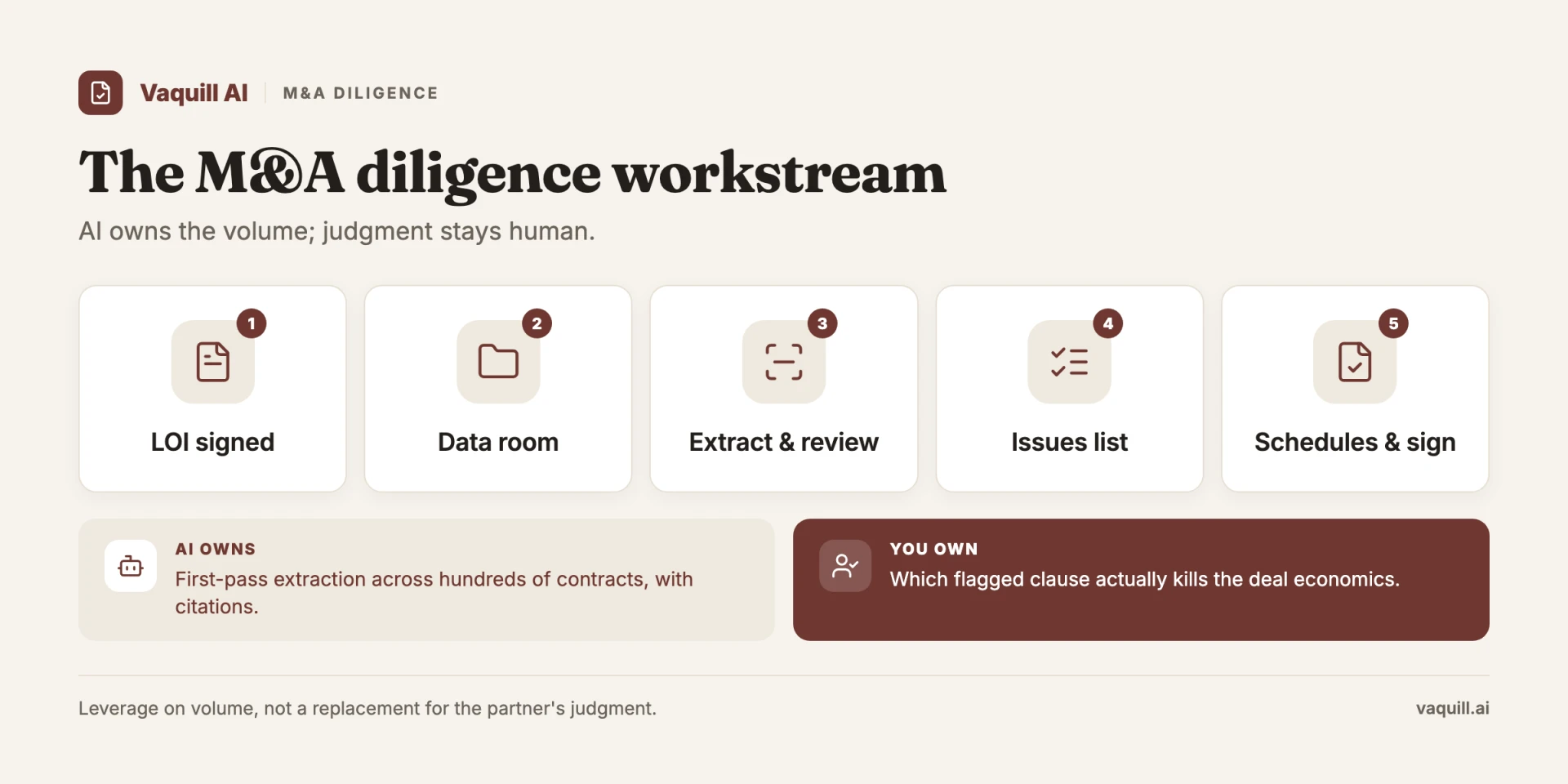
AI owns extraction and first-pass review; judgment on what kills the deal stays human.
Short answer: Disclosure schedules (also called the schedule of exceptions or disclosure letter) are the annex to an M&A purchase agreement that qualifies the seller's representations and warranties. Each rep reads as an absolute statement "except as set forth in Schedule X.Y," and the schedule lists the exceptions section by section. They allocate pre-closing risk: a properly disclosed item shifts that risk to the buyer, and an omitted item stays with the seller.
TL;DR
- The schedule of exceptions modifies the reps in the purchase agreement. Without it, the seller is making absolute statements it cannot back. With it, the reps read "except as set forth in Schedule X.Y."
- Structure: organized by reference to the section of the agreement the disclosure modifies, in section order.
- Four categories: statutory exceptions, knowledge-qualified disclosures, materiality-threshold disclosures (above $X, lasting more than Y months), and catch-all references.
- Cross-section anti-sandbagging language inside the schedule, stating a disclosure under one section also qualifies any other to which it is reasonably apparent on its face, is what separates a working schedule from a malpractice claim.
- Coordinate with the 10b-5 rep. The full-disclosure rep makes the seller liable for omissions that render any statement misleading; the schedule has to address everything that would make any rep misleading.
When an M&A agreement is silent on sandbagging, which way does Delaware lean?
Part of our corporate and transactional lawyer playbooks.
What the schedule actually does
A representation is a statement of fact by the seller as of signing and closing. A warranty is a promise the statement is true. The two collapse into one block called the representations and warranties, often forty to eighty pages in a serious transaction.
Read them cold and they are unbearable. "The Company is not a party to any contract that would, after the closing, restrict the buyer from conducting business in any geography." That cannot be literally true.
There is a non-compete in some 2017 distribution agreement nobody has thought about, and an exclusivity in the contract with the largest customer.
The fix: the rep does not say "is not a party." It says "except as set forth in Section 3.14 of the Schedule of Exceptions, the Company is not a party." The schedule lists, under 3.14, the contracts that fall within the carve-out.
Sign the deal, and the seller is bound by what the schedule says, not the absolute words of the rep.
How to structure it
The schedule is organized by reference to the section the disclosure modifies, in section order: 3.1 first, then 3.2, then 3.3, through the reps article. A working schedule is a long Word document with one heading per rep that has any disclosure.
Reps with no disclosure either get no heading (cleaner) or a "None" heading. Either works as long as you are consistent, because mixing creates uncertainty about whether the absence of a heading means "no disclosure" or "we forgot."
The ABA Model Stock Purchase Agreement with Commentary, published by the ABA's Mergers and Acquisitions Committee, treats the schedule as a separately bound annex. So does Kling and Nugent's Negotiated Acquisitions of Companies, Subsidiaries and Divisions, the working reference for private-company M&A.
Separately bound and separately initialed at closing is harder to lose and easier to track across drafts than exhibits stapled to the back of the agreement.
The four categories of disclosures
A schedule entry is doing one of four things. Confusing them is where deals go wrong.
Statutory exceptions. The rep says "except as set forth in the Schedule," and the schedule contains the carve-out. The cleanest category.
The rep says "the Company is not party to any agreement that would prohibit a change of control without consent except as set forth in Section 3.14 of the Schedule." The schedule, under 3.14, lists the three change-of-control consent requirements. The buyer has notice that those three consents will need to be obtained or waived.
Knowledge qualifiers. The rep is qualified by knowledge: "to the Seller's Knowledge, there is no pending or threatened litigation." The schedule lists what the seller knows: "Pending: the Acme v. Company action filed S.D.N.Y. March 4, 2025. Threatened: a letter dated April 12, 2026 from counsel for X demanding mediation."
The qualifier limits the universe the seller is on the hook for; the schedule discloses the subset within it.
Materiality thresholds. The rep applies only above a stated dollar amount or time horizon. "The Company is not party to any contract requiring annual payments in excess of $250,000 except as set forth in Section 3.14." The schedule lists every contract above the threshold.
If a sub-threshold contract turns out to matter, the seller did not breach, because the rep did not cover it. A threshold too low buries the schedule in noise. Too high invites the buyer to argue post-closing that something material was omitted.
Catch-all references. General references to the data room or documents previously delivered: "all documents made available to Buyer in the Project Falcon data room as of 11:59 p.m. on June 6, 2026 are incorporated by reference into this Schedule." Delaware courts have generally declined to give broad references the protective effect sellers hope for.
Cobalt Operating LLC v. James Crystal Enterprises, LLC, decided by Vice Chancellor Lamb of the Court of Chancery in 2007, is the case buyers cite when they argue a vague reference is no reference at all. The takeaway is not "data-room references never work"; it is that they cannot carry the items most likely to produce a claim. Name the document and the rep for anything material.
The Delaware sandbagging question
Lurking under every schedule is the question of what happens when the buyer already knew about the problem the schedule failed to disclose. The buyer's diligence found pending litigation; the seller forgot to schedule it; closing happens; a year later the litigation goes badly. Can the buyer recover under the indemnity, even though it knew?
That is the sandbagging question, and it has three possible answers depending on drafting.
The pro-sandbagging answer is that the buyer's knowledge is irrelevant. The seller made the rep. The rep was inaccurate. The buyer paid for the rep. This is buyer-friendly and, in the experience of most deal counsel, the market default in private-company deals north of mid-market.
The anti-sandbagging answer is that the buyer cannot recover if it had knowledge of the inaccuracy at signing or closing. The rep is conditioned on the buyer's good-faith ignorance. Seller-friendly, common in deals where the seller has leverage or the buyer is a strategic with deep diligence.
The third answer is silence. The agreement says nothing, and the question falls to background state law. Delaware, the forum that matters most because most targets are Delaware corporations, leans pro-sandbagging when the agreement is silent.
Eagle Industries, Inc. v. DeVilbiss Health Care, Inc., 702 A.2d 1228 (Del. 1997), is read for the proposition that pre-signing buyer knowledge does not automatically defeat a breach-of-warranty claim, and Cobalt extends the logic. The Court of Chancery sharpened the point in In re Dura Medic Holdings, Inc. Consolidated Litigation, a February 20, 2025 opinion by Vice Chancellor J. Travis Laster, which confirmed that a buyer's pre-closing knowledge does not defeat an indemnification claim because "a breach of contract claim is not dependent on a showing of justifiable reliance" and the reps "serve an important risk allocation function" (Harvard Law School Forum on Corporate Governance, April 2025; Mayer Brown, March 2025). The practical takeaway: under silence, the buyer's claim survives in Delaware most of the time, which is why sellers refuse to leave the clause out and why sophisticated buyers fight for express pro-sandbagging language anyway.
Kling & Nugent and the PLI securities-acquisitions treatise treat the sandbagging clause as a top-five negotiated provision. Whichever side wins, the seller has every reason to be precise: under anti-sandbagging, you want disclosed items recorded where the buyer cannot deny seeing them; under pro-sandbagging, anything not disclosed is a recovery risk.
Sellers who treat sandbagging as a partner-level fight and the schedule as an associate-level chore are doing it backwards.
One drafting point follows directly from Dura Medic: the integration clause does the heavy lifting. A standard integration clause stops the seller from arguing that something the buyer learned outside the four corners of the deal (a site visit, a diligence call, an email thread) modified the reps. Only what lands in the agreement and its schedules counts. That is why a disclosure has to live on the schedule itself to have legal effect, and why a data room reference alone is so weak.
Updating the schedule between signing and closing
When the deal signs and closes on the same day, the schedule is fixed. When there is a gap (a sign-then-close deal waiting on antitrust clearance or a third-party consent), the question becomes whether the seller can update the schedule for things that happen in the interim, and whether an update changes the buyer's recovery.
The answer is a negotiated right, not a default. Three positions are common: no updates (the closing-date reps must be accurate as of signing, all interim risk on the seller); updates allowed for disclosure but not for indemnity (the buyer sees the new fact but keeps its claim if it is also a closing condition failure); and updates that cure both the rep and the indemnity (most seller-friendly, rare in buyer-driven deals).
A buyer that agreed to an anti-sandbagging clause should resist any update right that lets a late disclosure create knowledge and extinguish a claim in the same move. Tie the update mechanic to the bring-down condition and the indemnity carve-outs, and say in the agreement exactly what an update does and does not do.
The 10b-5 rep and why it changes the schedule
Most private-company purchase agreements contain a 10b-5 representation, named after Rule 10b-5 under the Securities Exchange Act of 1934. The rep typically reads: no representation or warranty by the Seller contains any untrue statement of a material fact, or omits to state a material fact necessary in order to make the statements contained therein, in light of the circumstances under which they were made, not misleading.
The 10b-5 rep catches omissions. A specific rep covers what it says. The 10b-5 rep covers what was not said but should have been to keep the said things from being misleading.
Under specific reps alone, a disclosure under 3.14 is needed only to make 3.14 accurate. Under a 10b-5 rep, every disclosure has to be considered against every rep, because anything material the seller knows that is not on the schedule risks an omission claim. Buyers insist on it because it is the firewall against a seller technically complying with each individual rep while leaving something materially wrong off the schedule.
The 10b-5 rep is the strongest argument for cross-section disclosure language inside the schedule itself. Practitioners draft a front-of-schedule paragraph along these lines: "Any matter disclosed in any section of this Schedule shall be deemed disclosed for purposes of any other section to which the relevance of such disclosure is reasonably apparent on its face."
That one sentence saves you from the buyer arguing post-closing that a disclosure under 3.14 does not satisfy 3.18 because it was filed in the wrong place. Sophisticated buyers counter by narrowing "reasonably apparent" to "expressly cross-referenced," and the negotiation lives or dies on whether the seller keeps the broader formulation.
Common drafting failures
The same mistakes repeat across deals, whether $50 million or $500 million.
Vague references that do not survive litigation. "See the data room" with no specification. Cobalt held a reasonable buyer is not required to comb a data room for items the seller had an affirmative duty to disclose. Name the document, the rep, the carve-out.
Wrong section numbers. The reps article gets renumbered the day before signing because the buyer added a cybersecurity rep. The schedule still points to Section 3.14 when the rep on customer consents is now at 3.16. A search-and-replace fixes it, but only if someone is checking, and at 2 a.m. before signing nobody is checking.
Section-only disclosure where cross-section was needed. The schedule discloses an item under 3.14 (material contracts), and the item also implicates 3.18 (litigation, because the contract is being disputed). The buyer post-closing argues the disclosure does not satisfy 3.18 because it was not made there. Without cross-section anti-sandbagging language, the argument has legs.
Failure to coordinate with the 10b-5 rep. Sellers focus on the individual reps and forget the catch-all. A schedule rigorously accurate on each section can leave the seller exposed under 10b-5 for the thing nobody put on any section.
The fix is a final-pass review: is there anything we know that would make any of these reps misleading if a court read them together? If yes, schedule it somewhere and cross-reference it.
Three things junior deal counsel get wrong
Treating the schedule as fill-in-the-blanks instead of drafting. The schedule is not a form. Every entry is a tactical call about what to say, how much, and where. A junior who treats each rep as "what items go here" rather than "what is the right level of disclosure for this risk" produces a schedule over-disclosed in the boring places and under-disclosed in the dangerous ones.
Confusing knowledge-qualified reps with absolute reps. A knowledge-qualified rep gets a different schedule. The seller is disclosing what it knows, not what exists.
A junior who treats them the same will either over-disclose (eroding the qualifier) or fail to disclose actually-known items because they did not feel "actual enough." Map every rep against its qualifier before drafting the entry.
Not building the cross-reference table. Senior deal counsel keep a private spreadsheet mapping every rep against every other rep that touches the same factual area: litigation, contracts, IP, employees, taxes. That spreadsheet is how you spot the disclosure that needs to live in three places. Juniors who work rep-by-rep produce schedules that satisfy individual sections and fail the integration test.
Lower-middle-market vs sponsor-backed deals
The schedule looks different in the two segments. In sponsor-backed deals, sellers push for narrow reps and short schedules and lean on R&W insurance to absorb residual risk; the underwriter, not the schedule, is the firewall.
In lower-middle-market deals without R&W coverage, schedules balloon: every operational anomaly gets disclosed because the indemnity escrow is the only recovery vehicle and over-disclosure is the seller's hedge against being read narrowly. Knowing which segment you are drafting for is the difference between defensive and indefensible work.
The 24-hour pre-signing checklist
In the day before signing, deal counsel runs five passes in order: (1) confirm every section number in the schedule matches the current numbering of the reps article; (2) check every materiality threshold matches the rep it modifies; (3) regenerate the cross-reference table mapping every disclosed item against every rep it touches and confirm cross-section language covers the gaps; (4) re-read the schedule against the 10b-5 rep; (5) confirm every catch-all reference names a specific document, not a folder.
Anything caught here is corrected in red lines that night. Anything missed is the dispute the litigators will be reading two years later.
FAQ
What is a schedule of exceptions in an M&A deal? It is the annex to a purchase agreement that lists the exceptions to the seller's representations and warranties, section by section. The reps read as absolute statements "except as set forth in Schedule X.Y," and the schedule supplies the carve-outs. It is also called the disclosure schedule or disclosure letter, and it is incorporated into the agreement by reference.
What is the difference between disclosure schedules and the schedule of exceptions? None in practice. The terms are used interchangeably for the same document. Some practitioners reserve "schedule of exceptions" for the entries that qualify a rep and "disclosure schedule" for the broader annex that also includes affirmative lists the reps require (all real property, all benefit plans). The legal effect is the same: both modify the reps.
How are disclosure schedules organized? By reference to the section of the agreement each disclosure modifies, in section order: 3.1, then 3.2, then 3.3, through the reps article. Each rep with a disclosure gets a heading; reps with nothing to disclose either get no heading or a "None" entry, applied consistently so a reader can tell "no disclosure" from "we forgot."
What is the difference between a list schedule and an exception schedule? A list schedule answers a rep that affirmatively requires an inventory (list all real property, all material contracts, all registered IP). An exception schedule carves out a fact that would otherwise breach an absolute rep (there is one pending lawsuit, one contract restricts a change of control). Many schedules contain both kinds across different sections.
Can a disclosure schedule be updated after signing? Only if the agreement grants an update right, which is negotiated. In a same-day sign-and-close there is no gap to update. In a sign-then-close deal, the parties decide whether an interim update is allowed and whether it affects the buyer's indemnity. A buyer with anti-sandbagging protection should resist updates that create knowledge and kill a claim in one step.
What is sandbagging in an M&A disclosure schedule? Sandbagging is a buyer recovering under the indemnity for a breached rep even though it knew about the problem before closing. A pro-sandbagging clause says the buyer's knowledge is irrelevant; an anti-sandbagging clause bars recovery for known issues. When the agreement is silent, Delaware leans pro-sandbagging, confirmed in In re Dura Medic Holdings (Del. Ch. Feb. 20, 2025).
What is the 10b-5 representation and how does it affect the schedule? The 10b-5 rep, named after Rule 10b-5 under the Securities Exchange Act of 1934, is a full-disclosure rep: no rep contains an untrue statement of material fact or omits a material fact needed to keep the statements from being misleading. It catches omissions, so every material fact the seller knows has to appear on the schedule somewhere, even if it does not fit neatly under one rep.
Who drafts the disclosure schedules? The seller and seller's counsel do the bulk of it, because the seller holds the underlying facts. Counsel maps each rep to the items that belong under it, sets the level of disclosure, and runs the cross-reference and 10b-5 passes. Buyer's counsel reviews the schedule against the reps and the diligence record and negotiates the gaps.
Drafting the schedule from structured data
Where the schedule pulls from a data room of forty or eighty contracts, Vaquill AI's Document Matrix extracts the change-of-control, consent, and threshold terms across the whole set at once, so the disclosure entries start from structured data instead of a manual read of each agreement. You can try it on a real data room before the next signing week.
For related diligence and deal-doc coverage, see M&A Due Diligence: The Legal Workstream Checklist for 2026, the Term Sheet Review Checklist for Corporate Counsel, and AI and Corporate Law in 2026.
New legal AI guides, weekly.
Further Reading
- M&A Due Diligence: The Legal Workstream Checklist for 2026
- The 409A Valuation Playbook for Corporate Counsel
- Legal AI for Corporate Counsel: Deals, Diligence, and Entity Work in 2026
- SAFE vs Convertible Note vs Priced Round: A 2026 Practitioner's Guide
- Delaware vs California vs New York Incorporation in 2026
- AI and Corporate Law in 2026: What AI-Powered Legal Intelligence Actually Does

Co-Founder & CEO · Attorney
Arshita leads product and strategy at Vaquill AI, the US primary law data API. As an attorney, she decides which law we carry, how each section is sourced and cited, and what legal AI and compliance teams need from the data.