A founder calls their corporate lawyer in March of their seed year. The pitch deck has a term sheet attached, a tier-one fund is leading, and the lawyer on the other side of the wire has a question that sounds boring and is not: "where are you incorporated?"
The founder, who set up the company with a $99 web filer eighteen months ago, says California. Or Nevada. Or, more often than anyone admits, Wyoming. The lead's counsel pauses, then asks the question that is going to cost the company about a quarter of its seed legal budget: "any chance you'll re-domesticate before close?"
That phone call happens enough in early-stage venture that every corporate lawyer in the Bay Area, New York, and Boston has a folder of two-step-merger templates on standby.
The conversation in 2026 is harder than it was in 2016 for three reasons: three states are now actively competing for the incorporation, the post-Tornetta v. Musk fallout is still settling in Delaware, and Texas spun up its own business court in September 2024 to take a swing at the Court of Chancery.
Tesla flipped to Texas in 2024. Dropbox flipped to Nevada in 2024. Both moves got attention. Neither answers the question for a seed-stage startup with a term sheet on the table.
This post is the reference a corporate lawyer wants to put in a founder's hands before that call happens.
Short answer: For any startup that plans to raise institutional venture capital, Delaware is still the best state to incorporate in 2026. California fits founders who will stay bootstrapped and in-state; New York fits closely-held operating businesses that want a court to enforce a real shareholder agreement. The "DExit" headlines (Tesla to Texas, Dropbox to Nevada, a16z to Nevada in July 2025) are about mature companies with controlling stockholders, not seed-stage cap tables.
| Factor | Delaware | California | New York |
|---|---|---|---|
| Annual minimum | $400 to $500 franchise tax (assumed par value method) + $50 report fee | $800 minimum franchise tax (R&TC 23153) | Fixed-dollar minimum scales with NY receipts (low three figures up to low six figures) |
| Initial filing fee | ~$110 to incorporate | ~$100 articles of incorporation + $25 statement of information | ~$125 certificate of incorporation (no publication requirement for corporations) |
| Formation speed | A few business days online; same-day and 2-hour expedite available | Days online; roughly 4 to 8 weeks by mail; expedite available | Same or next business day online; 2-hour and 24-hour expedite available |
| Specialized court | Court of Chancery (~230 years of case law, no juries) | No corporate-only court; superior court | Commercial Division (specialized business docket since 1995) |
| Investor expectation | Default in the NVCA model documents | Buy-side has to re-paper the standard charter | Not a venture default |
| Closely-held remedy | Section 226 custodian; Section 273 dissolution | Sections 1100 to 1500 quirks; Section 2115 long-arm | BCL 1104-a oppression; BCL 1118 buyout election |
| Best for | VC-backed startups, day one | Bootstrapped in-state operating companies | Closely-held and family enterprises |
Fee and tax figures: Delaware Division of Corporations, California Secretary of State and Revenue and Taxation Code, and New York Department of State fee schedules, verified 2026. Formation-speed figures track each state's standard and expedited filing options. See the franchise-tax sections below for the full math.
TL;DR
- Delaware is the default for VC-backed startups in 2026. The DGCL is the most flexible US corporate statute, the Court of Chancery has roughly 230 years of case law on corporate disputes, and Section 220 books-and-records practice is the most predictable in the country.
- California is the right call only when the founder will not change. The franchise tax floor is $800 a year from day one, Cal. Corp. Code Section 25102(f) limited-offering exemptions add friction to venture financings, and the closely-held statutes in Sections 1100 through 1500 carry quirks no Delaware lawyer expects.
- New York is for closely-held and family enterprises with east-coast tax planning. NY Business Corporation Law and the General Obligations Law give shareholder-agreement drafters more room than founders realize, and the New York Commercial Division knows private deals cold.
- Re-domesticating pre-Series A is the most expensive avoidable mistake in early-stage venture. Budget $30,000 to $75,000 in legal and filing fees, plus four to eight weeks of timeline, and a 75% supermajority that may not exist if you waited too long.
What is California's minimum franchise tax on a C-corp doing business in the state?
Part of our corporate and transactional lawyer playbooks.
Why Delaware is still the default
The case for Delaware is the case against surprise.
The Delaware General Corporation Law (DGCL) is the most amended, most litigated, and most internally consistent corporate statute in the United States. Section 102 of the DGCL governs what goes in a certificate of incorporation, and any corporate lawyer who has read it twice can tell a founder in thirty seconds whether a clause they want is enforceable or going to draw an objection from acquirer's counsel two rounds from now.
Section 141 covers the board. Section 251 covers mergers. Section 271 covers asset sales. Section 220 governs the books-and-records demand that every plaintiffs' firm in the country files before bringing a derivative claim. None of these provisions are exotic. They are the bones of US corporate law, and the rest of the country, including California and New York, is largely drafting against them.
The Court of Chancery is the second half of the answer. There are no juries. The five sitting Chancellors and Vice Chancellors take corporate cases full time and write opinions that read like the inside of a deal lawyer's brain.
The opinions are searchable, indexable, and remarkably consistent across decades. When a corporate lawyer tells a founder that a particular fiduciary-duty question is "settled," they mean that Chancery has answered it, usually more than once, in a way that a transactional team can rely on without booking partner time to argue about it.
That predictability is the moat. It is why funds default to Delaware in their term sheets, why most acquirers want a Delaware target on the buy side, and why the secondary market in early-stage stock works at all. Switching off Delaware is switching off the assumption every downstream counterparty is going to make.
Section 174 of the DGCL is the part founders rarely read until they wish they had. It imposes joint and several monetary liability on directors who vote for or assent to unlawful dividends or stock repurchases, with a six-year statute of limitations.
Section 102(b)(7), the exculpation provision, lets a Delaware corporation eliminate director liability for breaches of the duty of care but not the duty of loyalty, not for unlawful distributions under Section 174, and not for transactions from which the director derived an improper personal benefit.
The 2022 amendment to Section 102(b)(7) extended exculpation to certain officers, and the 2025 Senate Bill 21 amendments reshaped the rules around controlling-stockholder transactions and books-and-records demands (covered in the 2026 headlines section below). Both changes matter at the financing stage. Neither is intuitive from the outside.
When California is the right call
The case for California exists, but it is narrower than founders think.
California Corporations Code Section 200 gets you incorporated. Section 204 governs the articles. Section 309 sets the director-duty standard, which is functionally a duty of care plus a business-judgment overlay that tracks but does not perfectly mirror Delaware.
The closely-held provisions in Sections 1100 through 1500 cover mergers, conversions, and reorganizations, and they carry quirks Delaware practitioners routinely miss: California requires a separate class vote in more situations than Delaware, the appraisal mechanics under Section 1300 are tighter, and the long-arm provision in Section 2115 will apply California governance rules to a foreign corporation that meets the property, payroll, and shareholder thresholds, regardless of where it is incorporated.
The franchise-tax math is the part founders fixate on. California imposes an $800 minimum franchise tax under Revenue and Taxation Code Section 23153 on every C-corp doing business in the state, plus an 8.84% corporate income tax on net income under Section 23151. The 15-day rule (formation in the last 15 days of a taxable year with no business activity) avoids the minimum tax for that short period, but a brand-new C-corp formed in January is paying $800 by April 15.
Delaware's franchise tax under Title 8 Section 503 offers two calculation methods: the authorized-shares method, which starts at $175 minimum but spikes fast for any startup with a large authorized share pool (10 million authorized shares lands in the four-figure range), and the assumed par value capital method, which is what every Delaware C-corp lawyer actually files.
The assumed par value method floors at $400 and is what keeps a typical post-seed Delaware C-corp's annual franchise-tax bill around $400 to $500 instead of the $50,000-plus the default authorized-shares calculation might suggest. The $50 annual report filing fee for a non-exempt domestic corporation is on top of either method (Delaware Division of Corporations, 2026). A founder who reads the first franchise-tax invoice without understanding the two methods is the founder who calls their corporate lawyer in March in a panic.
The Section 25102(f) issue is the one VCs care about. Cal. Corp. Code Section 25102(f) is the limited-offering exemption from California securities registration. It covers issuances to a small number of qualified investors and requires a Form D-style notice filing within 15 days after the first sale.
A venture financing led by a California-based fund will usually qualify, but the documentation overhead is non-trivial, and the moment the cap table includes investors outside California the analysis gets fact-specific in a way that Delaware's analogous exemptions do not.
Every venture lawyer has the same diligence checklist on a California target: pull the Section 25102(f) notice filings for every prior round, confirm cumulative-voting compliance under Section 708, check the Section 2115 long-arm thresholds (more than 50% of property, payroll, and stockholders in California), confirm the shareholder vote on any prior charter amendment under Section 902 met California's higher class-vote requirements, and re-paper anything that does not line up.
Three of those five issues typically come back with at least one cleanup item. None of them exist for a Delaware target. The hidden cost of California incorporation shows up as 8 to 15 hours of additional buyer-side diligence at every priced round, billed back to the company at the cap.
The case for California incorporation in 2026 is narrow on purpose: the founder is staying put, the cap table will remain in-state, institutional venture capital from outside California is unlikely in the next 24 months, and the founder treats California's mandatory shareholder protections (cumulative voting under Section 708, the Section 25102(f) framework, the closely-held statutes in Sections 1100 through 1500) as a feature rather than friction.
Profitable bootstrapped service companies, professional partnerships converting to corp form, and founder-owned operating businesses with no venture aspirations fit that profile. A YC-track seed-stage startup does not, and a corporate lawyer who lets one incorporate in California without flagging the re-domestication cost is setting up the bad March phone call.
The NVCA model documents (the venture industry's standard term-sheet, charter, voting agreement, and stockholders' agreement templates, last updated in 2024) assume Delaware throughout.
Substitute California, and counsel on the buy side has to rewrite the standard charter to remove provisions that conflict with mandatory California shareholder rights, modify the voting agreement to address Section 708, and add a Section 25102(f) notice-filing covenant. Every one of those edits is a billable hour. Delaware skips all of them.
When New York is the right call
New York is the third leg, and the founders who pick it correctly are usually closely-held operating businesses, family enterprises, or east-coast professional-services firms with succession planning baked into the original cap table.
The New York Business Corporation Law (BCL) gets the entity formed. BCL Section 402 sets the certificate-of-incorporation requirements. BCL Section 626 governs derivative actions and is meaningfully different from Delaware's Court of Chancery practice.
BCL Section 1104-a allows a holder of at least 20% of a non-public New York corporation to petition for judicial dissolution on grounds of oppressive conduct, illegal acts, or waste, which is the closely-held remedy Delaware does not really have an analogue for. Founder's counsel for a two-brother LLC-converting-to-corp in Queens treats Section 1104-a as a feature, not a bug.
The New York General Obligations Law (GOL) carries the shareholder-agreement architecture. GOL Section 5-701 is the statute of frauds for contracts not to be performed within one year, which catches a surprising number of side letters. GOL Section 15-303 governs the assignability of contract rights, including stock and partnership interests.
For New York closely-held practice, the GOL plus BCL combination gives shareholder-agreement drafters more room to lock in transfer restrictions, drag-along mechanics, and put-call structures than Delaware does, because New York courts will police the document and Delaware courts will defer to it. Those are different postures, and they suit different founder profiles.
New York franchise tax under Tax Law Article 9-A applies to corporations doing business in the state. The tax is the highest of three measures: a tax on the business income base (generally 6.5% for small businesses, 7.25% for larger), a tax on the business capital base, or a fixed-dollar minimum tax that scales with New York receipts (running from a low-three-figure floor for the smallest filers up into the low-six-figures for the largest).
The economic-nexus rules are aggressive, so a Delaware corporation doing meaningful business in New York will end up paying Article 9-A tax anyway, which collapses one of the more cited reasons for picking Delaware over New York for a New York-based operating company.
The New York Commercial Division, the Supreme Court's specialized business docket, has handled high-stakes private-company disputes since 1995. The judges are sophisticated, the case law on shareholder agreements and closely-held disputes is dense, and any deal lawyer who has briefed a fully-integrated-agreement defense in front of a Commercial Division justice knows the bench reads the contract before reading the briefs. That is not a small advantage.
In practice, a New York closely-held formation comes with a shareholder agreement that does more drafting work than its Delaware equivalent. The contrast shows up cleanly in deadlock.
A two-founder Delaware corporation with a deadlocked board has Section 226 (custodian for deadlocked corporations) and, in extreme cases, Section 273 (dissolution by stockholders of two-stockholder corporations). Delaware practice trends toward dissolution: the parties wind it down, distribute assets, and walk.
A two-founder New York corporation with the same deadlock has BCL 1104 (judicial dissolution on deadlock) and BCL 1104-a (oppressed-minority dissolution), plus the BCL 1118 buyout election (the other shareholders can elect to buy out the petitioning shareholder at fair value, avoiding dissolution).
The 1118 buyout is the heart of the difference. New York's framework assumes the business is worth preserving and gives the majority a way to keep it; Delaware assumes the parties will price the exit themselves or wind down.
That structural divergence drives why a New York closely-held shareholder agreement spends ten pages on transfer restrictions, valuation mechanics, and put-call triggers, while a Delaware venture-backed cap table covers most of the same ground in a four-page right of first refusal and co-sale agreement. The clauses look similar. The judicial backstop is doing different work.
The case for New York incorporation is: the founders are New York residents, the operating company has nexus in New York anyway, the equity story is closely-held rather than venture-scale, and the shareholder agreement is doing real structural work that the parties want a New York court to interpret.
Outside that profile, the math favors Delaware for entity-level governance and California for tax-aware founders who refuse to leave the state.
The foreign-qualification cost nobody quotes on the way in
The pitch a founder hears for Delaware is "no state corporate income tax." That is true only for a company doing business outside Delaware. It says nothing about the state where the company actually operates.
A Delaware corporation with an office, employees, or sales in California or New York has to foreign qualify in that state: register as a foreign corporation, appoint an agent for service of process, and file the same annual or biennial reports a domestic entity files. Foreign qualification is a registration, not a tax shelter. A Delaware C-corp run out of San Francisco still owes California's $800 minimum franchise tax (R&TC 23153) and files California returns. A Delaware C-corp run out of Manhattan still pays New York Tax Law Article 9-A. Delaware's own $400-plus franchise tax and $50 report sit on top of that, not instead of it.
So the real annual maintenance for a Delaware-formed, California-operating startup is two sets of filings and roughly $1,250 in combined minimums before a lawyer touches anything. That is still the right trade for a venture-track company, because the governance predictability is what the term sheet is buying, but a founder who chose Delaware to dodge the California $800 was sold a fiction. The $800 follows the operations, not the certificate.
The 2026 corporate-law headlines
Four things changed the calculus between 2023 and 2026, and a corporate lawyer running the conversation in mid-2026 should be ready to name all four.
Delaware Section 102(b)(7) officer exculpation, 2022 amendment. The amendment let Delaware corporations extend exculpation from monetary damages for breach of the duty of care to certain senior officers, not just directors. The change matters at the financing stage because it reshapes the D&O insurance conversation and the indemnification-agreement template.
Most modern charter forms now include the officer-exculpation provision by default, and the standard carve-outs (no exculpation for breach of the duty of loyalty, no exculpation in derivative suits by the corporation, no exculpation for transactions involving improper personal benefit) track the director provision. A corporate lawyer who does not flag the officer-exculpation language during a seed conversion will be answering questions at Series A.
The Tornetta v. Musk decision, January 30, 2024. Chancellor McCormick's opinion in Tornetta v. Musk (Court of Chancery) rescinded Elon Musk's roughly $56 billion 2018 Tesla pay package on findings of an unfair process and a controlled-transaction failure of the entire-fairness standard. The opinion ran more than 200 pages and was rendered against the backdrop of a prior stockholder vote that had approved the package.
Two responses followed. Tesla re-domesticated to Texas after a stockholder vote in June 2024, and the Delaware General Assembly answered with Senate Bill 21, signed by Governor Meyer on March 25, 2025 (Harvard Law School Forum on Corporate Governance, April 2025).
Delaware Senate Bill 21, signed March 25, 2025. SB 21 amended DGCL Section 144 to give controlling-stockholder transactions a statutory safe harbor from both damages and equitable relief if the deal is approved either by an independent board committee of at least two directors or by a majority of disinterested-stockholder votes (going-private deals need both). It defined "controlling stockholder" as someone holding a majority of voting power, or holding at least one-third of voting power plus managerial authority over the corporation. SB 21 also narrowed Section 220 books-and-records demands, requiring a stated proper purpose with reasonable particularity and limiting which records a stockholder can reach. This is the most consequential DGCL change in years, and it landed in direct response to the post-Tornetta migration. On February 27, 2026, the Delaware Supreme Court unanimously upheld SB 21's constitutionality, including its retroactive reach (Jones Day, March 2026).
The category-level takeaway: Chancery is willing to unwind enormous transactions when the process fails, the legislature responds when Chancery's signals shake corporate confidence, and the courts have now blessed that response. The rest of the system is pricing all three behaviors.
Texas Business Court, effective September 1, 2024 (HB 19). The Texas Legislature created a specialized business court with jurisdiction over high-dollar commercial disputes, judges appointed by the governor, and procedures modeled in part on the Chancery practice. The pitch is direct: Texas courts will hear your case faster, the appellate path runs through the Fifteenth Court of Appeals, and the predictability gap with Delaware is narrowing.
The reality is that the Texas Business Court has only been live for under two years as of mid-2026, and the body of opinions is thin compared to Chancery's two centuries of case law. A startup choosing Texas in 2026 is betting on a docket that has not yet been fully tested.
Nevada's anti-Delaware messaging. Nevada has been running an explicit "we are not Delaware" campaign through statutory revisions to NRS Chapter 78, including expanded director exculpation under NRS 78.138, narrower fiduciary duties, and aggressive limits on stockholder derivative actions. The Nevada pitch resonates with founders who want maximum director protection and minimum litigation exposure, and Dropbox's 2024 re-domestication to Nevada gave the campaign a marquee name. In July 2025 the venture firm Andreessen Horowitz (a16z) reincorporated itself from Delaware to Nevada and urged portfolio companies to weigh the same move, which turned "DExit" into a real boardroom conversation rather than a one-off.
The problem for VC-backed companies is the same as it was five years ago: the NVCA model documents do not contemplate Nevada, most institutional investors do not want Nevada portfolio companies, and the secondary market discounts Nevada stock relative to Delaware. A founder going Nevada in 2026 is opting out of the standard term-sheet template, and the investor on the other side will either insist on a flip or price the friction into the term sheet.
The 2026 picture is that Delaware is still the center of gravity, but the gravity is weaker than it was in 2020. Texas, Nevada, and a more confident California are all pulling on it. The DExit headlines are loud, but the formation numbers are not following them down: Delaware reported roughly 30% more new corporations in 2025 than in 2024, one of its strongest years on record (per coverage of the Delaware Division of Corporations annual data). For a VC-backed startup, the answer is still Delaware. For everyone else, the answer is more situational than the conventional wisdom admits.
What re-domestication actually costs
When the call comes that a fund will not invest in a non-Delaware target, the company has two real options.
Two-step merger (most common). Counsel forms a new Delaware C-corp (NewCo) with the same capitalization. The existing entity (OldCo) merges into NewCo, with OldCo's stockholders receiving NewCo shares in the same proportions. NewCo is the surviving entity. The merger requires board approval, stockholder approval (with whatever supermajority OldCo's charter requires), and filings in both states.
The deal closet looks familiar to any M&A associate: a merger agreement, a plan of merger, a new certificate of incorporation, new bylaws, board and stockholder consent packages, an assignment-and-assumption for IP and contracts, and a stack of state-law filings. Budget $40,000 to $75,000 in legal fees for a typical seed-stage company with a clean cap table. Add $5,000 to $15,000 in filing fees, franchise-tax catch-ups, and good-standing certificates.
Statutory conversion. Some states (California under Section 1151, Delaware under Section 266) allow direct conversion of a corporation from one jurisdiction to another without a separate merger. The mechanics are cleaner but the substantive requirements are similar: board approval, stockholder approval at the required threshold, certificate filings in both jurisdictions.
Conversion is usually faster (four to six weeks instead of six to ten) and slightly cheaper ($30,000 to $50,000 in legal fees), but only available when both states' statutes line up. California allows conversion out; New York's conversion statute is narrower and trickier in practice.
The cost that does not show up in the bill is the deal delay. A re-domestication discovered during diligence delays closing by four to eight weeks in the best case. Funds will sometimes close on the original entity with a covenant to re-domesticate within 30 days post-close, which trades one set of headaches for another.
The 75% supermajority is the killer in any flavor. Picture the actual diligence call: lead counsel pulls the charter, sees a 75% supermajority for fundamental transactions, runs the cap table, and identifies a former co-founder holding 26% who left in year one over a co-founder dispute and stopped returning emails 18 months ago.
The deal does not close until that person signs a written consent or sells. The price for that signature is now a negotiation. The lead's funding becomes contingent on the negotiation. The runway clock is the only thing not paused.
The pre-incorporation message a founder's counsel should deliver: if there is any chance of institutional venture funding in the next two years, incorporate in Delaware on day one. The $99 a founder saves on a non-Delaware web filer is the worst trade in early-stage venture.
Common founder mistakes
The pattern repeats often enough that startup counsel can recite it in order.
Incorporating in the home state, then re-domiciling pre-Series A. This is the mistake the whole post is about. The founder picks the home state because that is what their accountant suggested or what the web filer offered.
Eighteen months later the lead investor's counsel wants Delaware, and the company spends $50,000+ on legal fees and four to eight weeks of timeline to fix it. The savings of a non-Delaware filing in year one is destroyed five times over by year three.
Choosing Nevada or Texas without VC alignment. Nevada and Texas are both pitching themselves hard. Both are wrong for a VC-backed startup unless the founder has already cleared the choice with the prospective lead. A founder picking Nevada in 2026 is taking a bet that the deal lawyers on the other side of the term sheet will not push back. They will.
Ignoring DGCL Section 174. Directors who vote for unlawful dividends or stock repurchases are jointly and severally liable for the unlawful distribution under Section 174. The six-year statute of limitations is unforgiving.
Founders running early board meetings as informal conversations sometimes approve a "founder repurchase" without running the Section 173 solvency analysis. The director liability survives even the company's bankruptcy. A startup counsel walking new directors through their fiduciary deck without flagging Section 174 is malpracticing.
Missing the supermajority for re-domestication. Charters drafted by web filers routinely include 66 2/3% or 75% stockholder-vote requirements for fundamental transactions. Founders who hand 25% of the cap table to an angel investor on a handshake at incorporation sometimes find, two years later, that the angel is a blocker on the Delaware flip. The fix is expensive and slow. The prevention is reading the charter at incorporation.
Forgetting the Cal. Corp. Code Section 2115 long-arm. Section 2115 applies California governance rules (cumulative voting, dissenters' rights, indemnification limits, and others) to a foreign corporation that has more than half its property, payroll, and stockholders in California. A Delaware C-corp run out of San Francisco with a California-heavy cap table is partially a California corporation as a matter of statutory law. Counsel who only opines on the DGCL for that company is missing the rest of the analysis.
Corporate law looks like paperwork until the day it doesn't, and the day it doesn't is the day the term sheet shows up.
The practical ranking
Strip the doctrine out and the practical advice for 2026 fits in four lines. For a VC-track startup with any prospect of institutional capital in the next two years: Delaware, day one, no exceptions. For a closely-held New York operating business with east-coast founders and a real shareholder agreement: New York, with the BCL 1118 buyout election as a feature.
For a bootstrapped California operating company with no venture aspirations and a long-tenured cap table: California, accept the $800 minimum, draft around Section 2115. For anything else, default Delaware and revisit at a later financing event when the facts have settled.
The states actively trying to be Delaware (Nevada, Texas) are real options for mature public companies running a flip with stockholder support. They are bad options for a seed-stage startup whose investors are using the NVCA model docs.
The practical move for founder's counsel reading this, this week, on any company in the seed-to-Series A window: pull the current certificate of incorporation, confirm the state of formation, confirm the supermajority threshold for mergers and fundamental transactions (look for "two-thirds" or "75%" language in the voting provisions), confirm whether any blocking holder sits above the threshold, check the state-tax nexus footprint (property, payroll, sales) against Cal. Corp. Code Section 2115 if the company touches California, and confirm whether the investor consent provisions in any existing financing documents pre-clear a re-domestication.
Those five checks take an hour. The same five checks during diligence on a priced round, with a $50,000 re-domestication invoice waiting on the other side, take a month.
FAQ
Is Delaware still the best state to incorporate a startup in 2026? For a startup that plans to raise institutional venture capital, yes. The NVCA model documents assume Delaware, the Court of Chancery gives investors predictable case law, and most funds want a Delaware target before they wire. Delaware also reported about 30% more new corporations in 2025 than in 2024, so the formation trend has not turned despite the DExit press.
Delaware vs California incorporation: which is cheaper? Delaware is cheaper to maintain for a venture-track C-corp. A typical post-seed Delaware corporation pays roughly $400 to $500 in franchise tax (assumed par value method) plus a $50 annual report fee. California charges an $800 minimum franchise tax from the first year under Revenue and Taxation Code Section 23153, regardless of revenue.
Delaware vs New York incorporation: when does New York win? New York wins for closely-held operating businesses, family enterprises, and east-coast professional firms that want a real shareholder agreement enforced by a sophisticated court. The BCL 1118 buyout election and the Commercial Division's deep closely-held case law are features for that profile. For venture-scale equity, Delaware still wins.
What is "DExit" and should my startup care? DExit is the trend of companies leaving Delaware for Texas or Nevada, popularized by Tesla's 2024 move to Texas and a16z's July 2025 move to Nevada. It is mostly a controlling-stockholder and mature-company story. A seed-stage startup with no controller and NVCA-template investors gets little benefit and real friction from leaving Delaware.
What did Delaware Senate Bill 21 change in 2025? SB 21, signed March 25, 2025, amended DGCL Section 144 to create a safe harbor for controlling-stockholder transactions approved by an independent committee or by disinterested stockholders, defined "controlling stockholder" (majority voting power, or one-third plus managerial authority), and narrowed Section 220 books-and-records demands. The Delaware Supreme Court upheld it on February 27, 2026.
How much does it cost to re-domesticate to Delaware before Series A? Budget roughly $30,000 to $75,000 in legal fees plus filing and franchise-tax catch-up costs, and four to eight weeks of timeline. A two-step merger runs about $40,000 to $75,000; a statutory conversion (where both states' statutes line up) runs about $30,000 to $50,000. The real risk is a supermajority vote requirement that a departed co-founder can block.
Do I need a registered agent if I incorporate in Delaware? Yes. Every Delaware corporation must maintain a registered agent with a physical Delaware address. Most out-of-state founders pay a commercial registered-agent service, which usually runs about $50 to $300 a year.
If I incorporate in Delaware but operate in California or New York, do I still register there? Yes. A Delaware corporation doing business in another state has to foreign qualify: register as a foreign corporation, appoint an agent for service of process, and file that state's ongoing reports. It also pays that state's tax. A Delaware C-corp operating in California owes California's $800 minimum franchise tax; one operating in New York owes New York Tax Law Article 9-A. Delaware's franchise tax and report sit on top, not in place of, the operating state's obligations.
Do New York corporations have a publication requirement? No. New York's publication requirement (running a notice in two newspapers for six weeks) applies to LLCs, not to business corporations. A New York C-corp files a certificate of incorporation with the Department of State and a $9 biennial statement every two years. Founders often assume the LLC publication cost applies to corporations; it does not.
Can I just incorporate in my home state and switch to Delaware later? You can, but it is the most expensive avoidable mistake in early-stage venture. The home-state filing saves a small amount up front and then costs tens of thousands and weeks of delay to unwind during a priced round. If institutional capital is plausible within two years, incorporate in Delaware on day one.
For related financing and valuation coverage, see SAFE vs Convertible Note vs Priced Round, The 409A Valuation Playbook for Corporate Counsel, and the Term Sheet Review Checklist for Corporate Counsel.
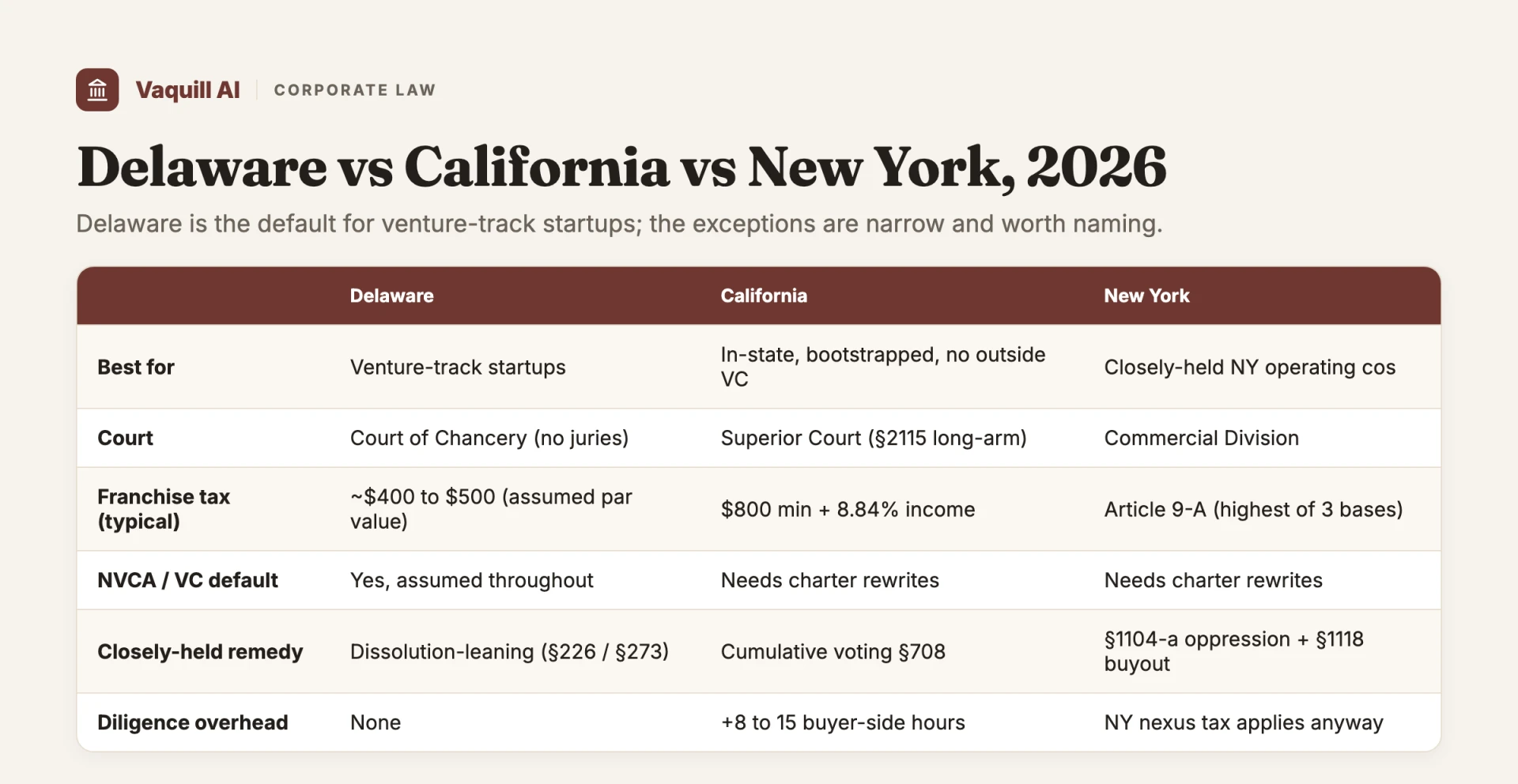
Delaware is the default for venture-track startups; California and New York fit narrow, nameable profiles.
Vaquill AI, a legal AI workbench for in-house and corporate counsel, drafts formation documents and surfaces statutory text, charter clauses, and amendment history side by side. See statutes and regulations or start a 7-day trial at app.vaquill.ai.
New legal AI guides, weekly.
Further Reading
The 409A Valuation Playbook for Corporate Counsel
Read postSAFE vs Convertible Note vs Priced Round: A 2026 Practitioner's Guide
Read postLegal AI for Corporate Counsel: Deals, Diligence, and Entity Work in 2026
Read postDrafting the Schedule of Exceptions in an M&A Deal
Read postM&A Due Diligence: The Legal Workstream Checklist for 2026
Read postAI and Corporate Law in 2026: What AI-Powered Legal Intelligence Actually Does
Read post
Co-Founder & CEO · Attorney
Arshita leads product and strategy at Vaquill, building the legal AI suite that solo, small-firm, and in-house US lawyers use to run a matter end to end.