Short answer: use a SAFE for a seed round under $5M, a convertible note for a bridge or extension where maturity and interest give the investor real protection, and a priced round once you are raising above $5M. A SAFE is a contract for future equity with no interest and no maturity. A convertible note is debt that converts (4% to 8% interest, an 18 to 24 month maturity, usually a cap and discount). A priced round is preferred stock at a set valuation, with a board seat, protective provisions, and the full document stack. The instrument should match round size, runway, and the realistic timeline to your next round, not whichever side's preferred form lands in your inbox.
Picture the meeting. A founder forwards a cap-table model two weeks before the Series A signs. They raised on five SAFEs over twelve months, total $6.8M, caps from $7M post on the first to $14M post on the last, two of them carrying MFN clauses.
The Series A is pricing at $22M pre-money. The model shows the SAFE block converting into 41% of the pre-A cap table. The founder thought the answer would be closer to 25%.
The lead is asking, politely, whether the cap is reflective of value. The founder is asking, less politely, whether their lawyer should have caught this six months ago.
The case for understanding which instrument fits which round is not academic in 2026. It is a meeting you do not want to be in.
The seed market shifted in September 2018. In 2013, Y Combinator released the original pre-money SAFE and called it a replacement for the convertible note.
Five years later, YC killed the pre-money version and replaced it with a post-money cap that converts on the company's fully-diluted capitalization including all outstanding SAFEs. The text changed by about a paragraph; the dilution math changed by roughly ten percentage points on a real seed cap table, and most founders did not notice until their Series A.
The trajectory since shows up in the public data. Carta reported that SAFEs were used in 92% of pre-seed rounds on its platform as of Q3 2025, and that post-money SAFEs went from roughly 60% of all SAFEs in 2021 to nearly 90% by 2025, with the cap-only structure now the single most common form (Carta, State of Pre-Seed, Q3 2025). Read those as platform figures from Carta's own book of customers, not the whole market, but the direction is unambiguous.
Industry trackers (Cooley's quarterly venture financing report among them) put the median Seed-to-A timeline well past 24 months by late 2024, and once a company is in extension territory the debt-vs-equity conversation reopens. Notes, declared dead by half the early-stage bar after the YC rewrite, came back as bridge paper through 2023 and 2024.
Here is the call worth making explicit: the right instrument is not the founder's preferred form or the investor's preferred form, it is the one that matches round size, runway, and the realistic timeline to the next round.
Startup counsel earns the fee in the moment a founder says "let's just use a SAFE for this $7M raise." That is the moment to walk through the math, and the right answer in 2026 is more often "price it" than the bar has been willing to say out loud.
TL;DR
- Use a SAFE for seed rounds under $5M. YC's post-money SAFE (September 2018 version) is the US default. The math is transparent if you actually run it.
- Use a convertible note for bridges and extensions. Interest, a maturity date, and creditor status matter when the next round is uncertain. 4 to 8% interest, 18 to 24 month maturity, 15 to 25% discount, valuation cap.
- Price the round above $5M raised. Series A on NVCA model documents, broad-based weighted-average anti-dilution, real board composition, protective provisions. The legal cost (real) is dwarfed by the cap-table cost of stacking SAFEs into a round that should have been priced.
- The thing that actually moved. Post-money SAFEs dominate; pre-money SAFEs are functionally extinct; convertible notes have come back as bridge paper because the median Seed-to-A timeline has stretched well past 24 months.
- A founder taking a $7M raise on SAFEs at an $8M post-money cap is on track to give away around 87% of the cap table at conversion. "We'll fix it at the A" is not a plan. It is a hope, and the SAFE investors get the better of the math.
What ownership does a $2M investment at an $8M post-money SAFE cap convert into?
Part of our corporate and transactional lawyer playbooks.
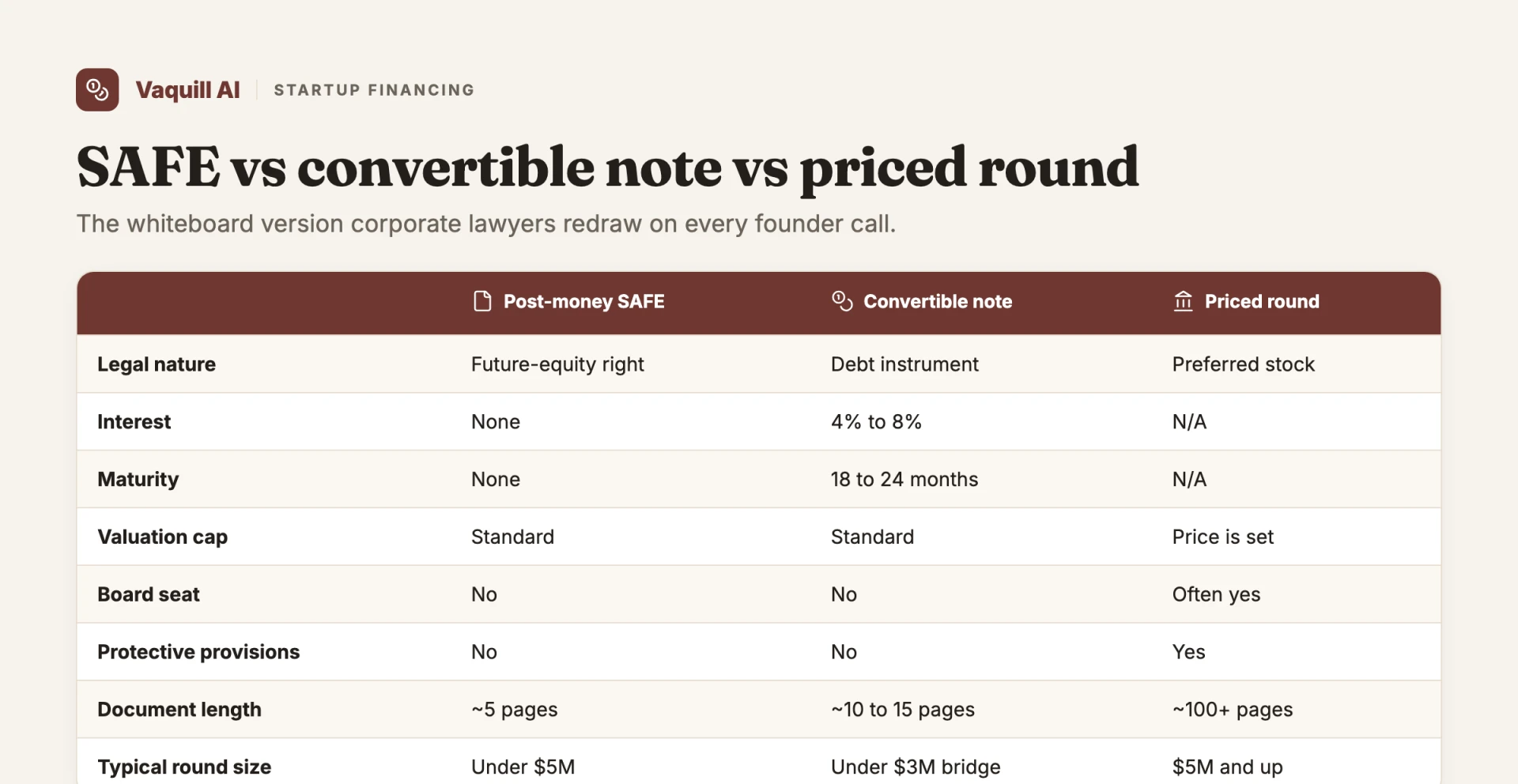
SAFE, convertible note, and priced round, side by side.
The three instruments, side by side
Side-by-side reference, the whiteboard version corporate lawyers redraw on every founder call.
| Post-money SAFE | Convertible note | Priced round (Series A) | |
|---|---|---|---|
| Legal nature | Contract right to future equity | Debt instrument | Equity (preferred stock) issuance |
| Interest | None | Yes (typically 4% to 8%) | N/A |
| Maturity | None | Yes (typically 18 to 24 months) | N/A |
| Valuation cap | Standard | Standard | N/A (price is set) |
| Discount | Optional (rare on post-money) | Standard (15% to 25%) | N/A |
| Conversion event | Equity financing, liquidity, dissolution | Equity financing, maturity, liquidity | Already equity |
| MFN provision | Common | Rare | N/A |
| Pro rata | Side letter (not in the SAFE) | Side letter | Investor rights agreement |
| Anti-dilution | None | None until conversion | Broad-based weighted-average standard |
| Board seat | No | No | Often yes (investor director) |
| Protective provisions | No | No | Yes (charter) |
| Document length | ~5 pages | ~10 to 15 pages | ~100+ pages across the stack |
| Typical round size | Under $5M | Under $3M (bridge) or note round | $5M and up |
| Standard form | Y Combinator post-money SAFE | Cooley GO templates | NVCA model documents |
No statute requires these forms, and BigLaw firms run their own variations. But every US venture lawyer should be able to pick up the YC post-money SAFE, the Cooley GO convertible note, or the NVCA Series A stack and recognize 95% of the language on sight.
If a counterparty's redline is fighting boilerplate, pause on it.
The repeat misunderstandings: founders treat the SAFE cap as a ceiling on dilution (it is a floor on the investor's percentage); investors treat note maturity as theoretical (in 2026 it is the most important date in the document); both sides treat protective provisions as formality (they are the governance package).
The decision, compressed to the questions that actually decide it:
What you are actually drafting under each
The SAFE
A post-money SAFE has four levers, plus a fifth to refuse.
Cap. The most consequential number on the document, because the post-money cap includes all outstanding SAFEs. Under the old pre-money SAFE, founders bore the dilution from later SAFEs in the same financing; under post-money, SAFE investors share that dilution proportionally.
Do the math before signing the second SAFE, and the third.
Discount. Less common on post-money because the cap usually does the work. 10% to 20% when you see it.
MFN. If the company issues a later SAFE on better terms, this SAFE adjusts to match. Useful for investors stacking SAFEs; dangerous for the company that forgets the clause by the time it cuts the next one.
Pro rata side letter. YC moved pro rata out of the SAFE and into a separate side letter on purpose. Pro rata is a negotiation, not a default. If an investor wants it inside the SAFE, push back.
The lever to refuse: liquidation preference above 1x. Standard is 1x non-participating. 1.5x or 2x is a Series A term smuggled into a seed instrument; price it into a lower cap or refuse it.
The discipline is not to refuse SAFEs; it is to track every cap, discount, MFN, and pro rata side letter in a single capitalization model from the first one signed, and rerun the math before every additional close.
The convertible note
A convertible note is debt that converts; that is not a technicality, it is the whole point.
Interest. 4% to 8%, with Carta putting the median near 7% (via CRV's founder guide, February 2026). Sub-4% raises imputed-interest issues under the Applicable Federal Rate; above 8% looks like a premium that should have been priced in the cap. Most notes accrue rather than pay interest, which converts alongside principal.
Maturity. 18 to 24 months standard, 12 on a tight bridge. At maturity the holder can demand cash or force conversion at the cap.
In 2022 this barely mattered; in 2026, with companies 30 months past their last priced round, maturity is a real lever.
Discount. 15% to 25%. The investor gets the better of cap-based price and discount-based price at conversion.
Cap. Same logic as a SAFE cap, but it interacts with interest and discount in ways founders miss. A $500K note at 8% over 18 months has accrued $60K at conversion. Small in dollars, meaningful through a low cap.
The big drafting question is maturity. Pick a side and write the mechanic. Do not paper over it with "the parties will negotiate in good faith."
The priced round
A Series A is a stack, not one instrument. NVCA's model documents enumerate seven core forms: term sheet, charter, stock purchase agreement, investor rights agreement, right of first refusal and co-sale agreement, voting agreement, management rights letter.
If your stack does not match NVCA at the section-heading level, you are doing something nonstandard.
Four terms drive the negotiation.
Anti-dilution. Broad-based weighted-average is standard. Full ratchet still exists in deeply distressed rounds and signals trouble; on a first lead it is a question worth asking.
Board. Two-investor / two-founder / one-independent is canonical. The investor director almost always gets a seat; the independent is the negotiation.
Protective provisions plus board control is the entire governance package, and founders routinely give one up without understanding the other.
Protective provisions. Preferred consent for charter amendments, senior or pari-passu issuances, dividends, redemptions, mergers, option pool increases, debt above a threshold. The negotiation is the threshold and the carve-outs, not whether to have them.
Drag-along. Majority preferred plus majority common is normal. Preferred-alone is a red flag for common holders.
The dilution math, three scenarios
Abstractions are easy to nod along to. Numbers are where it bites.
Assume a two-founder company, 8,000,000 common (50/50), 10% option pool (888,889 shares), no prior financing. Pre-money fully diluted: 8,888,889.
Series A always tops the pool up to 15% post-A. Numbers are rounded to the nearest tenth.
Scenario A: $2M post-money SAFE at $8M cap, Series A at $20M pre-money for $5M
Walk the math step by step.
Step 1, the SAFE converts at the cap because $8M post is below the $20M pre-A price. Under post-money mechanics the SAFE owns exactly $2M / $8M = 25% of the company immediately before the Series A closes.
That percentage is not approximate; it is what the YC post-money document is engineered to deliver.
Step 2, the Series A prices at $20M pre-money for $5M. Post-money is $25M; the priced investor takes $5M / $25M = 20% post-Series A.
Step 3, the pool tops up. To get to 15% post-Series A, the company issues new options that come out of the pre-Series A cap table. That dilutes the founders, the SAFE investor, and the existing pool proportionally.
Approximate post-Series A ownership after all three steps:
- Founders combined: 55.5%
- SAFE investor: 20.0%
- Series A investor: 20.0%
- Pool top-up plus existing pool: 4.5% unallocated (15% gross counting prior grants)
The SAFE investor converted at 25% pre-A and got diluted to roughly 20% by the round and the top-up.
The lesson under a post-money SAFE is that you can read the conversion percentage off the document: $2M at an $8M post-money cap means 25%, period, before the next round dilutes everyone proportionally.
Scenario B: $500K convertible note, 20% discount, $5M cap, 6% interest, Series A 18 months later at $10M pre-money
Principal $500K, accrued interest at 6% over 18 months roughly $45K, total $545K.
At $10M pre-A, the cap binds (lower than the $8M discounted price). The note converts at the $5M cap into roughly 5.2% of the pre-A cap table ($545K / $10.5M). After Series A takes 20% and the pool tops up, the note holder lands at ~5.0% post-A.
Accrued interest matters in dollars (extra $45K) but barely moves the percentage. The cap is dominant; the discount only binds when the next round prices close to the cap or below it.
Scenario C: $3M priced seed at $12M post-money, Series A at $20M pre-money for $5M
The priced-seed-then-A path. Seed investor buys preferred at a clear price, no conversion mechanic, no surprise math.
Post-seed: seed investor 25% ($3M / $12M), pool sized to target pre-money, founders ~65% combined.
Series A at $20M pre / $5M raised: Series A 20%, pool tops up to 15% post-A on the pre-A cap table, seed investor 25% dilutes to ~19%.
Approximate post-Series A:
- Founders: ~52%
- Seed: ~19%
- Series A: ~20%
- Pool: balance to 15% gross
Compare to Scenario A. Same Series A, similar seed dollars ($3M vs $2M), but the priced seed left a cleaner cap table and a known percentage from day one. The cost was the legal bill and an investor director or observer seat.
The math is not against the SAFE; it is against using a SAFE for a round that should have been priced.
When each instrument is actually wrong
SAFE for a round above ~$5M. The most common 2026 misfire. The conversion math at a too-low cap is brutal, and "we'll fix it at the A" is not a fix; it is the SAFE investors getting the better of the math in any reasonable Series A.
Above roughly $5M raised on SAFEs, the answer is usually a priced seed. The number is not a hard threshold; a company with a single lead writing the whole check at a sensible cap is a different conversation from one stacking five SAFEs at unrelated caps.
The signal is "stacked SAFEs over months at moving caps," not the dollar total alone.
Convertible note past maturity in a soft market. A $500K note that hit 24-month maturity in 2025 with no Series A on the horizon is a creditor with the right to demand cash. In 2022 that was theoretical; in 2026, with extensions and structured down rounds back in the conversation, it is real.
Negotiate the maturity mechanic when you draft the note, not when it matures.
Priced round too early. A priced seed at $1M raised is usually overkill. Priced rounds come with governance and a cap-table structure that locks in a percentage you might not want to lock in at the smallest end of the market.
Rough cutoff: under $1M SAFE; $1M to $5M depends on investor sophistication and the company's clarity on valuation; above $5M priced is the safer default.
There is also a signaling dimension founders underweight. Taking a SAFE from a lead investor who is sophisticated enough to price a round is itself a tell: either the investor wants optionality on the price (an investor-favoring posture) or wants speed.
Sometimes that is fine, sometimes it is the moment to ask for a priced seed and use the leverage of a hot round to get it. Counsel adds value here by reading the room, not just the document.
The tax and compliance layer most guides skip
The cap table is not the only place these instruments diverge. Two layers underneath decide whether the paper holds up at diligence.
Note interest is taxable to the holder and usually non-deductible to the company. Accrued interest on a convertible note is income to the investor even when no cash ever changes hands, which can pull the company into annual 1099-INT or OID reporting on interest it never paid out. And under IRC Section 163(l), interest on debt convertible into the issuer's own stock is a "disqualified debt instrument," so the company generally cannot deduct it. The note carries a tax cost with no offsetting deduction. A SAFE, a contract for future equity rather than debt, creates none of this until it converts.
QSBS clocks start when stock is issued, not when the SAFE is signed. Qualified Small Business Stock under IRC Section 1202 requires C-corporation stock, acquired at original issue, held more than five years. A SAFE and a convertible note are not stock; the five-year holding period generally starts when they convert into shares, not on the day the wire lands. Preferred stock from a priced round is issued at closing, so its clock starts then. For a founder or angel counting on the QSBS exclusion, the instrument choice can move the start date by a year or more.
Reg D compliance is time-boxed, and diligence finds the gaps. Every SAFE, note, and priced round is a securities sale. On a Rule 506 exemption the company files Form D with the SEC within 15 days of the first sale (Rule 503), makes state blue-sky notice filings where investors reside, and clears the bad-actor disqualification check on every principal (Rule 506(d)). Miss those and the Series A diligence request surfaces the hole, sometimes forcing a rescission offer or a reprice. Securities compliance matters more than the instrument label; get it wrong before the first dollar and no cap negotiation fixes it later.
The 2026 trends that matter
Post-money SAFEs dominate; pre-money SAFEs still exist on paper but almost nobody uses them. If one shows up in a redline, ask why; sometimes it is a fund's outdated template, sometimes a deliberate ask.
Convertible notes are back for bridges. A company that raised a Series Seed in 2023, expected a 2024 A, and is staring at a Q3 2026 close needs a bridge.
Sometimes that bridge is a new SAFE; increasingly it is a note, because maturity and interest give the bridge investor real economic protection if the A does not happen.
Extension rounds are a category, not a hack. A 2026 "Series A-1" is a planned bolt-on to the last priced round on the same terms, commonly papered as a SAFE that explicitly converts into the existing Series A stock. Draft the conversion mechanic explicitly.
Pro rata is a negotiation again. In 2021, pro rata side letters got signed without much thought. In 2026, with allocation in oversubscribed rounds scarce, counsel should treat the pro rata side letter as a real term, not a form.
One clause-level trend worth watching: "side letter MFNs," where a SAFE investor takes a standard SAFE but layers a side letter promising any future investor preference (pro rata, information rights, board observer) flows back to them.
The redline often arrives looking like boilerplate. It is not; it is an open-ended right that compounds across every subsequent close and can hand a small early check the rights of a much larger lead. Either name the rights specifically or refuse the side letter.
A second pattern: "uncapped MFN-only" SAFEs in cold sectors. Treat as a signal the investor lacks conviction; price the round later or close a smaller cap.
The standard documents to actually use
Three sets do the work:
- The Y Combinator post-money SAFE (cap only, discount only, MFN only, and cap-and-discount). The cap-only version is the most common in 2026.
- Cooley GO hosts free templates for convertible notes, simple SAFEs, and the surrounding seed-stage instruments, with commentary on what each clause is doing.
- The NVCA model legal documents are the Series A baseline, updated by NVCA working groups and redlined by every major venture firm.
Orrick's Series Seed and the Series Seed Equity Documents project exist too and have their place. But against YC, Cooley GO, and NVCA, you can paper 90% of the US early-stage market without reinventing a clause.
A drafting checklist for the next seed financing
Before papering the next SAFE, note, or priced round, ask:
- Does the instrument match the round size? Under $1M SAFE, $1M to $5M depends, above $5M priced.
- For a SAFE: what does the cap imply as a conversion percentage if the next round prices at 2x the cap? At 1x?
- For a note: what happens at maturity? Write the mechanic.
- For a priced round: who controls the board after closing? Read the voting agreement.
- For any of them: is pro rata in the right document, and does the company actually want this investor pro rata-ing into the A?
The form is the easy part. The cap-table model that comes out the other side is the hard part.
Build it, keep it current with every additional SAFE, and rerun the conversion scenarios before signing the next one. That work is where the fee gets earned.
FAQ
Is a SAFE better than a convertible note?
Neither is better in the abstract; they fit different jobs. A SAFE is simpler and founder-friendly because it carries no interest and no maturity date, which is why it dominates first-money seed rounds. A convertible note gives the investor a maturity date and accruing interest, which matters most on a bridge or extension where the next priced round is uncertain. Pick the SAFE for a clean early raise and the note when the investor needs the downside protection of creditor status.
What is the difference between a SAFE and a priced round?
A SAFE is a contract for future equity: the investor pays now and converts into shares later, usually at your next priced round, based on a valuation cap. A priced round (typically Series A) issues preferred stock today at a set valuation, so everyone knows the exact percentage on day one. The SAFE defers the valuation fight and the legal cost; the priced round settles both up front and adds governance like a board seat and protective provisions.
Do convertible notes or SAFEs dilute founders more?
The instrument itself does not set the dilution; the valuation cap and the amount raised do. A post-money SAFE locks the investor's percentage the moment you sign (a $2M raise at an $8M post-money cap equals 25%), and a convertible note converts on its cap plus accrued interest, so the interest adds a sliver of extra dilution. The real dilution risk is stacking several SAFEs at low caps and only doing the combined math at the Series A.
When should a startup do a priced round instead of a SAFE?
Once you are raising above roughly $5M, or once you have stacked multiple SAFEs at moving caps, price the round. The conversion math on a too-low cap is brutal, and "we will fix it at the A" hands the SAFE investors the better side of the deal. A single lead writing one large check at a sensible cap can stay on a SAFE; many small checks at unrelated caps is the signal to price.
What is the difference between a pre-money and a post-money SAFE?
Y Combinator released the pre-money SAFE in 2013 and replaced it with the post-money SAFE in 2018. Under the pre-money version, founders absorbed the dilution from later SAFEs in the same financing. Under the post-money version, SAFE holders share that dilution proportionally and their ownership is measured after all the SAFE money is counted, so the percentage is fixed and readable off the cap. Almost everyone uses the post-money form now.
Do SAFEs have a maturity date?
No. A SAFE has no maturity date and no interest rate, so there is no repayment deadline and nothing for the company to pay back in cash if the next round is delayed. That is the core difference from a convertible note, which can come due at maturity and let the holder demand repayment or force conversion.
How much does a priced round cost compared to a SAFE?
A SAFE is a roughly five-page document and is often the cheapest instrument to paper. A convertible note with side letters typically runs longer and costs more. A priced round is a full document stack (term sheet, charter, stock purchase agreement, and more) and carries the highest legal bill. As a rough 2026 benchmark, CRV's founder guide pegs SAFE legal costs at up to $2K and convertible notes at $2K to $5K, with a priced round running far higher across its full stack (CRV, February 2026). The right comparison is not the legal fee in isolation; it is the legal fee against the cap-table cost of stacking SAFEs into a round that should have been priced.
Do SAFEs or convertible notes create tax paperwork?
A SAFE creates none until it converts; the IRS treats it as a variable prepaid forward contract, so there is nothing to report while it sits outstanding. A convertible note is different. Its accrued interest is reportable income to the holder even when unpaid, which can trigger annual 1099-INT or OID filings, and under IRC Section 163(l) the company generally cannot deduct that interest because the debt is convertible into its own stock. That is a tax cost with no offsetting benefit, and it is one reason first-money rounds default to SAFEs.
Can you mix SAFEs and convertible notes in the same round?
You can, and companies sometimes do, but model the stack together before you sign. The note is debt, so its principal plus accrued interest generally converts ahead of the SAFEs and takes its slice of the cap table first. Two instruments at different caps, one carrying interest, is exactly the setup that produces a conversion percentage nobody on the founder side expected at the Series A.
For related valuation and entity coverage, see The 409A Valuation Playbook for Corporate Counsel and Delaware vs California vs New York Incorporation in 2026. When the SAFE block finally converts into the priced round, two terms decide who wins the math: the term sheet review checklist for corporate counsel walks the full provision set, and liquidation preference math in venture deals shows what the 1x non-participating line in your SAFE actually pays out at exit.
Vaquill AI handles this end to end: draft the SAFE, note, or priced-round paper, then run a side-by-side review across a whole financing's documents with the Document Matrix, sanity-checking each cap against the round it converts into.
New legal AI guides, weekly.
Further Reading
The 409A Valuation Playbook for Corporate Counsel
Read postDelaware vs California vs New York Incorporation in 2026
Read postLegal AI for Corporate Counsel: Deals, Diligence, and Entity Work in 2026
Read postDrafting the Schedule of Exceptions in an M&A Deal
Read postM&A Due Diligence: The Legal Workstream Checklist for 2026
Read postAI and Corporate Law in 2026: What AI-Powered Legal Intelligence Actually Does
Read post
Co-Founder & CEO · Attorney
Arshita leads product and strategy at Vaquill, building the legal AI suite that solo, small-firm, and in-house US lawyers use to run a matter end to end.