US courts are sanctioning lawyers for filing AI-fabricated citations at a rising clip. The penalties run from a $2,000 fine to a $110,204.38 award. Some lawyers have been suspended. This page tracks the US cases where a court fined, removed, referred, or rebuked someone over fake authority. Each row gives the docket, the order date, the decisive aggravating fact, and a source you can pull.
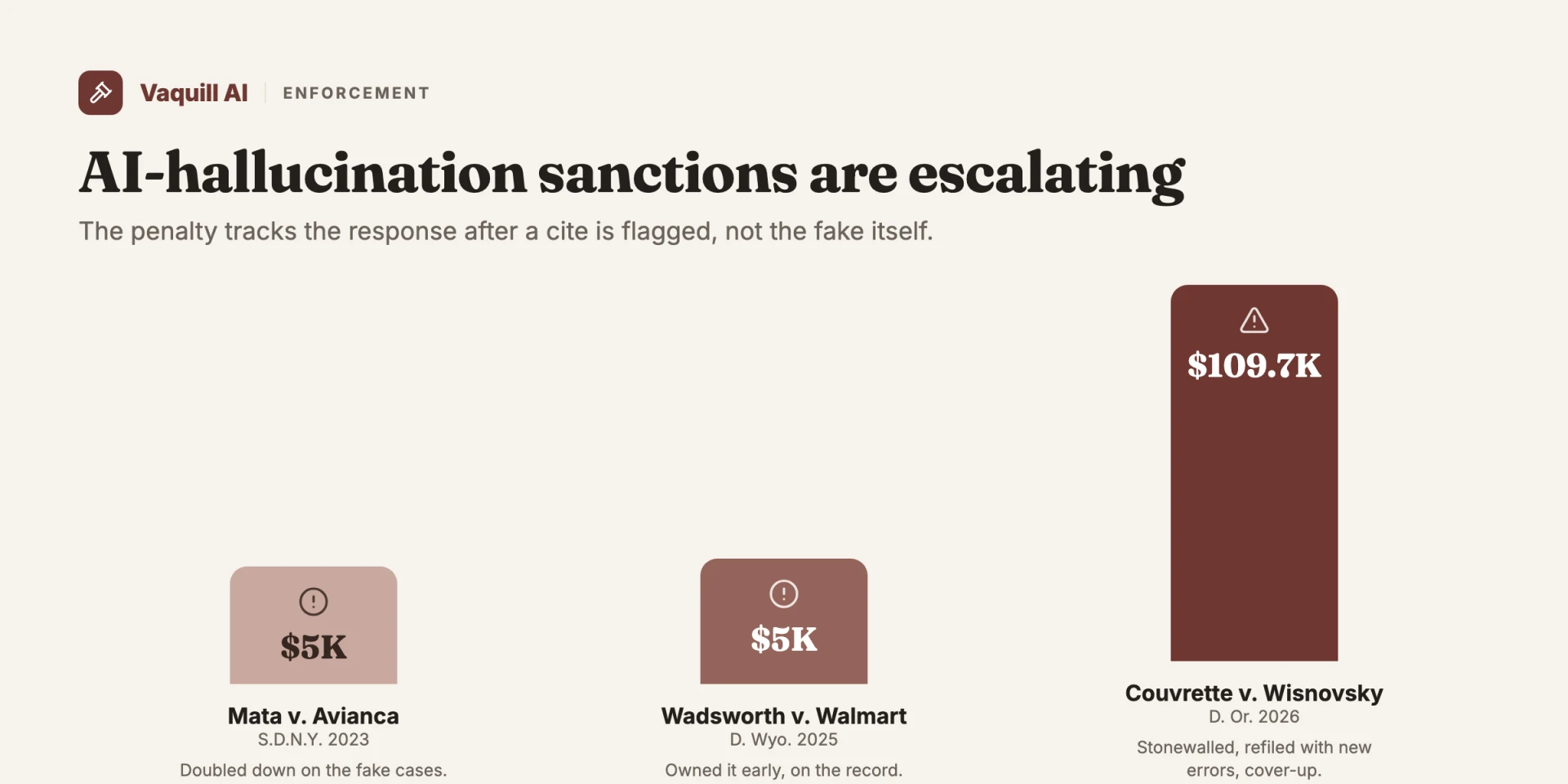
The penalty tracks how the lawyer responded after a cite was flagged, not the fabrication itself.
TL;DR
- This tracker holds 19 verified US matters. In each, a court sanctioned, removed, referred, or rebuked someone over AI-fabricated citations or quotes. It is curated, not the full universe.
- The money range is wide. It runs from a $2,000 fine in Gauthier v. Goodyear and $2,500 in a Fifth Circuit case, through $10,000 to $31,100 across several 2025 cases, up to $110,204.38 in Oregon's Couvrette v. Wisnovsky.
- It is no longer only fines. Colorado suspended a lawyer for two years, Nebraska entered an interim license suspension, and the Ninth Circuit suspended two lawyers for six months. A Mississippi court barred four lawyers from appearing for two years, another court stripped court-appointed fees, and others issued public reprimands or referred lawyers to the bar.
- The tool is usually a general chatbot. ChatGPT is the named tool in most rows where any tool is identified; Fletcher v. Experian is a rare case tied to purpose-built tools (vLex and CoCounsel).
- The decisive aggravator is almost always the response. Four moves scale the penalty: denying AI use, asking the chatbot to confirm its own cite, refiling after a warning, or blaming a junior.
- This is general information, not legal advice. Pull the underlying order before you rely on any row below.
What is the largest US AI-hallucination sanction recorded in this tracker?
Part of our legal AI verification and hallucination guide series. For the rule-by-rule lens, see AI hallucinations in legal research and how to avoid sanctions.
Methodology
This is a curated list, not a census. A matter earns a row when a US court has done one of five things over AI-fabricated or misrepresented authority. It fined a lawyer. It referred one to bar discipline or a grievance panel. It removed counsel from a case. It suspended a license. Or it issued a formal public reprimand.
We add a row only after reading a named, dated source. That means the court order itself, or coverage from the ABA Journal, Reuters, Bloomberg Law, LawSites, or the Charlotin database. If a docket, date, or dollar figure cannot be confirmed, we drop the detail. A row with no nameable case and court does not go in.
A few counting rules. Pro se filings show up in the broader data, but they are not listed here. Every row is a licensed attorney. When a court added the other side's fees on top of a flat fine, we mark the total as combined. When a court set a per-item price, like $500 per fake case, we note it. That shows how the number was built. Dates reflect the order, not the underlying filing.
Want the broadest running count of incidents worldwide, including pro se and non-US filings? The Charlotin tracker is the most complete public dataset.
AI hallucination sanctions tracker: verified US cases
Ordered newest first. Dollar figures are the penalty as reported in the cited source.
| Case (docket) | Court / Jurisdiction | Order date | The AI misuse | Decisive aggravating fact | Outcome / sanction | Source |
|---|---|---|---|---|---|---|
| Withers v. City of Aberdeen | US District Court, N.D. Miss. | Jun 8, 2026 | Both sides filed briefs with AI-hallucinated cases and quotes in a dispute over unpaid legal fees | Counsel on both sides "blindly relied on" AI, and the signing lawyers had not read the briefs their colleagues wrote | Four lawyers sanctioned: two barred from the court for two years and fined ($2,500 and $3,500), two others disqualified and fined $1,000 each, with orders sent to state bars | Bloomberg Law, Jun 2026 |
| Lnu v. Blanche (24-4790) | US Court of Appeals, 9th Cir. | Jun 3, 2026 | Immigration briefs with nonexistent opinions and fabricated quotes, drafted by an unlicensed law-school graduate using unauthorized AI | First called the fabrications "typographical errors," then conceded the AI origin | $2,500 each (two attorneys) plus a six-month suspension from practice before the 9th Circuit | Bloomberg Law, Jun 2026 |
| Coomer v. Lindell (1:22-cv-01129) | US District Court, D. Colo. | May 2026 (2nd order) | Opposition brief with about 30 defective citations, including a fabricated Perkins v. Fed. Fruit & Produce | Admitted AI only when the judge asked directly, then drew a second sanction for a repeat mis-cite | $3,000 each to two lawyers (Jul 2025), then a further $5,000 for a repeat mis-citation | Reason / Volokh, May 2026 |
| Fivehouse v. U.S. Dept. of Defense | US District Court, E.D.N.C. | Apr 2026 | Brief with fabricated quotations attributed to real authority | Filed fabricated quotes without verifying them | Public reprimand | Norton Rose Fulbright, 2026 |
| State v. Lake (Prososki v. Regan, S-25-0295) | Nebraska Supreme Court | Apr 16, 2026 | Divorce-appeal brief with 57 of 63 citations defective, 3 cases nonexistent | First denied using AI for weeks, then admitted it days before the order | Interim license suspension pending a referee's final recommendation | Nebraska Public Media, Apr 2026 |
| Whiting v. City of Athens (25-5425) | US Court of Appeals, 6th Cir. | Mar 13, 2026 | Over two dozen fake or misrepresented citations across three consolidated appeals | Both lawyers had prior candor discipline and defied the show-cause order | $15,000 punitive fine per attorney (two attorneys) plus opposing fees and double costs under 28 U.S.C. 1927 | LawSites, Mar 2026 |
| In re Eric Chibueze Nwaubani | US Court of Appeals, 4th Cir. | Mar 2026 | Briefs citing three nonexistent cases | Filed fabricated authority in an appellate matter | Public admonishment | Norton Rose Fulbright, 2026 |
| Ghiorso matter | Oregon Court of Appeals | Mar 2026 | Brief with 15 bogus citations and 9 quotes "contrived from thin air" | Signed a brief built on unchecked AI-sourced search results | $10,000 fine (intended $16,500, capped for medical reasons) | Salem Reporter, Mar 2026 |
| United States v. Farris | US Court of Appeals, 6th Cir. | Early 2026 | Fabricated citations in a criminal appeal handled by court-appointed counsel | AI-fabricated authority from appointed defense counsel | Removed from the case, denied all Criminal Justice Act compensation, plus disciplinary referrals | Norton Rose Fulbright, 2026 |
| Fletcher v. Experian (25-20086) | US Court of Appeals, 5th Cir. | Feb 18, 2026 | Reply brief with 16 fabricated quotations and 5 misstatements, drafted with vLex and CoCounsel | Failed to verify a brief drafted largely by AI before filing | $2,500 sanction; a rare case tied to purpose-built legal AI tools | 5th Cir. order (PDF) |
| Couvrette v. Wisnovsky (1:21-cv-00157-CL) | US District Court, D. Or. | Dec 12, 2025 / Mar 2026 | Three briefs with 15 nonexistent cases and 8 fabricated quotations | Refiled by Notice of Errata after notice; refile still misstated the law (court called it a cover-up) | $110,204.38 combined; built at $500 per fake case and $1,000 per fake quote, plus fees; largest US AI penalty to date | docket (govinfo); our breakdown |
| Noland v. Land of the Free (B331918) | California 2d District Court of Appeal | Sep 12, 2025 | Appellate briefs in which 21 of 23 case quotations were fabricated | Admitted he did not read the AI-"enhanced" briefs before filing | $10,000 fine and a State Bar referral | CalMatters, Sep 2025 |
| Johnson v. Dunn (2:21-cv-01701) | US District Court, N.D. Ala. | Jul 23, 2025 | Five fabricated cases from ChatGPT in a prisoner-safety filing | Partner admitted the ChatGPT use at the show-cause hearing | Three lawyers removed from the case, publicly reprimanded, referred to the Alabama State Bar; no fine | ABA Journal, Jul 2025 |
| Lacey v. State Farm (2:24-cv-05205) | US District Court, C.D. Cal. | May 6, 2025 | Supplemental brief built on "bogus AI-generated research" | Neither firm cite-checked the AI outline before filing | $31,100 (Ellis George and K&L Gates, jointly and severally); special master called it a "collective debacle" | Reason / Volokh, May 2025 |
| Wadsworth v. Walmart (2:23-cv-00118) | US District Court, D. Wyo. | Feb 24, 2025 | Motion in limine with 8 cases that did not exist, from a firm in-house tool | Lead lawyer pasted AI output into the brief without checking a single cite | Pro hac vice revoked; $3,000 + $1,000 + $1,000 | LawSites / docket, Feb 2025 |
| Gauthier v. Goodyear Tire & Rubber Co. (1:23-CV-281) | US District Court, E.D. Tex. | Nov 25, 2024 | Summary-judgment response drafted with Claude that cited two nonexistent 5th Cir. cases and fabricated quotes from six real ones | A Lexis AI check failed to flag the errors and counsel took no corrective action after opposing counsel pointed them out | $2,000 penalty plus at least one hour of Texas MCLE on generative AI, under Rule 11(b)(2) | ABA Journal, 2025 |
| Park v. Kim (22-2057) | US Court of Appeals, 2d Cir. | Jan 30, 2024 | Reply brief cited a nonexistent case the lawyer admits she generated with ChatGPT | Could not produce the case when ordered, then called it a "non-existent case" | Referred to the court's Grievance Panel for disciplinary investigation | Reason / Volokh, Jan 2024 |
| People v. Crabill (23PDJ067) | Colorado (Presiding Disciplinary Judge) | Nov 22, 2023 | Motion to set aside judgment supported by ChatGPT-fabricated citations | Falsely blamed a legal intern when the judge asked | Two-year suspension, 90 days actively served | stipulation order (PDF) |
| Mata v. Avianca (1:22-cv-01461) | US District Court, S.D.N.Y. | Jun 22, 2023 | Brief with 6 cases ChatGPT invented | Went back to ChatGPT to "confirm" the cases, then filed that false assurance | $5,000 sanction under Rule 11; bad-faith finding | Reason / Volokh, Jun 2023 |
Note: the Fletcher sanction order issued in February 2026 followed the merits opinion in the underlying appeal. Coomer v. Lindell produced two separate sanction orders, in July 2025 and again in May 2026, which is why both dates appear.
By the numbers
A quick read of the 19 rows above. Every figure here comes straight from the table.
- By year: 2 matters in 2023, 2 in 2024, 5 in 2025, and 10 in 2026 so far. The trend is up, not down.
- Largest fine: $110,204.38, in Couvrette v. Wisnovsky. That figure is more than 20 times the original Mata sanction of $5,000.
- Flat-fine range: the stated fines run $2,000 to $110,204.38. Among the single-attorney flat fines, $10,000 sits in the middle of the pack (it appears in both Noland and Ghiorso).
- More than a fine: 11 of the 19 carried discipline beyond money. Three were suspensions (Crabill, Lake, and the two lawyers in Lnu v. Blanche). Withers barred four lawyers from the court for two years, Farris stripped court-appointed fees, and Nwaubani and Fivehouse drew a public admonishment and reprimand. The rest were bar or grievance referrals (Park, Noland), a revoked pro hac vice (Wadsworth), and three lawyers removed and referred (Johnson v. Dunn).
- Tool named: ChatGPT is the named tool in several rows (Mata, Johnson, Park, Crabill). Fletcher names purpose-built legal tools (vLex and CoCounsel), and Gauthier names Claude, with a Lexis AI check that missed the fabrications. The rest name a firm in-house tool or no specific product.
The headline is in that fourth bullet. Almost half of these matters reached past the checkbook and into the lawyer's standing.
Patterns: what gets lawyers sanctioned
Read the rows together and the same arc shows up in nearly every one. A lawyer reaches for a chatbot to find authority. The model returns citation-shaped text that looks real. Nobody checks it against a database before the brief is filed.
The fabrication itself rarely sets the penalty. Judges tend to treat a first hallucination as a competence slip and impose a modest fine. What turns a $5,000 problem into a six-figure one is what the lawyer does after the cite is flagged. The aggravator column above is the spine of this list, and it sorts into four moves judges punish hard.
Asking the chatbot to confirm its own cite. Mata is the founding example. Steven Schwartz did not draw a bad-faith finding for using ChatGPT. After opposing counsel questioned the cases, he asked ChatGPT to confirm them. Then he filed that false assurance. That is what drew the finding. Judge Castel wrote that "existing rules impose a gatekeeping role on attorneys to ensure the accuracy of their filings."
Denying AI use, then admitting it. Greg Lake denied using AI for weeks in Nebraska. He conceded it only in an affidavit that called it a "grave error of judgment." In Colorado's Coomer v. Lindell, the lawyer admitted AI only when Judge Nina Wang asked directly. The denial converts a competence problem into a candor problem, which is the door to suspension.
Refiling after a warning. In Couvrette, Stephen Brigandi refiled by Notice of Errata instead of withdrawing, and the refile still misstated the law. Judge Mark D. Clarke called it an attempted cover-up. The number landed at $110,204.38, built at $500 per fake case and $1,000 per fake quote, plus fees. Coomer shows the repeat version: a second sanction for a fresh mis-cite after the first.
Blaming a junior or staff. Zachariah Crabill blamed an unnamed intern at the hearing, and Colorado suspended him for two years. The supervision rules put the signing lawyer on the hook regardless of who ran the prompt.
Two cross-cutting facts deepen the picture. First, the tool is almost always a consumer chatbot the lawyer already had, not a paid legal product. Fletcher v. Experian is the visible exception. Counsel used vLex and CoCounsel and still filed 16 fabricated quotes. Purpose-built tools hallucinate too, and they still need a human check. Second, what judges write is converging on a single line. The Sixth Circuit in Whiting and the California panel in Noland used nearly identical language: no paper filed in any court should contain a citation the responsible attorney has not "personally read and verified."
The severity ceiling keeps rising. Whiting stacked two aggravators on top of the fabrications: prior discipline, and defiance of the show-cause order. That is how two appellate lawyers each drew the maximum $15,000, plus fees and double costs. Repeat conduct, as in Coomer, now draws a second order rather than leniency.
What the rules require now
There is no "the AI did it" defense. The duty to verify your own citations predates ChatGPT, and every order above rests on rules that already existed.
ABA Formal Opinion 512, issued July 29, 2024, is the operating manual. It maps the existing Model Rules onto generative AI. Competence (Rule 1.1) means a reasonable grasp of a tool's limits. Candor to the tribunal (Rule 3.3) governs what gets filed. Supervision (Rules 5.1 and 5.3) keeps the signing lawyer on the hook for work a junior or a chatbot produced. The opinion is blunt: lawyers "should not rely on GAI outputs without independent verification or review."
Federal Rule of Civil Procedure 11 is the other backbone. When you sign a filing, you certify a reasonable inquiry into its claims. Filing cases you never read is the textbook failure of that inquiry. That is why Mata, Wadsworth, and the Park v. Kim referral all turn on it.
State courts and individual judges are adding their own layers. Standing orders now require AI disclosure or a certification of accuracy. They appear in pockets of federal court and a few state appellate panels. The rules differ by court. If you practice in more than one, the state-by-state AI rules guide tracks which ones apply to you.
How to not end up on this list
The lawyers in this tracker were not careless people who skipped all review. Most of them spot-checked. Spot-checking looks like verification and behaves like a gap, because the fabricated cite is rarely the prominent one. It hides in the middle of the brief where a tired reader trusts the formatting.
The fix is a workflow, run the same way you run a conflicts check.
- Treat every AI citation as a lead, not authority. A general chatbot is a language model, not a retrieval system. Its citations are starting points, not facts.
- Check every cite against a primary source. Open each one in Westlaw, Lexis, Google Scholar, PACER, or a citator built on a real corpus. Confirm the case exists, that it says what the brief claims, and that it is still good law. Not a sample. Every one. The pre-filing verification checklist walks through the steps.
- Verify quotations word for word. A real case name paired with an invented quote is the dangerous kind. A "did this case exist" check passes it.
- Name who owns verification, and log the sign-off. A one-line dated attestation in the matter file is a strong mitigator. It is one of the best things a lawyer can show a disciplinary referee.
- Have a response plan before you need one. If a cite gets flagged, the first move is the database, not the chatbot. Verify, acknowledge fast, and file a clean correction or a withdrawal. Asking the model to confirm its own cite is the Mata mistake.
This is also a tool-choice question. Research grounded on a real corpus gives you citations a reviewer can click and open. That makes the check fast enough that you actually do it. It is the gap legal AI that avoids hallucinating cases is built to close. It is also why in-house counsel increasingly route research away from raw ChatGPT.
The first 24 hours after a cite is flagged
Opposing counsel sends the letter on a Thursday afternoon. What you do next sets the size of the sanction. The cases above show the slope is built here, not at the moment of the bad cite. Move in this order.
- Freeze the filing chain. Do not file anything else in the matter until you know the scope. Pull the brief and the research log.
- Verify in a primary database, not the model. Run every cite through Westlaw, Lexis, PACER, or a citator on a real corpus. Confirm each case exists, says what you claimed, and is still good law.
- Do not ask the model to self-validate. This is the move that sank Mata. The chatbot will happily "confirm" a case it invented. That answer is worthless and filing it is fatal.
- Tell the client if the error is material. A fabricated cite in a filed brief usually is. The conversation is uncomfortable now and far worse if the court finds out first.
- Decide: withdraw or correct. Withdraw when the brief is riddled with fakes. Correct when one discrete section is affected, and name every change in the notice. Either way, get it on the docket fast.
- Send a same-day acknowledgement to opposing counsel. Timestamp your awareness. Speed and candor are the two mitigators every order above rewards.
This is the mitigation workflow the sanction orders reward. The lawyers who paid six figures did the opposite: they stalled, denied, or quietly refiled.
FAQ
How many lawyers have been sanctioned for AI hallucinations? This tracker lists 19 verified US matters. That is a curated set, not a count of every incident. The Charlotin hallucination database listed more than 1,600 cases worldwide as of its mid-June 2026 count. The clear majority are in US courts. New rows are added almost daily, so any single number is a snapshot.
What is the largest AI hallucination sanction in the US? The largest known US penalty is $110,204.38, imposed in Couvrette v. Wisnovsky (No. 1:21-cv-00157-CL, D. Or.) across orders dated December 2025 and March 2026, against San Diego lawyer Stephen Brigandi and Portland local counsel Tim Murphy. Their briefs contained 15 nonexistent cases and 8 fabricated quotations.
Can a lawyer lose their license for using AI? Yes, though not for using AI itself. Colorado suspended Zachariah Crabill for two years in 2023 (No. 23PDJ067), and the Nebraska Supreme Court entered an interim suspension against Greg Lake in April 2026. In both, the license consequence followed a candor failure layered on the underlying fabrication, not the AI use alone.
Was Mata v. Avianca the first AI hallucination sanction? Mata v. Avianca (No. 1:22-cv-01461, S.D.N.Y., June 22, 2023) was the first high-profile one. Lawyers Steven Schwartz and Peter LoDuca filed six cases ChatGPT invented. They then submitted the chatbot's false assurance that the cases were real. Judge P. Kevin Castel fined them $5,000 under Rule 11.
Do purpose-built legal AI tools show up in these cases? Mostly the failures involve general chatbots like ChatGPT. The clearest exception is Fletcher v. Experian (No. 25-20086, 5th Cir., 2026), where the lawyer used vLex and Thomson Reuters CoCounsel and still filed fabricated quotes, drawing a $2,500 sanction. Grounded tools lower the error rate; they do not remove the duty to read the cited opinion.
What rule do these sanctions rely on? Most federal cases rest on Federal Rule of Civil Procedure 11. It requires a reasonable inquiry into the claims you sign. Bar discipline rests on the Model Rules of Professional Conduct, primarily competence (1.1), candor (3.3), and supervision (5.1 and 5.3). ABA Formal Opinion 512 ties all of these to generative AI use.
Why do some lawyers get a small fine and others get suspended? The split is the response after detection, not the fabrication. A first hallucination with a fast, candid correction tends to draw a modest fine. Four moves push a matter toward suspension or removal: denying AI use, asking the chatbot to confirm its own cite, refiling after a warning, or blaming a junior.
Is this tracker complete? No. It is a curated, sourced list of notable US matters. We keep it narrow so every row traces to a source you can check. For the broadest running count, the Charlotin tracker is the most complete public dataset.
How do I keep my firm off a list like this? Treat every AI-produced citation as a lead. Check each one against a primary source before filing. Verify quotes word for word, name who owns verification, and keep a dated sign-off. Have one written AI policy and a response plan for when a cite gets flagged. The verification checklist is a working starting point.
What this tracker excludes and why
We leave some matters out on purpose, and the line matters for trust. Pro se filings are excluded; every row here is a licensed attorney. Warning-only orders are excluded too, where a judge flagged a bad cite but imposed no sanction. Fabricated factual quotes with no fake legal authority do not qualify, since the focus is invented cases and holdings. Non-US matters are out of scope. Those filters keep the list tight enough that every row is a real, sourced consequence.
A living document
This tracker is updated as new US sanctions and disciplinary orders are reported and confirmed against a named source. It is general information, not legal advice. Pull the underlying order before relying on any case here.
Update log: last checked June 2026. This update added Coomer v. Lindell and Fletcher v. Experian. It split the combined Couvrette and Coomer orders into dated entries. It also pointed the marquee rows to primary court orders.
Every case on this list shares one root cause. A lawyer signed a citation they had not read. The tool that produced it never mattered to the court. The unread cite is the whole story. A database check on every citation is the one habit that keeps a name off lists like this.
You want that check to be fast, not painful. One way to get there is a workbench that grounds research on a real corpus. It shows the source text right beside each cite.
New legal AI guides, weekly.
Further Reading
Judges Use AI, Lawyers Get Sanctioned for It: The 2026 Double Standard
Read postHow to Build a Litigation Chronology From Documents With AI
Read postCan AI Give Legal Advice?
Read postIs Claude Private for Legal Work?
Read postCan ChatGPT Be Used Against You in Litigation?
Read postDoes ChatGPT Have Attorney-Client Privilege?
Read post
Co-Founder & CEO · Attorney
Arshita leads product and strategy at Vaquill, building the legal AI suite that solo, small-firm, and in-house US lawyers use to run a matter end to end.