Here is the 2026 split that has the bar talking. A majority of responding federal judges now use AI in their own work, per a Northwestern and NYC Bar survey, while US courts fined lawyers more than $145,000 in the first quarter of 2026 alone for filing AI-fabricated citations. Read fast and it looks like a rule for thee but not for me. Read the orders and the picture flips: judges use AI with verification and human review, and every sanctioned lawyer skipped that step. What separates the two groups is whether the output got verified and disclosed before it counted.
TL;DR
- 61.6% of responding federal judges reported using at least one AI tool in their judicial work (Northwestern University and NYC Bar random-sample survey, published March 2026). This is a self-reported figure with a 22.3% response rate, so treat it as a read on the judges willing to answer, not a census of the bench. Fewer than one in four use it daily or weekly.
- US courts imposed over $145,000 in sanctions in Q1 2026 for AI-fabricated citations, including a record $110,000 Oregon award and the first substantial federal appellate fine (ComplianceHub, EDRM, Apr 2026).
- The asymmetry is real, but the "judges are allowed, lawyers are not" framing misreads it. Judges use AI under supervision and disclosure norms; the sanctioned lawyers filed unverified output and, often, denied doing so.
- The size of the penalty tracked how lawyers reacted once a fake cite was flagged. Denying AI use, refiling after a warning, or asking the chatbot to confirm its own cite is what scaled the fines.
- ABA Formal Opinion 512 already told you the standard: competence, candor to the tribunal, and supervision apply to generative AI exactly as they apply to a junior associate's memo.
- For in-house teams, the takeaway is a workflow rule, not a ban. Verify every citation before it leaves the building.
Per the post, what actually separates judges who use AI from the lawyers who got sanctioned?
What actually happened
Two data points landed in the same quarter and got welded into a headline.
First, the bench. A random-sample survey of federal judges run by Northwestern University with the New York City Bar Association surveyed 502 bankruptcy, magistrate, district, and appellate judges in late 2025. Of the 112 who responded (a 22.3% response rate), 61.6% said they use at least one AI tool in their judicial work (LawSites, Mar 2026). Legal research was the top chambers use at 39.8%, document review next at 16.7%. Daily use is still rare. Roughly a third of judges permit or encourage AI in chambers, a third discourage or prohibit it, and about a quarter have no policy at all.
Second, the bar. In Q1 2026, US courts imposed at least $145,000 in sanctions for fabricated citations (EDRM, Apr 2026). The curve was steep inside the quarter: about $5,000 in January, $250 in February, then over $139,000 in March as several penalties hit within weeks.
The costliest one is Couvrette v. Wisnovsky out of the District of Oregon, where Magistrate Judge Mark D. Clarke imposed a total of $110,000 in fines and fees (Apr 4, 2026) against two lawyers in a dispute over the Valley View winery (ComplianceHub, 2026). The Sixth Circuit entered a roughly $30,000 sanction in March 2026, the largest federal appellate penalty tied to AI-fabricated cites to date, and dismissed the case on top of the fine. Smaller ones stacked up: $7,500 in the Southern District of Ohio, $2,500 in a Fifth Circuit matter, a $5,000 New Jersey sanction. Researcher Damien Charlotin, who runs the most-cited public database of these rulings, logged "10 cases from 10 different courts on a single day" in early 2026, with a global running total above 1,200 cases.
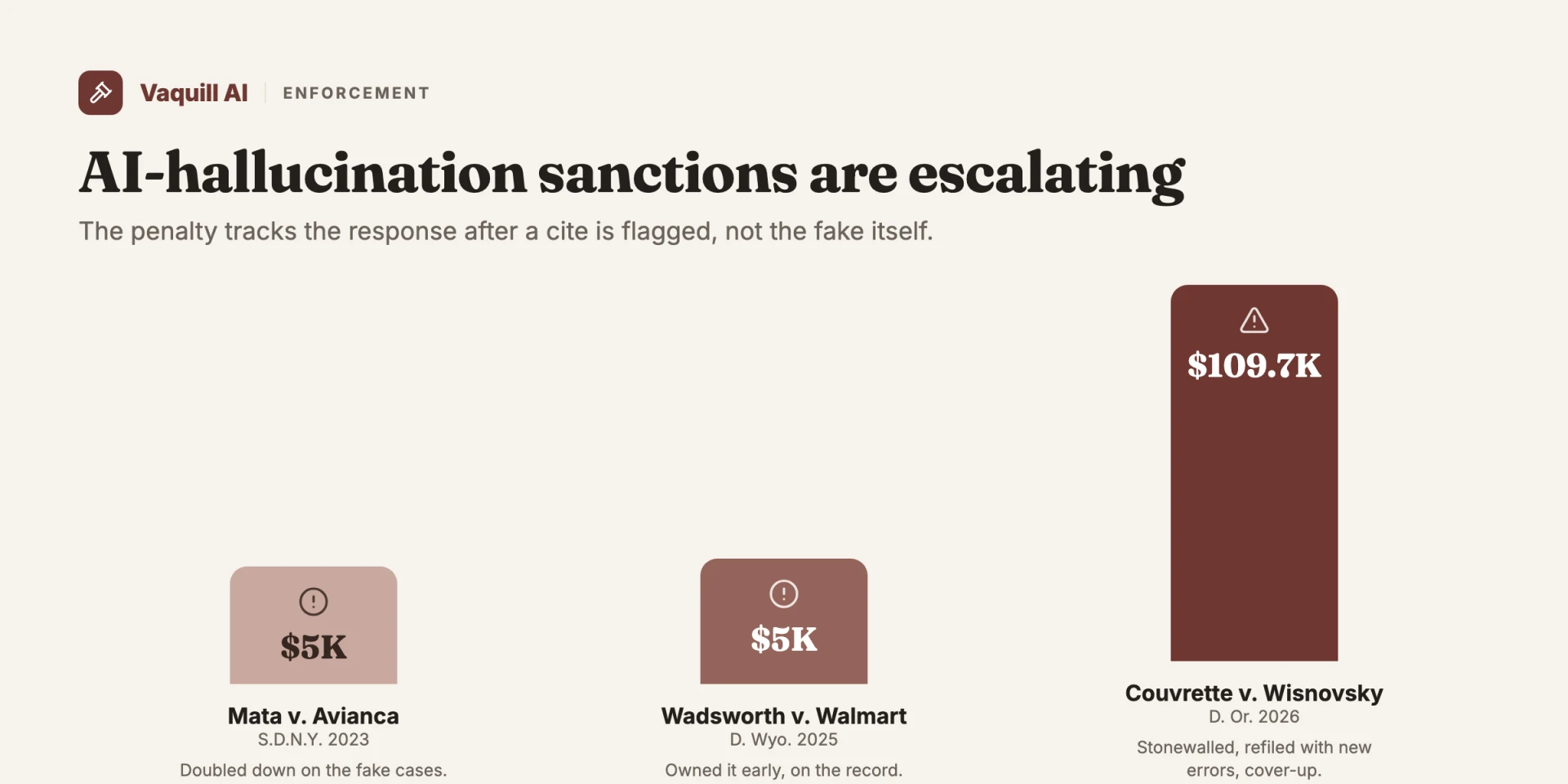
We keep the case-by-case US list current in our AI hallucination sanctions tracker, which is the running evidence behind everything below.
Why judges use AI while lawyers get sanctioned
The cynical take writes itself: the same institution that fines you for AI turns around and uses it. That framing is lazy, and it will get an in-house team into trouble if they read it as permission to panic-ban the tools or shrug off the rules.
Look at what the judges are actually doing. They use AI for research triage and document review inside chambers, with a clerk and a judge reading the output before anything becomes an order. Picture the chambers workflow: a magistrate judge asks a clerk to run an opening research pass with an AI tool, the clerk pulls every case the tool surfaces, reads each one against the point it supposedly supports, and flags anything that will not reconcile. The AI narrows a 40-case reading pile to a dozen. A human still reads all twelve. Nothing reaches a docket until the judge has seen the underlying authority. Daily use is uncommon and a large share of judges restrict AI or keep a policy. That is a supervised tool under human review, which is the entire point.
Now look at what the sanctioned lawyers did. Take Couvrette v. Wisnovsky in the District of Oregon: counsel filed briefs citing cases that do not exist, and after the court flagged the problem they filed again with more unverified authority. The skipped step was simple. Nobody pulled the cases and read them before filing. In case after case across 2026, what drew the heavy sanction was how the lawyer handled the fake cite once the court flagged it. Denying AI use when asked. Refiling the same fake authority after a warning. Asking the chatbot whether its own citation was real and treating "yes" as verification. The $110,000 Oregon award and the Sixth Circuit dismissal did not come down because AI was used. They came down because unverified output reached the court and the lawyers compounded it.
So the real split runs along a different axis. On one side sits verified-and-disclosed work; on the other, unverified-and-denied filings. A judge who has a clerk confirm every cite is on one side of that line; a lawyer who pastes ChatGPT output into a motion is on the other. The bench holds itself to accuracy. It practices the discipline the rules already demand.
The rule was never "do not use AI"
ABA Formal Opinion 512 said this plainly before the sanctions wave. Generative AI does not create new duties; it maps your existing ones onto a new tool. Competence means you understand the tool's limits, including that it fabricates confident, well-formatted citations. Candor to the tribunal means you do not file what you have not checked. Supervision means AI output gets the same review you would give a first-year's memo, which is to say you read the cases. We walk the whole opinion in our ABA Formal Opinion 512 guide.
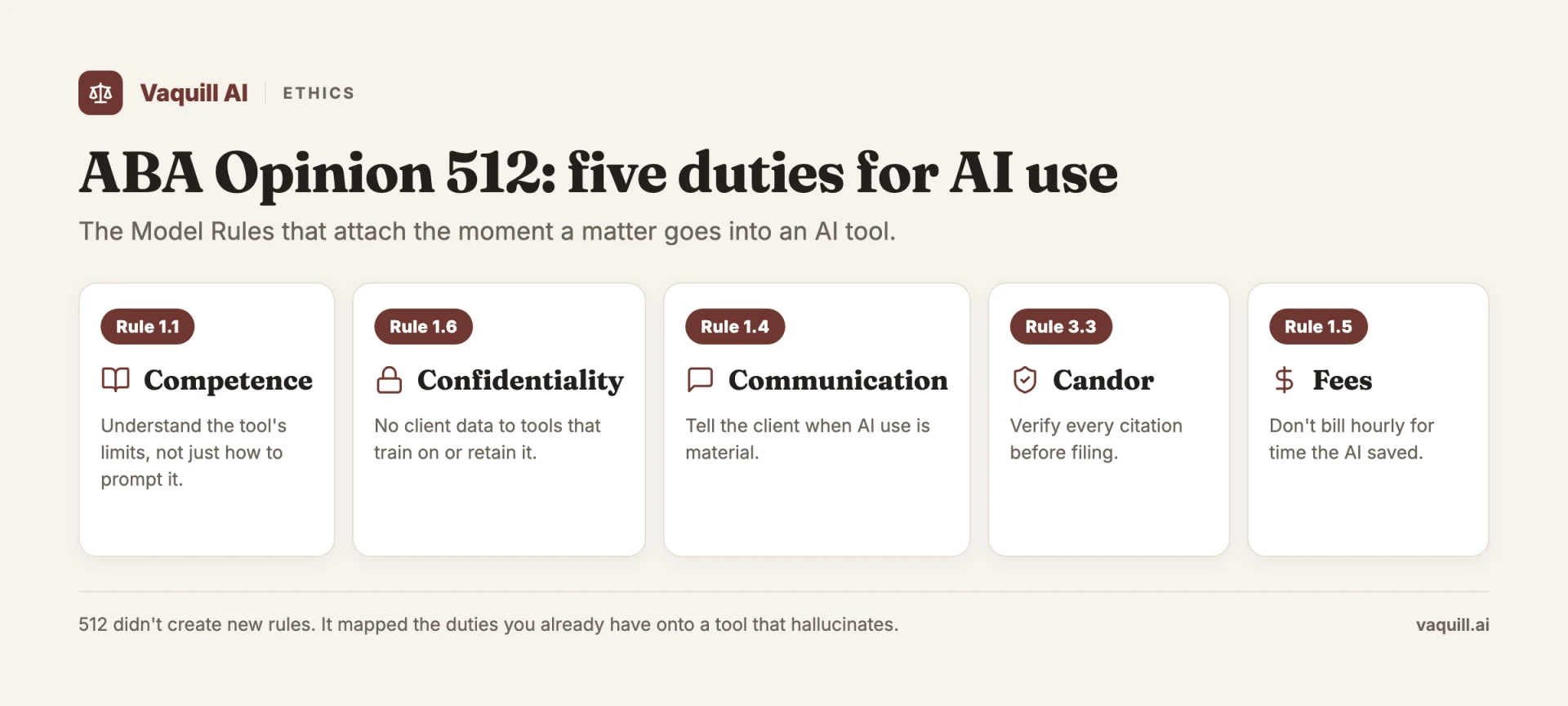
None of the sanctioned lawyers were punished for using a machine. They were punished for skipping the read. That is a workflow failure, and workflow failures are fixable.
Here is the same idea as a side-by-side, because the double standard collapses the moment you line up behavior instead of job title.
| Behavior | Judge in chambers | Sanctioned lawyer |
|---|---|---|
| Uses AI for research or review | Yes | Yes |
| Human reads the output before it is filed or entered | Yes | No |
| Discloses or would defend the tool's use candidly | Yes | Often denied it |
| Refiled after a warning | No | In several cases, yes |
| Outcome | Routine, unremarkable | Five-figure sanction |
The tool column is identical. Everything that matters lives in the rows below it.
What in-house counsel should actually do
You are not a litigator racing a filing deadline, but the exposure is the same shape. An unchecked AI citation in a demand letter, a compliance memo, or a board deck is a credibility event, and for regulated work it can be a liability event. The fix is not a ban. Banning AI in 2026 is a productivity tax your team will route around anyway.
Do three things instead. One, make verification a step, not a vibe. Every AI-surfaced authority gets pulled and read before it leaves the team; we break down the mechanics in how to verify AI legal citations before filing. Two, write the policy down. A third of federal judges keep a chambers AI policy; your legal team should too, covering approved tools, what must be human-reviewed, and what gets disclosed. Three, use tools built for law, not a consumer chatbot that invents a citation and confirms it when you ask.
Here is how that plays out in practice. On one two-lawyer in-house team I worked with, baseline NDA turnaround averaged 4.2 days from intake to signature-ready, and roughly one in three redlines came back with a rework loop because a clause reference or a cited standard did not hold up on a second read. They ran a 30-day pilot with a simple rule bolted on: AI could draft and mark up, but no clause citation or authority left the queue until a human opened the source and confirmed it, and the verification step was logged. Over the 30 days, median cycle time dropped to 1.6 days because the drafting grunt work compressed, while the rework rate on cited material fell to about 8% because the fake or mismatched references got caught before they shipped instead of after. The measured lesson was blunt: the AI saved time on the draft, and the mandatory read is what kept the saved time from turning into a credibility problem downstream.
This is where the tool choice earns its keep. The tools worth paying for are the ones where every surfaced authority links to its primary source, so the read takes one click instead of one hopeful prompt. You still read the cases. The point is that the source sits in front of you instead of somewhere you have to trust the model found. For the pattern behind the penalties, our guide to AI hallucinations in legal research and sanctions maps how each one happened.
FAQ
Do federal judges actually use AI?
Yes. A Northwestern University and NYC Bar random-sample survey published in March 2026 found 61.6% of responding federal judges use at least one AI tool in their work, mostly for legal research and document review. Fewer than one in four use it daily or weekly, and about a third have a formal chambers policy governing it.
Why do judges get to use AI when lawyers get sanctioned?
They are not being treated differently for the same conduct. Judges use AI with human review before anything becomes an order. The sanctioned lawyers filed AI output that no human verified, and several then denied using AI or refiled fake cites after a warning. The penalty is for the unverified filing and the lack of candor, not for touching the tool.
How much have lawyers been sanctioned for AI hallucinations?
US courts imposed more than $145,000 in Q1 2026 alone, per ComplianceHub and EDRM reporting. The largest single sanction was roughly $110,000 in an Oregon case (Couvrette v. Wisnovsky, April 2026). Individual fines in the running tracker range from about $2,000 to that $110,000 award.
What is ABA Formal Opinion 512?
It is the ABA's formal ethics opinion on generative AI. It confirms that existing duties, competence, confidentiality, candor to the tribunal, supervision, and reasonable fees, apply fully when a lawyer uses AI. It does not ban AI; it requires you to understand and verify what it produces.
Can I get sanctioned for using AI if I check the citations?
The pattern in the 2026 orders is that sanctions follow unverified filings and dishonest responses, not AI use itself. Lawyers who pulled and confirmed every cite before filing are not the ones getting fined. Verification and candor are the protective steps.
What is the safest way for an in-house team to use AI?
Write an AI policy that names approved tools and required review, verify every AI-surfaced citation against primary source before it leaves the team, and use tools built for legal work that link each citation to its source. General chatbots dominate the named-tool sanction orders precisely because they fabricate cites and then "confirm" them when asked.
The bottom line
The double standard is a headline, not a defense. Judges and sanctioned lawyers used the same tool; only one group read the output before it counted. Build the verification step into your workflow, write the policy down, and pick tools that show their sources. Do that and the "judges use AI" story stops being a warning and starts being the model.
If you want the verification step built into the tooling rather than bolted on, Vaquill AI links every statute and case citation back to its primary source, so your team reads the actual law instead of trusting the model found it. Take a look at how Vaquill AI approaches sourced legal research and see whether it fits the workflow above.
New legal AI guides, weekly.
Further Reading
AI Hallucination Sanctions Tracker: US Cases Where Courts Penalized AI Use (2026)
Read postAI in Legal Practice: State-by-State Regulation and Bar Guidance (2026)
Read postHow to Build a Litigation Chronology From Documents With AI
Read postClaude Fable 5 and Legal AI: What Its Benchmark Records Actually Mean
Read postThe AI Value Gap: In-House Counsel Want AI Results Their Outside Counsel Are Not Delivering
Read postClaude for Legal: What In-House Teams Need to Know
Read post
Co-Founder & CEO · Attorney
Arshita leads product and strategy at Vaquill AI, the US primary law data API. As an attorney, she decides which law we carry, how each section is sourced and cited, and what legal AI and compliance teams need from the data.