
The dispute almost never starts with the drag-along. It starts with a $180M strategic offer the founder thinks is light, an investor syndicate that wants the cash back inside the fund's wind-down window, and a voting agreement signed five years earlier nobody has re-read.
Then somebody pulls the binder, reads Section 3.1, and the founder learns three things in twenty minutes: a 60% preferred vote is enough to drag the common, the qualifying-transaction definition covers this deal, and the carve-out the founder thought protected their IP veto rights kicks in only over a different dollar threshold. Forty lines of text. In that moment it is the entire deal.
The NVCA Model Voting Agreement gives you the skeleton. The negotiation, and the lawsuit risk, lives in the seven levers the model leaves to the parties.
Short answer: A drag-along provision (also called a drag-along clause or drag-along rights) lets a defined majority of shareholders force the minority to sell their shares in a company-wide sale, on the same price and terms the majority gets. It removes the holdout problem that kills acquisitions. The fight is never whether to have one. It is the trigger threshold, what deals it covers, the price floor, the reps the minority has to give, and the carve-outs that protect founders. In Delaware, a well-drafted drag is enforceable (and can even waive minority appraisal rights, per Manti Holdings), but only if the controllers follow the notice and procedure to the letter (the lesson of Halpin).
TL;DR
- A drag-along forces minority holders to sell when a defined majority signs. The seven negotiation levers are the trigger threshold, the qualifying-transaction definition, the price floor or sufficient-consideration test, rep/warranty allocation among sellers, the board approval requirement, founder veto carve-outs, and the escrow plus per-seller indemnification cap.
- Post-Moelis, the NVCA published revised model documents on October 2, 2025 specifically to address West Palm Beach Firefighters' Pension Fund v. Moelis & Company, 311 A.3d 809 (Del. Ch. 2024), and the related stockholder-agreement validity questions. If your form predates that revision, it is out of date.
- The five litigation patterns are inadequate price (Schnell-style fairness attacks), misallocated rep/warranty obligations among the selling stockholders, inadequate notice to the dragged minority, fiduciary-duty claims tied to board approval of the drag, and qualifying-transaction definitions broad enough to sweep in transactions the common never agreed to sign onto.
- Enforceability turns on substance and mechanics. Manti Holdings v. Authentix (Del. 2021) enforced a drag and an advance appraisal waiver against sophisticated holders; Halpin v. Riverstone (Del. Ch. 2015) refused to enforce one because the controllers skipped the required notice. Clear language plus exact procedure, or the right evaporates.
- Take the position now and put it in the document. Drag-alongs are rarely boilerplate. The lawyer who treats them as form language is the lawyer in the deposition five years later.
In Halpin v. Riverstone (Del. Ch. 2015), why did the court refuse to enforce the drag-along?
Part of our corporate and transactional lawyer playbooks.
What a drag-along actually does, and the 2026 baseline
A drag-along is the converse of a tag-along. A tag-along lets a minority ride a controlling sale on the same terms. A drag-along lets the controlling holders compel the minority to sell on the same terms. Both usually sit in the same voting or shareholders' agreement, alongside the right of first refusal and co-sale terms that govern share transfers before any exit.
Investors want exit certainty so a strategic acquirer doing 100% of the equity does not have to chase three dozen tiny common holders. Founders want the deal to close instead of dying in signature-collection purgatory. Without it, a Delaware corporation selling 100% of its equity needs every holder to sign or needs a long-form merger that exposes the deal to appraisal and dissent.
How it works in practice. Say a strategic buyer offers $200M for 100% of a Series C company. The holders who meet the trigger (typically a majority of preferred, sometimes plus a majority of common) sign the deal and deliver a drag notice. Every other holder is then contractually bound to vote their shares for the merger, sign the purchase agreement, and take the same per-share consideration the dragging holders take, allocated through the certificate's liquidation waterfall. A holder of 0.4% of the common cannot block the sale, demand a side payment, or hold out for a higher price. The protection running the other way: that minority holder gets the identical price and terms, so the majority cannot sell itself a sweetheart deal and leave the common behind. That equal-treatment rule is what makes the clause defensible in court instead of a naked squeeze-out.
The NVCA Model Voting Agreement (operative version posted at nvca.org/model-legal-documents, updated October 2, 2025) places the drag in a discrete section with four interlocking conditions: who can drag (board plus preferred majority plus, in bracketed alternative, founder common majority), what triggers the drag (a defined Sale of the Company), price and treatment (same form, same per-share price, allocation per the certificate's liquidation waterfall), and mechanics (notice, obligation to vote and sign, power of attorney, and the obligation to give the same reps as the dragging holders). Two pages of text, forty negotiated decisions.
The seven negotiation levers
The negotiation is not "do we have a drag-along." It is "what are the conditions." Take each lever in order.
1. Trigger threshold
A majority of the preferred voting together as a single class is the 2026 baseline. The founder-side lever is an additional majority of the common, a majority of the founder common, or a supermajority of the preferred (66.7% is the next stop up).
The lever cuts on cap-table arithmetic, and the math gets worse the deeper the preferred stack goes. At Series A, with preferred at 22% fully-diluted, "majority of preferred" is meaningless without founder cooperation. By Series C, with preferred at 55% to 65%, the same words let two funds and a strategic investor sign the drag without a single common signature. After a Series D extension with a 1.5x participating preference, preferred passes 75% and the common is a passenger.
The standard partner-redline move is a separate "majority of common (excluding shares held by Preferred Holders)" tranche on top of the preferred vote. The follow-on fight is whether founder shares subject to vesting count toward the common majority. Both bracketed alternatives appear in the NVCA model footnotes; both get fought over every time.
A preferred-only drag in a deeply preferred-stacked company lets the syndicate exit at the liquidation preference and forces the common to take scraps. That is the fact pattern that produces fiduciary-duty claims against the directors who approved the drag.
2. Qualifying transaction definition
The most-litigated drafting failure is not the threshold; it is a qualifying-transaction definition broader than what the common agreed to be dragged into. A clean 2026 definition covers (a) a sale of more than 50% of voting power, (b) a merger or consolidation where existing stockholders own less than 50% of the surviving entity, and (c) a sale of all or substantially all assets.
The fights are over brackets: exclusive IP licenses, subsidiary sales, recapitalization in a different security, SPAC merger. The drafting move that resolves most of these: define the qualifying transaction tightly and add a separate consent right (not a drag obligation) for boundary cases.
3. Price floor or sufficient consideration test
The cleanest investor protection is no floor. The cleanest founder protection is a floor expressed as a multiple of the most recent preferred issue price.
The middle ground 2026 deals settle on is a sufficient-consideration test: the common receives at least its liquidation preference, or consideration at least equal to the most recent preferred round price per share on an as-converted basis. A founder of a Series B company at a $400M post-money should be asking for a $400M floor on the drag for the first three years, with step-down or sunset after that. The floor only matters once you have run the liquidation-preference math, because in a participating-preferred stack the common can be dragged into a sale where the preference eats most of the price before the common sees a cent.
4. Rep, warranty, and indemnification allocation
The 2026 NVCA baseline limits the dragged holder's reps to (a) ownership of the shares, (b) authority to sign, (c) no conflict, and (d) no liens. The dragged holder does NOT give business reps about the company. Selling stockholders share indemnification on company-level reps pro rata to consideration, with the dragged holder's exposure capped at proceeds.
The failure mode: an older voting agreement dragging the holder into joint and several liability on company reps with no cap. Forced sale on uncapped reps is not a drag; it is a hostage situation.
5. Board approval requirement
The drag should require approval by the board, with a specified number of independent or non-preferred-elected directors. The investor-side lever is to delete the board requirement entirely; the founder-side lever is to require approval by a director not elected by the dragging preferred holders.
Post-Moelis (covered below), the 2025 NVCA revision makes board approval a precondition to the contractual drag rather than something the agreement itself effectuates. The structural choice now matters in a way it did not in 2022.
6. Founder veto carve-outs
A drag with no carve-outs is the drag founders sign and regret:
- Cofounder departure. If a cofounder leaves, their common can still be dragged (otherwise the drag is illusory), but they retain the right to the same price per share as the dragging holders.
- IP-related transactions. A drag pulling the common into a deal structured primarily as an exclusive license of the company's IP is a deal the common did not sign up for. Exclude IP licenses from the qualifying transaction or require a higher threshold.
- Affiliate transactions. No drag where the acquirer is an affiliate of the dragging preferred holder. Non-negotiable on the founder side; the investor counter is usually a fairness-opinion safety valve.
- Continuing service or non-compete obligations. The drag forces a share sale. It should not force a non-compete, an earnout participation agreement, or an ongoing service contract.
7. Escrow and per-seller indemnification cap
Pro rata participation in escrow, capped at each holder's share of proceeds. Anything else lets the syndicate recover from the dragged common after the dragging holders are paid first.
The 2026 numbers: 10% to 15% of consideration in escrow for 12 to 18 months, with a separate special-indemnity basket for known issues. The drag should explicitly cap the dragged holder at its pro rata share, not a penny more.
The post-Moelis update
The current structure of the NVCA drag is a direct response to a 2024 Delaware decision and the legislative scramble that followed. In February 2024, Vice Chancellor Laster issued West Palm Beach Firefighters' Pension Fund v. Moelis & Company, 311 A.3d 809 (Del. Ch. 2024), invalidating significant portions of a stockholder agreement under DGCL Section 141(a).
The decision turned on whether contractual provisions improperly constrained the board's statutory authority. The Delaware General Assembly responded with amendments to DGCL Sections 122 and 141 effective August 1, 2024, expressly authorizing many of the provisions Moelis had questioned.
What this changed in drag-along drafting: pre-2024 forms often blurred the line between "the board shall approve" and "the holders shall vote to approve." The blurring is now exposure.
The 2025 NVCA revision rewrites the section so the contract operates as a stockholder obligation (vote, sign, deliver a power of attorney), with board approval as a stated precondition rather than something the agreement directly compels. The old form said "upon the holders' delivery of a Drag Notice, the Company shall consummate." The new form says "upon the holders' delivery of a Drag Notice (which may be delivered only after the Board has approved), each Stockholder shall vote, execute, and deliver."
The diligence consequence: when reviewing a target's voting agreement, check the date. Anything before October 2, 2025 should be redlined against the current NVCA model. Anything before February 2024 needs a structural review, because the board-vs-stockholder mechanics in that vintage may not survive a Moelis-style attack even with the statutory fix.
Is a drag-along enforceable? What Delaware courts actually held
A well-drafted drag-along is enforceable in Delaware, including against common holders who never signed the sale documents. Two Court of Chancery and Supreme Court decisions set the boundaries, and they point in opposite directions on the same clause.
Manti Holdings, LLC v. Authentix Acquisition Company, Inc., 261 A.3d 1199 (Del. 2021), is the case that gives the drag its teeth. The Delaware Supreme Court held that sophisticated stockholders, represented by counsel and with bargaining power, can waive their statutory appraisal rights in advance through a stockholders' agreement. The petitioners argued an advance appraisal waiver was void as against public policy under the DGCL. The court rejected that, holding that appraisal is a personal right a stockholder may contract away. So a drag that requires the dragged holder to refrain from seeking appraisal is enforceable, which is the whole point: a buyer wants the deal closed, not a year of appraisal litigation from a 0.4% holder. (Verified against the opinion, decided September 13, 2021.)
Halpin v. Riverstone National, Inc., 2015 WL 7783741 (Del. Ch. Nov. 30, 2015), is the warning. The Chancery refused to enforce a drag against common holders because the controllers did not follow the clause's own procedure: they tried to invoke the drag through a written consent already executed, without first giving the common the contractually required notice and the chance the agreement contemplated. Vice Chancellor Laster read the drag against the controllers and declined specific performance. The lesson is blunt: the right exists, but it is a creature of contract, and a controller who skips a notice step or fires the drag in the wrong sequence can lose it.
Read together, the two cases give you a drafting and diligence rule. Manti says the substance (including an appraisal waiver) holds up if the holders were sophisticated and the language is clear. Halpin says the mechanics are not decoration: notice timing, the order of board approval versus stockholder consent, and strict compliance with each numbered step decide whether you can actually drag anyone. Sloppy procedure beats good substance every time a dragged holder has a litigator.
Five failure modes that produce litigation
Real drag-along disputes cluster into five patterns.
Inadequate price. The dragged common holder sues, arguing the consideration was below fair value and directors breached fiduciary duties. The doctrinal hook is often Schnell v. Chris-Craft Industries, Inc., 285 A.2d 437 (Del. 1971): inequitable action does not become permissible because it is legally possible. Schnell does not provide a price-fairness right by itself, but it underlies the body of Delaware fairness review a dragged minority deploys. Defense: sufficient-consideration test, clean board process, fairness opinion.
Misallocated rep obligations. The dragged holder ends up exposed beyond proceeds, or allocation among sellers was not pro rata. Defense: per-seller caps, pro rata allocation, clear language in the drag itself.
Inadequate notice. The drag required notice; the controllers tried to invoke it through a consent without the required notice or proper sequence; the dragged holder argues the drag was never validly exercised. This is the Halpin fact pattern, and the holder won. Defense: notice tied to the stock ledger, electronic notice authorized, an actual mailing-and-tracking process, and strict adherence to the order of steps the clause spells out.
Board approval and director fiduciary duty. Directors approving the drag were elected by preferred holders who benefit disproportionately from the liquidation preference. This is the In re Trados Inc. Shareholder Litigation pattern (Del. Ch. 2013): even where the drag mechanically permits the deal, directors satisfying entire fairness when sitting on both sides is a separate analysis. Defense: independent director participation, special committee process, contemporaneous record.
Misdefined qualifying transaction. The definition swept in a transaction the common never agreed to: a subsidiary sale, a recapitalization, an exclusive IP license. Defense: tight defined term, separate consent rights for boundary cases.
One bad clause, and what it should have been
The recurring pre-2024 drafting failure looks something like this:
"Each Stockholder agrees that, if the holders of a majority of the Preferred Stock approve a Sale of the Company, such Stockholder shall vote all shares in favor of such transaction, and the Company shall take all action necessary to consummate the same."
Four things wrong. No board-approval gate (Moelis exposure plus director-fiduciary risk). The defined term "Sale of the Company" is doing all the heavy lifting and almost certainly sweeps in transactions the common did not intend to be dragged into.
No price floor and no rep cap. And "the Company shall take all action" is the precise formulation the 2024 Chancery decision treated as an unauthorized constraint on board discretion.
The corrected pattern, post-2025 NVCA:
"If (i) the Board has approved a Sale of the Company (as defined and subject to the carve-outs in Section 1.2), (ii) the holders of a majority of the Preferred Stock voting as a single class and (iii) the holders of a majority of the Common Stock (excluding shares held by Preferred Holders and their affiliates) deliver a Drag Notice, then each Stockholder shall (a) vote all shares in favor, (b) execute and deliver the definitive documents, and (c) be subject to the same per-share consideration, the same reps (limited to ownership, authority, no-conflict, no-liens), and indemnification capped at such Stockholder's share of the proceeds, subject to the price floor in Section 1.3 and the carve-outs in Section 1.4."
Longer, more conditional, harder to read at a glance. That is what doing the work looks like. The shorter version is what gets litigated.
The positions worth defending
Stating the checklist as positions rather than questions:
- The trigger threshold gets a common majority on top of preferred, full stop. Whether founder shares subject to vesting count is the next-level fight; the principle is not negotiable.
- The qualifying transaction is defined narrowly; boundary cases get a separate consent right, not a drag obligation.
- A sufficient-consideration test is mandatory for any company with material going-concern value. "Any price the syndicate agrees to" is what founders sign because they did not read it.
- The dragged holder gives four reps only (ownership, authority, no-conflict, no-liens), capped at proceeds.
- Board approval is a stated precondition structured to survive Moelis and the August 2024 DGCL amendments.
- IP-license, affiliate, and cofounder-departure carve-outs are non-negotiable on the founder side.
- Escrow exposure is pro rata, capped at proceeds, with no separate basket outside the main escrow.
If any answer is "the form says" rather than "we discussed it," the form is doing the negotiating.
Cooley GO's drag-along commentary at cooleygo.com and Andreessen Horowitz's published guidance both treat the drag as a separately negotiated term, not boilerplate. The same discipline applies when the drag first shows up in a term sheet: catch it then, not at signing, and run it through your term-sheet review checklist alongside the preference and protective provisions. A drag-along is where the cleanest piece of venture documentation produces the messiest litigation, and the difference is the redline you ran on a Tuesday afternoon five years before the strategic offer arrived.
FAQ
What is a drag-along provision? A drag-along provision is a contract term in a venture company's voting or shareholders' agreement that lets a defined majority of shareholders force the minority to join a sale of the company. The minority must sell on the same price and terms the majority accepts. Its job is to deliver a buyer 100% of the equity without any holdout blocking the deal.
What is the difference between drag-along and tag-along rights? A drag-along is a right the majority uses against the minority: it forces the minority to sell. A tag-along (co-sale) is a right the minority uses for itself: it lets the minority join a sale the majority is making, on the same terms. One compels participation, the other permits it.
What threshold triggers a drag-along? There is no statutory number; it is whatever the agreement says. The 2026 NVCA baseline is a majority of the preferred voting as a single class. Founder-friendly versions add a separate majority of the common (excluding preferred-held shares) or raise the preferred bar to a supermajority such as 66.7%. Thresholds in market range roughly from 50% to 75%.
Are drag-along rights enforceable against minority shareholders? Yes, in Delaware, if the clause is clear and the controllers follow its procedure. In Manti Holdings v. Authentix (Del. 2021) the Supreme Court enforced a drag and upheld an advance waiver of appraisal rights by sophisticated stockholders. In Halpin v. Riverstone (Del. Ch. 2015) the court refused to enforce a drag because the controllers skipped the required notice and sequence. Substance and mechanics both have to be right.
Can a drag-along force me to sell below the price I want? It can, unless you negotiated a floor. A bare drag forces the minority to take whatever price the triggering holders accept. Founders protect against this with a price floor or a sufficient-consideration test (for example, no less than the most recent round price per share, or at least the liquidation preference). Negotiate it when the agreement is drafted; you cannot add it once a sale is on the table.
Do drag-along rights require board approval? The NVCA model and post-Moelis Delaware practice make board approval a stated precondition to invoking the drag. Founders generally want the board-approval gate (it adds a fiduciary check); investors sometimes try to delete it so the holders can drag without a board vote. After the 2024 Moelis decision and the August 2024 DGCL amendments, structuring the board approval correctly is what keeps the clause defensible.
What reps and warranties does a dragged shareholder have to give? Under the 2026 NVCA baseline, only fundamental reps about themselves: that they own the shares, have authority to sign, are not in conflict, and the shares are free of liens. A dragged holder should not give business reps about the company, and indemnification should be capped at that holder's share of the proceeds, allocated pro rata. Uncapped, joint-and-several liability is the red flag in older forms.
What carve-outs should a founder negotiate into a drag-along? The four worth fighting for: no drag where the buyer is an affiliate of the dragging investor, no drag through a deal structured mainly as an exclusive IP license, equal per-share price for a departed cofounder's common, and no obligation to sign a non-compete, earnout, or ongoing service contract as a condition of the sale.
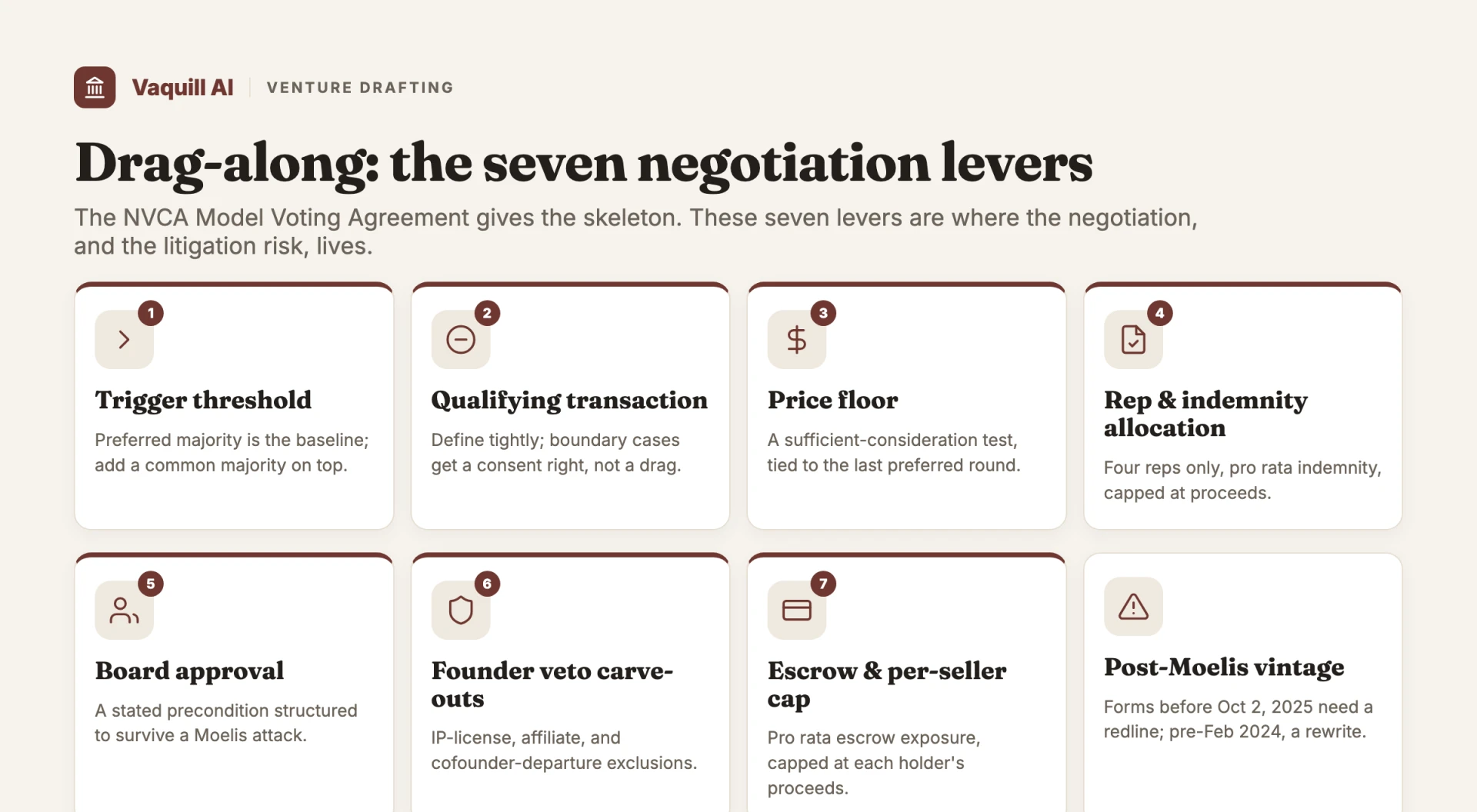
The seven levers that decide a drag-along, plus the post-Moelis vintage check on any form you inherit.
New legal AI guides, weekly.
Further Reading
- Right of First Refusal (ROFR) Drafting in Venture Deals: A 2026 Guide
- Liquidation Preference Math in Venture Deals: A 2026 Walkthrough
- Term Sheet Review Checklist for Corporate Counsel: The 24 Provisions That Matter
- Liquidated Damages Enforceability by State
- Drafting the Schedule of Exceptions in an M&A Deal
- Delaware vs California vs New York Incorporation in 2026

Co-Founder & CEO · Attorney
Arshita leads product and strategy at Vaquill AI, the US primary law data API. As an attorney, she decides which law we carry, how each section is sourced and cited, and what legal AI and compliance teams need from the data.