
The right of first refusal in a venture deal is six paragraphs that decide who joins the cap table for the life of the company, and 2026 is the wrong year to draft it on autopilot.
Three pressure points are stacking on top of each other right now: programmatic secondary liquidity at unicorn-stage companies (Forge, EquityZen, and Hiive ran more total volume in 2025 than at any prior point), founder estate planning has migrated into family LLCs and grantor trusts that didn't exist in the form-book ten years ago, and the IPO window reopening means more S-1 cleanups where underwriter counsel will not move until the ROFR is conclusively dead.
The NVCA treats this as a separately negotiated agreement. Most associates treat it as a boilerplate appendix. The gap between those two postures is where the litigation gets paid for.
TL;DR
- A ROFR gives a defined party (usually the company first, then the major preferred holders) the right to match a third-party offer for common stock before the sale closes. It controls cap-table composition without giving anyone a permanent veto.
- The six elements that have to be right: scope of covered transfers, the trigger event, the response window (typically 15 to 30 days), the matching mechanism, the carve-out list of exempt transfers, and the termination trigger (almost always an IPO or qualified financing).
- The NVCA Right of First Refusal and Co-Sale Agreement (current version October 2025, released alongside the rest of the model package on October 2, 2025 per NVCA's press announcement) is the market reference. Drafting from a blank page in 2026 means doing the wrong job.
- The failures that produce litigation: vague exempt-transfer definitions (especially around family vehicles), notice mechanics nobody can actually comply with, mismatched matching when consideration is non-cash, ROFR-versus-ROFO confusion in the operative section, and silence on what terminates the right at IPO.
- ROFR and right of first offer (ROFO) are not interchangeable. ROFR matches a real third-party offer. ROFO forces the seller to come to the holder first. Confusing them in the operative clause is a malpractice exposure, not a stylistic preference.
What response window does the NVCA model use as its bracketed default?
Part of our corporate and transactional lawyer playbooks.
What the right actually does
A right of first refusal is a contingent purchase option. The holder cannot force a sale. The holder can only step in when somebody else has agreed to buy, and substitute itself on the same terms.
The right does two things at once in a venture deal: it lets the company keep stock from leaking to competitors or unwanted secondary buyers, and it lets the lead preferred holders maintain pro-rata position when a founder or early common holder exits. Founder-side counsel call it a cap-table firewall. Investor-side counsel call it a pre-emption right. Both are correct.
The operative document is the right of first refusal and co-sale agreement. The certificate of incorporation may echo it as a protective provision; side letters may layer on top. None of that matters if the operative agreement is wrong.
What the right does not do: give the holder a right to buy newly issued shares from the company. That is the pre-emptive right, which lives in the investors' rights agreement. Conflating the two is one of the most common drafting confusions, which is why the NVCA model addresses both in separate documents.
The six drafting elements
A working ROFR has six moving parts. Get any one wrong and the clause is either toothless or unworkable.
Scope of covered transfers. What counts as a "transfer." NVCA default is broad: any sale, assignment, pledge, encumbrance, gift, or other disposition. Drafters get into trouble around pledges (collateral for personal loans) and trust transfers (estate planning). Investor-side counsel want both covered. Founder-side counsel want both exempt. That fight is the first element to negotiate, not the last.
The trigger event. When the right activates. Standard formulation: receipt of a bona fide written offer from a third party that the transferring stockholder is willing to accept.
"Bona fide" and "willing to accept" are doing the work. A non-binding indication of interest is not a trigger. An informal conversation at a conference is not a trigger.
The response window. How long the holder has to decide. The NVCA model offers 30 days as the bracketed default; Cooley's GO library uses 30; Wilson Sonsini and Gunderson typically negotiate to 15 or 20.
In secondary-tender deals (Forge, EquityZen, Hiive) the operative window is whatever lets a tender close on its posted schedule, which is usually 20 calendar days. Under 15 days tends to be litigated as commercially unreasonable. Over 45 days deters real third-party offers because buyers cannot hold financing open that long.
The matching mechanism. The cleaner version: identical price and identical terms, full stop. The more flexible version: identical price, with the holder allowed to substitute cash for non-cash consideration at fair market value. The NVCA bracketed language permits cash substitution at fair value.
The most-cited federal authority is Frandsen v. Jensen-Sundquist Agency, Inc., 802 F.2d 941 (7th Cir. 1986), which read a stock-sale ROFR narrowly enough that a parent-level transaction did not trigger the right (a result the appellate court tied to the literal contract text, not a general rule). The lesson practitioners pull from Frandsen and its progeny is the same: if you want the right to bite on stock-for-stock, asset-deal, or parent-level transactions, draft for it.
Exempt transfers. The carve-out list. Standard NVCA-style exemptions: transfers to immediate family members, transfers to trusts for the benefit of the transferor or family, transfers on death, transfers among affiliated funds. The compromise that survives is exempt-as-to-trigger, subject-to-the-right thereafter: the founder can move stock to the trust without triggering ROFR, but the trust is bound by ROFR on any further transfer.
Termination. The standard triggers are (a) closing of a firm-commitment underwritten public offering meeting a defined size threshold (a "qualified IPO"), (b) closing of a deemed liquidation event. Drafters who leave termination vague get the kind of S-1 cleanup work that holds a roadshow for two weeks. The right phrasing is "immediately prior to and conditioned upon the closing of," which gets the right off the cap table before new shares list.
The NVCA model is the floor, not the ceiling
The National Venture Capital Association maintains the Right of First Refusal and Co-Sale Agreement (the document is titled exactly that; the current version is dated October 2025) alongside the rest of the model financing package (term sheet, certificate of incorporation, investors' rights agreement, voting agreement, stock purchase agreement). In its October 2, 2025 release, NVCA said the refresh was meant to reflect evolving market norms and recent legal developments, calling out the Outbound Investment Security Program and bulk-data transfer regulations, both of which reach who is allowed to sit on a cap table. The package is drafted by a working group of fund-side and company-side practitioners, and it is what most institutional venture deals start from. For the broader financing context, see our term sheet review checklist for corporate counsel.
The ROFR and co-sale agreement bundles two related rights. The right of first refusal sits first. The co-sale (tag-along) right sits second, giving investors the right to sell pro-rata alongside a founder when the founder transfers above a threshold. Both rights run from substantially the same notice. Both terminate on substantially the same triggers.
Cooley GO and the Y Combinator Series A documents treat the NVCA package as default. So does Wilson Sonsini's term sheet generator. The a16z Open Source Legal portfolio mirrors the same defaults on the founder side.
Negotiating from outside that framework in 2026 puts the burden on the deviating side to explain why. The model is not perfect, but it is the document the other side has already read.
What the model does not do well: novel exempt-transfer mechanics (founders running personal foundations, founders with multiple stakeholding entities), cross-border transferees, and tokenized equity. Draft on top of the model, not as a replacement for it.
The secondary-tender problem
The ROFR was designed for one-off transfers. It was not designed for an organized tender at 200 employees and 40 ex-employees with a single per-share price set by the company.
By the time a unicorn is running its third programmatic secondary, the ROFR mechanics in the company-side documents are either silently waived in every tender (because running individual transfer notices on 240 holders is operationally impossible) or are coordinated through a tender-specific board waiver plus a pro-rata allocation among the preferred.
The recurring redline at Series B and Series C: founder-side counsel push for the company-organized tender carve-out at the financing, investor-side counsel agree on condition that any tender be capped at a percentage of fully diluted shares (often 10 percent) and conditioned on the preferred holders being offered the same liquidity pro-rata. That is the redline that lands in 2026.
Counsel who do not put a "company-organized tender" exception in the operative ROFR end up running every tender on a series of board waivers that survive in the corporate minute book and die in any litigation that turns on whether the waivers were authorized.
The fix: a single sentence in the ROFR agreement permitting the company to waive on a transaction-wide basis for tenders meeting defined parameters (minimum price, FMV anchor, opt-in by holders). One sentence at financing time saves the cap-table cleanup four years later.
The five negotiation patterns that show up every time
Founder-side versus investor-side on exempt transfers. This is the first thing real deals fight about and the last thing junior associates flag. Founder-side counsel push for an unconditional carve-out for transfers to family, grantor trusts, GRATs, and single-member family LLCs that the founder controls; investor-side counsel insist the transferee take the stock "subject to the same restrictions," which means the right re-attaches at the LLC level.
Where deals actually land in 2026: the LLC and trust transfers go through without trigger, but the operative agreement defines "Permitted Transferee" to require the transferee to sign a joinder. The joinder is the leverage. Without it, exempt-as-to-trigger collapses into exempt-forever the first time the trust spins out a sub-trust.
Non-cash consideration is the buy-side fight. The cleanest buy-side position is "we get to substitute cash at FMV for any non-cash component." The cleanest sell-side position is "match identical or step aside."
What gets signed in practice in 2026: cash substitution permitted only where non-cash exceeds a defined percentage (often 25 percent), with FMV determined by a named mechanism (the company's most recent 409A for early stage, an independent investment banker for later stage). Where the actual compromise lands: founders accept cash-substitution on parent-level transactions, investors accept founder-friendly carve-outs for genuine estate-planning vehicles, and the valuation-mechanism language gets the most red-line rounds.
A concrete example of where the drafting actually moves. The bad clause: "the Holder may purchase the Offered Shares on the same terms set forth in the Transfer Notice." That is what associates produce on the first pass. The litigation when the offer is part-cash, part-rolled-equity is predictable.
The better clause: "the Holder may purchase the Offered Shares for the cash purchase price set forth in the Transfer Notice, and (i) for any non-cash consideration constituting marketable securities, an equivalent number of such securities, or (ii) for any other non-cash consideration constituting more than [25%] of the aggregate consideration, the cash equivalent thereof, with such cash equivalent determined by [the Company's most recent Section 409A valuation / an independent investment bank mutually agreed by the Holder and the transferring Stockholder]." Five extra lines, no litigation.
The NVCA bracketed language in the Model Right of First Refusal and Co-Sale Agreement is the closest off-the-shelf version of the second clause, and Cooley GO publishes a substantially similar form on its free document set.
Pro-rata versus first-in-line. When the company declines to exercise, the right flows to the major preferred holders. Pro-rata to existing holdings is the NVCA default, with over-allotment among holders who elected to exercise. First-in-line mechanics are rare and produce coordination problems boards do not want to mediate.
Acceleration and waiver mechanics. The clean drafting: the company may waive by board consent; holders may waive only by holders of a defined percentage (usually a majority of the preferred). Anything looser invites the founder to walk a sympathetic minor investor through an informal waiver and create a real-versus-claimed-waiver dispute.
Co-sale interaction. ROFR and co-sale operate in sequence. Third party makes an offer; the company and the holders get the first refusal; if they decline, co-sale activates and the holders can sell their pro-rata share into the offer alongside the founder. If the third party will buy 10,000 shares and the co-sale holders elect to sell 3,000, the founder sells 7,000 and the holders sell 3,000. NVCA default: the third party takes the package as offered or walks.
The whole sequence runs off a single transfer notice. Drawn out, it looks like this:
Drag-along interaction. A drag, sitting in the voting agreement, forces the whole cap table into a sale of the company. ROFR controls individual stock transfers.
A drag-triggered sale should be a "deemed liquidation event" under the ROFR agreement and therefore terminate the right, not trigger it. Drafters who do not coordinate the two documents produce a closing where the founder has to satisfy both rights simultaneously, which usually means a closing that does not happen.
The four failure modes that produce litigation
Vague exempt-transfer definitions plus broken joinder. "Transfers to family members" without defining "family member," combined with no requirement that the transferee sign a joinder, is the most common failure. Investor-side counsel sue when the founder spins stock through a family LLC and the LLC sells to a competitor without notice. Define "immediate family" and "Permitted Entity" by enumeration, and require a joinder on every exempt transfer.
Inadequate notice mechanics and non-cash matching. Two failures that travel together. The agreement says "notice in writing" and "match identical terms," and a transfer comes in by email for a 60/40 cash-and-rolled-equity package.
The founder argues receipt was email; the investor argues the stock-purchase-agreement notice clause is incorporated; nobody can match rolled equity, and courts that read ROFRs narrowly (the posture Judge Posner took in Frandsen v. Jensen-Sundquist Agency, Inc., 802 F.2d 941 (7th Cir. 1986)) will not supply a cash-substitution right the parties never wrote. Fix both at drafting: govern notice inside the ROFR agreement and expressly permit cash substitution at a defined FMV mechanism.
ROFR-versus-ROFO confusion. The header says "right of first refusal," the mechanics describe a right of first offer, or the reverse. ROFR matches a real third-party offer. ROFO forces the seller to come to the holder first. Practitioner sources, including Practical Law's pre-emption-right materials, treat the confusion as a recurring drafting error. Pick the structure, name it correctly, check the operative paragraph against the title.
Failure to terminate cleanly at IPO. "Terminates on a qualified initial public offering" without defining when. The bankers ask whether the right exists during the registration window. The transfer agent asks whether it survives between effectiveness and pricing. The fix, lifted from the NVCA model: "immediately prior to and conditioned upon the closing of a Qualified IPO."
ROFR versus ROFO: the doctrinal distinction
Practitioner treatments, including Practical Law's pre-emption-right materials, frame the difference cleanly:
- Right of first refusal. Seller goes to market, gets a real offer, holder may match. The seller controls timing; the holder controls only the right to substitute itself. Risk to the seller: a chilling effect on third-party offers (buyers know they may waste diligence dollars to set a price for the holder to match). Risk to the holder: the seller can manufacture a sweetheart offer the holder cannot match.
- Right of first offer. Seller offers first to the holder. If the holder declines, the seller may sell to a third party on terms no better than what was offered. The chilling effect is reversed: third-party buyers know the asset has been shopped, which can suppress their willingness to pay full price.
| Right of first refusal (ROFR) | Right of first offer (ROFO) | |
|---|---|---|
| Trigger | Seller has a signed third-party offer in hand | Seller decides to sell; no third-party offer needed |
| Who sets the price | The third-party buyer | The seller (or seller and holder negotiate) |
| Holder's move | Match the existing terms or step aside | Make an offer; seller can shop for better |
| Who it favors | The holder (buyer-protective) | The seller (more freedom to market) |
| Main risk | Chills third-party offers (buyers fear being a stalking horse) | Holder may lowball; seller still gets to test the market |
| Typical home | Venture cap tables, closely held stock | Joint ventures, commercial real estate |
ROFR is more common in venture deals because the company and the preferred holders want real market validation before committing capital. ROFO is more common in joint ventures and real estate, where the asset cannot be efficiently shopped without committing the seller to a process. The same sequencing logic governs the drag-along provisions that sit one document over in the voting agreement.
The two are not stylistic alternatives. They produce different transactional dynamics and different breach-of-contract claims when they fail.
A drafter who writes "right of first refusal" in the header and ROFO mechanics in the body has produced an agreement no court will read consistently.
The 2026 drafting checklist
Seven passes before a clean draft goes out. Most take ten minutes; all save the fight in year three.
- Right document. ROFR over transfers belongs in the ROFR and co-sale agreement, not the investors' rights agreement (which handles pre-emption over new issuances).
- Scope and notice. Scope-of-transfer covers pledges and trust transfers expressly; the notice provision is governed inside the ROFR agreement or by an express cross-reference, not by inference.
- Response window. Matches the rest of the package. If the stock purchase agreement has 30-day notice and the ROFR has 15-day, somebody will miss a deadline.
- Exempt transfers. Defined by enumeration, with a joinder requirement on every exempt transfer. "Family members" is a fight; "spouse, lineal descendants, lineal ascendants, siblings, and trusts the beneficiaries of which are limited to the foregoing" is not.
- Matching mechanism. Addresses non-cash consideration expressly (match-identical or permit cash substitution at a defined FMV mechanism such as the most recent 409A).
- Termination and drag coordination. Termination uses "immediately prior to and conditioned upon the closing of"; a drag-triggered sale is a deemed liquidation event so the ROFR dies into the close rather than running alongside it.
- Title check. Read the operative ROFR section against the header. If the mechanics are ROFO and the header is ROFR, fix it today.
The deal counsel who get this clause right negotiate it as a single integrated unit at financing time.
The ones who get it wrong are the ones who pass the schedule of holders, the exemptions, and the termination language through unread because the cover memo said the form was "the standard NVCA package."
FAQ
What is a right of first refusal in a venture deal?
A right of first refusal (ROFR) lets a defined party, usually the company first and then the major preferred holders, match a third-party offer for common stock before that sale closes. It is a contingent purchase option, so the holder cannot force a sale; it can only step in once someone else has agreed to buy and substitute itself on the same terms. The point is to control who joins the cap table.
What is the difference between ROFR and ROFO?
A ROFR reacts to a real, signed third-party offer: the holder may match it or step aside. A ROFO comes first: the seller has to offer to the holder before going to market, and if the holder passes, the seller can sell to a third party on terms no better than what the holder was offered. ROFR is buyer-protective and common in venture cap tables; ROFO gives the seller more freedom and shows up more in joint ventures and real estate.
Does the NVCA model have a right of first refusal document?
Yes. The NVCA publishes a document titled the Right of First Refusal and Co-Sale Agreement (current version October 2025, released with the rest of the model package on October 2, 2025) as part of its model financing package. It bundles two rights: the ROFR sits first, and the co-sale (tag-along) right sits second.
Who holds the right of first refusal, the company or the investors?
Usually both, in sequence. The company gets the first refusal. If the company declines to buy all the offered shares, the right flows to the major preferred holders, typically pro-rata to their existing holdings with an over-allotment among those who elected to exercise.
How long is a typical ROFR response window?
The NVCA model uses 30 days as the bracketed default. Many firms negotiate to 15 or 20 days. In company-organized secondary tenders the window is usually whatever lets the tender close on schedule, often around 20 calendar days. Windows under 15 days risk being challenged as commercially unreasonable, and windows over 45 days deter real third-party offers.
How does a ROFR interact with co-sale rights?
They run in sequence. A third party makes an offer, the company and the holders get the first refusal, and if they decline, co-sale activates so the holders can sell their pro-rata share into the offer alongside the founder. If the buyer wants 10,000 shares and co-sale holders elect to sell 3,000, the founder sells 7,000 and the holders sell 3,000.
When does a right of first refusal terminate?
The standard triggers are the closing of a qualified IPO (a firm-commitment underwritten public offering meeting a defined size threshold) and the closing of a deemed liquidation event. The clean phrasing is "immediately prior to and conditioned upon the closing of," which gets the right off the cap table before new shares list.
Can a ROFR cover non-cash consideration?
Only if you draft for it. The cleanest buy-side position is the right to substitute cash at fair market value for any non-cash component. The NVCA bracketed language permits cash substitution at fair value, often with a defined FMV mechanism such as the most recent Section 409A valuation for early stage or an independent investment bank for later stage. Without that language, a part-cash, part-rolled-equity offer can leave the holder unable to match.
Pair it with the liquidation preference math when you check the deemed-liquidation termination trigger.
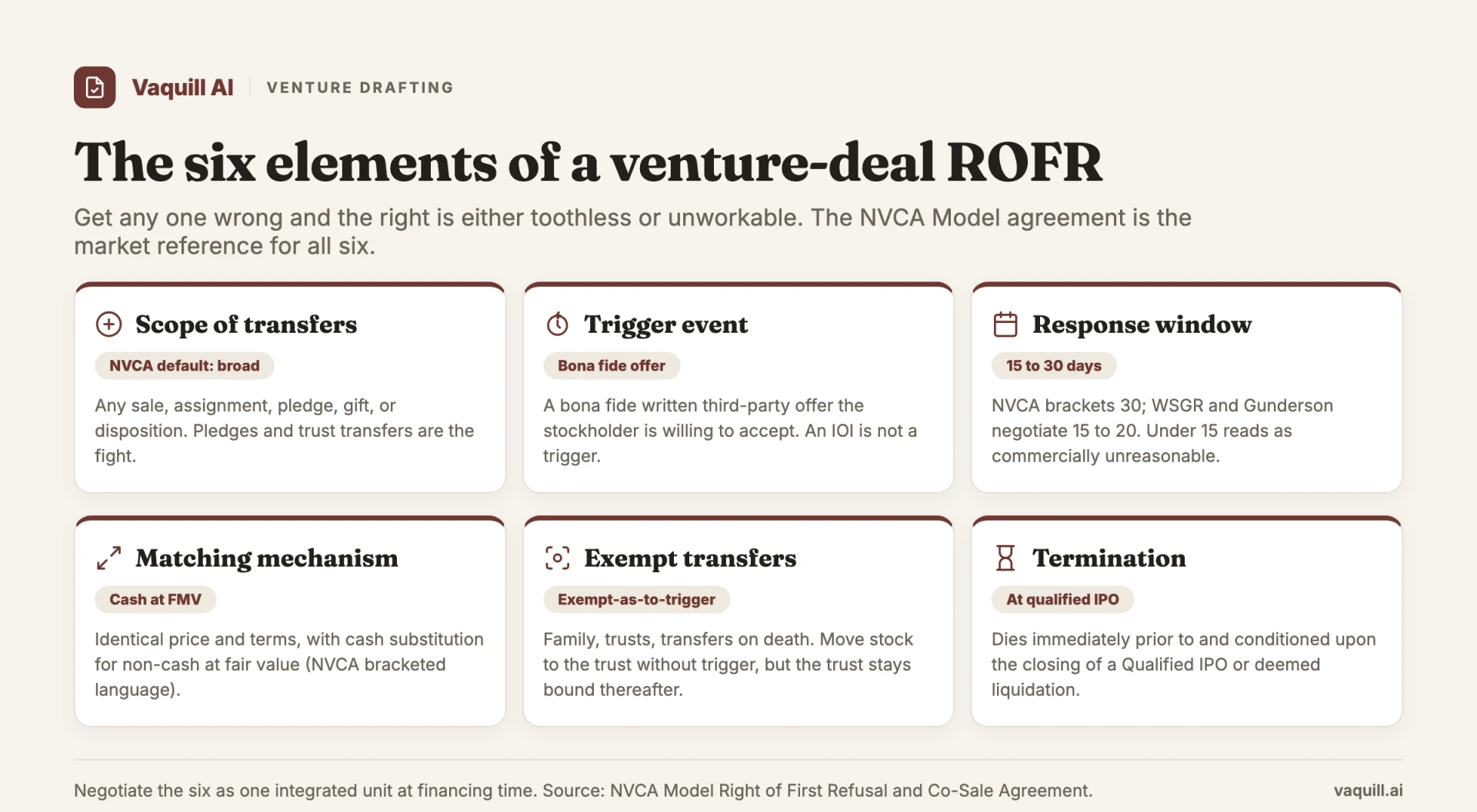
The six elements every ROFR has to get right, with the market-standard defaults from the NVCA Model agreement.
For related corporate drafting coverage, see Drafting the Schedule of Exceptions in an M&A Deal and the 409A valuation playbook for corporate counsel.
New legal AI guides, weekly.
Further Reading
- Liquidation Preference Math in Venture Deals: A 2026 Walkthrough
- Drag-Along Provisions in Venture Deals: A 2026 Drafting Guide
- Term Sheet Review Checklist for Corporate Counsel: The 24 Provisions That Matter
- Liquidated Damages Enforceability by State
- Drafting the Schedule of Exceptions in an M&A Deal
- Delaware vs California vs New York Incorporation in 2026

Co-Founder & CEO · Attorney
Arshita leads product and strategy at Vaquill AI, the US primary law data API. As an attorney, she decides which law we carry, how each section is sourced and cited, and what legal AI and compliance teams need from the data.