A founder closes a $5M Series A on a $20M post-money. The board deck calls it a 25% sale. The term sheet calls it 1x participating preferred.
Eighteen months later, the company sells for $30M, which most people in the room would tell you is a fine outcome. The investor walks with $11.25M. The founders and the option pool split $18.75M, of which the option pool actually got about $4M.
If the same deal had been 1x non-participating, the investor would have taken $7.5M and the common would have split $22.5M. Same headline price. Same cap table. $3.75M less to the people who built the company.
That gap is the entire reason liquidation preference is the single most-fought-over economic term in a venture financing. The mistake that produces it, almost every time, is the same: founder-side counsel treats "1x preference" as the negotiated point and lets "participating vs non-participating" slip through as a drafting detail.
It is not a drafting detail. It is the term that decides whether the investor's percentage of the cap table matches the investor's percentage of the exit, and it is invisible until the wire transfer goes out.
Short answer: Liquidation preference math is the payout order at a sale. With 1x non-participating preferred (the 2026 market standard), the investor takes the greater of their money back or their ownership percentage of the sale price, never both. With 1x participating preferred, the investor takes their money back AND their percentage of what is left, so common stock loses roughly the preference amount at every exit price. A 2x multiple doubles the floor and can hand the investor half the proceeds at a moderate exit. The worked examples below show the exact dollars at $10M, $30M, and $50M.
TL;DR
- Liquidation preference math is the order of operations at exit: who gets paid back first, and on what terms, before the common stock sees a dollar. The math, not the percentage owned, decides who actually walks away with what.
- 1x non-participating preferred is the 2026 market standard for early-stage priced rounds. Carta's deal-terms data put roughly 95% of recent venture deals at non-participating and about 98% at a 1x preference (Carta, 2025); treat that as the typical baseline, not a rule.
- Participating preferred and multipliers above 1x are signals, not just terms. They show up in down rounds, in late-stage extension rounds, and in any deal where the investor is using preference to back-fill conviction they do not actually have.
- Three worked exit scenarios at $10M, $30M, and $50M make the structural difference visible. Same $5M check, same 25% ownership, three different return profiles depending on which preference type sits on top.
Under 1x non-participating preferred, what does the investor get at exit?
Part of our corporate and transactional lawyer playbooks. The preference clause sits inside the broader term sheet review checklist for corporate counsel, and it only bites in a priced round, so the choice between a SAFE, a convertible note, or a priced round sets the table for it. For the adjacent strike-price problem that sits underneath every preference negotiation, see our 409A valuation playbook for corporate counsel.
What liquidation preference actually does
Liquidation preference is a contractual override of the default pro rata distribution at a "deemed liquidation event," which is the term the NVCA Model Certificate of Incorporation uses for the events that trigger the waterfall: a sale of substantially all assets, a merger where the target's stockholders own less than a majority of the surviving entity, and similar change-of-control transactions.
IPOs do not trigger preference; preferred typically converts to common at IPO under a separate provision.
Inside the deemed-liquidation waterfall, the order is fixed and mostly familiar:
- Senior secured creditors take their collateral.
- Other secured creditors take theirs.
- Unsecured creditors are paid from what is left.
- Preferred stockholders are paid according to their liquidation preference, in order of seniority across series and pari passu within a series unless the charter says otherwise.
- Common stockholders split whatever remains.
Steps 1 through 3 are bankruptcy law and contract law doing their normal work. The interesting fight, the one that founder-side counsel should be losing sleep over, is step 4, because step 4 is where the charter can rewrite the economics of the entire deal without changing the headline price.
The relevant provision in the NVCA model is Article IV, Section 2.1 ("Payments to Holders of Series A Preferred Stock"). The language has alternative blocks for non-participating, full participating, and capped participating, and the choice between those alternatives is the term sheet negotiation.
The three structural types
Almost every deal collapses to one of three structures, with knobs on each.
1x non-participating preferred. At a deemed liquidation, each share of Series A is entitled to the greater of (a) its original issue price plus declared but unpaid dividends, or (b) the amount it would receive on conversion to common and pro rata participation in the proceeds. The investor picks the better of a floor and a share of the upside. They cannot take both. This is the structure embedded in NVCA Section 2.1 Alternative 1.
1x participating preferred (full participation). Each share of Series A first receives its original issue price (the "preference amount"), then participates pro rata with common in the remaining proceeds on an as-converted basis. The investor takes the floor AND the share of upside. This is double-dipping, and it is exactly what it sounds like. NVCA Section 2.1 Alternative 2.
Capped participating preferred. Same as full participating, except the total return is capped at a multiple of the original issue price (commonly 2x or 3x). Once the cap is hit, the preferred converts to common and shares pro rata from there. This is the negotiated middle ground that lets an investor argue for participation without the optics of unlimited double-dipping.
Multiple-x preferred. The preference amount is 2x or 3x the original issue price instead of 1x. It can be non-participating (rarer) or participating (more common when a multiple shows up at all). In 2026 this is overwhelmingly a distress signal: bridge rounds, recap rounds, and down rounds where the new money is demanding a larger floor.
Carta's deal-terms data is the most-cited industry source on adoption. Carta reported that in Q2 2025 about 98% of venture deals used a 1x preference and about 95% were non-participating (Carta, deal-terms data, 2025). The typical pattern: non-participating at 1x dominates Series A and B by a wide margin, participation creeps in at later stages, and higher multiples cluster in the weakest rounds by valuation step-up.
Cooley GO's quarterly venture financing reports tell a similar story (Cooley GO Trends): participating preferred had a brief revival in the 2022-2023 funding correction and has been receding since. Treat these as typical-market reads, not guarantees; your specific round can sit outside them.
Worked example 1: $5M Series A, 1x non-participating preferred
The setup, identical across all three examples:
- $5M Series A investment at $20M post-money.
- Investor owns 25% of the company on a fully diluted basis.
- No prior preferred. No accrued dividends. Common holds 75%, including the option pool.
The non-participating election is the greater of (a) the $5M preference, or (b) 25% of total proceeds on as-converted conversion. Crossover happens at $20M of proceeds, which is, not coincidentally, the post-money valuation.
Exit at $10M. The investor takes the preference: $5M back. Conversion would yield only $2.5M (25% of $10M), so the floor wins. Common splits the remaining $5M.
The founders just sold the company at the post-money and got back half of it.
Exit at $30M. Conversion now beats the floor: 25% of $30M is $7.5M, more than the $5M preference. The investor converts and takes $7.5M. Common splits $22.5M.
Exit at $50M. Conversion clearly wins: 25% of $50M is $12.5M. Common splits $37.5M.
This is the structure founders want. It aligns the investor with upside above the post-money and gives them a floor below it. The decision to convert is forced by the math, not by negotiation at exit.
When 1x non-participating is rational for both sides: the investor underwrites to a return distribution where the upside cases dominate, the floor is insurance against the bottom-quartile outcome, and the upside cases are large enough that conversion is the dominant strategy. That is the standard early-stage venture math.
Participating preferred is only rational from the investor's side when the expected exit distribution is compressed around the post-money, which is to say, when the investor does not actually believe in the upside.
The right thing for founder-side counsel to say in the room, exactly once: "If you are asking for participation, you are telling us you do not think this gets to a 3x exit. What do you know that we should also know?"
Worked example 2: $5M Series A, 1x participating preferred
Same cap table. Same check. Different waterfall: the investor takes the $5M preference first, then participates pro rata with common in the remainder.
Exit at $10M. Preference of $5M off the top, leaving $5M to split. The investor's pro rata share of that $5M is 25%, or $1.25M. Investor total: $6.25M. Common total: $3.75M.
The investor's effective return on a $10M exit is 1.25x. The common shareholders, who own 75% of the company, walked away with 37.5% of the proceeds.
Exit at $30M. Preference of $5M off the top, leaving $25M. Investor takes 25% of $25M, or $6.25M, on top of the preference. Investor total: $11.25M. Common total: $18.75M. The $3.75M delta versus the non-participating case in the same exit is the participation premium, and it is paid entirely by common.
Exit at $50M. Preference of $5M off the top, leaving $45M. Investor takes 25% of $45M, or $11.25M, plus the preference. Investor total: $16.25M. Common total: $33.75M.
The pattern: participating preferred costs common roughly the preference amount in absolute dollars at every exit price above the floor. It is a flat tax on the common stack, not a sliding one.
On a small exit it looks ruinous (the 1.25x on a 1x preference at the floor); on a large exit it looks merely expensive (the same $3.75M gap on a $50M exit is 7.5% of the deal). Founders tend to underweight it at signing because the term sheet conversation centers on the headline valuation, not the waterfall at a range of plausible exits.
Worked example 3: $5M Series A, 2x participating preferred
Same cap table again. Now the preference is 2x ($10M back) and the investor participates pro rata in whatever is left.
Exit at $10M. The preference alone is $10M, which exhausts the proceeds. Common gets zero.
The investor takes a 2x return; the founders take nothing on an exit that just returned the post-money.
Exit at $30M. Preference of $10M off the top, leaving $20M. Investor takes 25% of $20M, or $5M, on top. Investor total: $15M. Common total: $15M. The investor, with 25% nominal ownership, just took half the proceeds.
Exit at $50M. Preference of $10M off the top, leaving $40M. Investor takes 25% of $40M, or $10M, on top. Investor total: $20M. Common total: $30M.
This is the structure that should make a founder walk. A 2x participating preferred at $20M post-money means the company has to clear $20M of enterprise value just to put a dollar in the founders' pockets, and the investor's effective ownership at moderate exit prices runs closer to 40-50% than to the 25% on the cap table.
When this term appears in a 2026 term sheet outside a distressed context, the right response is to ask which other terms the investor is willing to trade to take it off the table.
Comparison: same exit, three preference structures
| Exit | 1x non-part. (investor / common) | 1x part. (investor / common) | 2x part. (investor / common) |
|---|---|---|---|
| $10M | $5.0M / $5.0M | $6.25M / $3.75M | $10.0M / $0 |
| $30M | $7.5M / $22.5M | $11.25M / $18.75M | $15.0M / $15.0M |
| $50M | $12.5M / $37.5M | $16.25M / $33.75M | $20.0M / $30.0M |
Three rows, three structures. The cap table is unchanged across all nine cells. The headline valuation is unchanged.
The only variable is the language in Article IV of the charter, and the variable moves between $3.75M and $10M of common shareholder value at each row.
That is the price of the term, and it is rarely priced into the negotiation that way.
The 2026 market: where participation and multipliers actually live
The clean version of the market in 2026:
- Series Seed through Series B. 1x non-participating preferred is the floor. Anything else is a tell about either the investor (out-of-pattern, or pushing because they think they can) or the company (signal of weakness the founder may not have realized was visible). Carta's recent deal-terms data has consistently shown the large majority of early-stage rounds at 1x non-participating (Carta, 2025).
- Series C and later. Participation starts to appear, usually capped (2x or 3x participation cap), often as the price of a quality lead at a higher headline valuation. The trade is real: the founder gets the optics of a strong round, the investor gets the floor. Whether that trade is good depends on the exit distribution the founder believes in.
- Down rounds and recaps. Participating preferred and multiplier preferences proliferate. This is the rational response to a re-pricing risk: if the next round prices below today's, the investor wants the floor to protect against the worst case. The defensible negotiation is usually a participation cap, a sunset on participation (converts to non-participating after a fixed period or on a qualifying event), or a pay-to-play that forces the investor to keep funding to keep the preference.
- Bridge and extension rounds. SAFEs and convertible notes that convert into participating preferred should be flagged at term-sheet stage. The instrument is invisible at signing and obvious at exit, which is exactly the worst time for the founder to discover it.
The position founder-side counsel should defend, sharply, is that 1x non-participating is the default for any priced round above seed and that any deviation needs a specific, named justification.
"It is what we do" is not a justification. "We are taking pricing risk on a step-up of more than 4x" is one, and it opens a real negotiation about caps and sunsets.
A specific 2026 signal: the brief revival of participating preferred during the 2022-2023 correction was concentrated in growth-stage extension rounds at flat or modestly-down valuations, where the new investor was effectively buying yield on a stale price.
Cooley GO's trends reporting from that period flagged participation rising at later stages before receding; recent Carta deal-terms reads have non-participating back as the dominant structure across stages (Carta, 2025). Read both as directional market color, not a promise about your round.
The capped-participation compromise (2x or 3x cap, then conversion to common) is the structure that absorbed most of those deals, and it remains the standard ask when an investor will not let go of participation outright. If you see uncapped participating preferred in a 2026 priced round at a respectable valuation, the term is asking a question the investor is not saying out loud.
A specific pattern from recent deal practice: side letters that quietly grant a single fund a senior preference position over the rest of a pari passu Series B class, in exchange for the fund leading the round, are showing up more often.
Founder-side counsel routinely catches the headline charter and misses the side letter, because the charter cleanly says "pari passu" and the side letter is a separate document the deal team has not put on the term-sheet table.
The fix is procedural: any side letter with a most-favored-nation clause or an economic preference modification gets attached to the long-form charter review with the same sign-off as the charter itself.
The concession ladder founder-side counsel should run, in order, when the term sheet comes back with participating preferred: (1) push back to 1x non-participating, citing the relevant Carta or Cooley GO benchmark for the stage, and offer a small valuation adjustment to make the swap painless; (2) if that does not move, accept participation only with a 2x cap and an explicit sunset on the participation right at a qualified IPO or after a fixed period (commonly five to seven years); (3) if a multiple is still on the table, demand a pay-to-play that strips the preference if the investor does not participate in the next down round, plus a participation cap.
Stop ladder-walking when you have one of those three; do not give up two of them.
Stacked preference: when there is more than one series
The earlier examples assumed a single series of preferred. Real cap tables stack. Series A, Series B, Series C, often with different preference terms in each round.
The charter has to specify the seniority structure, and the choice has cash consequences.
Senior (last-in-first-out). The newest series is paid its preference before any earlier series. NVCA Section 2.1 supports this with explicit series seniority language. This is the most common late-stage structure, because the new money is the marginal capital and uses seniority as leverage.
Pari passu. All preferred series share the preference pool pro rata, regardless of when they were issued. If the pool is insufficient, each series takes its proportional share of what is available. Common in earlier rounds where the new investor either does not have leverage to demand seniority or the existing investors veto it.
Pro rata to original investment. Less common. Preferred share the pool in proportion to dollars invested, not shares held.
Counsel should track which series is senior to which in a one-page waterfall memo every time a new round closes. The single most-common drafting error in late-stage charters is a Series C seniority provision that does not cleanly stack against the Series B's pre-existing preference, leading to ambiguity that surfaces during a sale process when nobody has time to litigate it.
Resolving that ambiguity post hoc usually costs the founders, because the founders are the residual claimants and the residual is what gets squeezed.
Drafting checklist that actually protects founders
The $3.75M gap from the opening of this post was not the product of a complex provision or a hidden clause. It was the difference between two checkboxes in Article IV of a standard NVCA charter.
The terms below are the ones founder-side counsel should hold a line on at term-sheet stage, before the lawyers are even drafting, so that the checkbox question gets asked once, on the right side. Once the term sheet is signed, the leverage is gone.
The first three items below are the ones that actually move dollars. Items four through nine are the cleanup that prevents drafting accidents from rewriting the deal in the long-form charter.
The three that move economics most:
- 1x non-participating as the default. Specify it in the term sheet, not just in the long-form charter. Term sheets that say "1x liquidation preference" without "non-participating" are the source of more bad outcomes than any other ambiguity. Hold this line first; everything else is downstream.
- No multiple-x preference. If a multiple is on the table, ask what is wrong with the round. There is usually an answer the term sheet is not telling you. A 2x participating preference at $20M post-money costs common roughly the post-money valuation off the top, which is what the worked example above showed quantitatively.
- Participation cap if participation is unavoidable. 2x cap is the floor of acceptable; 3x is the normal compromise. Above 3x, you are not really negotiating, you are accepting.
The cleanup that prevents downstream drafting accidents:
- Conversion right cleanly drafted. The right to convert to common at the investor's option needs to be unconditional and apply at any time, not gated on a qualified financing or a board event. Conversion is what makes non-participating preferred work as a floor; if the right is conditional, the floor is not real at small exits.
- Acceleration overlap. Founder vesting acceleration on a change of control interacts with preference. If founders accelerate on close but the deal price barely clears the preference stack, the accelerated shares are accelerating into zero. Model it.
- Pay-to-play. A pay-to-play that strips preferred status from investors who do not participate in down rounds is the single most-effective defensive term founders can have. It is rarely included by default. Ask for it.
- Seniority documented in the term sheet. Pari passu unless explicitly negotiated otherwise. Late-stage rounds will push for senior preference; do not let that show up first in the long-form charter.
- Deemed liquidation defined narrowly. The set of triggering events should not sweep in routine recapitalizations or financings. NVCA's default is reasonable; bespoke broadening should be resisted.
- Exit waterfall modeled at three prices. Counsel should walk the founders through the waterfall at the post-money, at 2x post-money, and at 0.5x post-money before the term sheet is signed. The 0.5x case is the one founders never want to look at, and it is the one that shows them what they are actually trading away.
Nothing in this checklist requires invention. Every item is supported by language in the NVCA model documents, and the negotiation in the room is which alternative gets selected and which optional provisions get included.
The leverage is highest before signing, and the cost of fixing a bad term post-close is sometimes literally impossible, since charter amendments require the same approvals as the original deal.
A practitioner observation
The pattern that shows up in actual closings is that founders read the term sheet as a valuation document and the long-form charter as a paperwork document. Both assumptions are wrong.
The term sheet is a valuation document and an economics document, and the economics live in the preference, the seniority, and the participation choice as much as in the price per share. The charter is where those economics get committed in language a Delaware court will read literally.
Counsel who frames the conversation as "the term sheet sets the price, the charter sets who gets what when it sells" tends to get better outcomes than counsel who frames it as "the price is the deal, the rest is standard."
There is no "standard" in this part of the agreement. There are defaults, and the defaults are negotiable, and the negotiation happens once, before the signature page.
Before the term sheet is signed, do two things in order: redline the proposed charter against the NVCA model to surface every alternative the term sheet quietly picked, then run a three-price waterfall (0.5x, 1x, and 2x the post-money) and have the founders read the numbers themselves.
The redline step is where most of the value hides, and it is the most mechanical part. Two related clauses worth the same treatment in the same charter: right of first refusal and drag-along provisions.
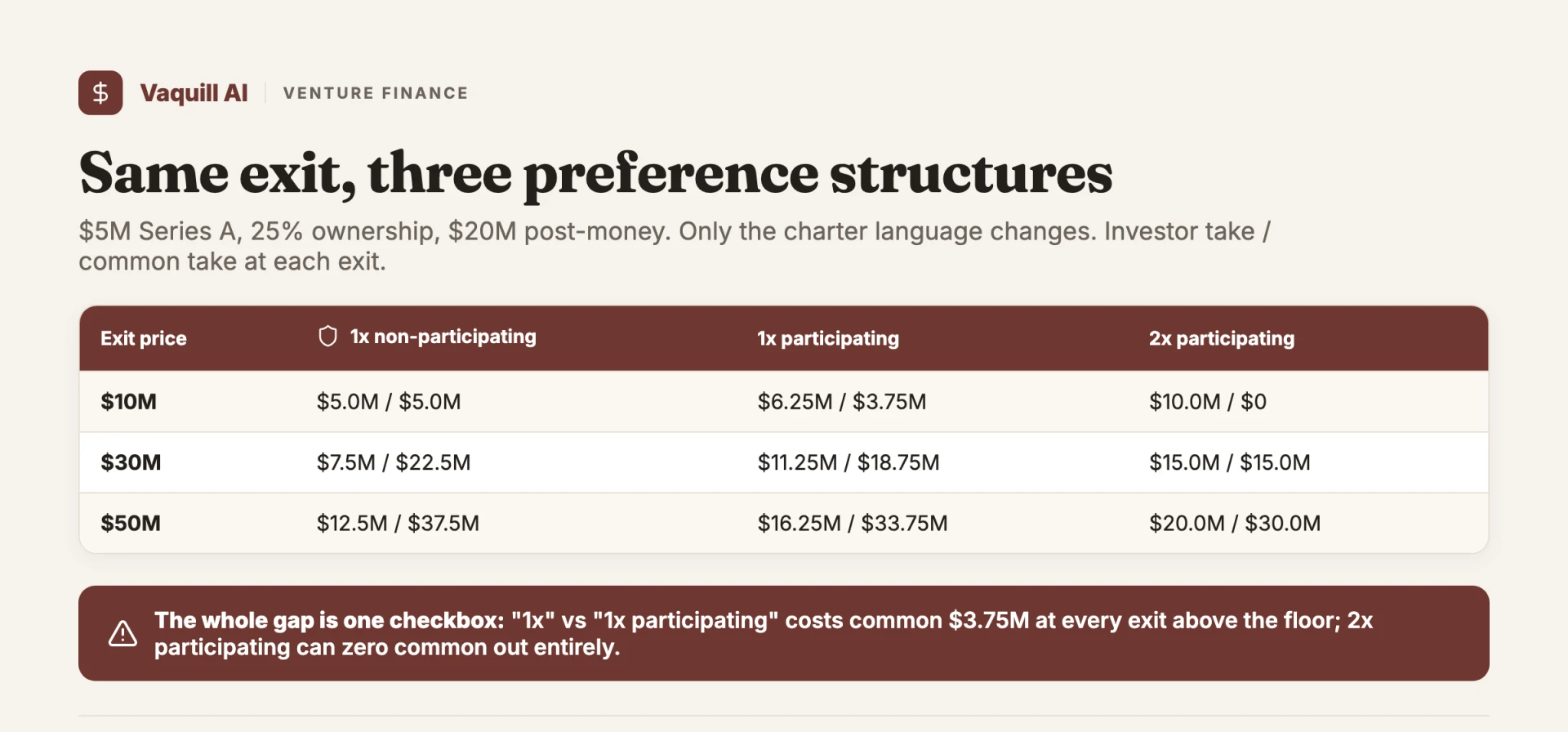
Same $5M check and 25% ownership: only the preference structure changes, and it swings $3.75M to $10M of common value at each exit.
FAQ
What is liquidation preference math?
Liquidation preference math is the order of payout at a sale or wind-down: secured and unsecured creditors first, then preferred stockholders take their liquidation preference, then common stock splits whatever is left. The math, not the ownership percentage on the cap table, decides who actually walks away with what. A worked example: a $5M investor at 1x non-participating in a $30M sale converts to common and takes $7.5M (25%), leaving $22.5M for common.
What does 1x non-participating preferred mean?
1x non-participating preferred means the investor gets the greater of two amounts at exit: their original investment back (1x), or their ownership percentage of the total sale proceeds on an as-converted basis. They pick one, never both. Below the post-money valuation they take the 1x floor; above it they convert to common and ride the upside. It is the most founder-friendly common structure and the 2026 market standard for priced rounds.
What is the difference between participating and non-participating preferred?
Non-participating preferred takes the greater of the preference or the as-converted share, so the investor cannot double-dip. Participating preferred takes the preference first AND then shares pro rata in the remaining proceeds, so the investor double-dips. On a $5M check at 25% in a $30M sale, non-participating returns $7.5M and participating returns $11.25M. That $3.75M gap comes straight out of common stock.
Is a 1x non-participating liquidation preference standard?
Yes. Carta's deal-terms data put roughly 95% of recent venture deals at non-participating and about 98% at a 1x multiple (Carta, 2025). Anything beyond 1x non-participating in an early-stage priced round is out of pattern and signals either an aggressive investor or a weak round. Treat it as the baseline and ask for a specific justification for any deviation.
When does liquidation preference actually matter most?
It bites hardest at small-to-medium exits, roughly between 1x and 3x of total capital raised. At those prices the preference stack eats a large share of the proceeds and a participating or multiple preference can leave common with little or nothing. At very large exits the preference is usually irrelevant because the investor converts to common and rides the percentage. Always model the 0.5x and 1x post-money cases, not just the optimistic one.
What is a capped participating preferred?
Capped participating preferred works like full participation (preference plus pro rata share of the remainder), but the investor's total return is capped at a multiple of the original investment, commonly 2x or 3x. Once the cap is hit, the preferred converts to common and shares pro rata from there. It is the usual middle-ground compromise when an investor will not drop participation outright.
What does a 2x liquidation preference do to founders?
A 2x preference doubles the floor the investor takes before common sees a dollar. On a $5M check (2x participating) at $20M post-money, a $10M sale returns the full $10M to the investor and zero to common, and a $30M sale splits 50/50 even though the investor nominally owns 25%. A 2x multiple in a healthy priced round is usually a walk signal; it most often appears in down rounds, recaps, and bridges.
Does liquidation preference apply at IPO?
No. An IPO does not trigger liquidation preference. Preferred stock typically converts to common at IPO under a separate conversion provision, so everyone is paid as common on a per-share basis. Preference only fires at a "deemed liquidation event," meaning a sale of substantially all assets, a change-of-control merger, or a wind-down.
New legal AI guides, weekly.
Further Reading
Drag-Along Provisions in Venture Deals: A 2026 Drafting Guide
Read postRight of First Refusal (ROFR) Drafting in Venture Deals: A 2026 Guide
Read postAttorneys' Fees Provisions by State: When Contractual Fee-Shifting Survives
Read postDelaware vs California vs New York Incorporation in 2026
Read postDrafting the Schedule of Exceptions in an M&A Deal
Read postLiquidated Damages Enforceability by State
Read post
Co-Founder & CEO · Attorney
Arshita leads product and strategy at Vaquill, building the legal AI suite that solo, small-firm, and in-house US lawyers use to run a matter end to end.