Short answer: NDAs are enforceable in all 50 states when they protect a legitimate business interest, are supported by consideration, and are reasonable in scope and duration. What changes by state is the carve-outs. The federal Speak Out Act voids pre-dispute NDA and non-disparagement clauses that cover sexual harassment or sexual assault everywhere, and roughly a dozen states (California, New York, New Jersey, Washington, Illinois, Oregon, Maine, Vermont, Connecticut, Maryland, Virginia, and others) add their own limits on employment NDAs that try to silence discrimination, harassment, or retaliation. Use the 50-state table below to find the rule for the signer's state.
The call you actually get
A general counsel at a 60-person SaaS company calls on a Friday. A VP of sales who left in March is now at a competitor and has been posting on LinkedIn about a "toxic culture" with enough specificity that customers are asking.
The NDA she signed at hire is on the GC's screen. Two-page form, downloaded from a template site in 2019, defines "Confidential Information" as "any information relating to the Company." No carve-out for whistleblowers. No reference to 18 U.S.C. § 1833(b). No Speak Out Act recital. The GC wants to send a cease-and-desist by Monday.
That is the wrong instinct, and this map is for the lawyer who has to talk the GC out of it.
For corporate counsel at a 20-to-500-person company, the practical payoff is this: a 90-minute redline of the form NDA materially reduces exposure to the SEC Rule 21F-17 enforcement program (a steady source of settled orders against issuers and registered investment advisers since the SEC's first such action in 2015, with continued activity in 2024-2026), the NLRB charge framework operationalized by McLaren Macomb in 2023, and the state Silenced No More private rights of action now on the books in Washington, California, New York, and a growing list of others.
The redline is mechanical; the cost of not doing it is not.
NDAs are enforceable as a baseline matter wherever a state has addressed them, with the dispute living in the carve-outs and the scope test rather than the basic instrument. They are also the contract most likely to be drafted once in 2017 and used for the next nine years without an update.
Between the federal Speak Out Act, California Civil Code § 1670.11, New York's 2023 General Obligations Law amendments, Washington's Silenced No More Act, and a steadily growing list of state-specific carve-outs, the 2017 form NDA is not what the GC thinks it is. This piece sorts the 50 states into four buckets, walks the six substantive drafting failures, and gives a checklist that survives in every bucket.
How to use the map: identify the signer's state of residence and the type of information at issue first. If the signer lives in California, New York, New Jersey, Washington, Illinois, Oregon, Maine, Vermont, or Connecticut, start with the Bucket 2 statute before you touch the template.
If the dispute relates to sexual harassment or sexual assault, start with the Speak Out Act, regardless of state. Everywhere else, the baseline reasonableness test plus the federal floor controls.
TL;DR
- NDAs are enforceable as a baseline matter in every state, on a reasonableness-and-consideration test. The fight is over the carve-outs and the scope definition, not the basic instrument.
- The Speak Out Act, 42 U.S.C. §§ 19401-19404 (effective Dec. 7, 2022), voids pre-dispute NDAs and non-disparagement clauses covering sexual harassment and sexual assault claims. Federal floor, applies everywhere.
- California (§ 1670.11, CCP § 1001), New York (Gen. Oblig. Law § 5-336), New Jersey (N.J.S.A. 10:5-12.8), Washington (Silenced No More Act, RCW 49.44.211), Illinois (WTA, 820 ILCS 96/), Oregon (Workplace Fairness Act), Maine, Vermont, and Connecticut layer additional employment-related carve-outs on top.
- The DTSA whistleblower-immunity notice under 18 U.S.C. § 1833(b)(3) is required in every employment-and-contractor NDA that touches trade secrets. Missing it costs exemplary damages and fees.
- Six drafting failures, in order of frequency: overbroad scope, indefinite duration, no whistleblower carve-out, no subpoena response clause, penalty-disguised liquidated damages, stacking with a non-compete to backdoor enforcement.
Part of our all-50-states legal reference series.
What does the federal Speak Out Act do to NDAs nationwide?
The federal baseline: the Speak Out Act
Most employment-related NDA arguments in 2026 start, and many end, with the Speak Out Act. Public Law 117-224, codified at 42 U.S.C. §§ 19401-19404, was signed by President Biden on December 7, 2022.
It does one specific thing: with respect to a sexual assault or sexual harassment dispute, no nondisclosure clause or nondisparagement clause "agreed to before the dispute arises" is judicially enforceable to the extent it relates to the dispute. § 19403(a). The statute does not invalidate the entire NDA, and it does not reach post-dispute settlement nondisclosure clauses (those remain subject to state law).
Four points the form-NDA drafters tend to miss.
First, the statute applies to claims filed on or after December 7, 2022, regardless of when the NDA itself was signed. § 19404. A 2015 broad-form NDA does not get grandfathered. A claim filed in 2026 invalidates the clause to the extent it covers a sexual harassment or sexual assault dispute.
Second, the statute reaches non-disparagement clauses, not just nondisclosure clauses. § 19402(2). Most pre-2022 forms have both. Both fall.
Third, the statute is a floor, not a ceiling. § 19403(b) preserves state laws "at least as protective" of the right to speak. California, New York, New Jersey, Washington, Illinois, Oregon, and Maine have layered more on top.
Fourth, the carve-out is limited to sexual harassment and sexual assault. Race, disability, age, and pay discrimination are not covered by federal law (yet). Several states cover all protected-class claims by statute.
How to draft for it: every NDA touching employment, services, or settlement should carry a Speak Out Act recital that the agreement does not restrict disclosure of conduct alleged to constitute sexual harassment or sexual assault.
The four buckets
The bucket framework below is a drafting heuristic, not a doctrinal taxonomy. State NDA law is messier than a four-category sort: states differ in baseline reasonableness tests, in whether settlement-NDA rules track employment-NDA rules, and in the procedural posture (pre-dispute vs. settlement) where each statute bites.
The buckets give counsel a fast way to identify which constraints attach to a given drafting decision; the binding analysis still lives in the specific state's statute and case law. Most states sit in more than one bucket.
Bucket 1: Strict enforcement of reasonable NDAs (the default in all 50)
The baseline rule everywhere: an NDA is enforceable if it (a) protects a legitimate interest in confidential business information, (b) is supported by consideration (employment, payment, or access to the information), and (c) is reasonable in scope and duration. The carve-outs in Buckets 2-4 layer on top, they do not replace this baseline.
Texas, Delaware, Massachusetts, Pennsylvania, Virginia, Ohio, Indiana, Georgia, Tennessee, Florida, North Carolina, South Carolina, Arizona, Colorado, Michigan, Missouri, Wisconsin, Minnesota, Iowa, Kansas, Nebraska, Oklahoma, Arkansas, Louisiana, Mississippi, Alabama, Kentucky, West Virginia, New Hampshire, Rhode Island, Utah, Idaho, Nevada, Wyoming, Montana, South Dakota, North Dakota, Alaska, Hawaii, New Mexico: all enforce reasonable, supported, scope-limited NDAs as a matter of course. The disputes in these states are about scope, not existence.
Delaware in particular has emerged as the venue of choice for the M&A and joint-defense NDA. The Delaware Supreme Court's enforcement-friendly posture, most recently reaffirmed in joint-defense and confidentiality contexts, makes it the go-to choice-of-law clause for commercial NDAs where neither party has a stronger sovereign claim.
Bucket 2: Sexual harassment and discrimination carve-outs
States that have layered statutory restrictions on pre-dispute and settlement NDAs covering sexual harassment, sexual assault, and in some cases broader discrimination:
- California: Cal. Code Civ. Proc. § 1001 (Stand Together Against Non-Disclosures Act) voids settlement provisions silencing sexual harassment, sexual assault, and discrimination claims; Cal. Civ. Code § 1670.11 voids any contract provision (entered on or after Jan. 1, 2019) waiving a party's right to testify under subpoena or written agency request about criminal conduct or sexual harassment; Cal. Gov't Code § 12964.5 (Silenced No More Act expansion) bars employment-NDA restrictions on disclosing unlawful workplace acts.
- New York: N.Y. Gen. Oblig. Law § 5-336 (as amended by L. 2023, ch. 658) voids pre- and post-dispute NDAs covering discrimination, harassment, or retaliation unless the complainant requests confidentiality after a 21-day reflection period; CPLR § 5003-b parallel rule for settlements. The 2023 amendments also voided liquidated-damages and no-rehire clauses tied to such NDAs.
- New Jersey: N.J.S.A. 10:5-12.8 voids any settlement, separation, or employment-contract provision concealing the details of a discrimination, retaliation, or harassment claim.
- Washington: Silenced No More Act, RCW 49.44.211, voids NDAs and non-disparagement provisions in employment-related agreements that restrict disclosure of illegal discrimination, illegal harassment, illegal retaliation, a wage-and-hour violation, or sexual assault. Applies retroactively. $10,000 statutory damages or actual damages, whichever is greater, plus reasonable attorneys' fees and costs.
- Illinois: Workplace Transparency Act, 820 ILCS 96/, voids pre-dispute NDAs covering unlawful employment practices; requires 21-day consideration and 7-day revocation for post-dispute settlement NDAs.
- Maine: 26 M.R.S. § 599-C (An Act Concerning Nondisclosure Agreements in Employment, 2022) restricts settlement, separation, and severance NDAs covering discrimination, harassment, and retaliation claims; a confidentiality term needs separate consideration, must apply to both parties, and must preserve the employee's right to report to enforcement agencies.
- Oregon: Workplace Fairness Act, ORS 659A.370, voids NDAs and non-disparagement clauses covering discrimination, harassment, sexual assault, and bias-motivated conduct unless the employee requests confidentiality and gets 7 days to revoke.
- Vermont: 21 V.S.A. § 495h, restricts pre-dispute NDAs covering sexual harassment.
- Connecticut: Conn. Gen. Stat. § 31-51bb bars pre-dispute waiver of statutory employment rights. Section 46a-60 is the general anti-discrimination statute (CFEPA); it does not itself restrict settlement NDAs, and a broader Silenced No More-style NDA restriction has been proposed but is not enacted as of 2026.
Bucket 3: General employment-NDA scope restrictions
A few states regulate employment NDAs beyond the discrimination carve-out:
- California (again): Cal. Lab. Code § 432.6 bars pre-dispute waiver of FEHA-protected disclosures; combined with § 1670.11 and Bus. & Prof. Code § 16600's hostility to anything that "restrains" lawful work, broad employee NDAs are read narrowly.
- New Jersey: § 10:5-12.8 reaches all employment-related NDAs that conceal the "details" of a discrimination, retaliation, or harassment claim, drafted broadly enough to scoop in most settlement and severance forms.
- Connecticut: § 31-51bb restricts pre-dispute waivers of statutory employment rights, narrowing the workable scope of broad employee NDAs.
- Washington: RCW 49.44.211 applies to employment, contractor, and settlement agreements; the language reaches "any agreement between an employer and an employee."
Bucket 4: Public-policy and witness-gag limits
A near-universal pattern: courts consistently refuse to enforce NDA provisions that effectively gag a witness from reporting criminal conduct, responding to a subpoena, cooperating with a government investigation, or filing a charge with the EEOC, NLRB, SEC, or state agency.
The SEC's Rule 21F-17 (17 C.F.R. § 240.21F-17, adopted 2011, enforced aggressively since the 2015 KBR order), the NLRB's McLaren Macomb, 372 NLRB No. 58 (Feb. 21, 2023) decision (broad confidentiality and non-disparagement provisions in severance agreements violate § 7 of the NLRA), and the federal whistleblower-immunity floor at 18 U.S.C. § 1833(b) operationalize the policy.
The concrete 2024-2026 signal: the SEC's Rule 21F-17 enforcement program has continued to produce settled orders against registered investment advisers and public companies whose employment and separation agreements contained restrictive language without the required carve-outs for SEC communications.
The standard order pattern is a fine plus a required-undertaking to revise the form across the company's agreements. The NLRB has parallel activity on broad confidentiality and non-disparagement provisions in severance agreements under McLaren Macomb.
For the in-house lawyer, the practical lesson is that the form NDA is not just a private contract; it is a regulated instrument under at least three federal regimes.
The 50-state framework table
This is the map you want open while drafting. The table sorts every state by whether it has a sexual-harassment-specific NDA carve-out, whether it has broader employment-NDA restrictions, and the controlling authority.
The Speak Out Act floor applies everywhere and is omitted from the table. "Common law" means no NDA-specific statute, so the federal floor plus general reasonableness controls.
| State | Sexual harassment carve-out | Employment NDA restrictions | Key authority |
|---|---|---|---|
| Alabama | No state | No state | Common law |
| Alaska | No state | No state | Common law |
| Arizona | No state | No state | Common law |
| Arkansas | No state | No state | Common law |
| California | Yes | Yes, broad | Civ. Code § 1670.11; CCP § 1001; Gov't Code § 12964.5 |
| Colorado | No state-specific NDA bar | Limited | Common law |
| Connecticut | Limited | Limited | Conn. Gen. Stat. § 31-51bb; § 46a-60 (CFEPA) |
| Delaware | No state | No state | Common law; Delaware enforces NDAs broadly |
| Florida | No state | No state | Fla. Stat. § 542.335 (non-compete) doesn't reach NDAs |
| Georgia | No state | No state | Common law |
| Hawaii | No state | No state | Common law |
| Idaho | No state | No state | Common law |
| Illinois | Yes | Yes | Workplace Transparency Act, 820 ILCS 96/ |
| Indiana | No state | No state | Common law |
| Iowa | No state | No state | Common law |
| Kansas | No state | No state | Common law |
| Kentucky | No state | No state | Common law |
| Louisiana | No state | No state | Common law; La. R.S. 23:921 narrow non-compete rule |
| Maine | Yes | Limited | 26 M.R.S. § 599-C |
| Maryland | Limited | No state | Md. Code Lab. & Empl. § 3-715 (sexual harassment waivers in employment contracts) |
| Massachusetts | Speak Out Act only | No state | Common law; non-compete statute (ch. 149 § 24L) does not reach NDAs |
| Michigan | No state | No state | Common law |
| Minnesota | No state | No state | Common law |
| Mississippi | No state | No state | Common law |
| Missouri | No state | No state | Common law |
| Montana | No state | No state | Common law |
| Nebraska | No state | No state | Common law |
| Nevada | Limited | No state | Common law; limited public-policy carve-out for criminal-conduct disclosure |
| New Hampshire | No state | No state | Common law |
| New Jersey | Yes | Yes, broad | N.J.S.A. 10:5-12.8 |
| New Mexico | Limited | No state | Common law; healthcare-restrictive-covenant statute does not reach NDAs |
| New York | Yes | Yes, broad | N.Y. Gen. Oblig. Law § 5-336; CPLR § 5003-b |
| North Carolina | No state | No state | Common law |
| North Dakota | No state | No state | Common law |
| Ohio | No state | No state | Common law |
| Oklahoma | No state | No state | Common law |
| Oregon | Yes | Yes | Workplace Fairness Act, ORS 659A.370 |
| Pennsylvania | No state | No state | Common law |
| Rhode Island | No state | No state | Common law |
| South Carolina | No state | No state | Common law |
| South Dakota | No state | No state | Common law |
| Tennessee | No state | No state | Common law |
| Texas | No state | No state | Common law; Texas enforces NDAs broadly |
| Utah | No state | No state | Common law |
| Vermont | Yes | Limited | 21 V.S.A. § 495h |
| Virginia | Limited | No state | Va. Code § 40.1-28.01 (employment NDA covering sexual harassment) |
| Washington | Yes | Yes, broad | Silenced No More Act, RCW 49.44.211 |
| West Virginia | No state | No state | Common law |
| Wisconsin | No state | No state | Common law |
| Wyoming | No state | No state | Common law |
Two notes. First, "common law" in this table means the state has no NDA-specific statute, so the Speak Out Act floor plus general reasonableness controls.
Second, the table tracks employment-related NDAs. Commercial NDAs (M&A diligence, joint venture, vendor confidentiality) sit almost entirely in the common-law lane in every state.
The six substantive drafting failures
Reading docket sheets for the last two years across the Bucket 2 jurisdictions, the same six failures show up over and over.
What actually gets negotiated out of forms when in-house and outside counsel sit down to redline: the kitchen-sink "Confidential Information" definition (item 1 below) is the single longest back-and-forth, because sales-side counsel wants to keep customer-list data in scope while employee-side counsel wants any "general skills and knowledge" expressly carved out.
The clause in-house teams most frequently miss on a redline is the DTSA notice (item 3), because it lives in a separate federal statute and never shows up in commercial NDA templates that get repurposed for employees.
1. Overbroad scope
The most common failure. "Confidential Information" is defined as "any information relating to the Company," or "any non-public information the Employee learns during employment." A definition that broad reads in a Bucket 2 court as a restraint on lawful work, not protection of a specific secret.
Courts in the worker-protective states increasingly read an "all information" definition as a restraint on lawful work rather than protection of a specific secret (confirm the controlling case in your circuit before relying on it; this is a trend, not a single holding). The fix is a closed-list definition with carve-outs for (a) publicly available information, (b) information independently developed, (c) information lawfully received from a third party, and (d) information already known to the recipient.
2. Indefinite duration
Some NDAs run "in perpetuity." In a few states (notably New York and Massachusetts in employment contexts) perpetual NDAs face skeptical review unless they cover true trade secrets. Commercial NDAs for trade secrets can be perpetual; employee NDAs covering ordinary business information should run for a defined period (commonly 2-5 years post-termination for general confidential information, with a separate perpetual carve-out for actual trade secrets under the applicable UTSA and the DTSA). For how the underlying trade-secret protection varies, see trade secret enforceability by state.
3. No DTSA whistleblower notice
18 U.S.C. § 1833(b)(3) requires that every NDA, severance agreement, and contractor agreement governing trade secrets or "other confidential information" contain notice of the whistleblower immunity at § 1833(b)(1)-(2): no individual is liable under any federal or state trade-secret law for disclosing a trade secret in confidence to a federal, state, or local government official or to an attorney solely for the purpose of reporting or investigating a suspected violation of law, or in a sealed court filing.
The penalty for omission: the employer cannot recover exemplary damages or attorney's fees in a DTSA action against the employee. § 1833(b)(3)(C). The fix is one paragraph, dropped into every employment, contractor, and consultant NDA.
4. No subpoena and government-cooperation carve-out
A clean NDA tells the recipient what to do when the subpoena arrives: notify the disclosing party promptly (where lawful), comply with the subpoena, and seek a protective order if requested.
Without that language, recipients are caught between contractual silence and judicial process, and courts treat that ambiguity unfavorably to the drafter. A parallel carve-out for cooperation with government investigations (SEC, DOJ, NLRB, EEOC, state agencies) keeps the NDA out of McLaren Macomb and Rule 21F-17 trouble.
5. Penalty-disguised liquidated damages
A $50,000 or $250,000 per-breach liquidated-damages clause untethered from any reasonable estimate of harm reads as a penalty and gets struck under the standard Restatement (Second) of Contracts § 356 test in every state.
In New York, the 2023 amendments to § 5-336 went further and voided liquidated-damages clauses in discrimination-and-harassment NDAs as a matter of statute. The fix is either to drop liquidated damages entirely or to tie them to a reasonable forecast (e.g., the consideration paid for the confidentiality covenant) with the standard "not a penalty" recital.
6. Stacking with a non-compete to backdoor enforcement
The thesis most drafters miss: a Delaware or New York choice-of-law clause does not rescue a broad employee NDA when the employee resides in a worker-protective state.
The fact pattern: California-resident sales rep signs a Delaware-choice-of-law employment agreement with a 12-month nationwide non-compete and a broad NDA. The company files in Delaware to enjoin both. California Bus. & Prof. Code § 16600.5 and the Edwards v. Arthur Andersen, 44 Cal. 4th 937 (2008) line of cases pull the dispute back to California, where both the non-compete and the over-broad NDA fail.
The pattern repeats in Colorado, Washington, Illinois, and Minnesota under their respective worker-protective statutes. NDAs and non-competes are different instruments.
Drafting them as a unit, or using one to enforce the other, signals to the court that the NDA is a non-compete in costume, and the choice-of-law clause turns into evidence of the structural workaround rather than a shield against it.
What actually happens when the GC sends the cease-and-desist
Back to the Friday call. The right answer is not the cease-and-desist. The right answer is to read the form first, in a specific order.
The sequencing that should run before anything goes out:
- Pull the exact NDA the former employee signed, not the current template. The 2019 version on the GC's screen is probably not the same as the 2024 version sitting in HR's onboarding stack. Date-of-signature controls.
- Pull the LinkedIn posts and any other public statements verbatim. Screenshot them with the URL and timestamp. The factual question (is this disclosure of harassment, of pricing data, of customer-list data, of a personnel grievance) drives every statute below.
- Confirm the former employee's state of residence at signing and at posting. Both matter. Washington and California reach NDAs signed elsewhere if the employee resided in-state.
- Interview the manager who reported the LinkedIn posts and the HR partner who handled the departure. If anyone uses the phrase "she complained about" anything close to harassment, discrimination, or retaliation in March, the analysis changes.
- Then read the form. No Speak Out Act recital, no DTSA § 1833(b)(3) notice, a kitchen-sink "confidential information" definition, and a $100,000 liquidated-damages clause is the standard 2019 form. The cease-and-desist on that form, sent into a Bucket 2 state, invites a counterclaim under SEC Rule 21F-17, the state Silenced No More statute, or N.Y. Gen. Oblig. Law § 5-336.
The fact pattern that consistently turns into a recovery for the company: the LinkedIn posts disclose actual trade secrets (customer pipeline, source code, pricing models, M&A talks), the employee resides in a common-law state, and the form is updated enough to survive the 21F-17 review.
The fact pattern that consistently turns into a defense bill and a press story: the posts are about workplace culture, the employee resides in Washington or California, and the form has the 2019 kitchen-sink language. The Friday-afternoon cease-and-desist is almost always sent on the second fact pattern, because the first fact pattern is rare enough that the GC has time to think about it.
The GC update on the form, the part that actually fixes the problem, takes about 90 minutes with a redline. The fix that matters: closed-list definition, DTSA § 1833(b)(3) notice paragraph, Speak Out Act recital, subpoena and government-cooperation carve-out, deletion of the flat liquidated-damages number, and a state-rider exhibit for the nine Bucket 2 jurisdictions.
After the redline goes through GC and outside counsel sign-off, the new form replaces the onboarding-stack PDF and the severance template. The old form keeps showing up for about six months because of cached copies; the GC's calendar reminder at the six-month mark is the underrated last step.
Drafting checklist that survives in every bucket
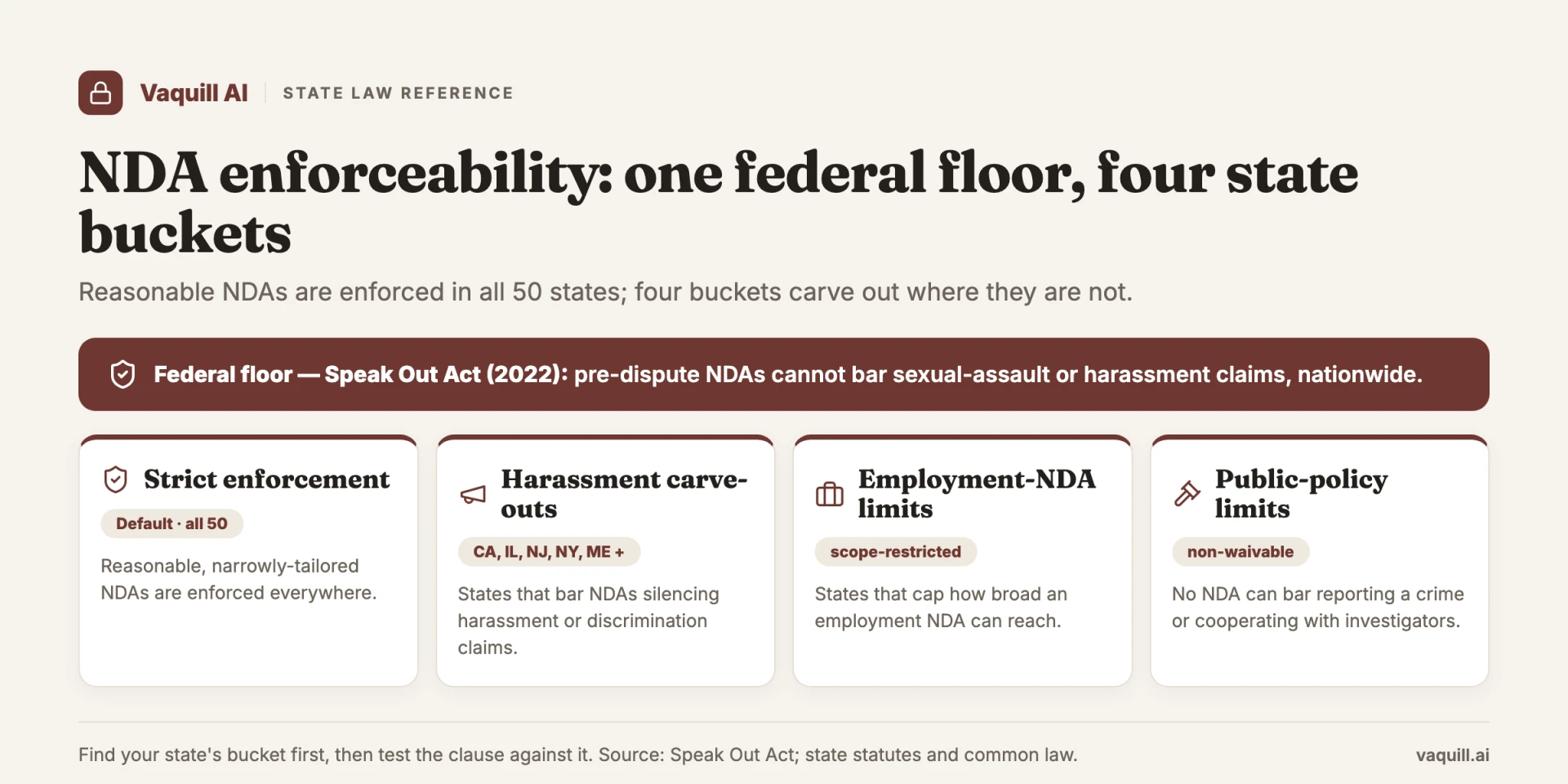
Reasonable NDAs are enforced in all 50 states; four buckets carve out where they are not, over a federal floor set by the Speak Out Act.
A single template, modified by state, will not survive a 2026 audit. The following minimum checklist holds:
- Speak Out Act recital: the agreement does not restrict disclosure of conduct alleged to constitute sexual harassment or sexual assault, consistent with 42 U.S.C. § 19403.
- DTSA whistleblower notice: drop the § 1833(b)(3) immunity language verbatim into every employment, contractor, and consultant NDA.
- Closed-list definition of confidential information with the four standard carve-outs (public, independently developed, third-party lawful, prior knowledge).
- Defined duration: 2-5 years post-termination for general confidential information; perpetual only for true trade secrets, expressly identified.
- Subpoena and government-cooperation carve-out: notice to the disclosing party where lawful, compliance with judicial process, no restriction on EEOC/NLRB/SEC/DOJ communications, no restriction on Rule 21F-17 protected activity.
- State-specific layer: if the signer resides in California, New York, New Jersey, Washington, Illinois, Oregon, Maine, Vermont, or Connecticut, add the state-specific carve-out language. A choice-of-law clause selecting Delaware does not solve the problem; the worker-protective states reach extraterritorially.
- Liquidated damages: either drop entirely or tie to a reasonable forecast with the standard recital. Never use a flat per-breach figure in a New York discrimination NDA.
- No stacking with a non-compete unless both are independently defensible under the applicable state law. The map of non-compete enforceability by state shows where each instrument can live.
- Annual form review with a docket spot-check of the relevant agencies (SEC settlements, NLRB advice memos, EEOC enforcement actions) and the Bucket 2 statutes.
FAQ
Are NDAs enforceable?
Yes. NDAs are enforceable in every state when they protect a legitimate business interest, are supported by consideration, and are reasonable in scope and duration. The disputes are about the carve-outs and how broadly "confidential information" is defined, not whether the instrument itself is valid. Federal law and a growing list of state statutes void specific clauses (sexual-harassment gag terms, whistleblower restrictions), but they do not make NDAs unenforceable as a category.
Are NDAs enforceable by state, or is it one national rule?
NDAs are governed mostly by state contract law, so the baseline reasonableness test and the carve-outs vary state to state. On top of that sit federal floors that no state can drop below: the Speak Out Act (sexual harassment and assault), the DTSA whistleblower immunity at 18 U.S.C. § 1833(b), SEC Rule 21F-17, and the NLRA as read in McLaren Macomb. The 50-state table above shows which states add employment-NDA restrictions and which sit in the common-law lane.
What makes an NDA unenforceable?
The common failure points are an overbroad "all information" definition, indefinite or perpetual duration on ordinary business information, a missing DTSA whistleblower notice, no subpoena or government-cooperation carve-out, a penalty-style flat liquidated-damages number, and stacking the NDA with a non-compete to backdoor a restraint on work. A clause that gags a worker from reporting harassment, cooperating with the SEC or EEOC, or responding to a subpoena is also struck on public-policy grounds.
How long is an NDA enforceable?
Commercial NDAs covering true trade secrets can run perpetually, because trade-secret protection lasts as long as the information stays secret. Employee NDAs covering ordinary confidential information should run for a defined term, commonly 2 to 5 years post-termination, with a separate perpetual carve-out limited to identified trade secrets. New York and Massachusetts courts in particular look skeptically at perpetual employee NDAs that are not tied to genuine trade secrets.
Can an NDA stop you from reporting sexual harassment?
No, not for a pre-dispute clause. The federal Speak Out Act (42 U.S.C. § 19403) makes pre-dispute nondisclosure and non-disparagement clauses unenforceable to the extent they cover a sexual harassment or sexual assault dispute, for any claim filed on or after December 7, 2022, regardless of when the NDA was signed. Many states (California, New York, New Jersey, Washington, and others) go further and reach discrimination and retaliation claims too.
What is the difference between an NDA and a non-compete?
An NDA protects specific confidential information; a non-compete restricts where a person can work for a period of time. NDAs are routinely enforced; employment non-competes are heavily restricted or banned in states like California, North Dakota, Oklahoma, Minnesota, and (in many roles) Washington and Colorado. Drafting the two as a single instrument, or using a broad NDA to achieve a non-compete effect, signals to a court that the NDA is a non-compete in disguise.
Does a Delaware or New York choice-of-law clause save a broad employee NDA?
Often no. Worker-protective states reach extraterritorially. California Bus. & Prof. Code § 16600.5 (effective Jan. 1, 2024) makes a void restraint unenforceable regardless of where it was signed and gives the employee a private right of action. Colorado, Washington, Illinois, and Minnesota have parallel pull-back rules. A choice-of-law clause that selects a friendlier state can become evidence of a structural workaround rather than a shield.
Is an NDA enforceable in California?
Yes, for protecting genuine confidential information and trade secrets. California voids the silencing parts: CCP § 1001 (settlement provisions covering sexual harassment, assault, and workplace discrimination), Civ. Code § 1670.11 (waiving the right to testify about criminal conduct or harassment), and Gov't Code § 12964.5 (employment-NDA restrictions on disclosing unlawful workplace acts). Because of Bus. & Prof. Code § 16600, broad employee NDAs that function as restraints on work are read narrowly.
Closing
NDAs are presumptively enforceable in all 50 states, and they remain the workhorse instrument for protecting business information. They are not, in 2026, the simple two-page form they were in 2017.
The Speak Out Act sets a federal floor; nine states layer additional restrictions on top; the DTSA notice is a near-universal requirement; and the SEC and NLRB are policing the rest under broader public-policy frameworks. The form NDA on the GC's screen, drafted before any of that, is the legal-department equivalent of a 2017 password policy.
The fix is mechanical, and it costs about 90 minutes per template. The downside of not fixing it is a counterclaim, a fine, or a public-policy ruling that puts the form into the next plaintiff's brief as Exhibit A.
For related state-by-state reference coverage, see Non-Compete Enforceability by State: A 2026 Map and Choice-of-Law Clauses That Quietly Fail: A State-by-State Breakdown.
Vaquill AI drafts and reviews NDAs against a reusable playbook and pulls the underlying state statute text before you sign. See the statutes API or start a 7-day trial at app.vaquill.ai.
New legal AI guides, weekly.
Further Reading
Attorneys' Fees Provisions by State: When Contractual Fee-Shifting Survives
Read postLiquidated Damages Enforceability by State
Read postTrade Secrets Enforceability by State: The 2026 50-State Reference
Read postAI NDA Review Software: 9 Tools Compared (Pricing + What They Flag)
Read postNDA vs Confidentiality Agreement: Are They the Same Thing?
Read postWhat Is an NDA? Meaning, Enforceability, and a Plain-English Guide
Read post
Co-Founder & CEO · Attorney
Arshita leads product and strategy at Vaquill, building the legal AI suite that solo, small-firm, and in-house US lawyers use to run a matter end to end.