Trade secrets by state: the short answer
Trade secret law by state runs on one near-uniform statute with two real holdouts. 48 states plus the District of Columbia have enacted the Uniform Trade Secrets Act (UTSA), so the definition of a trade secret, the misappropriation test, and the remedies look almost the same coast to coast. New York is the lone common-law holdout, and North Carolina has its own statute (the Trade Secrets Protection Act) rather than the UTSA. The federal Defend Trade Secrets Act (DTSA), 18 U.S.C. § 1836, overlays all of them since May 11, 2016 and does not preempt state law, so the standard complaint pleads both.
Three things actually vary between UTSA states: the statute of limitations (three years in most states, two in Alabama, four in Maine, Nebraska, Ohio, and Wyoming, five in Georgia, Illinois, and Missouri), whether the state accepts the inevitable disclosure doctrine (Illinois, Pennsylvania, Texas, and a few others do; California and New York reject it; most states are unsettled), and how strictly the state reads the "reasonable secrecy" requirement. The full 50-state table is below.
The two questions that decide a trade-secret matter
A general counsel at a mid-market industrial company called last fall about a departing VP of engineering who had just signed with a competitor. The same conversation happens four or five times a year. The departing employee has been at the company a decade, has touched everything the company would call confidential, and has now joined a direct competitor.
The GC wants to know two things before the partner gets on a plane: can we file in our home court under our state's UTSA, and is there a path to a preliminary injunction that does not require us to prove actual misappropriation, only inevitability.
Those two questions are different questions. The first turns on whether the home state adopted the Uniform Trade Secrets Act and which version, which controls definitional scope, the statute of limitations, and remedies.
The second turns on whether the state's appellate courts have adopted, narrowed, or rejected the inevitable disclosure doctrine. The framework answer to question one is reasonably uniform across the 48 UTSA states with edge-case variations on SOL, customer-list protection, and exemplary damages; the answer to question two genuinely splits the country.
The departing-VP matter ended up filed in the Northern District of Illinois, not the home district, because the GC's outside counsel did the forum analysis before drafting the complaint. Illinois inevitable disclosure was the case; the manufacturer's own state's appellate posture was not.
That move, choosing the federal-court venue under DTSA so the state-law theory you actually need is the operative one, is the single most consequential drafting decision of the matter. The leverage shift from DTSA joinder is not the federal cause of action itself but the venue and choice-of-law freedom it creates: with DTSA on the complaint, you anchor the case in the federal court whose state's substantive law works for your theory, then plead the parallel state UTSA claim.
Get the forum question wrong and you have spent the litigation budget proving misappropriation in a state where the doctrine you needed was never available.
This piece is the 50-state reference. It covers the federal Defend Trade Secrets Act overlay, the 48 UTSA states and the two common-law holdouts, the four doctrinal axes where states diverge, and the appellate authority that controls inevitable-disclosure motions in each state.
TL;DR
- 48 states plus the District of Columbia have enacted statutes substantially patterned on the Uniform Trade Secrets Act, with meaningful inter-state variation in adopted version (1979 vs 1985) and amendment history. New York and North Carolina are the holdouts: New York applies common law (Ashland Mgmt. Inc. v. Janien, 82 N.Y.2d 395 (1993)), and North Carolina applies its own statute, the Trade Secrets Protection Act, N.C. Gen. Stat. § 66-152.
- The federal Defend Trade Secrets Act, 18 U.S.C. § 1836 et seq., effective May 11, 2016, creates a federal private right of action that runs in parallel with state law. It does not preempt; it overlays. Pleading both is now standard practice in any cross-state matter.
- The statute of limitations is three years in most UTSA states, measured from discovery or when discovery should have occurred with reasonable diligence. A handful of states stretch it to four or five years. New York's common-law clock runs three years for the misappropriation tort and six years for the breach-of-confidence theory.
- Inevitable disclosure is the doctrinal axis with the widest state-by-state split. Illinois (PepsiCo, Inc. v. Redmond, 54 F.3d 1262 (7th Cir. 1995)), Pennsylvania, Missouri, Texas, and a handful of others accept it. New York (EarthWeb, Inc. v. Schlack, 71 F. Supp. 2d 299 (S.D.N.Y. 1999)) and California reject it sharply. The rest sit somewhere between, often without a clean appellate answer.
- The four axes drafters and litigators should know cold: reasonable-secrecy measures, customer-list protection (memorized vs documented), inevitable disclosure status, and attorneys' fees plus exemplary-damages availability.
Part of our all-50-states legal reference series.
How many states adopted the Uniform Trade Secrets Act (UTSA)?
The federal baseline: DTSA, 18 U.S.C. § 1836
Before the Defend Trade Secrets Act, trade-secret enforcement was a state-court exercise unless the parties had diversity jurisdiction or could plug into a federal computer-fraud claim. The DTSA changed that on May 11, 2016. It created a federal private cause of action for misappropriation of a trade secret "related to a product or service used in, or intended for use in, interstate or foreign commerce." 18 U.S.C. § 1836(b)(1).
The statute matters for three practical reasons. First, it creates federal jurisdiction without needing diversity, which is how most cross-state trade-secret cases now find their way into federal court.
Second, it preserves state-law claims expressly. § 1838 says the Act does not preempt or displace state-law remedies. The standard pleading is DTSA plus the state UTSA claim, both counts running together.
Third, it imports specific federal remedies: ex parte seizure (§ 1836(b)(2)), injunctive relief, damages including unjust enrichment, exemplary damages up to two times compensatory for willful misappropriation, and attorneys' fees in cases of bad faith or willfulness.
The DTSA also adds the immunity notice requirement under § 1833(b)(3). Employers who want exemplary damages or attorneys' fees against an employee under the DTSA must include immunity-from-suit language for whistleblower disclosures in any agreement governing trade-secret use entered into or updated after May 11, 2016.
Skip the notice and you forfeit the federal fee-shifting and exemplary-damages remedies against that employee. The state UTSA claim is unaffected, but the federal layer of the case loses two of its sharpest teeth.
The DTSA's three-year limitations period (§ 1836(d)) runs from discovery or when discovery should have occurred. Most state UTSAs match; a few do not. When the state clock is shorter than the federal one, file the state claim within the state window or lose it.
The UTSA framework adopted by 48 states
The Uniform Trade Secrets Act, drafted by the Uniform Law Commission in 1979 and amended in 1985, gave the country a near-uniform definitional and remedial framework. The 1985 amendments tightened the definition of misappropriation and added attorneys' fees for bad-faith claims.
The four operative pieces of the UTSA are the same in every adopting state:
Definition of trade secret. Information that derives independent economic value (actual or potential) from not being generally known and not being readily ascertainable through proper means, AND is the subject of reasonable efforts to maintain its secrecy. The two prongs are conjunctive. The "reasonable efforts" prong is where most cases are won or lost on summary judgment.
Misappropriation requirements. Either (a) acquisition by improper means, or (b) disclosure or use without consent by a person who used improper means to acquire, knew or had reason to know the information was acquired by improper means, or owed a duty of confidence. "Improper means" includes theft, bribery, misrepresentation, breach of duty, and electronic espionage.
Remedies. Injunctive relief (preliminary and permanent), monetary damages including actual loss plus unjust enrichment not captured in actual loss, or in the alternative a reasonable royalty. Exemplary damages up to two times compensatory for willful and malicious misappropriation. Attorneys' fees for bad-faith claims, bad-faith motions to terminate injunctions, or willful and malicious misappropriation.
Statute of limitations. Three years from discovery or when discovery should have occurred with reasonable diligence. The "continuing misappropriation" rule treats a course of misappropriation as a single claim with a single accrual date, not a series of separately accruing claims.
The minor variations across the 48 UTSA states fall into four buckets: which version was adopted (1979 vs 1985 vs hybrid), whether the state added a state-specific definitional carve-out (Massachusetts on customer lists, Illinois on the "knowing" requirement), whether the state lengthened the SOL beyond three years (Alabama at two but with a separate framework, Wisconsin at three with continuing-misappropriation language tightened), and whether the state has accepted the inevitable disclosure doctrine.
The two common-law holdouts
New York. New York never adopted the UTSA. Trade-secret misappropriation is a common-law tort governed by Ashland Mgmt. Inc. v. Janien, 82 N.Y.2d 395 (1993).
The Court of Appeals adopted the Restatement of Torts § 757 six-factor test: (1) extent to which the information is known outside the business, (2) extent known by employees and others involved in the business, (3) measures taken to guard the secrecy, (4) value of the information to the business and competitors, (5) effort or money expended in developing the information, (6) ease or difficulty with which the information could be properly acquired or duplicated by others.
The test predates the UTSA and is, in operation, materially harder for plaintiffs than the UTSA framework, because the six factors invite a jury question on every element.
New York's SOL on the misappropriation tort is three years (CPLR § 214(4)) running from each act of misappropriation under the continuing-tort rule, materially different from the UTSA discovery rule. The parallel breach-of-confidence theory runs six years (CPLR § 213(2)). Both are common practice in New York pleadings.
North Carolina. North Carolina enacted its own statute, the Trade Secrets Protection Act, N.C. Gen. Stat. §§ 66-152 through 66-157, in 1981. The structure is similar to the UTSA but the language differs.
Section 66-152 defines trade secret as "business or technical information... that... derives independent actual or potential commercial value from not being generally known or readily ascertainable through independent development or reverse engineering" and is the subject of "reasonable efforts" to maintain secrecy.
The North Carolina Supreme Court has read the statute closely; Drouillard v. Keister Williams Newspaper Servs., Inc., 108 N.C. App. 169 (1992), set the modern reasonable-efforts standard. North Carolina's SOL is three years (N.C. Gen. Stat. § 66-157), tracking the UTSA.
The four axes states actually vary on
Once you clear the UTSA-or-not threshold, four substantive issues drive almost every contested trade-secret motion. Knowing where your state lands on each is the working map.
Reasonable-secrecy measures. Every UTSA state requires "reasonable efforts" to maintain secrecy, but states diverge sharply on what counts. The strict-reading states (Massachusetts, New Jersey, Delaware in the Chancery Court) require documented written policies, marked confidentiality on the information itself, restricted access controls, and an exit-interview process.
The lenient-reading states (Texas, Georgia, Florida) accept a course of conduct showing the employer treated the information as confidential, even without formal documentation. The practical effect is large: a plaintiff with strong technical-security infrastructure but weak HR documentation will lose on summary judgment in Trenton and win in Houston.
Customer-list protection. The split is between states that protect memorized customer information and states that protect only documented customer lists. The protective states (Florida, Texas, Georgia, North Carolina) treat memorized customer relationships as trade secrets if the underlying list satisfies the UTSA definition.
The narrower states (California, with Morlife, Inc. v. Perry, 56 Cal. App. 4th 1514 (1997), as the canonical limit) protect documented lists but treat employee memory as fair game absent a separate confidentiality agreement. New York's Reed, Roberts Assocs., Inc. v. Strauman, 40 N.Y.2d 303 (1976), sits in the narrower camp. The split matters most in sales-rep departure cases, which are the most common factual posture for trade-secret litigation.
Inevitable disclosure doctrine. The doctrine, formally adopted in PepsiCo, Inc. v. Redmond, 54 F.3d 1262 (7th Cir. 1995), holds that a court can enjoin a former employee from working for a competitor on the theory that disclosure of the prior employer's trade secrets is inevitable, even without proof of actual or threatened misappropriation. The Seventh Circuit applied Illinois law; Illinois courts have followed.
Pennsylvania (Air Prods. & Chems., Inc. v. Johnson, 296 Pa. Super. 405 (1982), pre-PepsiCo but recognized), Missouri (H&R Block E. Tax Servs., Inc. v. Enchura, 122 F. Supp. 2d 1067 (W.D. Mo. 2000)), and Texas (Conley v. DSC Commc'ns Corp., 1999 WL 89955 (Tex. App. Feb. 24, 1999)) have accepted some form.
New York's EarthWeb, Inc. v. Schlack, 71 F. Supp. 2d 299 (S.D.N.Y. 1999), rejected inevitable disclosure as a freestanding doctrine and required proof of actual or threatened misappropriation. California rejects it categorically under Cal. Bus. & Prof. Code § 16600 and Whyte v. Schlage Lock Co., 101 Cal. App. 4th 1443 (2002). The middle states (Florida, Massachusetts, New Jersey, Ohio) have considered the doctrine without cleanly adopting or rejecting it; results turn on the trial judge.
Exemplary damages and attorneys' fees. The UTSA authorizes up to twice compensatory damages for willful and malicious misappropriation and attorneys' fees for bad-faith claims, willful and malicious misappropriation, or bad-faith injunction motions. States vary on application.
Texas applies the doubling cap strictly. California has read the "willful and malicious" standard narrowly in Ajaxo Inc. v. ETrade Group, Inc.*, 187 Cal. App. 4th 1295 (2010). Massachusetts, after its 2018 Noncompetition Agreement Act and the parallel Mass. Gen. Laws ch. 93 § 42 update, layers state-specific fee-shifting language onto the UTSA baseline. New York, with no UTSA, has no statutory fee-shifting on the misappropriation tort; plaintiffs rely on punitive damages under common-law standards, which are harder to obtain.
The 50-state table
Bucket assignment (UTSA / non-UTSA), statute of limitations, inevitable disclosure status, and a landmark case or controlling statute for each jurisdiction. A note on methodology: "inevitable disclosure: accepted" means the state's appellate courts or federal courts applying state law have endorsed the doctrine in some form. "Rejected" means the appellate authority has expressly declined. "Unsettled" means there is no clean appellate answer and trial-court outcomes vary. Verify the current status before filing; this is the doctrinal axis that moves most often.
- Alabama. UTSA (Ala. Code §§ 8-27-1 to 8-27-6). SOL two years from discovery (§ 8-27-5). Inevitable disclosure: unsettled. Allied Supply Co. v. Brown, 585 So. 2d 33 (Ala. 1991).
- Alaska. UTSA (Alaska Stat. §§ 45.50.910 to 45.50.945). SOL three years. Inevitable disclosure: unsettled.
- Arizona. UTSA (Ariz. Rev. Stat. §§ 44-401 to 44-407). SOL three years. Inevitable disclosure: unsettled.
- Arkansas. UTSA (Ark. Code §§ 4-75-601 to 4-75-607). SOL three years. Inevitable disclosure: unsettled.
- California. UTSA (Cal. Civ. Code §§ 3426 to 3426.11). SOL three years. Inevitable disclosure: rejected (Whyte v. Schlage Lock Co., 101 Cal. App. 4th 1443 (2002)). Customer-list protection narrowed by Morlife, Inc. v. Perry, 56 Cal. App. 4th 1514 (1997).
- Colorado. UTSA (Colo. Rev. Stat. §§ 7-74-101 to 7-74-110). SOL three years. Inevitable disclosure: unsettled, but Colorado's strong public policy against non-competes under Colo. Rev. Stat. § 8-2-113 cuts against the doctrine.
- Connecticut. UTSA (Conn. Gen. Stat. §§ 35-50 to 35-58). SOL three years. Inevitable disclosure: unsettled. Elm City Cheese Co. v. Federico, 251 Conn. 59 (1999), addressed misappropriation generally.
- Delaware. UTSA (6 Del. Code §§ 2001 to 2009). SOL three years. Inevitable disclosure: unsettled; Chancery has considered analogous theories but no controlling adoption.
- District of Columbia. UTSA (D.C. Code §§ 36-401 to 36-410). SOL three years. Inevitable disclosure: unsettled.
- Florida. UTSA (Fla. Stat. §§ 688.001 to 688.009). SOL three years. Inevitable disclosure: not formally adopted. Customer-list protection broad. Strong UTSA enforcement record. Del Monte Fresh Produce Co. v. Dole Food Co., 136 F. Supp. 2d 1271 (S.D. Fla. 2001).
- Georgia. UTSA (O.C.G.A. §§ 10-1-760 to 10-1-767). SOL five years. Inevitable disclosure: not adopted. Essex Group, Inc. v. Southwire Co., 269 Ga. 553 (1998).
- Hawaii. UTSA (Haw. Rev. Stat. §§ 482B-1 to 482B-9). SOL three years. Inevitable disclosure: unsettled.
- Idaho. UTSA (Idaho Code §§ 48-801 to 48-807). SOL three years. Inevitable disclosure: unsettled.
- Illinois. UTSA (765 ILCS 1065/1 to 1065/9). SOL five years (765 ILCS 1065/7). Inevitable disclosure: accepted (PepsiCo, Inc. v. Redmond, 54 F.3d 1262 (7th Cir. 1995), applying Illinois law).
- Indiana. UTSA (Ind. Code §§ 24-2-3-1 to 24-2-3-8). SOL three years. Inevitable disclosure: unsettled; trial-level decisions have considered the theory without clean appellate adoption.
- Iowa. UTSA (Iowa Code §§ 550.1 to 550.8). SOL three years. Inevitable disclosure: unsettled.
- Kansas. UTSA (Kan. Stat. §§ 60-3320 to 60-3330). SOL three years. Inevitable disclosure: unsettled.
- Kentucky. UTSA (Ky. Rev. Stat. §§ 365.880 to 365.900). SOL three years. Inevitable disclosure: unsettled.
- Louisiana. UTSA (La. Rev. Stat. §§ 51:1431 to 51:1439). SOL three years. Inevitable disclosure: unsettled, civil-law overlay.
- Maine. UTSA (10 M.R.S. §§ 1541 to 1548). SOL four years. Inevitable disclosure: unsettled.
- Maryland. UTSA (Md. Code, Com. Law §§ 11-1201 to 11-1209). SOL three years. Inevitable disclosure: unsettled. LeJeune v. Coin Acceptors, Inc., 381 Md. 288 (2004), addressed the doctrine without adopting it.
- Massachusetts. UTSA-style (Mass. Gen. Laws ch. 93 §§ 42, 42A, 42B, amended 2018). SOL three years. Inevitable disclosure: unsettled but disfavored under the 2018 noncompetition reform.
- Michigan. UTSA (Mich. Comp. Laws §§ 445.1901 to 445.1910). SOL three years. Inevitable disclosure: limited and narrow (CMI Int'l, Inc. v. Intermet Int'l Corp., 251 Mich. App. 125 (2002), recognizing the doctrine but requiring a high threshold).
- Minnesota. UTSA (Minn. Stat. §§ 325C.01 to 325C.08). SOL three years. Inevitable disclosure: federal-district acceptance under Minnesota law (IBM Corp. v. Seagate Tech., Inc., 941 F. Supp. 98 (D. Minn. 1992)); state-court appellate authority remains limited.
- Mississippi. UTSA (Miss. Code §§ 75-26-1 to 75-26-19). SOL three years. Inevitable disclosure: unsettled.
- Missouri. UTSA (Mo. Rev. Stat. §§ 417.450 to 417.467). SOL five years (§ 417.461). Inevitable disclosure: federal-district acceptance under Missouri law (H&R Block E. Tax Servs., Inc. v. Enchura, 122 F. Supp. 2d 1067 (W.D. Mo. 2000)); state appellate posture more cautious.
- Montana. UTSA (Mont. Code §§ 30-14-401 to 30-14-409). SOL three years. Inevitable disclosure: unsettled.
- Nebraska. UTSA (Neb. Rev. Stat. §§ 87-501 to 87-507). SOL four years. Inevitable disclosure: unsettled.
- Nevada. UTSA (Nev. Rev. Stat. §§ 600A.010 to 600A.100). SOL three years. Inevitable disclosure: unsettled. Frantz v. Johnson, 116 Nev. 455 (2000).
- New Hampshire. UTSA (N.H. Rev. Stat. §§ 350-B:1 to 350-B:9). SOL three years. Inevitable disclosure: unsettled.
- New Jersey. UTSA (N.J. Stat. §§ 56:15-1 to 56:15-9, enacted 2012). SOL three years. Inevitable disclosure: unsettled but disfavored. Lamorte Burns & Co. v. Walters, 167 N.J. 285 (2001), predates statute.
- New Mexico. UTSA (N.M. Stat. §§ 57-3A-1 to 57-3A-7). SOL three years. Inevitable disclosure: unsettled.
- New York. Non-UTSA. Common law (Ashland Mgmt. Inc. v. Janien, 82 N.Y.2d 395 (1993)). SOL three years on misappropriation tort (CPLR § 214(4)), six years on breach of confidence (CPLR § 213(2)). Inevitable disclosure: rejected (EarthWeb, Inc. v. Schlack, 71 F. Supp. 2d 299 (S.D.N.Y. 1999)).
- North Carolina. Non-UTSA. Trade Secrets Protection Act, N.C. Gen. Stat. §§ 66-152 to 66-157. SOL three years (§ 66-157). Inevitable disclosure: not adopted; the Court of Appeals declined to reach it on the facts in Analog Devices, Inc. v. Michalski, 157 N.C. App. 462 (2003), and later NC decisions have suggested it could apply in narrow circumstances. Treat it as unsettled-leaning-against, not a clean rejection.
- North Dakota. UTSA (N.D. Cent. Code §§ 47-25.1-01 to 47-25.1-08). SOL three years. Inevitable disclosure: unsettled.
- Ohio. UTSA (Ohio Rev. Code §§ 1333.61 to 1333.69). SOL four years. Inevitable disclosure: appellate acceptance in narrow circumstances (Procter & Gamble Co. v. Stoneham, 140 Ohio App. 3d 260 (2000)).
- Oklahoma. UTSA (Okla. Stat. tit. 78 §§ 85 to 94). SOL three years. Inevitable disclosure: unsettled. State's strong non-compete ban (Okla. Stat. tit. 15 § 217) cuts against the doctrine.
- Oregon. UTSA (Or. Rev. Stat. §§ 646.461 to 646.475). SOL three years. Inevitable disclosure: unsettled.
- Pennsylvania. UTSA (12 Pa. Cons. Stat. §§ 5301 to 5308, enacted 2004). SOL three years. Inevitable disclosure: appellate acceptance (Air Prods. & Chems., Inc. v. Johnson, 296 Pa. Super. 405 (1982)); federal courts in the Eastern District have continued to apply it under Pennsylvania law.
- Rhode Island. UTSA (R.I. Gen. Laws §§ 6-41-1 to 6-41-11). SOL three years. Inevitable disclosure: unsettled.
- South Carolina. UTSA (S.C. Code §§ 39-8-10 to 39-8-130). SOL three years. Inevitable disclosure: unsettled; earlier appellate authority (Stringer v. Herron, 309 S.C. 529 (Ct. App. 1992)) predates UTSA adoption and has not been squarely revisited.
- South Dakota. UTSA (S.D. Codified Laws §§ 37-29-1 to 37-29-11). SOL three years. Inevitable disclosure: unsettled.
- Tennessee. UTSA (Tenn. Code §§ 47-25-1701 to 47-25-1709). SOL three years. Inevitable disclosure: unsettled. Hamilton-Ryker Group, LLC v. Keymon, 2010 WL 323057 (Tenn. Ct. App. 2010).
- Texas. Texas Uniform Trade Secrets Act (Tex. Civ. Prac. & Rem. Code §§ 134A.001 to 134A.008, enacted 2013). SOL three years. Inevitable disclosure: appellate acceptance in limited form (Cardinal Health Staffing Network, Inc. v. Bowen, 106 S.W.3d 230 (Tex. App. 2003)). Customer-list protection broad.
- Utah. UTSA (Utah Code §§ 13-24-1 to 13-24-9). SOL three years. Inevitable disclosure: unsettled. Microbiological Research Corp. v. Muna, 625 P.2d 690 (Utah 1981).
- Vermont. UTSA (9 V.S.A. §§ 4601 to 4609). SOL three years. Inevitable disclosure: unsettled.
- Virginia. UTSA (Va. Code §§ 59.1-336 to 59.1-343). SOL three years (with continuing-misappropriation accrual rules). Inevitable disclosure: unsettled; trial-court authority exists (Government Tech. Servs., Inc. v. Intellisys Tech. Corp., 1999 WL 1499548 (Va. Cir. Ct. 1999)) but no controlling appellate adoption.
- Washington. UTSA (Rev. Code Wash. §§ 19.108.010 to 19.108.940). SOL three years. Inevitable disclosure: unsettled. State noncompete law (RCW § 49.62) cuts against it for most employees.
- West Virginia. UTSA (W. Va. Code §§ 47-22-1 to 47-22-10). SOL three years. Inevitable disclosure: unsettled.
- Wisconsin. UTSA (Wis. Stat. § 134.90). SOL three years. Inevitable disclosure: unsettled.
- Wyoming. UTSA (Wyo. Stat. §§ 40-24-101 to 40-24-110). SOL four years. Inevitable disclosure: unsettled.
Strategic consequence by cluster
Inevitable disclosure accepting (Illinois, Pennsylvania, Texas, Ohio in narrow circumstances, federal-district acceptance under Minnesota and Missouri law): PI brief can lead with inevitability, supporting evidence is the new role's overlap with the protected information, and the case can be effectively over at the TRO stage if the showing is strong.
Inevitable disclosure rejecting or near-rejecting (California and New York reject it outright; North Carolina has declined to apply it on the facts presented): the PI requires documentary or testimonial evidence of actual or threatened misappropriation. Pre-departure download logs, solicitation emails, retained-confidential-information forensics. No log, no case.
Inevitable disclosure unsettled (the majority): the trial judge is the variable. Local counsel's read on the assigned judge's prior orders is the most valuable input. The brief should plead actual or threatened misappropriation as the primary theory and inevitable disclosure as a secondary one, so the case survives if the judge declines the doctrine.
Longer SOL states (Georgia and Missouri at five years, Ohio and Maine and Nebraska and Wyoming at four years, Virginia with continuing-misappropriation accrual): older facts can support fresh complaints. Worth verifying when the misappropriation predates the standard three-year window in the plaintiff's home state.
Non-UTSA states (New York, North Carolina): the pleading is different. New York requires the Restatement six-factor showing under Ashland; North Carolina requires the TSPA's statutory elements. Federal-court diversity matters here because DTSA still applies and gives the plaintiff a uniform federal cause of action even where the state common-law theory is harder to plead.
How the state differences change real case strategy
The doctrinal map only matters because it changes three concrete decisions a litigator makes in the first two weeks of a matter.
Forum choice in cross-state matters. When the departing employee lives in one state, the former employer is headquartered in another, and the new employer is in a third, the choice-of-law and venue analysis is what decides whether inevitable disclosure is on the table at all.
The pattern I see most often: an Illinois-headquartered manufacturer sues in the Northern District of Illinois under DTSA plus the Illinois Trade Secrets Act, leveraging PepsiCo v. Redmond for the preliminary-injunction theory. The same complaint filed by a California-headquartered competitor against an employee who relocated to Mountain View dies at the PI stage on Whyte v. Schlage Lock.
The forum is the case.
TRO and preliminary-injunction strategy. In Texas and Illinois, the inevitable disclosure motion can be the case-in-chief at the PI stage; the employer does not need to prove actual misappropriation, only inevitability, and the judge will reach the merits on the inevitability theory.
In New York, the same motion has to plead actual or threatened misappropriation with specificity (EarthWeb v. Schlack is the line), so the PI is built around documentary evidence of solicitation, copying, or pre-departure download activity. The Texas-style PI brief filed in the Southern District of New York will lose at the hearing.
Employee onboarding and offboarding controls. The state's reasonable-secrecy posture changes what the corporate compliance program has to look like to survive a future summary-judgment motion.
A Massachusetts or New Jersey employer needs the documented information-classification policy, the confidentiality markings, and the access-control logs as a baseline operating cost. A Texas or Florida employer can survive on a course-of-conduct showing, though the better-organized defendants in those forums increasingly demand the documentation anyway.
A worked example from the customer-list axis. A sales VP departs a New York-headquartered B2B SaaS company for a competitor and starts calling on accounts she handled at the prior employer.
In New York under Reed, Roberts v. Strauman, the memorized customer relationships are likely not protectable as a trade secret; the employer's case depends on a separate non-solicitation covenant in the employment agreement or on documentary evidence the VP downloaded the actual customer list before departing.
The same fact pattern in Florida is a different case. Florida courts will treat the customer relationships themselves as protectable under the UTSA if the underlying list satisfies the reasonable-secrecy prong, even without proof of downloading. The complaint, the discovery, and the PI argument all look different.
Recent appellate signal worth tracking
The trade-secret docket has been busier than the categorical headlines suggest. Three patterns are worth flagging in the appellate signal across 2024 and 2025.
The DTSA "use" requirement continues to be the federal-court question. The case worth reading on this is Caudill Seed & Warehouse Co. v. Jarrow Formulas, Inc., 53 F.4th 368 (6th Cir. 2022), which affirmed a $2.4 million damages award and clarified the "use" standard for DTSA purposes.
The 2024-2025 federal-district decisions applying Caudill Seed have generally tightened the "use" requirement: mere acquisition without commercial exploitation has been increasingly held insufficient to support damages, even where it supports injunctive relief.
Reasonable-secrecy measures continue to be the summary-judgment battleground. The plaintiffs who survive summary judgment are the ones who produce three things in opposition papers: a written information-classification policy with an effective date that predates the alleged misappropriation, an access-control log showing which employees had access to the specific information at issue, and an exit-interview certification signed by the departing employee.
The plaintiffs who lose on summary judgment are the ones who argue "the company always treated this as confidential" without producing the underlying paper. MicroStrategy Inc. v. Bus. Objects, S.A., 643 F. Supp. 2d 728 (E.D. Va. 2009), is still the most-cited illustration of the documentation-driven win.
The inevitable disclosure doctrine has not gained ground. The states that accepted it before 2010 (Illinois, Pennsylvania, Missouri, Texas) continue to apply it. The states that reject it (California and New York) have reaffirmed that position in their 2020s docket, and North Carolina courts have stayed reluctant to apply it.
The middle states have stayed in the middle. The doctrine's practical use has narrowed to high-skill technical roles where the departing employee will demonstrably make decisions on the same product line at the new employer; outside that fact pattern, even the accepting states are increasingly skeptical.
The Sedona Conference's Commentary on Protecting Trade Secrets in Litigation About Them (June 2022 public-comment version) has become the de facto practitioner reference for the protective-order framework. Federal courts increasingly cite it in trade-secret discovery orders. If your protective-order practice is more than two years old, refresh against the current Sedona commentary before the next case.
Drafting checklist: protecting trade secrets across jurisdictions
The reasonable-secrecy prong is what most cases turn on, and the moves are mechanical.
- Written information-classification policy. A document that defines tiers of confidential information, what counts in each tier, and what access controls apply. Annual review and update.
- Confidentiality marking on the information itself. Headers, footers, watermarks, file-system metadata, document-management-system tags. Not all of it, but enough to show the company treated the information as confidential.
- Access controls tied to job function. Least-privilege access. Logged access. The access log is the document plaintiffs' counsel reaches for first at the PI hearing to show the defendant was in the system on a date close to departure, and the document defense counsel uses to show the company controlled access in the ordinary course. Absent any access controls, the reasonable-secrecy prong fails on summary judgment in the stricter states.
- NDAs and employment agreements with DTSA immunity notice. The immunity notice under 18 U.S.C. § 1833(b)(3) is the cheapest thing on this list and the most commonly skipped. Without it, the federal exemplary-damages and fee-shifting remedies against employees are forfeit.
- Exit interviews with information-return certification. A signed certification at exit, listing the categories of information returned and confirming no copies retained. Mechanical, but the evidentiary value at preliminary-injunction stage is large.
- Vendor agreements with confidentiality and audit rights. Trade secrets shared with third parties (manufacturing partners, IT vendors, contractors) need contractual protection and an audit right. A trade secret disclosed to a vendor without confidentiality protection is a trade secret no longer.
- Document the "reasonable measures" rationale in the policy itself. Two sentences: what the company protects, why those measures are reasonable for an organization of this size and industry. Courts in the documentation-heavy states (Massachusetts, New Jersey, Delaware Chancery) cite this kind of policy recital on summary judgment when they hold the reasonable-secrecy prong satisfied.
The corollary on the litigation side: pre-filing, document the misappropriation timeline with specificity. The complaints that survive Rule 12 are the ones that identify (a) the specific trade secret, (b) the specific act of misappropriation, (c) the specific use by the defendant, and (d) the specific harm.
Complaints that allege "trade secrets" categorically without identifying any specific information fail on Rule 12 in most circuits.
FAQ
How many states have adopted the Uniform Trade Secrets Act?
48 states plus the District of Columbia have enacted a statute substantially based on the UTSA. The Uniform Law Commission also counts Puerto Rico and the U.S. Virgin Islands as adopting jurisdictions. New York is the only state with no UTSA-style statute (it uses common law), and North Carolina has its own Trade Secrets Protection Act rather than the UTSA.
Which states have not adopted the UTSA?
New York and North Carolina. New York applies the common-law tort under Ashland Mgmt. Inc. v. Janien, 82 N.Y.2d 395 (1993), and the Restatement of Torts six-factor test. North Carolina enacted its own Trade Secrets Protection Act, N.C. Gen. Stat. §§ 66-152 to 66-157, in 1981, which is similar to the UTSA but worded differently.
Does federal trade secret law (the DTSA) replace state trade secret law?
No. The Defend Trade Secrets Act, 18 U.S.C. § 1836, creates a federal private cause of action that runs alongside state law and does not preempt it (§ 1838). In any cross-state matter the standard practice is to plead the DTSA count and the parallel state UTSA count together, which is also how plaintiffs get into federal court without needing diversity.
What is the statute of limitations for trade secret misappropriation?
Three years in most UTSA states and under the federal DTSA (§ 1836(d)), measured from when the misappropriation was discovered or should have been discovered with reasonable diligence. The outliers are Alabama (two years), Maine, Nebraska, Ohio, and Wyoming (four years), and Georgia, Illinois, and Missouri (five years). New York runs three years on the misappropriation tort and six years on the breach-of-confidence theory.
What is the inevitable disclosure doctrine and which states accept it?
It lets a court enjoin a former employee from a new job on the theory that they cannot help but use the prior employer's trade secrets, even without proof of actual misappropriation. The doctrine traces to PepsiCo, Inc. v. Redmond, 54 F.3d 1262 (7th Cir. 1995). Illinois, Pennsylvania, Texas, Missouri, and Ohio (in narrow form) have accepted some version. California (Whyte v. Schlage Lock Co.) and New York (EarthWeb v. Schlack) reject it. Most states are unsettled.
Does California recognize trade secret protection?
Yes. California adopted the UTSA at Cal. Civ. Code §§ 3426 to 3426.11. What California rejects is the inevitable disclosure doctrine and non-compete enforcement under Cal. Bus. & Prof. Code § 16600, so a trade secret case there must rest on evidence of actual or threatened misappropriation, not on the employee's new role alone.
Are customer lists protected as trade secrets?
It depends on the state. Florida, Texas, Georgia, and North Carolina will protect customer relationships, including ones an employee carries in memory, if the underlying list meets the UTSA definition. California (Morlife, Inc. v. Perry) and New York (Reed, Roberts Assocs. v. Strauman) protect documented lists but treat an employee's memory as fair game absent a separate confidentiality or non-solicitation agreement.
What counts as "reasonable efforts" to keep a trade secret?
Every UTSA state requires reasonable secrecy measures, but the bar varies. Stricter states (Massachusetts, New Jersey, Delaware Chancery) expect written classification policies, confidentiality markings, access controls, and exit interviews. More lenient states (Texas, Georgia, Florida) accept a course of conduct showing the company treated the information as confidential. The reasonable-efforts prong is where most trade secret cases are won or lost on summary judgment.
Closing
Forty-eight UTSA states, two common-law holdouts, a federal overlay since 2016, and a Restatement-rooted definitional core that has not changed materially in forty years. The litigation outcomes diverge more than that uniformity suggests, because the reasonable-secrecy prong is fact-bound, the inevitable disclosure doctrine genuinely splits the country, and the customer-list and fee-shifting variations move case strategy.
The two questions the GC needs answered at the start of any matter: which UTSA framework applies, and does this state accept inevitable disclosure. The first answer is in the statute. The second is in the appellate map. Read both before the partner gets on the plane, because the cross-state matter is decided as much by forum choice as by the underlying facts.
For related state-by-state coverage, see Non-Compete Enforceability by State: A 2026 Map, NDA Enforceability by State, Statute of Limitations by State, and Liquidated Damages Enforceability by State.
For more on pulling the live state UTSA text, current SOL provisions, and federal Title 18 sections before filing the TRO or drafting the protective order, see the US primary law API.
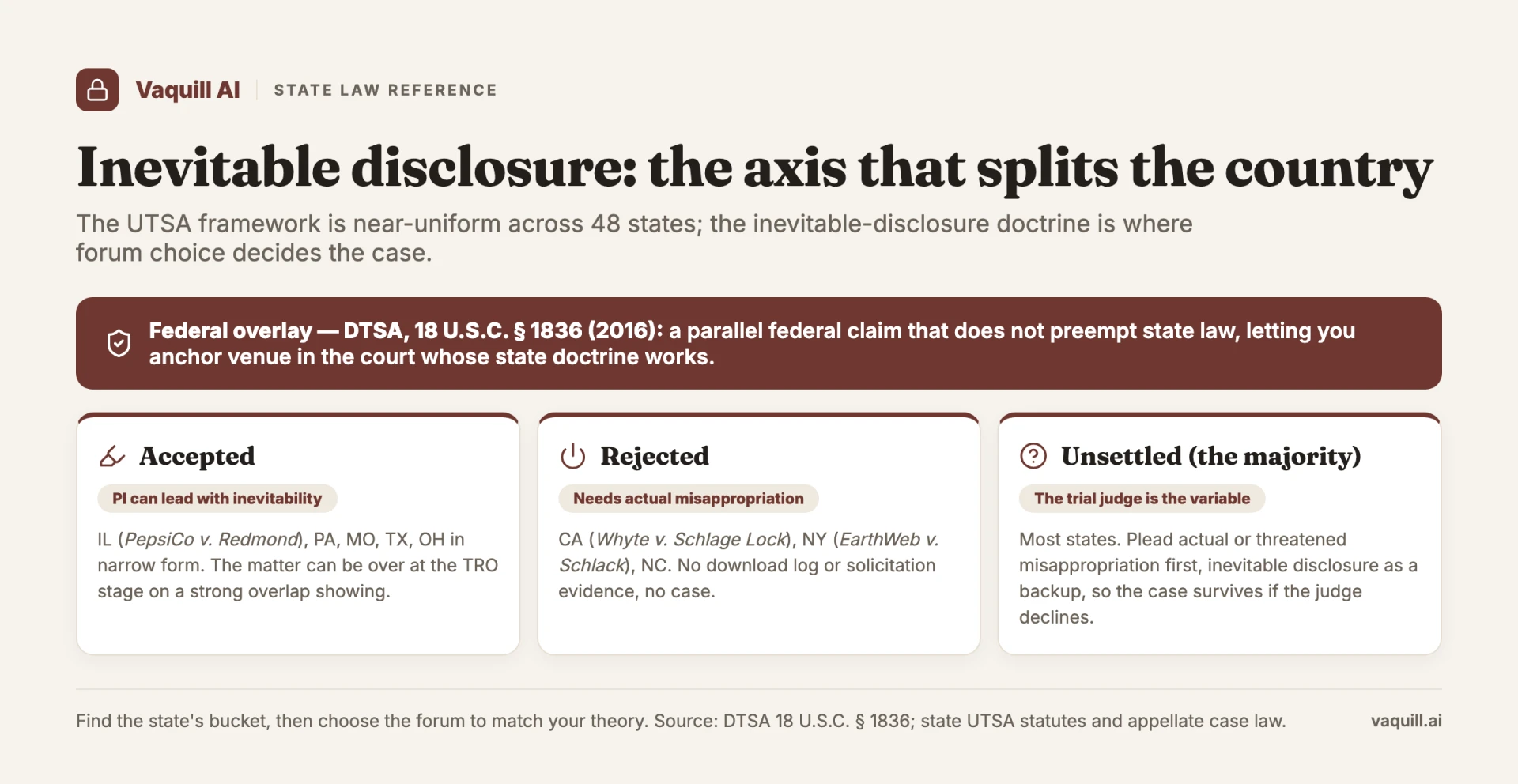
Inevitable disclosure splits states into accepted, rejected, and unsettled buckets; the DTSA overlay lets you pick the forum whose doctrine fits your theory.
New legal AI guides, weekly.
Further Reading
Attorneys' Fees Provisions by State: When Contractual Fee-Shifting Survives
Read postNDA Enforceability by State: A 2026 Reference for Corporate Counsel
Read postLiquidated Damages Enforceability by State
Read postTypes of Primary Law in the US: The Complete Map (Statutes, Regs, Cases, and More)
Read postLegal AI for Corporate Counsel: Deals, Diligence, and Entity Work in 2026
Read postThe 409A Valuation Playbook for Corporate Counsel
Read post
Co-Founder & CEO · Attorney
Arshita leads product and strategy at Vaquill, building the legal AI suite that solo, small-firm, and in-house US lawyers use to run a matter end to end.