A Master Service Agreement is the document that sets the rules for an entire vendor relationship, and it is also where the worst risk hides: a one-sided liability cap, an indemnity that runs in one direction, an auto-renewal buried near the signature block. AI MSA review does not replace your judgment on those terms. It compresses the reading so you spend your time deciding, not searching.
This guide covers what an MSA is, the clauses that carry the most risk, an AI-assisted review workflow you can run today, how the MSA relates to the SOW underneath it, and the red flags worth slowing down for. There is a worked example of a single flagged clause so you can see what the output actually looks like.
This is general information for in-house teams, not legal advice for a specific deal.
TL;DR
- An MSA governs the whole relationship; the SOW governs one engagement. Review them together, because the dangerous gaps live in how they reference each other.
- The highest-risk MSA clauses are limitation of liability, indemnification, IP ownership, confidentiality, payment terms, termination, and the SLA. Most disputes trace back to one of these.
- The AI-assisted pass is four steps: extract a clause matrix, compare each clause to your playbook, flag off-market terms by severity, and draft fallback language. A lawyer reviews every flag.
- AI is reliable on extraction, missing-clause detection, and deviation from a set playbook. It is weak on business context, negotiation strategy, and how the MSA interacts with the SOW and exhibits.
- The most common red flags: an uncapped or sub-12-month liability cap, a one-directional indemnity, broad IP assignment, and a long auto-renewal notice window.
In the worked example, the vendor MSA capped liability at how many months of fees, against the playbook's standard?
For the broader method this fits into, see our AI contract review lawyer's guide and the in-house contract review playbook.
What is a Master Service Agreement?
An MSA is the umbrella contract between a company and a vendor. It sets the terms that apply to every project the parties do together: who is liable for what, who owns the work, how confidential information is handled, how either side gets out. The actual work, the deliverables, timelines, and fees, lives in a separate Statement of Work (SOW) that sits underneath the MSA.
The structure exists so you negotiate the hard legal terms once. After that, each new project is a short SOW that inherits the MSA framework. That is the upside. The downside is that a single weak term in the MSA flows into every SOW for the life of the relationship.
In-house teams see MSAs constantly: SaaS vendors, professional services firms, agencies, contractors, resellers. They tend to arrive on the counterparty's paper, which means the default position favors them, not you.
MSA vs SOW: what each one controls
The split matters because AI review (and human review) treats them differently. The MSA is the standing terms. The SOW is deal-specific and changes per engagement.
| Document | What it controls | Review frequency | Where risk concentrates |
|---|---|---|---|
| MSA | Liability, indemnity, IP, confidentiality, term, governing law, dispute resolution | Once, then on renewal | Legal allocation of risk |
| SOW | Scope, deliverables, milestones, fees, acceptance, specific SLAs | Every project | Scope creep, payment, acceptance criteria |
The trap is the order-of-precedence clause: when an SOW conflicts with the MSA, which wins? If the SOW can silently override the MSA's liability cap or IP terms, your one-time MSA negotiation can be undone by a project manager signing an SOW. Always check that the MSA caps what an SOW is allowed to change. This is one place AI helps fast, because it can read the precedence clause in every SOW against the MSA without fatigue.
The high-risk MSA clauses to review
These seven clauses carry most of the risk in a typical MSA. For each, the question is the same: what does the clause say, what is your standard position, and how far off-market is the gap?
Limitation of liability
This is the most negotiated clause in commercial contracts and the one that determines what you actually recover when something goes wrong. Watch the cap amount (a common in-house position is 12 months of fees), whether it is mutual, and what carve-outs sit above the cap. A cap that swallows everything, including a data breach or an IP infringement claim, is the quiet failure mode. See the limitation of liability clause page for standard positions and fallback language.
Indemnification
Indemnity shifts the cost of third-party claims from one party to the other. The two questions: is it mutual, and is it appropriately scoped? Vendor paper often gives you a narrow indemnity (or none) while asking you to indemnify broadly. Look for IP infringement coverage from the vendor, and watch for indemnities that sit outside the liability cap. Details on the indemnification clause page.
Intellectual property
Who owns what the vendor produces? For services where the vendor builds something for you, you generally want ownership or a broad license to the deliverables, with the vendor keeping its pre-existing and general tools. Off-market versions let the vendor retain ownership of custom work you paid for, or grant you only a thin license. See the intellectual property clause page.
Confidentiality
Confidentiality should be mutual, cover the information you actually share, and survive termination for a sensible period. Watch the definition of confidential information, the carve-outs, and whether the vendor can use your data for its own purposes (including model training, increasingly common in SaaS terms). The confidentiality clause page has the standard framing.
Payment terms
The commercial mechanics: net payment window, late fees, the right to dispute an invoice, and how price increases work on renewal. The frequent miss is an uncapped annual price escalator or an obligation to pay disputed amounts while you contest them. See the payment terms clause page.
Termination
Both termination for cause and termination for convenience matter. Check the notice period, the cure period for breach, whether you can exit for convenience at all, and the wind-down and data-return obligations. A relationship you cannot leave without a year's notice is a liability. The termination clause page covers the standard positions.
Service level agreement (SLA)
If uptime or response time matters, the SLA is where the vendor's promise lives, and where the remedies for missing it are defined. Service credits are common, but a credit that caps your recovery at a few percent of fees is weak protection for a critical system. Check whether chronic failure lets you terminate. See the service level agreement clause page.
For the full set of standard positions across clause types, the clause library is the reference.
An AI-assisted MSA review workflow
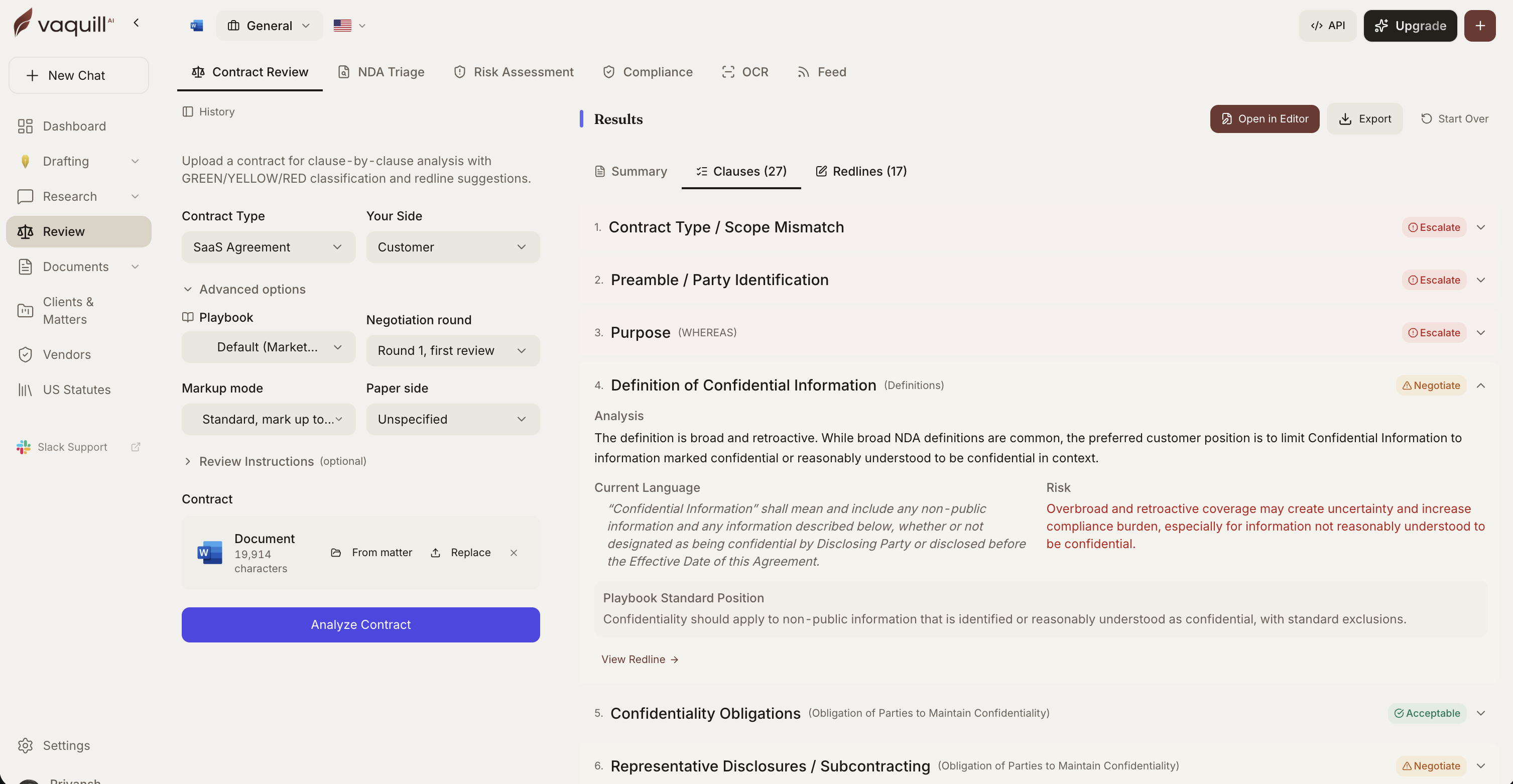
The point of AI here is not a magic verdict. It is a fast, consistent first pass that turns a 40-page document into a structured set of findings you can act on. Four steps.
Step 1: Extract a clause matrix
Have the tool pull every clause that matters into a structured table: limitation of liability, indemnification, IP, confidentiality, payment, term and termination, SLA, governing law, assignment, order of precedence. The matrix is the artifact. It replaces the linear page-1-to-page-40 read and shows you, at a glance, what is present and what is missing.
Step 2: Compare each clause to your playbook
A playbook is your set of standard positions: liability capped at 12 months of fees, mutual indemnity, vendor owns its tools but you own deliverables, no auto-renewal with more than 30 days notice, and so on. The tool compares each extracted clause against those positions. This consistency is the real value: the same standard applied to every MSA, every time, without drift between reviewers.
Step 3: Flag off-market terms by severity
Good output ranks findings (Critical, High, Medium, Low) so you can act in one pass. Each flag should say what the clause says, what your standard is, the risk, and the gap. A missing IP assignment on a custom-build SOW is Critical. A net-45 payment term when you prefer net-30 is Low.
Step 4: Draft fallback language
For each off-market clause, the tool proposes specific replacement language from your fallback positions. You are not writing redlines from scratch; you are approving or adjusting proposed ones. This is where minutes get saved.
A clause-by-clause review checklist
Use this as the spine of the AI pass and your human sign-off.
| Clause | What to check | Common off-market term | Severity if off |
|---|---|---|---|
| Limitation of liability | Cap amount, mutual, carve-outs | Sub-12-month cap; cap swallows breach/IP | Critical |
| Indemnification | Mutual, IP coverage, inside/outside cap | One-directional; broad obligation on you | High |
| Intellectual property | Ownership of deliverables, license scope | Vendor keeps custom work you paid for | Critical |
| Confidentiality | Mutual, survival, data-use carve-outs | Vendor may use your data for its purposes | High |
| Payment terms | Net window, escalator, dispute rights | Uncapped annual price increase | Medium |
| Termination | Convenience right, notice, cure, wind-down | No exit; long notice; no data return | High |
| SLA | Uptime, remedy, termination on chronic failure | Token service credit, no exit | Medium |
| Order of precedence | Whether SOW can override MSA | SOW silently overrides liability/IP | High |
What AI catches, and what it should not decide
AI is strong on the structured work: extracting clauses, spotting a missing data processing addendum, flagging a cap that is below your line, catching an auto-renewal notice window buried on page 31. It reads the whole document every time, which is exactly where tired humans slip.
It is weak on the parts that need a lawyer. It does not know this is your only viable vendor for a critical component, so you might accept terms you would normally reject. It does not weigh negotiation leverage. It treats each document in isolation, so the interaction between the MSA, the SOW, and an indemnity in Exhibit C is yours to connect. And it works from its training data, not yesterday's regulatory change.
A worked example: one flagged clause
We ran a vendor SaaS MSA through a playbook-driven pass with one rule: liability capped at 12 months of fees, with data-breach and IP-infringement claims carved out above the cap. The MSA contained this:
"In no event shall either party's aggregate liability arising out of or related to this Agreement exceed the total fees paid by Customer in the six (6) months preceding the event giving rise to the claim, and such cap shall apply to all claims including those arising from breach of confidentiality or data security obligations."
The position it breaks. The playbook sets the cap at 12 months and keeps data-breach claims above the cap. This clause sets a 6-month cap and pulls breach claims under it, so a security incident late in the contract year recovers a fraction of the harm.
The flag the tool produced:
| Field | Output |
|---|---|
| Severity | Critical |
| Clause | Limitation of Liability (Section 11.2) |
| Issue | Cap set at 6 months of fees; breach claims pulled under the cap |
| Standard | 12-month cap; data-breach and IP claims carved out above the cap |
| Risk | A late-year data breach recovers a fraction of actual loss |
| Suggested redline | "...exceed the total fees paid by Customer in the twelve (12) months preceding...; provided that the foregoing cap shall not apply to claims arising from breach of confidentiality or data security obligations." |
The model did not write a memo. It surfaced one clause, named the two ways it falls below your line, and proposed the exact language. A reviewer reads that row in ten seconds and decides whether to fight for it. The same pass flagged a missing data processing addendum and a one-directional IP indemnity, two of the most expensive misses in vendor MSAs.
Red flags worth slowing down for
- Liability cap that swallows the breach. A cap that applies to data security or IP claims with no carve-out can leave you under-recovered exactly when it matters.
- One-directional indemnity. You indemnify broadly; the vendor indemnifies narrowly or not at all. IP infringement coverage from the vendor is a standard ask.
- Vendor owns what you paid to build. On custom-build SOWs, retained vendor ownership of the deliverable is a frequent and costly off-market term.
- Auto-renewal with a long notice window. A 60- or 90-day notice requirement creates another year of commitment through simple inaction.
- SOW can override the MSA. A precedence clause that lets a project-level SOW change liability or IP terms undoes your MSA negotiation.
- Data-use creep. Confidentiality or DPA terms that let the vendor use your data for its own purposes, including model training, are increasingly common and easy to miss.
For vendor data terms specifically, the DPA review field guide goes deeper. For how AI MSA review compares to other tooling, see the AI contract review tools compared.
FAQ
What is an MSA in simple terms? A Master Service Agreement is the umbrella contract that sets the standing legal terms for an entire vendor relationship: liability, IP, confidentiality, termination. The specific work and fees live in a separate Statement of Work that sits underneath it.
What is the difference between an MSA and an SOW? The MSA governs the relationship and rarely changes. The SOW governs a single project and changes each engagement. Review them together, and check the order-of-precedence clause so an SOW cannot quietly override the MSA's liability or IP terms.
Which MSA clauses carry the most risk? Limitation of liability, indemnification, IP ownership, confidentiality, payment terms, termination, and the SLA. Most MSA disputes trace back to one of these, with liability and indemnity leading.
Can AI review an MSA accurately? AI is reliable on clause extraction, missing-clause detection, and deviation from a set playbook. It is weak on business context, negotiation strategy, and how the MSA, SOW, and exhibits interact. Use it for a fast first pass, and keep a lawyer reviewing every flag.
How long should an AI-assisted MSA review take? The structured first pass on a long MSA can drop from a couple of hours of linear reading to roughly 15 to 20 minutes of reviewing ranked flags. Treat that as a practitioner estimate; your real number depends on the contract mix and how well your playbook is configured.
What is the most overlooked MSA term? The order-of-precedence clause. If an SOW can override the MSA, a one-time MSA negotiation can be undone by whoever signs a later SOW. AI is fast at checking precedence across every SOW against the MSA.
Is it safe to upload an MSA to an AI tool? It can be, if the tool offers a written no-training commitment on your data, encryption in transit and at rest, defined retention and deletion, and SOC 2. Vet the specific tool rather than ruling out the category.
For the related play on employment contracts, see our AI employment contract review guide. Vaquill AI is a legal AI suite for in-house teams: contract review, document chat, drafting, and matter management in one workspace, with a written no-training commitment on your data.
New legal AI guides, weekly.
Further Reading
AI Employment Contract Review (2026): A Practical Guide for In-House Counsel
Read postWhat Vaquill AI Can Actually Do: Agentic Workflows, Verification Depth, and Open Benchmarks
Read postLegal AI in Microsoft Word: Contract Review, Redlining, and Research in a Word Add-In
Read postLegal AI Word Add-Ins Compared: 14 Tools, Features, and Pricing (2026)
Read postHow to Build a Litigation Chronology From Documents With AI
Read postBuilt-In Legal AI Skills: Which One to Run for Each Task
Read post
Co-Founder & CEO · Attorney
Arshita leads product and strategy at Vaquill, building the legal AI suite that solo, small-firm, and in-house US lawyers use to run a matter end to end.