Contract review is tedious. It is also expensive, error-prone at scale, and the single largest time sink for most in-house legal teams.
A mid-size company processing 500 vendor agreements per year burns roughly 1,250 lawyer hours on review alone. That is more than half a full-time lawyer dedicated to reading redlines.
AI contract review tools do not eliminate that work. They compress it. The open question for most teams is whether they can afford to keep reviewing manually while competitors move faster.
This guide covers what AI contract review actually does in 2026 and the adoption data behind it. It walks through a worked example of a real flagged clause, how to use these tools without leaking client data, and a 30-day pilot plan you can start this month.
What is AI contract review? (short answer)
AI contract review is software that reads a contract, extracts its clauses, compares them against your standard positions, and flags deviations and missing terms in minutes instead of hours. A modern tool does five things: pulls out every clause, checks each against your playbook, flags one-sided or absent terms, drafts a redline, and answers plain-language questions about the document. It compresses the routine reading. A lawyer still decides what to do with each flag.
TL;DR
- AI contract review is now a stack (extraction, risk flagging, redline, summarization, document chat), not a single product. Pilots fail when teams buy the chatbox and ignore the stack underneath.
- The fastest, highest-confidence wins are auto-renewal windows, liability caps, and one-sided indemnities on NDAs and vendor MSAs. Bespoke commercial deals and litigation-sensitive contracts are where false positives multiply.
- Adoption data converges: roughly half of in-house teams are active users in 2026, but most have not yet rebuilt their review SOP. Tools without an SOP wrapper produce inconsistent output.
- A 30-day pilot on NDAs is the cheapest way to falsify a vendor's pitch before signing a per-seat contract.
In the worked example, the vendor SaaS agreement capped liability at 3 months of fees. What cap did the review playbook require?
Part of our document tools, redline, and matrix guide series.
For related document-tools coverage, see Which AI Is Best for Contract Review? 7 Tools Tested for Solo and Small Firms and Set Up a Contract Review Skill: Turn Your Playbook Into a Reusable Reviewer, and 14 legal AI Word add-ins compared.
What AI contract review actually does in 2026
One thing trips up most buyers. AI contract review is a stack of capabilities. Different tools emphasize different layers, and buying "the chatbox" gets you one layer. Here is what the stack looks like today:
Clause extraction and identification. The baseline. AI identifies and categorizes clauses: indemnification, limitation of liability, termination, assignment, change of control, governing law. SpotDraft's 2025 survey found that 74% of in-house counsel rank clause identification and analysis as the most desired AI improvement in contract workflows. This is the layer that replaced Ctrl+F.
Risk flagging. The tool compares extracted clauses against your preferred positions or market benchmarks. It flags deviations. A one-sided indemnification clause, a missing liability cap, an auto-renewal with a 30-day notice window buried on page 14.
According to Sirion's 2026 analysis, AI reduces the time to spot these red flags from 1-2 hours of manual review to 10-15 minutes per contract.
Redlining and markup. More advanced tools generate suggested redlines based on your playbook. You define your fallback positions for key clauses, and the AI proposes specific language changes. This is where rule-based systems and large language models converge.
Full analysis and summarization. Upload a 40-page master services agreement and get a structured summary: key obligations, risk areas, unusual terms, missing standard clauses. This layer is powered by generative AI and has improved dramatically since 2024.
Document chat. The newest layer. Instead of reading a static summary, you interrogate the contract in natural language. "Does this agreement allow the vendor to use our data for training?" "What happens if we terminate for convenience in Year 2?" More on this below.
The layers run in sequence, and the human sits at the end of the pipeline, not outside it:
Set realistic expectations. AI handles structured, pattern-recognizable tasks extremely well. It struggles with ambiguity, novel clause structures, and business context it was never trained on.
A worked example: one clause, the position it breaks, the flag
Most guides describe what AI contract review does. Here is what it actually puts on your screen. We ran a standard vendor SaaS agreement through a playbook-driven review with one rule set: liability capped at 12 months of fees, mutual indemnification, no auto-renewal longer than 30 days notice.
The agreement contained this limitation-of-liability clause:
"In no event shall Vendor's aggregate liability arising out of or related to this Agreement exceed the fees paid by Customer in the three (3) months preceding the event giving rise to the claim."
The position it breaks. The playbook sets the cap at 12 months of fees. A 3-month cap means a failure that surfaces in, say, month 10 of an annual contract is capped at a quarter of what you paid, and the vendor keeps the rest. The cap is also one-directional: it limits Vendor, not Customer.
The flag the tool produced:
| Field | Output |
|---|---|
| Severity | High |
| Clause | Limitation of Liability (Section 9.2) |
| Issue | Cap set at 3 months of fees; playbook requires 12 months |
| Standard | 12-month fee cap is the most common in-house fallback; sub-6-month caps are outside market |
| Risk | A late-term breach recovers a fraction of contract value |
| Suggested redline | "...exceed the fees paid by Customer in the twelve (12) months preceding..." |
That is the whole point. The model did not write a memo. It surfaced one specific number, said why it is below your line, and proposed the exact word change. A reviewer reads that row in ten seconds and decides whether the cap is worth a fight on this deal. The same pass flagged a missing data processing addendum and a 60-day auto-renewal notice window, two of the most expensive misses in vendor contracts.
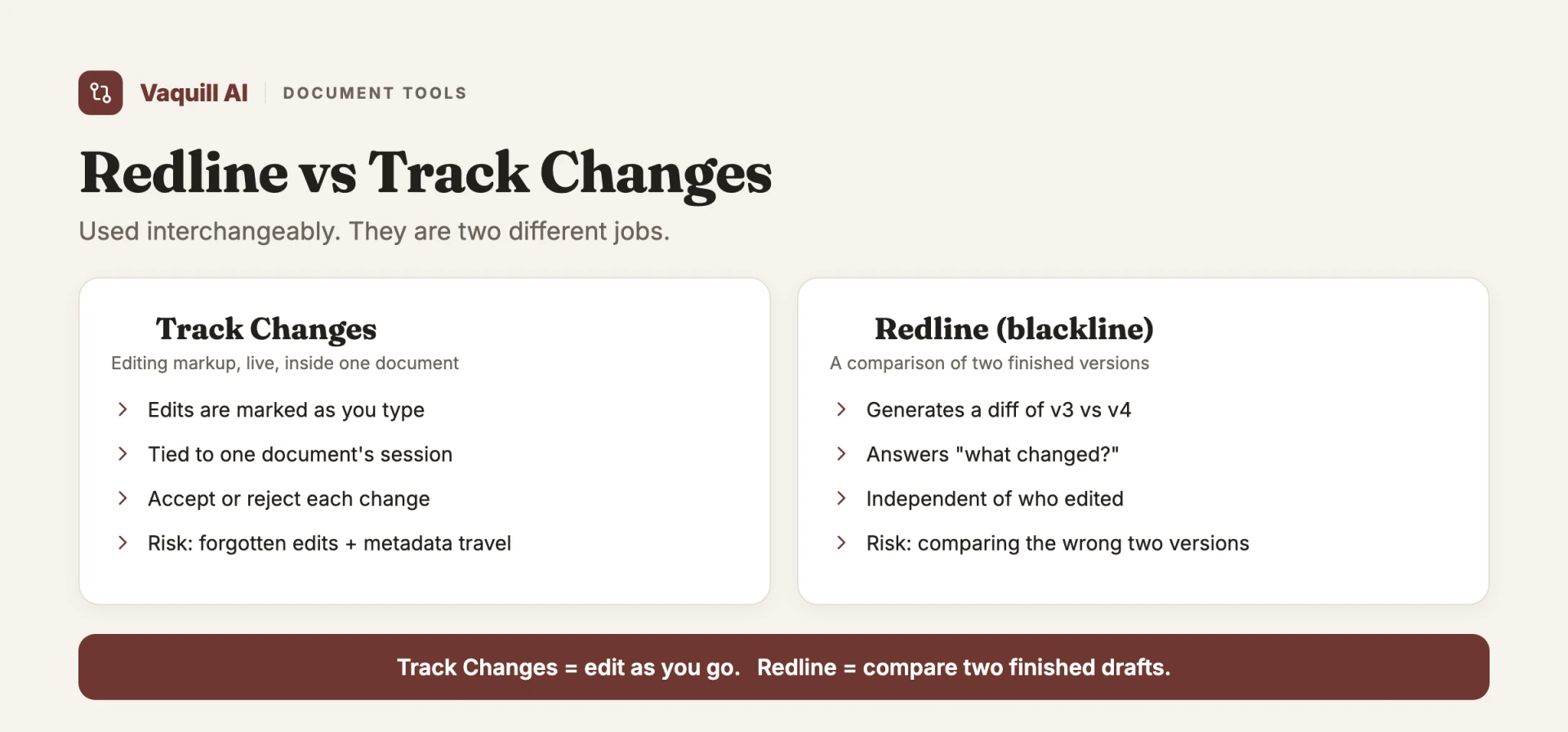
The suggested redline is not the same thing as a Word tracked change. The tool proposes the edit and the reasoning; you still accept, reject, or rewrite it inside the document, where the change becomes a normal tracked revision your counterparty sees.
For a deeper walk-through of turning a playbook into a reusable reviewer, see Set Up a Contract Review Skill and the in-house contract review playbook.
The adoption numbers: where the industry stands
The data on AI contract review adoption is no longer speculative. Multiple large-scale surveys from 2025 and early 2026 paint a consistent picture: adoption is accelerating fast, but most teams are still early.
ACC (Association of Corporate Counsel), October 2025. The ACC surveyed 657 in-house legal professionals across 30 countries. Active use of generative AI jumped to 52%, more than double the 23% reported in 2024.
Contract drafting efficiencies topped the list: 82% of respondents said they expect most AI-driven cost savings to come from contract work. One in five called AI's impact "transformative," nearly double last year's 11%.
Thomson Reuters, 2025. Their Generative AI in Professional Services Report found that 26% of legal organizations are actively using generative AI, up from 14% in 2024. Document review (77%), legal research (74%), and document summarization (74%) were the top use cases. By early 2026, their follow-up report showed 62% of legal professionals saying AI should be applied to their work.
Wolters Kluwer 2026 Future Ready Lawyer Survey. Surveying 810 lawyers across the U.S. and Europe, they found that more than 90% already use at least one AI tool in daily work. 62% report weekly time savings of 6-20%. Around 50% report revenue gains of 6-20%, with 32% attributing an 11-20% increase directly to AI.
LegalOn/In-House Connect, December 2025. Surveying 452 in-house legal professionals, they found that active AI usage in contract review has nearly quadrupled since 2024. More than 52% of in-house teams are already using or evaluating contract AI technology.
SpotDraft AI Impact Report, 2025. 70.8% of legal teams foresee AI-driven transformation in contract management over the next three years. But the gap between interest and daily use is real: 65% have shown interest, yet only 13% use AI every day for contract work.
Deloitte, cited by DocuSign (2026). A Deloitte study found that 88% of legal teams have already seen productivity gains from AI. 78% named contract review as one of the areas where AI had the greatest impact. The same DocuSign analysis cites Gartner's forecast that half of procurement contract management will be AI-enabled by 2027. It also cites a Bloomberg Law/ALM survey finding that contract tasks fill at least half the day for 43% of corporate counsel, roughly 120 working days a year per attorney. The through-line matches the 1,250-hour estimate at the top of this guide: review is the time sink, and the only open question is how much of it you compress.
Adoption is surging at the organizational level. Daily, embedded usage is still catching up. Teams have bought the tools faster than they have rebuilt the review process around them.
If you are reading this article, you are probably in the majority that has explored AI tools but has not yet made them a core part of the workflow. That is exactly the right time to run a structured pilot.
Use cases by practice area
AI contract review is not equally useful for all contract types. Here is where it delivers the most value, ranked by impact.
NDA triage (batch processing)
This is the highest-ROI starting point. NDAs are high-volume, structurally similar, and low-risk enough to test AI with confidence. A typical in-house team processes dozens of NDAs per month. Most are mutual, most follow a standard template, and most deviations are minor.
AI handles this in minutes. Upload 20 NDAs, get a structured comparison: which ones deviate from your standard terms, which have unusual carve-outs from the definition of confidential information, which extend the survival period beyond your norm.
One legal ops team reported reducing NDA review from 30 minutes per agreement to under 5 minutes, a reduction that compounds fast at volume.
M&A due diligence
Due diligence is where AI contract review earns its keep on high-stakes work. A mid-market acquisition might involve reviewing 200-500 contracts in the target's portfolio: customer agreements, vendor contracts, employment agreements, IP licenses, real estate leases.
AI extracts key terms across the entire corpus: change-of-control provisions, assignment restrictions, most-favored-nation clauses, termination triggers.
Instead of assigning a team of associates to read every agreement cover to cover, the lead lawyer gets a structured matrix of risk areas in hours rather than weeks. The human review then focuses on the 15-20 contracts that actually contain problematic terms.
The scale is real at the top end. JPMorgan Chase's implementation of AI-driven contract analysis reportedly saves 360,000 legal hours annually across its operations.
Employment agreements
Employment contracts contain some of the most consequential clauses in any company's portfolio: non-compete provisions (especially post-FTC scrutiny), IP assignment scope, severance triggers, change-of-control payments.
AI flags inconsistencies across a portfolio. Say it surfaces that your VP of Engineering's non-compete is twice as broad as every other executive's, or that three agreements reference a bonus plan discontinued two years ago. That is the kind of finding that prevents real problems.
Commercial leases
Lease review is repetitive enough for AI to add immediate value. Key extraction targets: rent escalation formulas, CAM reconciliation terms, assignment and subletting restrictions, co-tenancy clauses, exclusive use provisions, operating hours requirements. A retail company with 50 locations can audit its entire lease portfolio for consistency in an afternoon.
Vendor and SaaS agreements
These are the contracts that accumulate fastest and get reviewed least carefully.
AI catches the provisions that legal teams routinely miss under time pressure. Common examples: unlimited liability carve-outs that swallow the cap, broad indemnification that runs only one direction, auto-renewal clauses with 60-day or 90-day notice windows, and data processing terms that conflict with your privacy program.
The 80% rule: what AI catches vs. what it misses
A useful mental model for AI contract review is the 80/20 split. AI handles roughly 80% of the review workload, the structured, pattern-matching, clause-identification work. You handle the 20% that requires legal judgment, business context, and creative problem-solving.
What AI catches reliably
Missing clauses. No limitation of liability? No data protection addendum? No force majeure provision? AI flags the absence. This sounds simple, but missing clauses are one of the most common and most dangerous contract defects, precisely because humans tend to notice what is there, not what is absent.
Deviation from standard positions. If your playbook says liability caps should be set at 12 months of fees, AI flags every contract where the cap is lower, where there is no cap, or where carve-outs effectively gut the cap.
Inconsistent definitions. The agreement defines "Confidential Information" in Section 1 but uses "Proprietary Information" in Section 7. The effective date in the header does not match the effective date in the signature block. AI catches these because it reads the entire document, every time, without fatigue.
Unfavorable benchmarks. Some tools compare your contract terms against market norms. An indemnification obligation that extends to "any and all claims, whether or not arising from the indemnifying party's negligence" is outside market standard, and AI flags it.
Auto-renewal traps. Limitation of liability has been the most negotiated contract term every year since 2007, with indemnification at number two. But auto-renewal clauses cause more operational pain than either, because they create financial obligations through inaction.
AI tracks every renewal date and notice deadline.
What AI misses (and you should not delegate)
Business context. AI does not know that this vendor is your only source for a critical component, and therefore you might accept terms you would normally reject. It does not know that your company is about to be acquired, making change-of-control provisions suddenly critical.
Negotiation strategy. AI can tell you that a clause deviates from your playbook. It cannot tell you whether to push back, concede, or propose creative alternatives. That is where lawyering happens.
Ambiguity interpretation. When a clause is genuinely ambiguous (not poorly drafted, but intentionally vague as a compromise), AI may flag it as a risk when both parties actually prefer the ambiguity.
Cross-agreement dependencies. AI reviews each contract as an isolated document. It does not automatically understand that the indemnification in the MSA interacts with the limitation of liability in the SOW, which references the insurance requirements in Exhibit C.
Regulatory nuance. AI may not know that a particular state just changed its non-compete enforcement standard, or that a pending regulation will affect data transfer clauses. It works from its training data, not from yesterday's court ruling.
Treat the 80/20 split as the operating model. AI compresses the routine work so you can spend your limited time on the questions that actually require a lawyer.
How document chat changes the workflow
Traditional contract review is linear. You open the PDF, you read from page 1, you take notes, you search for specific terms using Ctrl+F. If the contract is 60 pages, that process takes hours.
Document chat flips this entirely. You upload the contract and ask questions.
Instead of searching for "indemnif" and scrolling through 14 results to find the operative clause, you ask: "Who bears the indemnification obligation, and are there any carve-outs from the liability cap for indemnification claims?" You get a direct answer with the relevant clause cited.
Instead of reading the entire termination section to understand your exit rights, you ask: "What are our termination options in Year 2 of this agreement, and what are the financial consequences of each?"
The AI synthesizes across multiple sections, because termination provisions often interact with payment terms, wind-down obligations, and IP ownership clauses scattered throughout the document.
Document chat changes how lawyers work with contracts in three concrete ways:
Speed of first review. A senior lawyer can form an initial risk assessment of a complex agreement in 15-20 minutes by asking targeted questions, rather than spending 90 minutes on a linear read-through.
Better issue spotting for non-specialists. A corporate lawyer reviewing a technology licensing agreement can ask specific questions about IP provisions without needing deep expertise in IP licensing. The AI surfaces the relevant terms and explains their implications.
Client responsiveness. When a business stakeholder asks "Can we assign this contract if we spin off the division?", you do not need to pull the file and read the assignment clause.
You open the document in your AI tool, ask the question, and respond in minutes.
A document-chat workflow lets you upload a contract and interrogate it conversationally. You can ask about a specific clause, compare a term against your standard position, or get a plain-language summary of a dense section. The bar to clear: it should answer in the language of the contract, not make you learn another dashboard.
Purpose-built legal AI vs. pasting it into ChatGPT
A fair question: why not just paste the contract into ChatGPT? For a one-off "summarize this in plain English," a general model is fine. For review you act on, three problems show up.
Hallucination on legal specifics. A Stanford RegLab study (Dahl, Magesh, Suzgun, Ho, 2024) found large language models hallucinated on legal queries at high rates, and even a leading model invented or misstated case-law details a meaningful share of the time. In contract review the failure mode is quieter: the model says a clause is "standard" when it is not, or misreads a cross-reference between the MSA and an exhibit. A wrong flag you trust is worse than no flag.
No memory of your positions. ChatGPT does not know your 12-month cap rule or that you never accept unilateral indemnification. Purpose-built tools encode a playbook, so the same standard is applied to every contract, every time. That consistency is the actual product.
Data handling. Consumer chat tools may retain or train on what you paste unless you are on a plan that contractually says otherwise. That collides directly with client confidentiality (more below).
Use general AI for a quick read. Use purpose-built contract AI for any review whose output you put your name on. For how the underlying models differ on this, see legal AI that avoids hallucinating cases.
Security and confidentiality: addressing the #1 objection
Every conversation about AI contract review eventually hits the same wall: "I can't upload client contracts to an AI tool."
This is the right instinct. Client confidentiality is non-negotiable. But the analysis does not end there. The real test is whether a specific tool handles sensitive data with adequate safeguards, not whether the category as a whole touches it.
ABA Formal Opinion 512 (July 2024)
The ABA's Standing Committee on Ethics and Professional Responsibility issued Formal Opinion 512, its first comprehensive guidance on lawyers' use of generative AI. The opinion addresses six ethical obligations under the Model Rules: competence, confidentiality, communication, candor toward the tribunal, supervisory responsibilities, and fees.
On confidentiality specifically, the opinion requires lawyers to evaluate the risks that client information "will be disclosed to or accessed by others outside the firm" before inputting it into any AI tool. The opinion warns that many "self-learning" AI tools may use input data to improve their models, and that client informed consent is required before using such tools.
The key distinction: not all AI tools learn from your data. Enterprise-grade legal AI tools typically commit in the contract that your data will not train any model, will be encrypted in transit and at rest, and will be deleted after processing. These are the tools that pass the ABA's framework.
What to evaluate in any AI contract review tool
Data isolation. Your contracts should be processed in isolated environments, not commingled with other customers' data. Ask whether the tool uses dedicated or shared infrastructure.
Training exclusion. Get it in writing: your data will not be used to train or fine-tune any AI model.
Encryption standards. AES-256 encryption at rest, TLS 1.2+ in transit. These are table stakes. Ask about key management.
Data retention and deletion. How long does the tool retain your uploaded documents? Can you delete them on demand? What happens to processed data after the analysis is complete?
SOC 2 compliance. This is not a legal requirement, but it is the industry standard for demonstrating that a vendor has adequate security controls. Ask for the report.
Subprocessor transparency. If the tool uses third-party AI models (OpenAI, Anthropic, Google), understand what data flows to those subprocessors and what contractual protections are in place.
The objection to AI contract review on confidentiality grounds was reasonable in 2023. The risk calculus has shifted since then. Enterprise-grade tools now offer zero-retention processing, SOC 2 certification, and contractual training exclusions. For how to actually verify a no-training claim rather than take the marketing line, see how to verify a vendor does not train on your data.
Before you rule out AI on safety grounds, weigh it against the process it replaces. A manual workflow carries its own human error rates, inconsistent review quality, and overworked reviewers. Neither side is risk-free, so compare them honestly.
Which category of tool fits your team
The tools cluster into four categories, and the right one depends on your contract mix and whether you already pay for a legal research database. Prices below are what each vendor publishes; most in the category sell by quote, so treat a public per-seat number as the exception, not the rule.
| Category | Examples | Best for | Pricing |
|---|---|---|---|
| Research-grounded assistants | CoCounsel (Thomson Reuters) | Litigation and research-heavy firms | Quote-based, not public |
| Contract-first reviewers | Spellbook, LegalOn, Ivo | Transactional and in-house contract work | Quote-based, not public |
| In-house legal suites | Vaquill AI | In-house teams that also want drafting and matter tracking in one place | Self-serve |
| General LLMs | ChatGPT, Claude, Gemini | Quick plain-English reads, never final review | Consumer subscription tiers |
A short, honest read on each:
- Research-grounded assistants. Strong when the answer has to be backed by case law and you already pay for the underlying database. Heavier and pricier than most in-house teams need for high-volume commercial redlining.
- Contract-first reviewers. The sharpest Word-native redlining and playbook enforcement in the market. The trade-off: you often pay separately if you also need legal research or matter management.
- In-house legal suites. Review, drafting, and matter tracking behind one login, which fits lean teams that do not want three subscriptions. Younger than the specialist point tools, so pressure-test each module on your own contracts.
- General LLMs. Fine for a throwaway summary. No memory of your positions and real hallucination risk, so never the reviewer of record.
For a tool-by-tool breakdown with the trade-offs spelled out, see Which AI Is Best for Contract Review?.
A 30-day pilot plan: testing AI contract review in your practice
Do not try to change your entire contract workflow at once. Run a narrow pilot, measure it against your current process, then expand only what earns it. Here is a week-by-week plan.
Week 1: Setup and baseline (Days 1-7)
Select your tool. Choose one AI contract review tool and get your team access. Focus on tools that offer document chat and clause extraction, the two features with the fastest time-to-value.
Establish your baseline. Pick 10 recently reviewed contracts (ideally NDAs or simple vendor agreements). Record how long the manual review took, what issues were flagged, and what was missed. You need this data to measure improvement.
Define your test set. Identify 20-30 incoming contracts over the next three weeks that you will route through AI review in parallel with your existing process. Start with low-risk, high-volume document types: NDAs, standard vendor agreements, SaaS subscriptions.
Brief your team. This is a parallel process, not a replacement. Every AI-reviewed contract still gets human sign-off during the pilot. The goal is to compare, not to delegate.
Week 2: Parallel review (Days 8-14)
Run dual tracks. For each incoming contract in your test set, run both the traditional review and the AI review. Track three metrics: time to complete, issues identified, and issues missed.
Test document chat. For at least 5 contracts, use the chat interface instead of (or in addition to) the structured analysis. Ask specific questions: "Are there any uncapped liability provisions?" "What is the notice period for termination?" "Does this agreement contain a most-favored-nation clause?" Compare the AI's answers against your manual findings.
Log discrepancies. When the AI flags something your reviewer missed, or vice versa, document it. This is your calibration data.
Week 3: Calibration and playbook (Days 15-21)
Analyze results. Compare the AI and human review results across your test set. Where did the AI add value? Where did it produce false positives? Where did it miss issues?
Build your playbook. Based on Week 2 results, define your preferred positions for the 5-10 most common clause types. Configure the AI tool to flag deviations from these positions. Most tools let you set custom review criteria.
Identify your 80/20 boundary. Determine which contract types and clause categories you are comfortable having AI handle as the primary reviewer (with human spot-checks), and which still require full human review.
Test at higher volume. If you processed 10 contracts in Week 2, aim for 15-20 in Week 3. Stress-test the workflow.
Week 4: Decision and rollout plan (Days 22-30)
Quantify the ROI. Calculate total hours saved, issues caught that would have been missed, and false positive rates. Organizations processing 500+ contracts annually typically see a 50-80% time reduction on routine review.
Draft your AI review policy. Define which contract types go through AI-first review, which require parallel review, and which are human-only. Address confidentiality protocols: which contracts can be uploaded, which cannot (e.g., matters under litigation hold, contracts with specific confidentiality restrictions on third-party tools).
Get stakeholder buy-in. Present your pilot results to the General Counsel or managing partner. Lead with time savings and issue-catch rates, not technology. Decision-makers care about outcomes, not features.
Plan the expansion. If the pilot validates AI review for NDAs and vendor agreements, your next targets should be employment agreements and commercial leases. Add one contract type per month. Do not rush.
FAQ
What is AI contract review?
AI contract review is software that reads a contract, extracts its clauses, compares them against your standard positions or market norms, and flags deviations, one-sided terms, and missing provisions. It produces a structured set of findings and often a suggested redline. A lawyer reviews the flags and makes the calls.
How do you use AI for contract review, step by step?
Pick a low-risk, high-volume document type to start (NDAs or vendor agreements). Load 10 already-reviewed contracts to set a baseline, then run new contracts through the tool in parallel with your normal review for two to three weeks. Compare what each catches, encode your top clause positions as a playbook, then let AI take a first pass with human sign-off. The 30-day plan above lays this out week by week.
Is AI contract review accurate?
It is reliable on structured, pattern-based work: clause extraction, missing-clause detection, deviation from a set playbook, and inconsistent definitions. It is weaker on business context, negotiation strategy, intentional ambiguity, cross-agreement dependencies, and brand-new regulatory changes. Treat it as an 80% first pass, not a final answer, and keep a human reviewing every flag.
Can I just use ChatGPT to review contracts?
For a quick plain-English summary, yes. For review you act on, a general model has no memory of your positions, can hallucinate on legal specifics, and may retain what you paste. Purpose-built contract AI encodes your playbook and offers contractual data protections. Use general AI for a quick read, purpose-built tools for anything you sign off on.
Is it safe to upload confidential contracts to an AI tool?
It can be, if the tool offers the right safeguards: a written commitment not to train on your data, encryption in transit and at rest, defined retention and deletion, SOC 2, and subprocessor transparency. ABA Formal Opinion 512 (July 2024) requires lawyers to evaluate disclosure risk before inputting client data and to get informed consent for tools that learn from inputs. Vet the specific tool, do not rule out the category.
How much time does AI contract review save?
Reported reductions cluster in the 50 to 80 percent range on routine review, with NDA triage often dropping from around 30 minutes to under 5 minutes per agreement. Treat these as practitioner and vendor estimates, not guarantees; the real number depends on your contract mix and how well your playbook is configured. Measure your own baseline during a pilot.
Which contracts should AI review first?
Start where volume is high and risk is low: NDAs, standard vendor agreements, and SaaS subscriptions. Expand to employment agreements, commercial leases, and M&A due diligence once your playbook and your team's trust are calibrated. Keep bespoke, litigation-sensitive, and heavily negotiated deals under full human review.
Can AI review a contract?
Yes, within limits. AI reads a contract, flags risky or missing clauses against a standard, summarizes the obligations and dates, and drafts suggested edits in minutes. What it does not do is exercise legal judgment or take responsibility for the result. It handles the first pass on routine agreements well, and a lawyer still owns the call on anything bespoke or high-stakes.
Which AI is best for contract review?
There is no single winner; it depends on your setup. Westlaw-grounded tools like CoCounsel suit research-heavy and litigation firms; contract-first tools like Spellbook, LegalOn, and Ivo suit transactional and in-house work; an in-house suite fits teams that also want drafting and matter tracking in one place. Match the tool to your contract mix and whether you already pay for a research database. Our comparison of AI contract review tools breaks down the trade-offs.
Will AI replace contract managers?
No, it reshapes the role. AI absorbs the repetitive first-pass review and data entry, which frees contract managers for the negotiation, escalation, and relationship work that needs judgment. Teams that adopt it tend to handle more volume with the same headcount rather than cut it. The job shifts from reading every line to supervising the system that reads every line.
Getting started today
The legal profession spent 2024 debating whether AI contract review was ready. It spent 2025 watching early adopters pull ahead. In 2026, over 90% of surveyed lawyers use at least one AI tool, and active contract AI adoption quadrupled in a single year. The window for "wait and see" is closing.
You do not need to overhaul your practice. You need 30 days, a set of test contracts, and the discipline to measure results. Start with NDAs. Validate the technology against your own standards. Expand from there.
The lawyers who thrive here will adopt AI deliberately. They will know exactly where it adds value and where a human still has to make the call.
That 80/20 split is the competitive advantage, once you know which 20% only a lawyer can handle.
Vaquill AI is a legal AI suite for in-house teams: contract review, document chat, drafting, and matter management in one workspace, with a written no-training commitment on your data.
New legal AI guides, weekly.
Further Reading
What Is NDA Triage? How Lawyers Sort Inbound NDAs in Minutes With AI
Read postNDA Triage AI: How AI NDA Review Works and How to Evaluate a Tool (2026)
Read postTop 12 Legal Redline Software Tools (2026)
Read postTop Contract Management Vendors for Fortune 500 Legal Teams
Read postHow to Build an NDA Playbook Your AI Can Actually Enforce
Read postLegal AI Workflows: How Law Firms Chain Multi-Step AI Tasks in 2026
Read post
Co-Founder & CEO · Attorney
Arshita leads product and strategy at Vaquill AI, the US primary law data API. As an attorney, she decides which law we carry, how each section is sourced and cited, and what legal AI and compliance teams need from the data.