Short answer: Bloomberg Law is worth it if your week is federal regulatory, securities, M&A, banking, tax, or labor and employment work. You are paying for SEC filings fused to EDGAR, Smart Code on the securities and banking titles, and BLAW Analytics on federal dockets and judges. The AI Assistant is competent and included free, but less mature than CoCounsel or Lexis Protégé. Pricing is sales-quoted (no published list price), and third-party reviews put it below Westlaw and Lexis at comparable depth. Skip it if you do state-court general practice, contract-first work, or need a public API.
Bloomberg Law is the right primary research seat for any team whose week is mostly federal regulatory work, securities, M&A, banking, tax, or labor and employment, and the wrong primary seat for almost everyone else. The reason is not pricing or AI maturity. It is content shape.
The renewal conversation that surfaces this usually happens after a CFO question on a Friday. Someone in securities compliance has been asked whether the firm is exposed under Reg Best Interest on a new advisory product, and which federal judges have ruled on this class of duty in the last eighteen months.
On the incumbent platform that build runs three queries, a citator pass, and a separate trip to PACER for docket profiles. On Bloomberg Law it runs once: pull Section 240.15l-1, open the Smart Code panel for the ranked line of controlling opinions, click into BLAW Analytics on the two judges sitting on the pending cases, and read the issuer's 10-K filings alongside.
By Monday the compliance lead is asking whether the firm should switch its primary seat. That is the conversation Bloomberg's strongest surfaces are designed to provoke, and the one generalist reviews miss because they evaluate Bloomberg against the wrong query mix.
Most reviews ask whether Bloomberg can replace Westlaw or Lexis as the primary case-law research seat. For a state-court trial shop, the answer is no.
That framing buries why public-company in-house teams, securities boutiques, M&A counsel, and bank regulators keep Bloomberg as their primary seat anyway. They are not buying case-law breadth. They are buying SEC filings fused to Edgar, federal-docket analytics, Smart Code on the securities and banking titles, and Bloomberg's financial data spine in the same surface as the law.
TL;DR
- Bloomberg Law is the third major US legal research platform after Westlaw and Lexis, and the only one whose data spine integrates Bloomberg-grade financial data, SEC filings, and corporate intelligence into legal research at first-class depth.
- Strongest content: financial services, securities, banking, tax, labor and employment, plus M&A transactional intelligence. BLAW Analytics on federal dockets, judges, courts, attorneys, and law firms is enterprise-grade and a genuine reason to buy.
- AI features (Bloomberg Law AI Assistant with iterative chat, document summaries, cross-jurisdiction comparison charts, one-click citation verification) are competent and included at no extra charge, but less mature than CoCounsel or Protégé as standalone AI workbenches.
- Pricing is sales-quoted; market reports place it in the $200 to $400 per seat per month range for full Bloomberg Law, materially below Westlaw or Lexis at comparable research depth. Best fit: financial services and securities in-house teams, M&A counsel, regulated-industry GCs, litigation analytics buyers. Wrong fit: solos, 2 to 15 lawyer general-practice firms, contract-automation buyers, and dev shops wanting a public API.
A legal-ops team wants to plug legal research into Zapier, Make, or n8n. Per this review, what makes Bloomberg Law a poor fit for that?
Part of our legal AI vendor comparison and pricing series.
At a glance: Bloomberg Law vs Vaquill AI
| Bloomberg Law | Vaquill AI | |
|---|---|---|
| Price | Sales-quoted, flat subscription (no published list price) | Self-serve, published (sign up for current pricing) |
| Access | Sales-negotiated contract | Self-serve sign-up |
| Best for | Financial services, securities, M&A, banking and regulatory in-house teams | Solo GCs and 2 to 10 person in-house teams |
| Free trial | Negotiated trial through a rep | Yes, self-serve |
| Word-native drafting | No native CLM or Word add-in playbook | Drafting and review workbench |
| Trains on your data | Not on customer data per its enterprise terms | No training on customer data |
| Public API | No general-purpose public API | Statutes API (US Code, CFR, all 50 states) |
What Bloomberg Law actually is
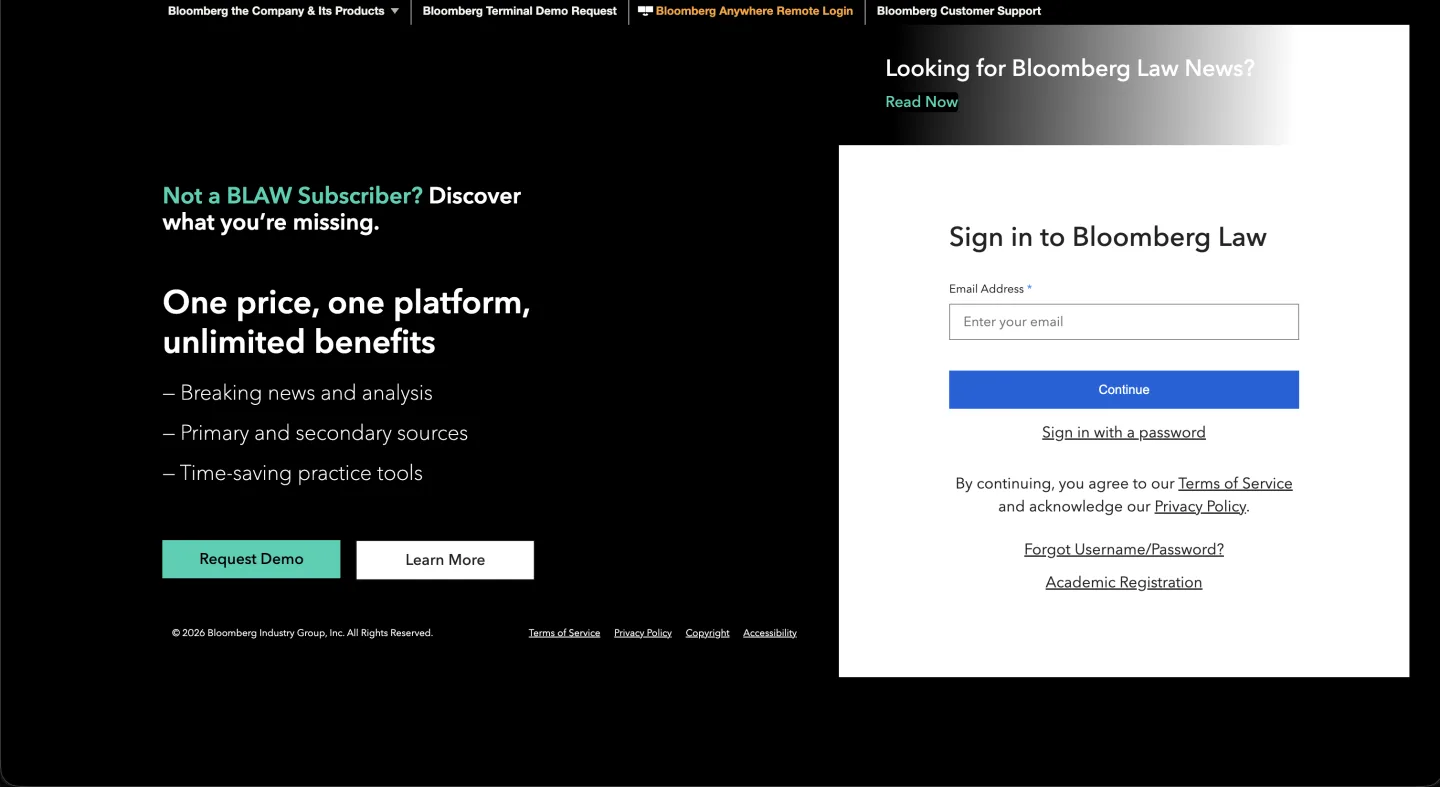
Bloomberg Industry Group (formerly Bureau of National Affairs, BNA) launched Bloomberg Law in 2009 and absorbed BNA in 2011. That history matters because the deep editorial content (BNA tax management portfolios, securities treatises, labor and employment dailies) carries BNA's institutional voice underneath the Bloomberg branding.
The product is US case law plus statutes, regulations, dockets, agency materials, transactional documents, and news, fused with Bloomberg's financial data.
The institutional bet was that practice intelligence (actual deal data, actual filings, actual market context) belongs in the same surface as the legal research. For corporate and transactional work, that bet aged well. For a state-court personal-injury practice, it never applied.
The product surface
Seven pieces carry most of the daily use.
Smart Code. Statutory annotations powered by machine learning. A regulatory lawyer working an Investment Advisers Act question pulls Section 206, reads the Smart Code panel, and the controlling federal opinions on fiduciary duty land in the first scroll, ranked strong-to-weak.
The time difference per query is small. The compound effect across a hundred queries a week is real, and it shows up where Smart Code's training data is densest: securities, banking, antitrust, tax, ERISA, employment.
BLAW Analytics. Federal dockets across U.S. District Court and Court of Appeals filings since 2007, with profiles for more than 100,000 attorneys at more than 775 law firms. The product profiles companies, law firms, attorneys, judges, and courts: motion outcomes, appeal outcomes, case length, case types, appearance patterns.
In practice, an in-house litigation manager scoping outside counsel for a federal securities defense stops asking three firms for "representative experience" and reading marketing decks. The manager pulls each firm's actual appearance record in the relevant districts, filters by case type, and sees motion-to-dismiss grant rates by partner.
The conversation inside an hour is different, and the selection happens on data instead of relationships. In one in-house evaluation I watched, that single workflow paid for the seat inside a quarter.
Bloomberg Law AI Assistant. Chat-based research, included with the platform. The enhancement release (announced by Bloomberg Industry Group on July 15, 2025) added iterative back-and-forth research, stored chat history, jurisdiction-specific filtering, cross-jurisdiction comparison charts (compare wage-and-hour rules across five states in one chart), document summaries, and one-click verification with inline citations linking to source.
Competent and integrated. Not at the depth of CoCounsel's matter workflows or Protégé's agentic skills, and not pretending to be.
Points of Law. AI-extracted legal propositions from case law, used for finding cases that stand for a given proposition. Useful, less mature than Westlaw's editorial taxonomy after a hundred years of headnoting. Treat it as a directional tool, not a primary citator.
Litigation Intelligence Center. A dedicated litigator workspace combining dockets, primary law, practical guides, news, verdicts, expert witness data, and BLAW Analytics in one surface. The right shape for a federal litigation team.
Transactional Intelligence Center. The M&A counterpart: precedent transaction documents, EDGAR filings, deal-points databases, Draft Analyzer (benchmarks your agreement language against market-standard clauses pulled from EDGAR filings), Bloomberg deal data.
On a live $400M technology acquisition, an associate building an indemnification basket position pulls the last twenty-four months of comparable deals at similar size, sees the median basket and cap as a percentage of purchase price, and walks into the partner meeting with a defensible market position instead of an anecdote. The partner's trust in the number is what gets the seat renewed.
Practical Guidance. Bloomberg's practitioner content (forms, checklists, annotated samples, step-by-step task guides), strongest where Bloomberg has historical depth: securities, M&A, banking, tax, labor and employment, antitrust.
Bloomberg's AI tools, rated
Bloomberg does not sell one AI product. It ships several, at different levels of maturity, all bundled into the seat. Rated honestly against what a practitioner actually gets:
| AI tool | What it does | Honest verdict |
|---|---|---|
| Bloomberg Law Answers | Generative quick answer over the full corpus: federal and state opinions, U.S. Code, CFR, state statutes and regulations, Practical Guidance, news, and secondary sources | Good for a fast orienting answer with citations. Opt-in. Not a substitute for a citator pass. |
| AI Assistant | Document-scoped chat: summarize and ask questions about the document you are viewing | Genuinely useful in-document. Falls short as a research agent; it is not CoCounsel's matter workflow or Protégé's agentic skills. |
| Draft Analyzer | Benchmarks your contract language against market-standard clauses drawn from EDGAR filings | The AI feature transactional teams rate highest. But it is comparison, not generation; it does not draft or redline for you. |
| Points of Law | AI-extracted legal propositions from case law | Directional. Thinner than Westlaw's century-old headnote taxonomy. Not a primary citator. |
| BLAW Analytics | Outcome analytics on judges, courts, firms, attorneys, and dockets | The strongest data asset on the platform. Enterprise-grade, and a genuine reason to buy the seat. |
The pattern: Bloomberg's AI is strongest where it sits on top of proprietary structured data (analytics, EDGAR benchmarks) and weakest where it competes head-on with dedicated AI workbenches on open-ended drafting and multi-step research.
Pricing reality and seat-allocation patterns
Bloomberg Law does not publish a list price. Pricing is sales-quoted as a flat subscription, not the metered or "per-search" surcharges that historically haunted Westlaw and Lexis bills.
Market reports and published buyer reviews generally place full Bloomberg Law access in the $200 to $400 per seat per month range, with volume discounts and bundle adjustments for litigation versus transactional configurations. That is materially below Westlaw or Lexis at comparable depth.
Two seat-allocation patterns recur in mid-market in-house teams.
The first is the primary-plus-lockbox configuration. Bloomberg as the primary research seat for the whole team at $300 to $400, with one or two Westlaw seats on the litigation partners' desks for occasional state-court reach.
A 25-lawyer in-house team at a public bank with two state-court matters a year does not need 25 Westlaw seats; it needs 25 Bloomberg seats and two Westlaw lockboxes, and the total spend lands meaningfully below an all-Westlaw configuration. In observed allocations, legal-ops teams running this configuration explicitly can save on the order of 30% on research-platform spend without losing functionality, depending on the incumbent's quoted seat price.
The second is the analytics-justified seat. A general counsel running outside-counsel selection across 40 federal matters a year can justify a small Bloomberg footprint purely on BLAW Analytics, with research and AI as included extras.
The seat math runs on the outside-counsel spend it shapes, not on the research-hours it saves. Two or three Bloomberg seats at a litigation-managing GC's office often pay back inside a single re-allocation of outside-counsel work.
Where Bloomberg Law clearly wins
Financial services, securities, and banking content. SEC filings via Edgar with Bloomberg-grade enrichment, no-action letters, staff bulletins, regulatory comments, Federal Reserve materials, OCC and FDIC supervisory guidance, cross-linked to the U.S. Code and CFR with Smart Code.
A bank regulator or securities lawyer working on a Reg Best Interest matter, a Section 13(d) filing question, or a banking supervisory issue gets to the answer in fewer hops here than on either competitor. This is the home turf.
BLAW Analytics on dockets and judges. A daily input for federal litigators and for in-house teams managing outside-counsel selection. The data depth is real, not marketing.
Transactional intelligence. The M&A precedent database, deal-points coverage, and EDGAR integration make the Transactional Intelligence Center an honest competitor to specialized M&A research tools, and a step above the M&A surfaces on either incumbent.
Bloomberg financial data integration. The piece no competitor reproduces. A corporate lawyer evaluating a public-company counterparty pulls recent financials, analyst notes, and Bloomberg news context alongside the legal research without context-switching to a Bloomberg Terminal seat.
Pricing relative to Westlaw and Lexis. Generally cheaper at comparable depth, particularly when the target practice is financial services, securities, M&A, or banking.
Where Bloomberg Law disappoints
Buyers overpay for Bloomberg when they evaluate the wrong workflow. The honest gaps:
General litigation research outside federal dockets. State case-law coverage and editorial annotation are thinner than Westlaw and Lexis in many jurisdictions. A state-court trial lawyer in California, Texas, or Florida who needs deep state-specific annotation and key-numbered case law will find the seat a poor substitute for upgrading the primary one.
Contract automation and drafting. Bloomberg is not a contract lifecycle management platform or an AI drafting workbench, and it does not pretend to be. No native CLM. No Word add-in playbook surface comparable to the in-house-AI category. For a team whose week is 70%+ contract review, this is the wrong primary tool, full stop.
Public API access. Bloomberg does not publish a general-purpose public API for programmatic access to case law, statutes, or analytics. For a legal-ops team plugging into Zapier, Make, or n8n, or a developer building a custom retrieval pipeline, the closed API surface is a hard constraint. (See why MCP is the 2026 integration plane.)
Solo and small-firm pricing fit. Cheaper than the incumbents, still priced for institutional buyers. The platform's strongest content (securities, M&A, banking regulatory) is not where a solo general-practice lawyer is bottlenecked.
AI feature maturity versus dedicated AI workbenches. The AI Assistant is competent and free with the seat. It is not CoCounsel and it is not Protégé.
The category leaders have shipped agentic skills, multi-step matter workflows, and deeper drafting integrations that Bloomberg does not match in 2026. A buyer choosing primarily on AI capability is buying the wrong tool.
Worth pricing in: AI adoption is still uneven across legal teams. Bloomberg Industry Group's own State of Practice survey of 760 practitioners (June 5, 2026) found four in ten law-firm respondents do not disclose attorney AI use on client bills. A bundled, free AI Assistant is easier to roll out than a separate $500-per-seat workbench when usage is this patchy.
What users actually say
Reviewer sentiment tracks the content-shape argument. On Softwarefinder, Bloomberg Law holds 4.3 out of 5 across 10 verified reviews. The praise clusters on real-time litigation alerts ("keeps me updated on new lawsuit activity as it happens") and flat pricing that lets users search across news, dockets, and opinions without per-search anxiety.
The complaints cluster just as tightly. Reviewers flag "limited secondary sources and treatises outside business-focused topics," document-download delays, and that the platform "falls behind Westlaw and Lexis when it comes to ease of research." That is the same gap this review keeps returning to: outside Bloomberg's financial and regulatory home turf, the depth thins out.
On AI reliability, note that the Stanford RegLab hallucination study (Magesh et al., Journal of Empirical Legal Studies, 2025) tested Lexis+ AI, Westlaw AI-Assisted Research, and Ask Practical Law, not Bloomberg's AI Assistant. There is no comparable independent benchmark of Bloomberg's tool yet, so treat any "most accurate" marketing claim as unverified and check citations yourself.
Who fits, who doesn't
The buy that pays back: an in-house team or law firm whose practice center is financial services, securities, M&A, banking regulatory, tax, or labor and employment, with federal litigation analytics as a real input. Mid-sized public-company in-house teams in regulated industries are squarely in the sweet spot.
A 30-lawyer banking-focused practice keeping Bloomberg as primary, with a thin lockbox seat on the incumbent for state work, is a common and rational configuration. The litigation-analytics-justified seat (small footprint, big budget influence) is another.
Predictable misfits:
General litigators in state court. Primary research should live elsewhere.
Transactional teams whose bottleneck is drafting, not research. Buy a contract review and CLM tool.
Solos and 2 to 15 lawyer general-practice firms. Pricing and content shape both point elsewhere. Look at workbenches priced for small firms (the small-firm stack).
Developer shops. No general public API. Build on platforms with generally available API and MCP surfaces (what that stack looks like).
Buyers choosing primarily on AI capability. CoCounsel and Protégé are deeper as AI workbenches in 2026. Buy one of them.
The bottom line
Bloomberg Law is not the third Westlaw. It is a different product whose strongest surfaces are financial services and securities content, BLAW Analytics on federal dockets, M&A transactional intelligence, and Bloomberg-grade financial data integration.
For the buyers those surfaces fit, Bloomberg is often the right primary seat at a price that beats the incumbents. For the buyers they don't fit, no pricing arbitrage rescues the wrong content shape.
Before requesting a trial, pull last quarter's research log, tag each query by content surface, and map your last 20 queries to where they would land on Bloomberg (Smart Code, BLAW Analytics, Edgar, Transactional Intelligence, AI Assistant, primary law).
If federal dockets, securities filings, banking regulatory materials, tax portfolios, or M&A precedent account for most of those queries, the trial is worth a week and a structured pilot against two real matters. If they account for a small minority, the seat is wrong as primary regardless of how favorable the quote, and the better use of the procurement cycle is to upgrade the incumbent or buy a dedicated AI workbench.
FAQ
How much does Bloomberg Law cost? Bloomberg Law does not publish a list price. It is sales-quoted as a flat subscription, without the metered or per-search surcharges that historically inflated Westlaw and Lexis bills. Buyers generally report it landing below Westlaw or Lexis at comparable research depth, but treat any specific figure as a negotiation starting point, not a fixed sticker.
Is Bloomberg Law worth it? For a team whose week is federal regulatory work, securities, M&A, banking, tax, or labor and employment, yes. SEC filings fused to EDGAR, Smart Code on the securities and banking titles, and BLAW Analytics on federal dockets are genuine reasons to buy. For state-court general practice or contract-first work, the content shape is wrong and no quote rescues it.
How good is the Bloomberg Law AI Assistant? It is competent and included with the seat at no extra charge. The July 15, 2025 release added iterative chat, stored history, jurisdiction filtering, cross-jurisdiction comparison charts, document summaries, and one-click citation verification. It is not as deep as CoCounsel's matter workflows or Lexis Protégé's agentic skills, and a buyer choosing primarily on AI capability is buying the wrong tool.
Bloomberg Law vs Westlaw and Lexis: which should I buy? Bloomberg wins on financial-services content, EDGAR integration, federal-docket analytics, and M&A transactional intelligence, usually at a lower seat price. Westlaw and Lexis win on state case-law depth, editorial annotation, and citator coverage. Many regulated-industry teams run Bloomberg as the primary seat with one or two incumbent lockbox seats for state work.
Is there a free trial? There is no no-credit-card public trial. Trials and pilots are arranged through a sales rep. Before requesting one, map your last 20 research queries to Bloomberg surfaces to confirm the content fit first.
Does Bloomberg Law fit solos, small firms, or in-house teams? Usually not. It is cheaper than the incumbents but still priced for institutional buyers, and its strongest content (securities, M&A, banking regulatory) is not where a solo general-practice lawyer is bottlenecked. Teams at that size tend to do better on a workbench priced for the segment, such as Vaquill AI.
What do reviewers say about Bloomberg Law? Sentiment is solid but qualified. On Softwarefinder it holds 4.3 out of 5 across 10 verified reviews, with praise for real-time litigation alerts and flat, no-per-search pricing. The recurring complaint is thin secondary-source and treatise depth outside business and regulatory topics, plus reviewers saying it "falls behind Westlaw and Lexis when it comes to ease of research." That matches the content-shape pattern: strong on its financial and regulatory home turf, thinner elsewhere.
Does Bloomberg Law offer a public API? No. There is no general-purpose public API for programmatic access to its case law, statutes, or analytics, which is a hard constraint for legal-ops automation or custom retrieval pipelines. Developer-facing teams should build on platforms with generally available API and MCP surfaces.
For more on legal AI vendor comparisons, see /topics/vendor-comparisons.
If the content shape points you toward a workbench priced for in-house teams rather than an institutional research seat, start a free Vaquill AI trial.
New legal AI guides, weekly.
Further Reading
Luminance Review 2026: An Honest Assessment for In-House Counsel
Read postCoCounsel Review 2026: An Honest Assessment for In-House Counsel
Read postLegora Review: Who It's For, What It Costs, and Where It Falls Short
Read postGC AI Review 2026: An Honest Assessment for In-House Counsel
Read postHarvey AI Review 2026: Honest Take + What It Really Costs
Read postIronclad Review 2026: An Honest Assessment for In-House Contract Teams
Read post
Co-Founder & CEO · Attorney
Arshita leads product and strategy at Vaquill, building the legal AI suite that solo, small-firm, and in-house US lawyers use to run a matter end to end.