Short answer: Luminance is a strong enterprise contract-AI platform, and the wrong first buy for an in-house team. It shines at high-volume due diligence, contract review at scale, and its headline feature: an agent that can negotiate a standard NDA end to end. It is also quote-only, enterprise-priced, and takes weeks to months to deploy, which is exactly the profile a solo GC or a five-lawyer department should be cautious about.
This review is written for an in-house buyer running a real evaluation, not a feature recap. It is based on Luminance's public product and technical pages, its own announcement of the autonomous-negotiation feature, third-party pricing breakdowns, and press coverage of the NDA demo, all linked below. We have not run a paid pilot, so where you see deployment timelines or pricing, read them as sourced estimates, not a report from inside a live rollout.
At a glance
| Luminance | A self-serve legal AI tool | |
|---|---|---|
| Best for | Large legal departments, high-volume diligence | Solo GCs and in-house teams |
| Pricing | Quote-only, enterprise (not published) | Published per-seat, often around $50 to $100/user/month |
| Access | Sales-led, demo required | Self-serve, free trial |
| Deployment | Weeks to months, DMS integration | Same day |
| Core strength | Autonomous NDA negotiation, diligence at scale | Everyday contract review, drafting, matters |
| Seat minimum | Enterprise (scales by users, volume, modules) | 1 |
TL;DR
- Luminance is enterprise Legal-Grade AI for contract review, due diligence, and document intelligence, aimed at large departments.
- Autonomous negotiation is the standout. Luminance markets an agent that negotiates a standard NDA end to end, redlining and responding without a human in the loop. The feature launched as Autopilot and is now branded Autonomous Negotiation.
- Pricing is quote-only. Luminance publishes no price; a third-party breakdown pegs a first-year enterprise deployment at roughly six figures a year for a mid-size rollout.
- Deployment is a project, not a signup: weeks to months, with playbook configuration, clause-library mapping, training, and document-management-system integration.
- It is overkill for in-house teams. For a solo GC or a small department, the price and rollout outweigh the depth you would actually use.
- The autonomy needs guardrails. Letting an agent settle NDAs is a real time saver on standard paper, but several clause types should still bounce to a human before anything goes out.
What makes Luminance a hard first buy for a solo GC or a five-lawyer in-house team?
What Luminance actually is
Luminance is an enterprise AI platform for the contract lifecycle, marketed as Legal-Grade AI. It grew out of Cambridge with a document-intelligence and machine-learning heritage, first known for AI-assisted due diligence, and it has since expanded across contract review, negotiation, obligation tracking, and management.
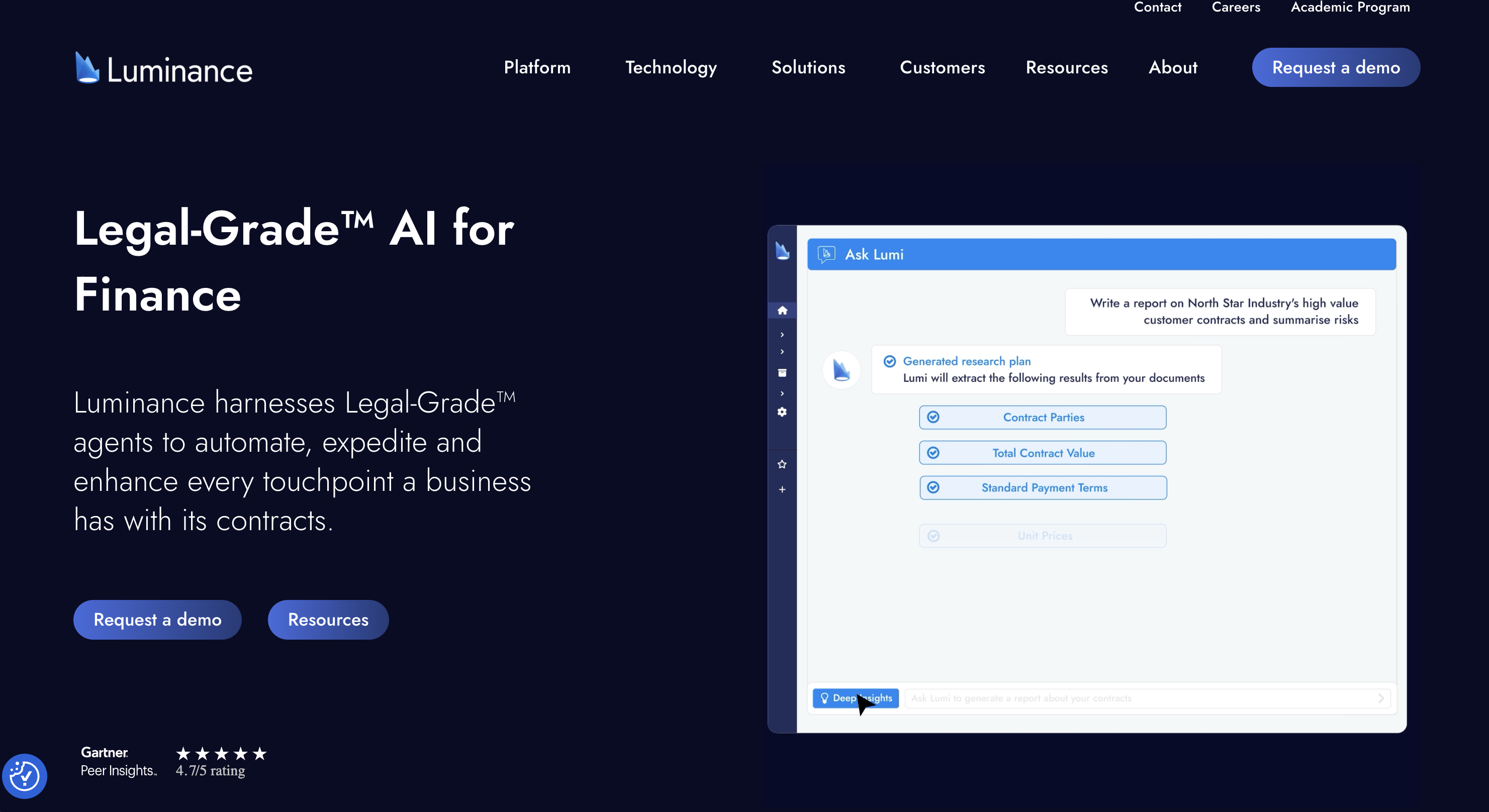
The pitch is a first-pass AI reviewer that reads any contract, flags risk against your positions, and increasingly acts on it. Its "Ask Lumi" assistant answers questions and builds extraction plans across a document set, as the product screenshot above shows: pulling contract parties, total contract value, and payment terms out of a stack of agreements.
The product is real and well regarded by enterprise buyers. The only question this review answers is whether it fits an in-house team, or whether you are buying enterprise weight you will not use.
What it does well
Autonomous NDA negotiation. This is the genuinely novel part. Luminance positions the agent as able to negotiate a standard NDA end to end, sending and responding to redlines against your playbook without a lawyer driving each turn. In its own announcement, Luminance says the system reads and analyzes the contract, remediates risk, sends revised drafts to the counterparty, tracks responses, and reacts in real time to the counterparty's AI, and that NDAs make up over 15% of enterprise contracts. When Legal Dive covered the original demo, two laptops ran four rounds of back-and-forth in minutes, with human lawyers keeping final review before signing. For a company that fields a high volume of inbound NDAs, that is real leverage.
Due diligence at scale. Luminance's roots are in reading large document sets fast for M&A and diligence, surfacing anomalies and outlier clauses across hundreds or thousands of contracts. High-volume review is where the platform is strongest.
Enterprise fit. Security posture, integrations with document management systems, and configurable playbooks are built for large legal departments and the procurement reviews they run.
Where the autonomy needs a human in the loop
Autonomous negotiation is the reason Luminance is on your shortlist, so it deserves sharper judgment than "AI negotiates NDAs, neat." The honest read: on standard mutual NDA paper, letting the agent settle the small stuff is fine. On anything that touches your risk tail, it should propose and then stop for review.
Safe to let the agent handle on its own, against a well-built playbook:
- Term length and survival within a range you pre-approve (for example, three to five years, survival of confidentiality obligations for a set period).
- Definition of Confidential Information where the counterparty's language is close to your standard.
- Boilerplate like notices, counterparts, and mutual-vs-one-way framing that matches your template.
- Return-or-destroy language that mirrors your gold standard.
Route to a human before anything goes back out when the redline touches:
- Non-standard confidentiality periods, especially perpetual survival or an unusually short term that guts protection.
- Residuals clauses. A broad residuals carve-out can quietly swallow the whole NDA; this is a judgment call, not a playbook match.
- Affiliates and definition of the receiving party. Extending the deal to undefined affiliates changes who is bound and who can sue.
- Injunctive relief and remedies, including any waiver of the need to post a bond.
- Export-control and sanctions language, where getting it wrong is a compliance problem, not a drafting preference.
- Data-security and privacy addenda bolted onto the NDA, which pull in obligations your infosec and privacy teams own.
- Governing law and venue mismatches, and any carve-out to arbitration.
The point is not that the agent is untrustworthy. It is that an NDA looks routine right up until a residuals clause or an affiliate definition turns it into a real exposure, and those are exactly the spots where a fast, confident autonomous reply is the wrong move. Configure the playbook so those clauses are hard stops, not auto-accepts.
Pricing reality
Luminance does not publish pricing. It is quote-only, and every deal is custom, scoped by user count, document volume, and which modules you buy. One third-party breakdown from Bind pegs a first-year enterprise deployment in the low-to-mid six figures a year for a mid-size rollout, with a 20-person legal team paying meaningfully less than a 100-person, multi-department one. Treat that as a reported estimate, not a rate card.
Expect the usual enterprise levers to matter: multi-year commitment, seat count, reference-customer willingness, and whether you bring a competing quote. Add implementation on top of the license, since an enterprise rollout is not free to stand up. For how this compares across the category, see the legal AI pricing benchmark.
What deployment actually looks like
"Weeks to months" is easy to write and easy to underestimate. Here is the shape of a real Luminance rollout for an in-house team, so you can price the internal time, not just the license.
Week 1: scoping and access. Kickoff with the vendor, decide which modules you are actually turning on, and identify the pilot group. Your infosec and IT teams start the security review: data residency, retention, sub-processors, SSO, and whether the tool can connect to your document management system. Nothing useful ships this week; you are lining up approvals.
Weeks 2 to 4: configuration. This is the real work. Playbook workshops translate your positions into the rules the AI enforces, clause by clause. You map your clause library and gold-standard templates so the redlining reflects your paper, not a generic default. The DMS integration gets built and tested. Your negotiation-policy owners sign off on what the autonomous agent is allowed to accept versus escalate (the hard stops from the section above live here). Pilot users get trained, because a first-pass AI reviewer is only as good as the reviewers reading its flags.
After go-live: adoption and tuning. The agent's redlines will be wrong in places early on; someone has to catch the misses and feed corrections back into the playbook. Expect a few tuning cycles before the team trusts the output enough to lean on it. Usage tends to lag the contract until champions show the rest of the team the time savings on a real matter. Budget for a legal-ops owner to run this, because a platform this deep does not self-serve.
For a 100-lawyer department with a legal-ops function, all of this is normal. For a team of one to five, it is a project with no obvious owner, which is the core mismatch this review keeps coming back to.
Where it falls short for in-house teams
Quote-only, enterprise pricing. A in-house team that wants to read a price, swipe a card, and start cannot. The buying motion is a demo and a sales cycle, and the floor is an enterprise number.
Deployment is a project. See the rollout map above. That work is fine for a department with a legal-ops function, and heavy for a team of one to five.
Depth you may not use. The diligence-at-scale and autonomous-negotiation muscle pays back at high volume. A small department doing everyday NDAs, vendor MSAs, and compliance checks is paying for capacity it will not fill.
Luminance review verdict: who should buy it
Buy Luminance if you run a large legal department or enterprise with real M&A diligence, high contract throughput, a document-management system to integrate, and procurement to drive an enterprise quote and a multi-week rollout.
Look elsewhere if you are a solo GC, a in-house team, or a small firm that wants transparent self-serve pricing, same-day setup, and everyday contract review, drafting, and matter management without an enterprise contract.
A rough break-even to sanity-check yourself: the autonomous-negotiation math starts to pay when you are fielding NDAs at a volume a person cannot keep up with, call it a few hundred a year or more, and the diligence engine pays when you are running real M&A deal review, not occasional vendor contracts. If your NDA flow is a handful a week and your diligence is an occasional renewal review, the volume will not reach the break-even. Under those numbers, the license plus the internal rollout hours rarely earns back against a lighter tool.
Where a lighter tool fits instead
If your week is inbound NDAs, vendor MSAs, first-pass contract review, compliance checks, and keeping matter documents organized, the self-serve workbench segment covers that load without a sales cycle: published per-seat pricing, a free trial, and same-day setup. That shape suits solo GCs and in-house teams that buy without procurement.
The honest tradeoff runs the other way too. For autonomous, high-volume M&A diligence across thousands of documents, or an agent that negotiates NDAs end to end, an enterprise platform like Luminance has more depth. Match the tool to the work: for everyday in-house volume, the enterprise seat is capacity you pay for and rarely fill. For a fuller list, see the best legal AI tools for in-house counsel.
FAQ
What does Luminance do? Luminance is an enterprise AI platform for contract review, due diligence, negotiation, and management. It reads contracts, flags risk against your positions, extracts key terms across large document sets, and, through its autonomous negotiation feature, can negotiate a standard NDA end to end.
How much does Luminance cost? Luminance does not publish pricing; it is quote-only. A third-party breakdown pegs a first-year enterprise deployment in the low-to-mid six figures a year for a mid-size rollout, scaled by user count, document volume, and modules. Expect a demo and a sales cycle rather than a self-serve price.
Is Luminance worth it? For large departments with high contract volume and real diligence work, yes: the diligence depth and autonomous negotiation are strong, and the platform is aimed squarely at that buyer. For in-house teams, the enterprise price and multi-week deployment usually outweigh the depth you would use.
What is Luminance Autopilot? Autopilot was the original name for Luminance's autonomous NDA negotiation agent, now branded Autonomous Negotiation. Luminance markets it as able to negotiate a standard NDA end to end, sending and responding to redlines against your playbook without a lawyer driving each round. On non-standard clauses like residuals, affiliates, or injunctive relief, keep a human in the loop.
What are the best Luminance alternatives? For high-volume tabular review, Legora. For Word-native contract work, Spellbook. For enterprise research and drafting, Harvey or CoCounsel. For solo GCs and in-house teams that want self-serve pricing and everyday contract, compliance, and matter work, a lighter suite priced per seat is usually the better first buy.
Is Luminance good for small firms or solo GCs? Generally no. The quote-only enterprise pricing and weeks-to-months deployment fit large departments, not solo or small teams. A self-serve tool sized for that segment is usually the better first buy.
For more, see the best legal AI tools for in-house counsel and the best AI contract review tools compared.
New legal AI guides, weekly.
Further Reading
7 Best Luminance Alternatives for In-House Teams (2026)
Read postCoCounsel Review 2026: An Honest Assessment for In-House Counsel
Read postLegora Review: Who It's For, What It Costs, and Where It Falls Short
Read postBloomberg Law AI Review 2026: An Honest Assessment for Transactional and Litigation Teams
Read postGC AI Review 2026: An Honest Assessment for In-House Counsel
Read postHarvey AI Review 2026: Honest Take + What It Really Costs
Read post
Co-Founder & CEO · Attorney
Arshita leads product and strategy at Vaquill AI, the US primary law data API. As an attorney, she decides which law we carry, how each section is sourced and cited, and what legal AI and compliance teams need from the data.