Spellbook is the top AI tool for contract drafting and review inside Microsoft Word in 2026. It is built for one team: in-house and deal lawyers who live in Word all week. It does Word-native redlines, playbook deviation checks, and clause-level market data well.
It is a poor fit if you need deep research, a document matrix, citation checks, matter management, or an API. Buy it for contracts in Word. Look elsewhere for a full research suite. The full review follows.
Do you draft or review contracts in Microsoft Word for a living? Then someone in your network has already pitched you Spellbook. The Toronto company spent four years answering one question: what does contract AI look like if you refuse to leave Word?
The bet is well funded. In October 2025 Spellbook closed a $50M Series B led by Khosla Ventures (BusinessWire, Oct 2025; also reported by BetaKit and Artificial Lawyer). In March 2026 it added a $40M RBCx debt facility for acquisitions.
Spellbook says it serves 4,500-plus in-house teams and law firms in 80-plus countries, and it signed an exclusive Canadian Bar Association deal in March 2026. These are vendor numbers, not audited ones. Still, the logos and the funding pace point the same way.
The buyer's question is narrower than the funding makes it look. Spellbook fits one shape of legal team. The rest of this post tells you which one.
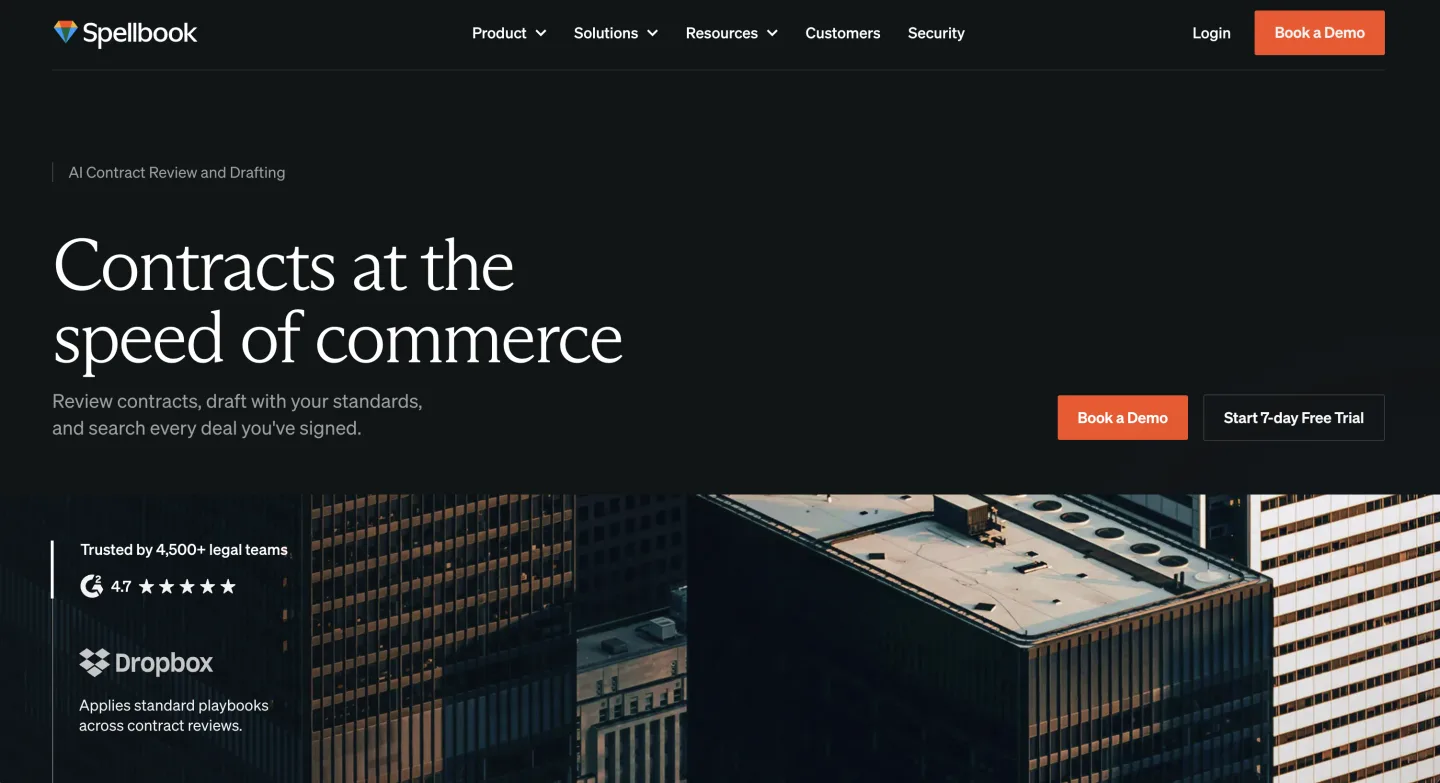
At a glance
| Spellbook | |
|---|---|
| Price | Not published; quote-based. Buyer reports put the base around $500/user/mo, quote-gated, with a reported 6-month minimum term (Bind, May 2026) |
| Access | Sales-led, demo required |
| Best for | Deal counsel and small-to-mid in-house contract teams in Word |
| Free trial | 7 days (longer for bigger teams) |
| Word-native | Yes, the best Word add-in for contract review |
| Trains on your data | Playbooks encode your clause standards |
Rated about 4.1 out of 5 by Lawyerist (accessed Jun 2026).
TL;DR
- Spellbook is the top AI tool for in-Word contract drafting and review in 2026. When the work is contracts and it happens in Word, the tool is polished and clearly ahead on fit.
- Where it wins: Word-native feel, AI redlines on track changes, playbook deviation checks, and clause-level market data from the 2026 State of Contracts set (hundreds of thousands of contracts, 30 countries, 270-plus benchmarks).
- Where it has gaps: research past contracts, a public API, multi-doc matrix work, citation checks, and matter management. Spellbook has not built any of these.
- Who should buy: deal counsel and small-to-mid in-house contract teams who live in Word.
- Who should look elsewhere: research teams, cross-border lawyers, teams that need a matrix or matter management, and devs who need an API.
Part of our legal AI vendor comparison and pricing series.
What is Spellbook best at, and where does it have gaps?
What Spellbook actually is
Spellbook is an AI add-in that lives inside Microsoft Word. Install it, sign in, and a side panel opens next to the document. Highlight a clause, and the panel suggests a redline.
Ask for a missing indemnity, and it drafts one. Ask how a clause compares to most SaaS MSAs, and it pulls benchmarks from a large contract dataset. You never have to leave Word.
The hardest part of legal AI uptake is workflow, not model quality. Picture a senior associate reviewing a vendor agreement at 4 PM. They will not copy a clause into a browser tab, ask a question, then paste the answer into a Word comment. And they will not do that forty more times in an hour.
Spellbook's bet, held since 2022, was simple. Contract AI belongs where lawyers already redline. Most rivals have since agreed and shipped their own Word panels.
Spellbook started in 2018 as Rally. It moved to GPT-era contract review in 2022 to 2023 and rebranded. Scott Stevenson is CEO. The product team sits in Canada. The customers are global, with the U.S. as the biggest market. Under the panel it runs on frontier models, and Spellbook cites GPT-5 and Claude, swapped as they improve (spellbook.com, accessed Jul 2026).
The product is five surfaces, all inside the Word panel:
| Surface | What it does |
|---|---|
| Review | AI redlines and risk flags on Word's native Track Changes |
| Draft | Generates clauses from your precedents (Smart Clause Drafting) |
| Ask | Q&A on the open contract, with citations to specific provisions |
| Compare to Market | Benchmarks a clause against the State of Contracts dataset by sector, jurisdiction, and deal type |
| Associate | Multi-document agent for transactional work: data-room review, financing docs, disclosure schedules |
Source: spellbook.com feature pages (accessed Jul 2026).
What users actually say
Among deal lawyers, Spellbook is the best-liked AI tool in this space, and the Word add-in gets praise. Lawyerist rates it about 4.1 out of 5.
The gripes are steady. It still inserts wrong citations now and then. It is built for deals and weak for litigation. And it does not publish a price.
So fans and critics agree on the same line. Great inside a contract in Word, thin everywhere else.
A typical Spellbook session
A real test week tends to go like this. Day one: a partner installs the add-in and watches Spellbook clear a stock NDA in under a minute. The reaction is usually "fine, but show me the messy paper."
Day two: load a 47-page vendor MSA and hit "review." Spellbook walks the doc section by section. It flags clauses against your uploaded playbook, or against generic market practice if you skipped that step.
Flags come back as Word comments in the existing thread, plus tracked-change suggestions you accept or reject. The suggestions stay safe. Spellbook nudges a $1M cap toward your standard $2M instead of rewriting the whole liability section on its own. That is the right posture for a tool a GC has to sign off on.
Halfway through, the indemnification is missing a third-party-claim carve-out. Highlight it, type "add a third-party IP indemnity with mutual carve-outs for gross negligence and willful misconduct," and Spellbook drafts the clause in the style of the surrounding text.
You get maybe 80% of what you would have written in eight minutes, back in ten seconds. Accept it, tighten three phrases, move on.
What surprises lawyers in week one is usually not the AI quality. It is how much friction goes away. Context switches between Word, browser, and clipboard drop to near zero.
What breaks is also predictable. Anything outside the playbook will trip it up. An exotic license-grant clause, an odd data-residency carve-out, or a clause the model has not seen will get a suggestion that looks confident and is subtly wrong.
Say you hit a liability cap that feels aggressive. Click "compare to market." Spellbook returns a distribution: in vendor MSAs of this size, caps cluster around fees paid in the prior 12 months, with a long tail at 2x or 3x for higher-value deals.
The data comes from the 2026 State of Contracts corpus (hundreds of thousands of contracts, 30 countries, 13 agreement types, 270-plus clause benchmarks). Ten seconds, with real data behind the answer. More than any other feature, this one earns the price tag.
For longer jobs, like "draft a one-way NDA, governing law New York, two-year survival," you reach for Spellbook Associate. That is the agent surface that produces a full first draft from a prompt. It is the newest layer and the most likely to keep changing.
Spellbook has wisely not tried to be a generalist research tool. It is not where you go to brief a dispute, run a citator, or read state code. The company is clear about that scope.
Spellbook pricing: what it actually costs
Spellbook does not publish per-seat pricing. The pricing page says "custom pricing for modern legal teams" and "pricing is determined by the number of team members on a license," then routes you to a demo (spellbook.com/pricing, accessed Jun 2026). There is a seven-day free trial, longer for bigger teams, and academic institutions can ask for free access. Everything past that is a sales-set quote tied to seat count and feature set.
So what does a seat actually cost? Spellbook does not publish a per-seat price, so every figure is a third-party estimate or a buyer report. Buyer accounts put the base around $500 per user a month, quote-gated and almost always on an annual commitment, with monthly billing reportedly adding about 20% (Bind, May 2026). Lower tiered estimates circulate on some trackers, but they conflict with each other and with buyer accounts, so we treat them as unverified. Older $20 to $40 listings are leftovers from Spellbook's Rally-era plans and no longer reflect the product. Plan for roughly $500 per seat, get the number for your exact seat count in writing, and expect enterprise quotes to run higher.
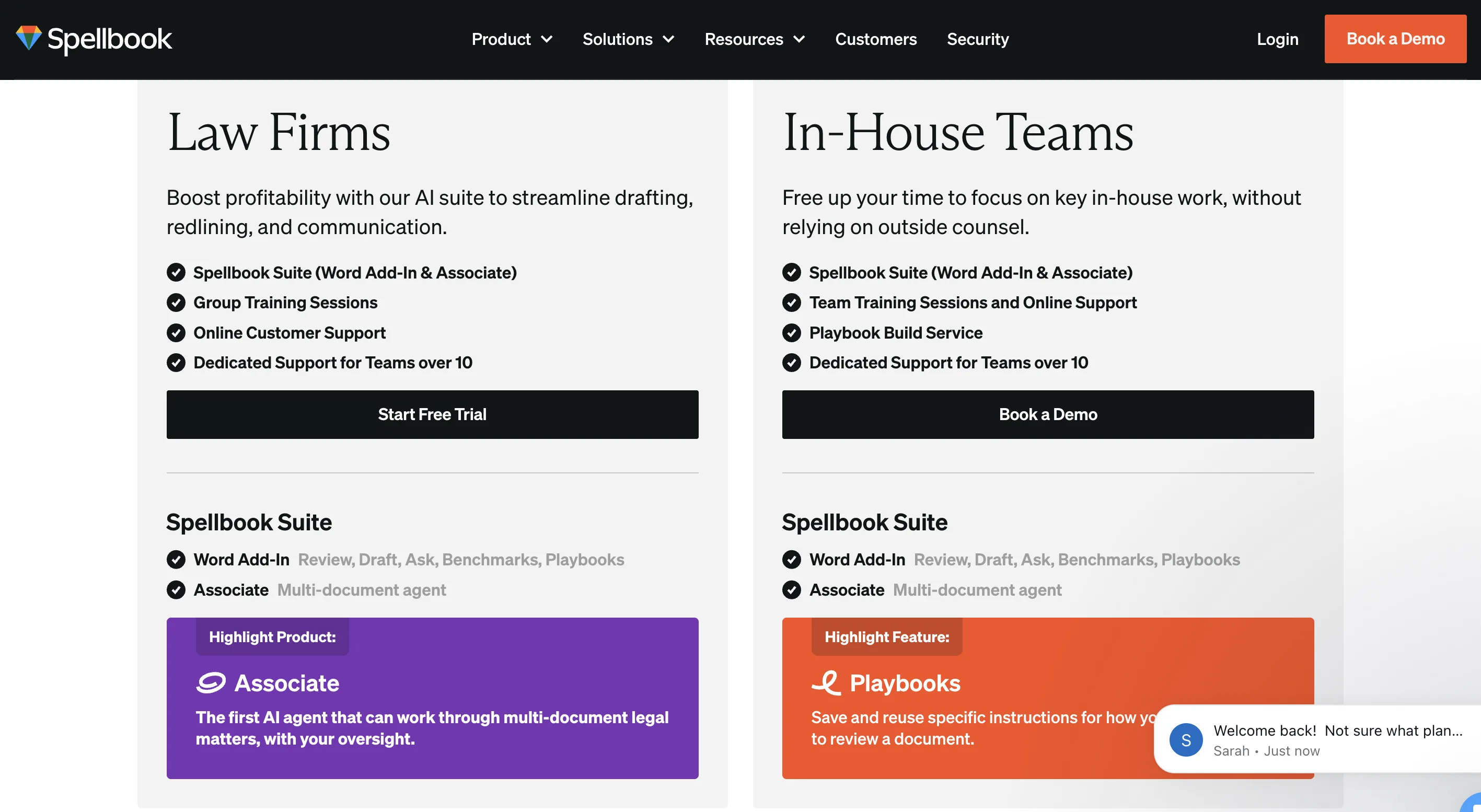
Watch the 6-month minimum. Multiple 2026 pricing teardowns report that Spellbook now carries a six-month minimum commitment, so even a pilot locks in roughly half a year of spend (Bind, May 2026; Hyperstart, May 2026). Spellbook does not state the term on its own page, so confirm it in writing during the demo.
Decision rule: say Spellbook saves each lawyer two hours a week on contract work. That is a conservative claim given the compare-to-market feature alone. If your blended internal cost is at least $150 an hour, the tool pays for itself at one seat in a month.
Below that line, the math gets thin. Junior reviewers at discounted internal rates, or teams running Spellbook on fewer than five contracts a month, will feel it. Break-even is about volume, not seat count.
Three procurement notes. First, no published price is normal here. Harvey, Legora, and CoCounsel all do the same, which reflects a sales-led motion in mid-market legal. A solo comparing Spellbook to credit-card sign-up tools should expect more friction.
Second, seven days is short for the work that matters: building a playbook against your own templates. Ask in the demo for an extended trial that covers a real playbook build, and clarity on the minimum term.
Third, buyers underrate the playbook authoring. It is what makes deviation checks reflect your team's standards, and the same discipline pays off no matter which tool you pick (see our in-house contract review playbook). Budget two to four weeks of senior lawyer time. Skip it and the tool falls back to generic market practice, and you leave half the value on the table.
Where Spellbook clearly wins
Four places, named plainly.
1. The Word integration is the best on the market for contract work. Track Changes is native, the panel does not fight the document, comments thread into Word's comment system, and there is no copy-paste tax.
Compare the other Word panels. BlackBoiler is strong on automated redlines against templates but weaker on the conversational side. ContractPodAI is a CLM with a secondary Word panel. Litera does drafting hygiene and comparison, not AI review.
Spellbook wins the specific job of AI-assisted redline review of inbound third-party paper. That edge vanishes the moment you need surfaces outside Word.
2. Clause-level market comparison is a real, underrated wedge. The State of Contracts dataset is a meaningful corpus, built from customers via a give-to-get model. The closest peer datasets sit inside CLM products like Ironclad and Sirion.
Those are locked inside CLM workflows that outside counsel rarely touch, and they index the buyer's own contracts rather than a market cross-section. Harvey and CoCounsel pull from public filings and trained corpora but do not surface clause-level distribution data.
For "where does this clause sit on the curve," Spellbook is the best answer in mid-2026. That edge weakens for agreement types the dataset under-represents, like regulated finance, healthcare clauses, and non-English jurisdictions.
3. Adoption among small and mid-size transactional teams is real. The 4,500-plus figure is plausible given public logos, funding traction, and the Canadian Bar Association deal. Spellbook did the unglamorous work of selling to three-to-fifteen-lawyer in-house teams, and the product reflects that buyer's workflow.
4. The annual State of Contracts report is a serious content asset. Released in December 2025, it analyzed hundreds of thousands of contracts across 30 countries. It found a near-50% jump in tariff-related contract mentions between June and October 2025. It tracked the rise of "AI Usage Policy" as a standalone clause type in software deals.
It also showed split dispute defaults. IP agreements lean 80% litigation. MSAs lean 68% litigation. SaaS contracts split three ways: 39% litigation, 43% mediation, and 46% with no binding mechanism named. This is a benchmark dataset contract lawyers can cite, not a thin trends PDF.
Where Spellbook has gaps
This is the part the marketing pages will never tell you. Each gap below is a category Spellbook chose not to build. Whether it matters depends on your work.
Research past contracts is shallow. Spellbook is built for contract drafting and review. If you also need to research a case, pull a current statute section, run a citation graph, or build a brief, this is not the tool. Contract teams who also do litigation or regulatory work will run Spellbook plus a research suite.
No public API. As of mid-2026, Spellbook has no public API. For most contract lawyers that does not matter.
For legal-ops teams wiring intake into a broader stack, in-house teams building an internal copilot, or developers building agentic workflows, it is a hard limit. The gap with API-first tools and the MCP integration plane for legal AI keeps getting starker.
Multi-document matrix work is not the wedge. Spellbook's strength is one document at a time inside Word. The "load 80 NDAs and tell me which three deviate" job, the document matrix surface legal AI is moving toward, is not where Spellbook competes.
Legora and CoCounsel built around the tabular review grid. Spellbook built around the Word panel. A buyer triaging stacks needs the grid.
Citation checks across case law and statutes are out of scope. Contract drafting rarely turns on case-law checks. When it does, like a force majeure clause citing Kel Kim Corp. v. Central Markets, Inc., 70 N.Y.2d 900 (1987), or an indemnity carve-out tracing to specific state-law authority, Spellbook will not verify those citations.
The 2023 Mata v. Avianca sanctions made citation checking table stakes for any product drafting legal text near case law. Buyers who need pleading-level drafting need a different tool.
No matter management. No matter folder, no matter-scoped chat, no place to file the email thread next to the draft next to the redline next to the closing checklist. Teams that want the matter as the unit of work need a different category. That is the all-in-one workbench shape Clio and vLex are building after their March 2026 combination.
Should you buy Spellbook? A decision path
Who should buy Spellbook
Buy Spellbook if you are a transactional lawyer or deal counsel whose week is mostly Word and mostly contracts. Buy it if you run a three-to-twenty-lawyer in-house contract team and want one AI surface for drafting and review without a full CLM. Buy it if compare-to-market would turn hours of "is this market" debate into seconds.
The buyer who gets the most value: senior in-house counsel at a Series B to Series D company, five to twelve reports, 200 to 800 contracts a quarter.
Who should look elsewhere
Skip Spellbook if your main problem is research, not contract review. Using it as a research tool will frustrate everyone.
Skip it if you work across non-U.S. contract regimes where the comparison data is thinner. The 30-country dataset is broad but uneven, and compare-to-market loses value outside well-covered jurisdictions.
Skip it if your core need is matrix review across stacks of similar documents. Look at tools whose main view is the grid, not the side panel.
Skip it if you are an engineer building an internal copilot or a legal-ops leader wiring AI into a programmatic workflow. With no API, Spellbook is a destination, not a building block.
Skip it if you need matter management. A contract surface bolted onto a workbench is not the same as a workbench with a contract surface built in.
The honest verdict
A bounded judgment, not a marketing line. For the specific job of AI-assisted redline review of inbound third-party contracts inside Microsoft Word, Spellbook is the workflow leader in mid-2026.
The Word-native surface is a real wedge. Compare-to-market is a real differentiator. The State of Contracts dataset is a real asset. The funding supports more iteration.
Outside that job, the leadership claim does not carry over.
One line per buyer type:
- Transactional law firm partner, three-to-twenty lawyers: buy it, budget four weeks of playbook work upfront.
- In-house GC at a Series B to D company: buy it if you have at least three reviewers and 50-plus contracts a quarter.
- Litigator or regulatory practitioner: skip it, the product is not built for your work.
- Multi-jurisdiction dealmaker outside the major English-language markets: check the comparison data for your jurisdictions before committing.
- Legal-ops or platform engineer: wait for an API or build around a different tool.
- Solo with low contract volume: the math does not work, use a cheaper tool.
For more vendor comparisons, see /topics/vendor-comparisons.
FAQ
How much does Spellbook cost?
Spellbook does not publish per-seat pricing; the page says "custom pricing" and routes you to a demo. Buyer reports put the base around $500 per user a month, quote-gated and usually on an annual commitment, with a reported 6-month minimum term (Bind, May 2026). Lower tracker estimates circulate but conflict and stay unverified. There is a seven-day free trial, longer for bigger teams, and academic institutions can request free access. Older $20 to $40 listings are from its Rally-era plans and no longer reflect the price.
Does Spellbook have a minimum contract or commitment?
Yes. Several 2026 pricing teardowns report a six-month minimum commitment, so even a pilot ties up roughly half a year of spend (Bind, May 2026; Hyperstart, May 2026). Spellbook does not state the term on its own pricing page, so get the minimum and any auto-renewal clause confirmed in writing before you sign.
Is Spellbook secure and SOC 2 compliant?
Spellbook states it is SOC 2 Type II certified and adds HIPAA, GDPR, and EU AI Act compliance, with Zero Data Retention agreements so your documents are not used to train its models (spellbook.com, accessed Jul 2026). It encrypts data in transit and at rest. For regulated work, ask in the demo for the current report and the data-processing terms, and confirm where your contracts are stored and for how long.
Is Spellbook worth it?
For a contract lawyer who lives in Word, usually yes. If Spellbook saves each reviewer two hours a week and your blended internal cost is at least $150 an hour, the seat pays for itself in a month.
Below that, or under roughly five contracts a month, the math gets thin. Break-even is about volume, not seat count.
Does Spellbook hallucinate or insert wrong citations?
It can. Lawyerist, which rates it about 4.1 out of 5, notes it still inserts wrong citations now and then, and clauses outside your playbook can come back confident and subtly wrong.
Spellbook does not run a citator across case law, so pleading-level citation checks are out of scope and human review still matters most on unfamiliar paper.
Is Spellbook good for solos or small firms?
It fits three-to-twenty-lawyer transactional and in-house teams well. A solo with low contract volume will struggle to hit break-even at a reported ~$500 seat plus a six-month minimum, and should use a cheaper tool.
Does Spellbook have a free trial?
Yes, seven days, longer for bigger teams. Seven days is short for the work that matters most, building a playbook against your own templates. Ask in the demo for an extended trial that covers a real playbook build.
What are the best Spellbook alternatives?
For tabular matrix review across stacks of documents, Legora or CoCounsel. For enterprise breadth, Harvey. For research, drafting, and matter management in one workbench at a lower price, the self-serve suite tier. We break the field down in the best Spellbook alternatives.
Spellbook vs Harvey: which is better?
Spellbook is Word-native by design and ahead on inline tracked-change polish and clause-level market comparison. Harvey is broader and heavier, with deeper M&A diligence and cross-border research, at a higher price. For a 5 to 30-lawyer transactional team, Spellbook usually wins on fit and price; for AmLaw-scale work, Harvey.
Spellbook vs Gavel Exec: which is better for contract review?
Both review contracts, but they aim differently. Spellbook is the broader Word-native suite with the compare-to-market dataset. Gavel Exec is the narrower redline specialist; users on Reddit praise its "surgical" suggestions that do not turn the whole document red (r/legaltechAI, accessed Jun 2026). If clause-level market data matters, Spellbook; if you want tight redlines and faster setup, try Gavel Exec.
Does Spellbook integrate with practice management software?
No. Spellbook lives inside Microsoft Word and does not connect to practice-management or matter-management systems, and it has no public API as of mid-2026. Teams that want the matter as the unit of work, with the draft, redline, and email thread in one place, need a workbench rather than a Word add-in.
New legal AI guides, weekly.
Further Reading
Luminance Review 2026: An Honest Assessment for In-House Counsel
Read postCoCounsel Review 2026: An Honest Assessment for In-House Counsel
Read postLegora Review: Who It's For, What It Costs, and Where It Falls Short
Read postBloomberg Law AI Review 2026: An Honest Assessment for Transactional and Litigation Teams
Read postGC AI Review 2026: An Honest Assessment for In-House Counsel
Read postHarvey AI Review 2026: Honest Take + What It Really Costs
Read post
Co-Founder & CEO · Attorney
Arshita leads product and strategy at Vaquill, building the legal AI suite that solo, small-firm, and in-house US lawyers use to run a matter end to end.