The honest headline for 2026 is that legal AI adoption roughly doubled in a year, but proven savings lag the hype. Roughly half of in-house teams now use generative AI, hours-saved estimates run high, and the best legal research tools still get facts wrong a meaningful share of the time. Those three facts sit in tension, and that tension is the real story.
This page collects the legal AI statistics worth knowing, each with a named report and a year. Every number below is third-party. We invented none of it. Where the sources disagree, or where a figure rests on self-report, we say so in plain language.
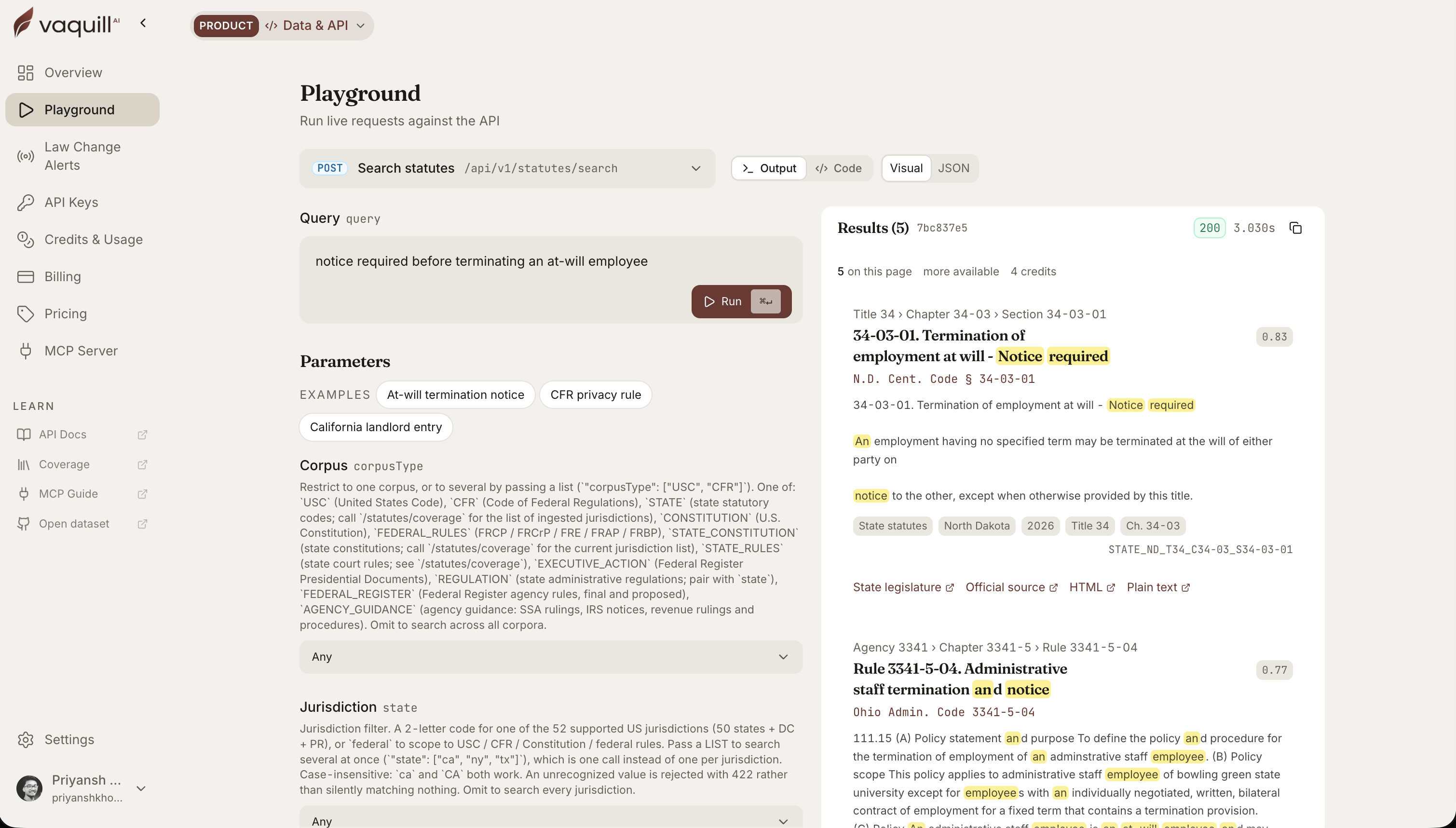 The same corpus behind this article, queried live. Every result carries its citation and a link to the official source.
TL;DR
- In-house adoption doubled. Generative AI use in corporate law departments rose from 23% in 2024 to 52% in 2025 (ACC and Everlaw, Generative AI's Growing Strategic Value for Corporate Law Departments, October 2025).
- Law firm adoption sits lower. 30% of lawyers reported using AI, ranging from 18% at solo firms to 46% at firms of 100-plus attorneys (ABA, 2024 Legal Technology Survey Report, released March 2025).
- The time-savings claim is large. AI could free up 12 hours per week per professional by 2029, and 4 hours per week within a year (Thomson Reuters, Future of Professionals, 2024).
- Spend is still small and poorly tracked. 26% of in-house teams spend under $100 a month on AI, and 44% do not know their AI spend at all (Counselwell and Spellbook, AI in Legal Departments: 2025 Benchmarking Report).
- Accuracy is the open problem. Leading legal research AI tools hallucinated between 17% and 33% of the time in a Stanford study (Magesh et al., Journal of Empirical Legal Studies, 2025).
- The economic ceiling is high, not proven. Generative AI could automate about 44% of legal work tasks (Goldman Sachs, 2023 estimate), but that is a modeled exposure figure, not measured output.
In the Stanford study cited here, how often did leading legal research AI tools from LexisNexis and Thomson Reuters hallucinate?
Part of our legal AI vendor comparison and pricing series.
Legal AI statistics 2026: what the numbers actually say
Strip out the marketing and three things are clear.
First, adoption is real and fast. The year-over-year jumps are not rounding errors. They show up across the ACC, ABA, Thomson Reuters, Clio, and Wolters Kluwer surveys, all measuring different populations and all pointing up.
Second, value is mostly projected, not banked. Most big savings numbers are predictions ("by 2029") or self-reported confidence, not audited results. Only 7% of in-house teams track AI with specific KPIs, so most departments cannot yet prove their own ROI.
Third, accuracy still gates trust. The same tools sold as research assistants get cites and holdings wrong often enough that human review stays mandatory. That single fact explains why adoption and proven savings have not converged.
Which of these numbers can you trust?
Before the section-by-section breakdown, here is every headline stat ranked by how much weight it can bear. Measured beats self-reported beats forecast, and academic or association sources beat vendor-sponsored ones.
| Stat | Type | Population / sample | Source type | Weight it bears |
|---|---|---|---|---|
| Research tools hallucinate 17% to 33% | Measured | Leading tools, fixed test set | Academic, peer-reviewed (Stanford) | High. The most rigorous number here. |
| Only 7% of teams track AI with KPIs | Self-reported | In-house departments | Survey | High for context. It is why every savings number is soft. |
| 23% of in-house use AI daily | Self-reported | US in-house lawyers | Independent (Bloomberg Law) | Medium-high. Legal-specific, measures depth not just trial. |
| In-house GenAI use 52%, up from 23% | Self-reported | 657 in-house counsel, 30 countries | Association + vendor (ACC, Everlaw) | Medium-high. Big sample, clear trend. |
| 42% of enterprises abandoned most AI | Self-reported | ~1,000 IT and business leaders | Independent (S&P Global) | Medium. Strong, but enterprise-wide, not legal. |
| AI frees 12 hours per week by 2029 | Forecast | Professionals across services | Vendor (Thomson Reuters) | Low. A projection, not a result. |
The single most reliable number is the hallucination rate, because it was measured on a fixed test set by an academic team, not self-reported in a vendor survey. The least reliable are the forward-looking hours-saved figures. Weight your decisions accordingly.
Adoption and usage
Adoption is the most surveyed number in legal AI, and it climbed across every source we checked.
| Population | Adoption stat | Source (year) |
|---|---|---|
| Corporate law departments | 52% using GenAI, up from 23% in 2024 | ACC and Everlaw (2025) |
| Lawyers (all firm sizes) | 30% using AI | ABA Legal Technology Survey (2024) |
| Solo firms | 18% using AI | ABA Legal Technology Survey (2024) |
| Firms of 100-plus attorneys | 46% using AI | ABA Legal Technology Survey (2024) |
| Legal professionals (use weekly) | 76% in corporate legal, 68% in firms | Wolters Kluwer Future Ready Lawyer (2024) |
| Professionals (GenAI central within 5 years) | 95% of corporate professionals | Thomson Reuters Future of Professionals (2025) |
What this means for an in-house team: you are now in the majority if you use AI, and behind the curve if you do not. The gap between corporate legal (52%) and solo firms (18%) is the real signal. In-house teams adopt faster because they own their budget and feel the cost pressure directly.
Where the stat is shaky: "using AI" has no fixed definition across these surveys. One counts anyone who tried a chatbot once. Another counts weekly active use. The Wolters Kluwer 76% measures weekly use among legal professionals in corporate departments, a narrower and stricter bar than the ACC 52%. Read each number against its own definition, not against the others.
Adoption is wide, but shallow
The headline adoption numbers hide how thin daily use really is, and how many AI projects get scrapped before they stick. Wide adoption and deep adoption are not the same milestone.
| Signal | Number | Source (year) |
|---|---|---|
| Lawyers using AI vs using it daily | 83% use AI, but only 23% of in-house lawyers use it daily, and 27% have not touched it in six months | Bloomberg Law, State of Practice (2026) |
| Enterprises that abandoned most AI initiatives | 42%, up from 17% a year earlier, with 46% of projects scrapped between proof of concept and rollout | S&P Global, Voice of the Enterprise: AI (2025) |
What this means for an in-house team: buying AI and using AI are different events. The most common way legal AI fails is quiet, a tool that clears procurement and then never enters the weekly workflow, not a dramatic cancellation. When you evaluate, track whether people still open it in week two, not whether they liked the demo.
Where the stat is shaky: the S&P Global 42% is enterprise-wide across every industry, not legal-only, so read it as the budget-scrutiny backdrop legal buyers now sit inside, not a legal figure. The Bloomberg daily-use numbers are legal and in-house-specific.
In-house vs law firm
In-house teams have moved faster than firms, and the surveys agree on direction even when the exact figures differ.
The ACC and Everlaw report put corporate law department GenAI use at 52% in 2025. The ABA pegged all-lawyer AI use at 30% for 2024. Wolters Kluwer found 76% of corporate legal professionals use GenAI at least weekly versus 68% at firms. Different questions, same lean: the client side is ahead of the firm side.
The reason is structural. In-house leaders frame AI as a way to cut outside-counsel spend. In the ACC data, 64% of respondents expect GenAI to reduce reliance on law firms over time.
What this means for an in-house team: the productivity case is strongest where you already feel margin pressure, which is contract review, research, and routine drafting. Where it is shaky: the "less reliance on firms" expectation is a forecast, not a result. Nearly 60% of the same ACC respondents reported no noticeable savings yet from outside counsel's AI use, and 58% said firms have not adjusted pricing to reflect efficiency gains.
Spend and budgets
Here the hype meets the budget line, and the budget line is small.
The Counselwell and Spellbook 2025 benchmarking report surveyed 256 in-house legal professionals in North America. It found 26% of departments spend under $100 a month on AI, 9% spend over $2,000 a month, and 44% do not know their AI spend at all.
| Spend tier | Share of in-house teams |
|---|---|
| Under $100/month | 26% |
| Over $2,000/month | 9% |
| Do not know their spend | 44% |
Investment intent runs ahead of current spend. In the Wolters Kluwer survey, 65% of legal professionals expect their organization's AI technology investment to rise over the next three years.
What this means for an in-house team: most departments are still in pilot-budget mode, not platform-budget mode. If you are spending under $100 a month, you are normal. Where it is shaky: the 44% "do not know" figure undercuts every spend number on the page. When almost half of buyers cannot state their own spend, the precise tier percentages are softer than they look. For how those budgets break down per seat, see our legal AI pricing benchmark.
Productivity and time savings
This is the most-cited and least-proven category in legal AI.
The Thomson Reuters Future of Professionals report (2024) projects AI could free up 12 hours per week per professional by 2029, and 4 hours per week within a year. For US lawyers, the firm framed that recovered time as worth roughly $100,000 a year in billable capacity. The 2025 edition found GenAI adoption among legal professionals nearly doubled, rising from 14% in 2024 to 26% as a primary or central tool.
Clio's 2025 Legal Trends Report approaches productivity sideways. It found firms with wide AI adoption are nearly 3x more likely to report revenue growth than non-adopters, and that growing firms are 2x more likely to use automation than stable ones.
What this means for an in-house team: the direction is credible and the mechanism is plausible. Drafting, summarizing, and first-pass research are exactly the tasks AI speeds up. Where it is shaky: the headline hours are projections and the $100,000 figure assumes recovered time converts cleanly to billable or strategic work, which rarely holds in-house. The Clio revenue correlation is also correlation, not cause. Firms that adopt AI may simply be the firms already growing and investing. Treat every hours-saved number as directional, and measure your own.
A worked example: does the math actually pencil out?
The surveys will not run this for you, so here is the calculation on stated assumptions. Treat the per-task times as practitioner estimates, not sourced figures, and swap in your own.
Take a four-lawyer in-house team that reviews 40 inbound contracts a month (NDAs, vendor paper, order forms). Assume a manual first-pass review averages 40 minutes, and an AI-assisted first pass plus human verification averages 20 minutes. That is 20 minutes saved per contract.
- Time saved: 40 contracts times 20 minutes is about 13 hours a month.
- Value at a loaded in-house cost of roughly $120 an hour: about $1,600 a month.
- Cost of a self-serve AI seat for the lawyer doing the reviews: a few hundred dollars a month.
On those assumptions the tool pays for itself in the first week and returns several times its cost. The result depends on two conditions holding: the saved time has to move to higher-value work rather than evaporate, and the output still has to be verified, which is why the example already counts verification inside the 20-minute figure, not a fantasy 5-minute one. Run it with your own contract volume and hourly cost before you sign anything.
Accuracy and hallucination risk
This is the number that should shape how you actually use these tools.
A Stanford RegLab team (Magesh, Surani, Dahl, Suzgun, Manning, and Ho) tested the leading legal research AI tools and published in the Journal of Empirical Legal Studies in 2025. They found the purpose-built tools from LexisNexis (Lexis+ AI) and Thomson Reuters (Westlaw AI-Assisted Research and Ask Practical Law AI) hallucinated between 17% and 33% of the time. The tools beat a general chatbot, but the study concluded that vendor claims of being "hallucination-free" were overstated.
Lawyers feel this risk. In the ABA survey, three-quarters of those hesitant about AI named hallucination concerns as the reason.
What this means for an in-house team: a tool that is wrong one time in five is useful for drafting and triage, and dangerous for any cite you file or any advice you give without checking. Verify every output that leaves your desk. Where it is shaky: the 17% to 33% range is from one study on specific research tools, tested at a point in time, and vendors update models often. The exact rate today may differ. The lesson holds regardless: do not trust unverified legal AI output. For real-world fallout, see our AI hallucination sanctions tracker.
Regulation and ethics
The rules are arriving faster than the consensus on them.
Most US legal AI governance still runs through existing duties of competence, confidentiality, and supervision rather than AI-specific statutes. Courts and bars are adding standing orders and ethics opinions on disclosure and verification. The pattern is uneven by state, not a single federal rulebook.
What this means for an in-house team: your duty to verify AI output is not new. It is the old competence and supervision duty applied to a new tool. Where it is shaky: the state-level rules shift quarterly, so any snapshot ages fast. We track the current state of play in our AI legal regulation by state page rather than freezing a count here that would go stale.
What is coming
The forward-looking numbers are the largest and the softest.
Goldman Sachs estimated in 2023 that generative AI could automate about 44% of legal work tasks, the highest exposure of any sector in its model except administrative work. The same report estimated AI could expose the equivalent of 300 million full-time jobs to automation globally and raise global GDP by about 7% over a decade. McKinsey, in its 2023 generative AI work, put the total annual value of generative AI across the economy at trillions of dollars, with a large share in knowledge work.
What this means for an in-house team: the long-run ceiling for legal automation is high, which is why vendors and investors keep pouring in. Where it is shaky: these are top-down economic models, not measured outcomes. "Exposed to automation" means a task could be assisted by AI, not that it will be, or that quality holds when it is. The 44% legal figure is the most quoted and least tested number in this entire post. Treat it as a ceiling estimate, not a forecast of your next budget cycle.
How we sourced these numbers
Every statistic on this page is third-party, dated, and named. We ran searches across the major report families, fetched the primary source where we could, and checked each cited link in June 2026.
A few honest caveats apply to all of it:
- Definitions drift. "Using AI," "adopted," and "active weekly" mean different things in different surveys. We label the population for each stat so you can compare like with like.
- Self-report dominates. Most adoption and savings figures come from people describing their own behavior, which tends to run optimistic. The Stanford hallucination study is the rare measured-output exception.
- Some sources have a stake. Vendor-published or vendor-sponsored reports (research and legal-software firms) have an interest in adoption looking high. We weight independent academic and bar-association data more heavily and flag the rest.
- A few pages block bots. Wolters Kluwer and Goldman Sachs return errors to automated checks, so we name them in plain text without a link rather than link something that does not resolve cleanly. The figures are quoted from their own published summaries.
Treat every number here as directional. The right move is to use these as a market backdrop, then measure your own team's adoption, spend, and time saved.
The verdict
Legal AI in 2026 is past the question of whether teams will adopt it. Roughly half of in-house departments already have. The open questions are how much it actually saves and how far you can trust it, and on both the data is thinner than the marketing.
Three calls worth making at your own desk:
- The metric to demand in week two is usage, not licenses. Ask what share of the team ran a real query in the first fortnight, not how many seats you bought. A tool nobody opens is the most common failure mode, and it hides inside a healthy-looking contract.
- Set your acceptable error rate by where the output goes. For a first draft or a triage pass you will verify anyway, a double-digit hallucination rate is tolerable. For anything you file or advise on without checking, the acceptable rate is effectively zero, so verification is not optional.
- Decide the kill condition before the pilot starts. If weekly active use is not climbing by week four, the pilot has failed regardless of how good the demo was. Name that threshold up front so a stalled rollout does not quietly renew.
The practical read for an in-house team: adoption is safe and normal, spend should stay modest until you can measure return, and verification is non-negotiable while hallucination rates sit in the double digits. If you want a tool that fits a small legal budget without a sales cycle, Vaquill AI is built for solo GCs and small teams. Before you commit to anything, run the math in our legal AI seat-cost buyer guide.
FAQ
What percentage of legal teams use AI in 2026? Adoption depends on the population. Corporate law departments hit 52% generative AI use in 2025, up from 23% in 2024 (ACC and Everlaw). All-lawyer AI use was 30% in the 2024 ABA survey, ranging from 18% at solo firms to 46% at the largest firms. In-house teams adopt faster than firms.
How accurate is legal AI? Less than vendors imply. A 2025 Stanford study (Magesh et al., Journal of Empirical Legal Studies) found leading legal research tools from LexisNexis and Thomson Reuters hallucinated 17% to 33% of the time. They beat general chatbots but were not "hallucination-free." Verify every output before you rely on it.
How much time does legal AI actually save? The most cited figure is from Thomson Reuters: AI could free up 12 hours per week per professional by 2029, and about 4 hours per week within a year. For US lawyers the firm valued that at roughly $100,000 a year in capacity. These are projections and self-reported estimates, not audited results, so treat them as directional.
How much do in-house teams spend on legal AI? Less than the hype suggests. A 2025 Counselwell and Spellbook benchmark found 26% of in-house teams spend under $100 a month, 9% spend over $2,000 a month, and 44% do not know their AI spend. Investment is expected to rise, but most departments are still in pilot-budget mode.
Is in-house or law firm AI adoption higher? In-house. Corporate law departments reached 52% generative AI use in 2025 (ACC), and 76% of corporate legal professionals use it at least weekly versus 68% at firms (Wolters Kluwer 2024). The driver is cost pressure: 64% of in-house respondents expect AI to reduce reliance on outside counsel.
Will AI replace lawyers? No current data supports replacement. Goldman Sachs estimated in 2023 that about 44% of legal tasks could be automated, but that is modeled task exposure, not job loss, and quality concerns keep humans in the loop. The realistic near-term effect is task augmentation, not headcount cuts.
Which legal AI statistics are most reliable? The Stanford hallucination study is the strongest because it measures actual output rather than self-report. Bar-association and academic surveys (ABA, Stanford) are more independent than vendor-published reports. Adoption and savings figures from software and research vendors are useful for direction but lean optimistic.
Where do these legal AI statistics come from? Every figure carries a named report and year: ACC and Everlaw, the ABA Legal Technology Survey, Thomson Reuters Future of Professionals, Clio Legal Trends, Wolters Kluwer Future Ready Lawyer, the Stanford RegLab hallucination study, Counselwell and Spellbook, Goldman Sachs, and McKinsey. See the Sources list below.
Sources
All links checked June 2026. Wolters Kluwer, Goldman Sachs, and McKinsey block automated checks, so they are named here without a link; their figures come from each firm's own published summaries.
- ACC and Everlaw, Generative AI's Growing Strategic Value for Corporate Law Departments (October 2025)
- ABA, 2024 Legal Technology Survey Report (ABA Journal coverage) (released March 2025)
- Thomson Reuters, Future of Professionals (12 hours per week by 2029) (2024)
- Magesh et al., Hallucination-Free? Assessing the Reliability of Leading AI Legal Research Tools, Stanford RegLab (Journal of Empirical Legal Studies, 2025)
- Counselwell and Spellbook, AI in Legal Departments: 2025 Benchmarking Report (LawSites coverage) (2025)
- Bloomberg Law, State of Practice 2026 (83% of lawyers use AI, 23% of in-house use it daily; named without a link, the report page blocks automated checks)
- S&P Global, Voice of the Enterprise: AI and Machine Learning, Use Cases 2025 (42% of enterprises abandoned most AI initiatives, up from 17%; enterprise-wide, not legal-specific; named without a link)
- Thomson Reuters, Future of Professionals (adoption nearly doubles, 2025; named without a link)
- Clio, 2025 Legal Trends Report (named without a link)
- Wolters Kluwer, Future Ready Lawyer Survey 2024 (named without a link; page blocks automated checks)
- Goldman Sachs, The Potentially Large Effects of Artificial Intelligence on Economic Growth (2023; named without a link)
- McKinsey, The economic potential of generative AI (2023; named without a link)
Last updated: July 2026.
New legal AI guides, weekly.
Further Reading
The State of In-House Legal Teams: Size, Budget, and AI in 2026
Read postWhat Lawyers Want From Legal AI in 2026: A 534-Lawyer Study
Read postAI Medical Record Review for Lawyers: How It Works, What It Costs, and Where It Breaks
Read postIs Legal AI a Bubble? What the 2026 Market Data Says
Read postWhat Lawyers Really Think of Legal AI in 2026 (Reddit + Reviews)
Read postHow to Verify a Legal AI Accuracy Claim (Before You Trust the Number)
Read post
Co-Founder & CEO · Attorney
Arshita leads product and strategy at Vaquill, building the legal AI suite that solo, small-firm, and in-house US lawyers use to run a matter end to end.