AI medical record review reads a stack of medical records, thousands of pages across many providers, and turns it into a date-ordered, source-cited chronology in hours instead of days. That part is real and it works. What does not work is trusting the output without checking it. The accuracy numbers vendors advertise ("99%") are marketing, the peer-reviewed evidence shows AI both fabricates and omits clinical facts, and a machine cannot verify its own reading. So the honest version is this: AI compresses the slowest step of a personal injury, workers' comp, or med-mal case, and your verification is still non-negotiable.
Here is how it actually works, where it breaks, what a real verification pass looks like, what it costs, and the HIPAA rules you cannot skip. We build a legal AI tool, so treat this as informed but interested, and check the sources yourself, they are named throughout.
TL;DR
- What it does: ingests records (including scanned PDFs via OCR), organizes them by provider and date, extracts the clinical facts, and produces a chronology, a bill and specials summary, a damages worksheet, and a gap log, each fact cited back to a source page.
- The real win is the reading step, not the judgment. AI is strong at sorting, extraction, timelines, and spotting treatment gaps. It is unreliable at causation and medical opinion, and a chronology should never draw those conclusions anyway.
- Accuracy marketing is meaningless without a test set. Peer-reviewed studies of medical-note summarization find real hallucination and, more often, real omission. Both fabrication and omission are documented failure modes.
- Human verification is mandatory, and it can be targeted. You do not re-read everything. You verify every new provider, every large charge, every liability-relevant diagnosis, every negation, and the OCR on handwritten pages.
- HIPAA and confidentiality are not optional. You may be a Business Associate (especially defense-side), and even when you are not, privilege, state privacy laws, and protective orders still bind you and your tools. Do not paste records into consumer ChatGPT. Require a signed BAA where HIPAA applies, plus no model training and zero retention.
- Cost: outsourced human review runs roughly $0.90 to $2.50 a page or $2,500 to $5,000 a case for a legal nurse consultant. AI tools land far lower per case, but budget the human review hours, they do not disappear.
In an AI-built medical chronology, which entries should a human always verify against the source page?
How we approached this
We read the current field of AI medical-record vendors and how-to guides, the peer-reviewed medical-AI literature on summarization accuracy, and the HIPAA guidance from a major law firm and HHS sources. Every figure below is tagged by where it came from. We separate two things carefully: vendor-published time-savings and accuracy claims (useful as market context, not as proof) and independent, peer-reviewed accuracy data (the numbers you can actually rely on). When the two conflict, the peer-reviewed data wins.
What AI medical record review actually does
Strip away the branding and every tool runs the same pipeline.
The four deliverables at the end are consistent across the field: a medical chronology (every provider merged into one date-ordered timeline), a bill and specials summary (date, provider, billed, paid, balance, running total), a damages worksheet, and a gap log of missing or contradictory records. Per encounter, a good tool pulls the date of service, provider and specialty, chief complaint, diagnoses, procedures, objective findings, treatment plan, medications, and documented pain and functional limitations (Inquery.ai, February 2026, vendor).
The newer capability, and the one least defended by incumbents, is conversational review: asking questions across the entire record set and getting an answer cited to the exact page, rather than reading a static summary. "Did any provider document a pre-existing back condition?" returns the passage and the page, not a paragraph you then have to trust.
The problem it solves, quantified honestly
Medical records are the bottleneck. A moderately complex personal injury case commonly runs 2,000 to 5,000 pages, and a catastrophic-injury or medical-malpractice case can reach 10,000 or more (multiple vendor guides, 2026). Reviewing that by hand takes an experienced reviewer somewhere in the range of 10 to 40 hours per case depending on the source you believe (EvenUp, NexLaw, MedLegal AI, all vendor-published, and the range itself tells you these are estimates, not measurements). A legal nurse consultant billing around $125 an hour puts the direct cost of manual review at roughly $2,500 to $5,000 a case (MedLegal AI, 2026, vendor).
That work is also mostly non-billable, which is why firms feel it. In the 2025 ABA Legal Industry Report, 31% of respondents said they personally used generative AI at work, up from 27%, and the single biggest barrier to adoption was accuracy, named by 75% of respondents (up from 58% in 2023). Hold onto that number. The people closest to this already know the accuracy is the catch.
What AI is good at, and what it is not
The most useful way to think about this, borrowed from the clearest writing in the field, is to split the work into mechanical tasks and judgment tasks.
| AI is reliable at | AI is unreliable at |
|---|---|
| Sorting and de-duplicating a page pile | Deciding whether an injury was caused by the incident |
| Extracting dates, providers, procedures, costs | Forming a medical opinion or standard-of-care view |
| Merging providers into one timeline | Weighing credibility or intent |
| Flagging treatment gaps and prior conditions | Anything a chronology should not do anyway |
| Answering "where does the record say X" | Answering "what does X mean for the case" |
This maps cleanly onto a rule that predates AI: a medical chronology summarizes documented facts, it is not a medical opinion, and it should never draw causation conclusions (Precedent, 2025, vendor, restating standard practice). Those conclusions require a qualified expert. AI belongs on the left column. Keep it there.
The accuracy question, without the marketing
Here is where nearly every article in this space fails. Vendors advertise "97%," "99%+," "above 90%" with no definition and no test set. Accuracy of what? Extracting a date correctly is a different task from ordering a timeline correctly, which is different again from not missing a record entirely. A single percentage that does not say what it measured is not evidence, it is a billboard.
The independent evidence is more sobering and more useful. It comes from peer-reviewed studies of large language models summarizing clinical text, the exact task underneath legal medical review.
| Study (type) | What it measured | Finding |
|---|---|---|
| npj Digital Medicine, Nature, 2025 (peer-reviewed) | LLM summaries across 450 clinical notes, 12,999 annotated sentences | 1.47% hallucination rate, 3.45% omission rate; 44% of hallucinations were "major" (could affect diagnosis or management) |
| ED discharge summaries, medRxiv, 2024 (preprint, not peer-reviewed) | GPT-4 summaries of 100 emergency encounters | 42% exhibited hallucinations; 47% omitted clinically relevant information |
| JAMA Network Open (peer-reviewed) | LLM extraction from unstructured notes | Errors clustered on negations ("without helmet," "denies"), and the model was "consistent in its hallucinations," repeating the same errors |
Two things fall out of this. First, omission is often the bigger threat than fabrication. A real-world EHR study (Nature portfolio, 2026) found clinicians reported missing or confusing information more often than made-up information. AI that quietly leaves out a provider or a finding is more dangerous in a legal file than AI that adds an obvious error, because the omission is invisible. Second, the model cannot catch itself. A 2025 pilot found LLM "judges" caught only 2 of 9 expert-identified hallucinations. You cannot bolt a second AI on top and call it verified.
A verification pass you can actually run
Do not re-read every page, that defeats the purpose. Verify the entries that carry legal weight or that AI is documented to get wrong. This checklist is the deliverable, print it and run it on every AI chronology:
- Every new provider in the chronology, confirmed against a source page. A fabricated or misattributed provider is a fabricated timeline.
- Every charge or procedure above a threshold you set (say $500), tied back to the actual bill. Specials drive the demand, so the dollars get read.
- Every diagnosis that affects liability or causation, read in the original note, not the summary. This is where an omission or a wrong reading costs the most.
- Every negation. Search the records for "no," "denies," "without," "negative for," and confirm the chronology did not flip them. This is the single most documented AI failure mode in the clinical literature (JAMA).
- A spot-check of OCR quality on handwritten notes, faxed pages, and degraded scans. This is where extraction silently fails, and the AI will not tell you it could not read a page.
- The gap log reconciled against your provider index. Catch the records the AI never saw, not just the ones it processed.
If your tool cites every fact back to a page, this pass is fast, you are confirming, not hunting. If it does not, you do not have a tool you can verify, and you should not use it on a live matter.
A worked example
Take a realistic set: an ER visit, an orthopedic consult, twelve physical-therapy notes, a handwritten pharmacy log, an MRI report, and primary-care records, six providers, about 900 pages. The AI produces a clean chronology in minutes. Two rows look like this:
- 03/14, Orthopedics (Dr. Reyes): MRI impression "L5-S1 disc herniation," no prior lumbar history noted. Source: Ex. 3, p. 212.
- Specials, PT (Active Recovery): 12 visits, billed $4,320, paid $2,180, balance $2,140. Source: Ex. 5, pp. 40 to 63.
Both are useful and both are checkable in one click. Now the two the checklist catches. The ER note actually reads "patient denies loss of consciousness," and the draft chronology recorded "loss of consciousness," a negation flip that would have wrongly propped up a head-injury claim (step 4 catches it). And the handwritten pharmacy log never got a clean OCR layer, so three opioid fills are missing from the medication timeline, which matters for both damages and the defense's over-treatment argument (step 5 catches it). Neither error is exotic. Both are exactly what the peer-reviewed data predicts, and both are invisible unless a human reads the source.
Where it breaks
Beyond the two above, the recurring failure modes are worth naming so you buy and use accordingly:
- Bad inputs. Handwriting, poor scans, and partial hospital files defeat OCR, and the tool rarely flags what it could not read.
- Missing records (false negatives). AI reviews what you upload. If a provider's records never arrived, the gap log only helps if it is built against a real provider index.
- Cross-provider reconciliation. Merging overlapping records from multiple facilities is where duplicate or conflicting entries slip in.
- The judgment line. Causation, standard of care, and prognosis are not extraction tasks. Keep them with your experts.
HIPAA, privilege, and defensibility
This is the part a lot of firms get wrong, and it is not a soft consideration.
Whether HIPAA binds you directly depends on how you got the records. A firm that receives protected health information from a covered entity to perform services for it, common on the defense side, is typically a HIPAA Business Associate, which triggers Security Rule obligations (Morgan Lewis, "AI in Healthcare," May 2026, citing 45 C.F.R. Parts 160, 162, 164). A plaintiff firm that receives its own client's records under a HIPAA authorization is generally not a Business Associate. Do not read that as a free pass: attorney-client privilege, state privacy laws, and litigation protective orders still impose parallel confidentiality duties, and those flow to the tools you use. Either way, three hard rules follow:
- Do not paste medical records into consumer AI. Consumer tiers of ChatGPT, Claude, or Copilot are not HIPAA-compliant, and using them on an active matter can raise privilege concerns. Enterprise tiers under a signed agreement are a different thing.
- Require a signed BAA. "HIPAA-ready" or "HIPAA-friendly" marketing language is not compliance. If a vendor will not sign a Business Associate Agreement, it is not a valid business associate, full stop. HHS has enforced this: absence of a required BAA has driven seven-figure OCR settlements.
- Require no training and zero retention. If the contract lets the vendor use your data to improve its models, the data is no longer confidential. The terms should prohibit model training on your data and require deletion on termination.
Layer on state privacy laws and litigation protective orders, which impose parallel duties independent of HIPAA. For a fuller vendor-vetting walkthrough, see our guide on HIPAA-grade legal AI for healthcare counsel.
There is an upside to doing this right. A chronology where every fact links to a source page is not just easier to verify, it is easier to defend. When opposing counsel challenges an entry, you open the record to the page. A summary with no citations is an assertion. A source-linked chronology is evidence.
What it costs
Ballpark the market, all figures vendor-reported or from service pricing:
- Outsourced human review: roughly $0.90 to $2.50+ per page; a 600-page file often runs 4 to 8 hours for a full chronology.
- Legal nurse consultant: around $125 an hour, so $2,500 to $5,000 a case for manual review.
- AI tools: far lower per case (often tens of dollars of processing), sold per page, per chronology (roughly $28 to $500), or by subscription (roughly $150 to $400 per user per month).
The honest framing: AI collapses the extraction and first-draft cost, but budget the human verification hours, they remain, and the candid vendors keep 3 to 6 hours of review in the loop per case. Any pitch that zeroes out the human review is selling you the risk the peer-reviewed data just described.
By practice area
The capability is the same, the emphasis shifts:
- Personal injury: chronology plus specials plus a demand package. See our step-by-step on turning records into a demand letter and chronology.
- Workers' compensation: causation, maximum medical improvement, impairment rating, and pre-existing conditions carry the file.
- Medical malpractice and mass tort: the highest page counts, and the timeline discrepancies matter most.
Disability and insurance-defense practices review the same records, though the specific workflows are less documented, so verify any tool against your own process before relying on it.
Where Vaquill AI fits
If you want this without stitching tools together: Vaquill AI lets you upload the records you have collected, chat across the whole set, and get answers cited to the exact page with the source highlighted in the PDF, then build a source-linked chronology and draft from it. Before any document reaches a model, PII is anonymized, we do not train on your data, records are hosted in the US, and a BAA is available on request. It is a document-grounded system, not a black box, which is what makes the verification pass above fast rather than theoretical.
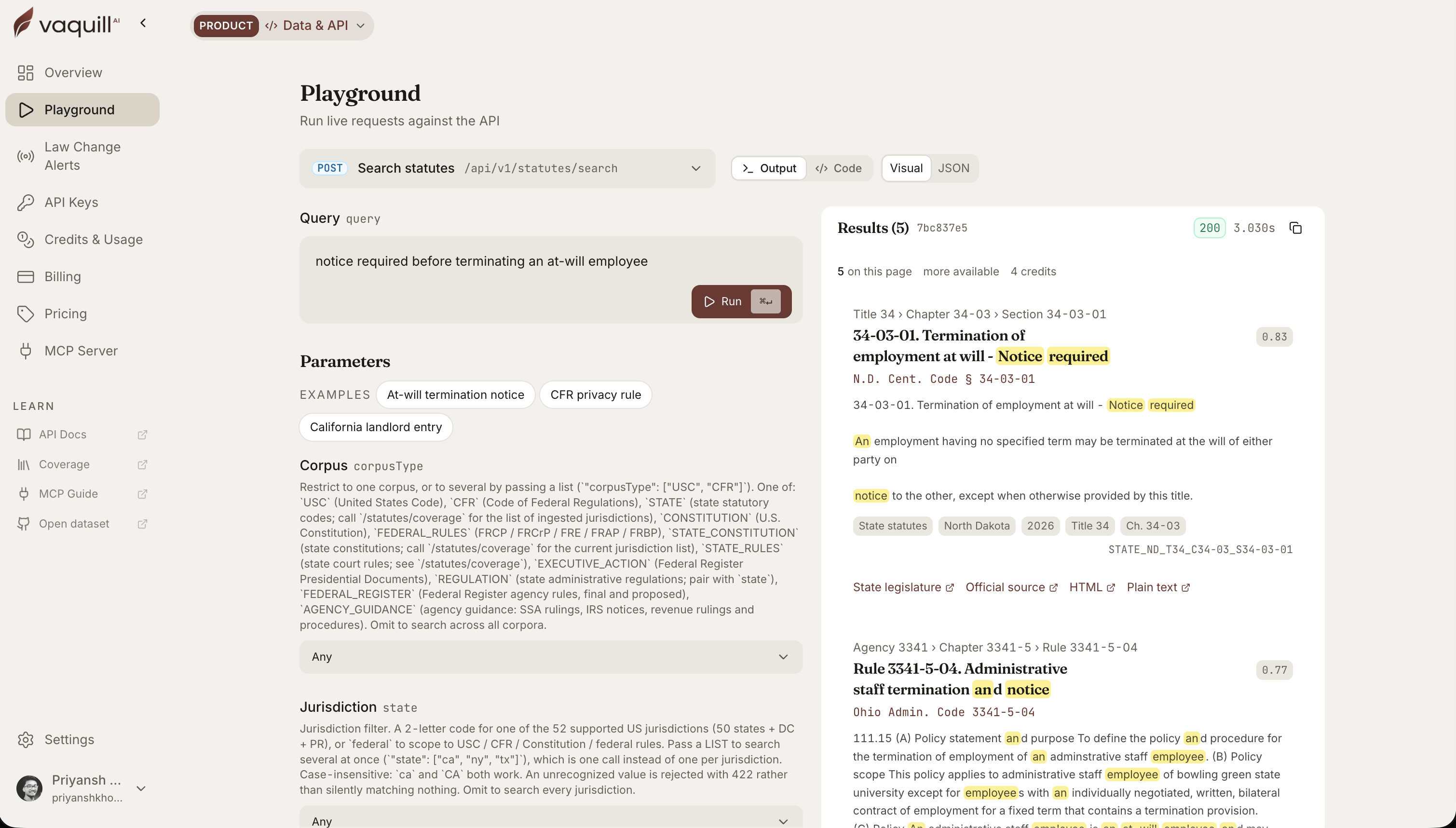 The same corpus behind this article, queried live. Every result carries its citation and a link to the official source.
FAQ
How accurate is AI at reviewing medical records? More accurate than a rushed human on extraction, and less accurate than the marketing claims. Peer-reviewed studies of LLM medical summarization find real hallucination rates (around 1.5% in one Nature study, far higher in a 2024 emergency-department preprint) and higher omission rates. Vendor "99% accuracy" claims are unverifiable and usually undefined. Treat AI output as a fast first draft that a human must verify.
Is AI medical record review HIPAA compliant? The tool can be, if you use it correctly. Whether HIPAA binds you depends on the records: a firm receiving PHI from a covered entity to serve it is usually a Business Associate, while a plaintiff firm getting its own client's records by authorization generally is not, though privilege and protective-order duties still apply. Where HIPAA applies, you need a vendor that will sign a BAA, will not train on your data, and retains nothing. Consumer AI tools do not meet this bar, and "HIPAA-ready" marketing is not the same as a signed BAA.
Can I put medical records into ChatGPT? Not the consumer version. It is not HIPAA-compliant and can raise privilege issues on an active matter. Enterprise deployments under a signed agreement with no training and retention controls are a different matter. When in doubt, do not paste PHI into a consumer tool.
How long does AI take to review medical records? The extraction and chronology draft take minutes to a couple of hours for a large file, versus 10 to 40 hours by hand. But add the human verification pass, which does not disappear. Realistic end-to-end for a candid workflow is a few hours per case, most of it review.
Can AI chronologies cite the source page, and are they defensible? The good ones cite every fact to a page (and Bates number), which is exactly what makes them defensible. A source-linked chronology lets you answer a challenge by opening the record. A summary with no citations is not defensible, and you should not use a tool that cannot show its sources.
Can AI flag treatment gaps and missing records? Yes, gap detection is one of its genuine strengths, but only against a real provider index. It flags gaps in what it processed. It cannot flag a provider whose records you never requested, which is why the gap log must be reconciled against your own list.
What does AI medical record review cost? Far less per case than outsourced human review ($0.90 to $2.50 a page, or $2,500 to $5,000 for a legal nurse consultant). AI tools sell per page, per chronology (roughly $28 to $500), or by subscription (roughly $150 to $400 per user per month). Budget the human verification hours on top.
Should I use AI or a legal nurse consultant? Increasingly both. AI does the mechanical extraction and first-draft chronology fast and cheap. A qualified human, a nurse consultant or an experienced paralegal, verifies the entries that carry weight and handles the medical judgment AI cannot. The tools that are honest about this keep a human in the loop by design.
Which practice areas use it? Personal injury, workers' compensation, medical malpractice, and mass tort most heavily, with disability and insurance-defense work close behind. Any matter that turns on a large medical record benefits.
Related reading
- AI for personal injury: the full guide
- Turn medical records into a demand letter and chronology, step by step
- Build a litigation chronology from documents with AI
- The best AI software for plaintiff law firms, compared
- HIPAA-grade legal AI for healthcare counsel
Sources
All links checked July 2026. Some report pages are login-gated or block automated checks and are named without a link; figures come from the publisher's own abstract or summary.
- npj Digital Medicine (Nature), "A framework to assess clinical safety and hallucination rates of LLMs for medical text summarisation," 2025 (peer-reviewed; full text login-gated)
- medRxiv, "Evaluating Large Language Models for Drafting ED Discharge Summaries," 2024 (preprint, not peer-reviewed)
- JAMA Network Open, LLM extraction from clinical notes, 2025 (peer-reviewed)
- Nature Medicine, "Adapted large language models can outperform medical experts in clinical text summarization," 2024 (peer-reviewed)
- Morgan Lewis, "AI in Healthcare: Key Legal Questions to Address Before Deployment," May 2026
- HIPAA Journal, "HIPAA Business Associate Agreement, 2026 Update" (named without a link)
- Morgan Lewis, "AI in Healthcare: Key Legal Questions to Address Before Deployment," May 2026 (named without a link)
- 2025 ABA Legal Industry Report (adoption and accuracy-concern figures), via ABA Journal
- Vendor guides for volume, cost, and workflow context: EvenUp, Inquery.ai, MedLegal AI, NexLaw, Precedent, ProPlaintiff.ai (each vendor-published; used for market context, not as independent proof)
New legal AI guides, weekly.
Further Reading
Lexis+ AI, CoCounsel and Westlaw AI: Is There an API?
Read postIs Legal AI a Bubble? What the 2026 Market Data Says
Read postHow to Verify a Legal AI Accuracy Claim (Before You Trust the Number)
Read postThe Vaquill AI Legal Benchmark: 93% vs 33% on US Law That Changed This Year
Read postClaude Fable 5 and Legal AI: What Its Benchmark Records Actually Mean
Read postThe AI Value Gap: In-House Counsel Want AI Results Their Outside Counsel Are Not Delivering
Read post
Co-Founder & CEO · Attorney
Arshita leads product and strategy at Vaquill AI, the US primary law data API. As an attorney, she decides which law we carry, how each section is sourced and cited, and what legal AI and compliance teams need from the data.