An AI legal seat costs anywhere from about $20 to $1,500 per user per month in 2026. Budget tools and general chatbots sit at $20 to $100, mid-market drafting and research tools at $100 to $500, and enterprise platforms at $500 to $2,000 plus per seat, often behind a multi-seat minimum and an annual lock-in. The per-seat number you are quoted is not really a price: it is four costs glued together.
Those four are the software the vendor built, third-party content licensed and passed straight through, usage or compute that may be metered, and seat-count padding from contract minimums. Decompose any quote into those four buckets before you negotiate, because you cannot negotiate a pass-through but you can refuse to pay margin on top of it. The sourced price table is below, then the method, with worked numbers.
A managing partner forwarded me a Harvey quote last month with one line highlighted in yellow: the per-seat number. "Is this normal?" he asked. It was the wrong line to highlight.
How much an AI legal seat costs in 2026 is almost never answered by the per-seat figure, because that figure is not a price. It is a bundle wearing a single number, and the bundle is doing a lot of quiet work the buyer never sees.
The senior partner had been trained by twenty years of Westlaw and Lexis renewals to read one number and negotiate it down. That instinct fails completely against AI vendor quotes, where the headline seat price is the least informative line in the document.
The money, the risk, and the leverage all live below it: in what content is being passed through, in what compute meter is hiding in an addendum, and in how many seats you are being made to buy whether or not you have the lawyers to fill them.
This is a buyer's method, not a verdict on any one vendor. If you want the worked example (is Harvey worth $2,400 a seat, is Legora a wrapper), read our breakdown of Harvey, Legora, and CoCounsel pricing. This post teaches you to read the next quote that lands in your inbox, regardless of whose logo is on it.
TL;DR
- An AI legal "seat price" is four things glued together: the software the vendor built, third-party content licenses passed straight through, usage or compute that may be metered, and seat-count padding from contract minimums.
- Harvey runs $1,200 to $2,000+ per user per month for unlimited AI usage, set by tier and per-feature add-ons, with a pay-as-you-go credit option on top. Much of the spread between bundles is content and add-on pass-through, not core product value.
- Contract minimums are where small firms get hit hardest: some enterprise tools force a five-lawyer firm to buy double the seats it can use.
- The 2026 shift toward usage and outcome pricing adds a new meter. Demand the pricing-unit definition, a spend cap, and audit rights before you sign.
- Decompose every quote into the four buckets before you negotiate. You cannot negotiate a pass-through, but you can refuse to pay vendor margin on top of it.
What four costs is a legal AI seat price glued together from?
Part of our legal AI vendor comparison and pricing series.
How we sourced these prices
We tracked roughly a dozen named legal AI tools across three tiers (budget, mid-market, enterprise) and pulled each per-seat figure from one of three sources: the vendor's own published pricing page (curl-verified live), a founder-confirmed number we hold internally, or a named third-party pricing roundup we link inline. Where a vendor publishes nothing, we say "quote-based" instead of inventing a sticker price. We build Vaquill AI, one of the tools below, so we list our own price plainly and flag it as ours.
AI legal seat cost by tool, 2026 (sourced per-seat prices)
These are list per-seat prices. The real per-lawyer cost can run higher once you apply seat minimums, content pass-through, and usage overage, which is the whole point of the four-bucket method further down.
| Tool | Per-seat list price | Access | Source |
|---|---|---|---|
| Vaquill AI | Self-serve, published (sign up for current pricing) | Self-serve, no minimum | Vaquill AI published |
| Paxton AI | $499 / user / mo (or $2,999 / user / yr) | Self-serve, 7-day trial | Paxton pricing, curl-200 Jun 2026 |
| Spellbook | ~$500 / user / mo base (quote-gated, no public price) | Sales / quote | Reported base, Jun 2026 |
| CoCounsel (Thomson Reuters) | ~$225 to $400+ / user / mo | Sales, no standalone SKU | Founder-confirmed; CoCounsel Core ~$225 (The Legal Prompts, Feb 2026) |
| GC AI | $500 / seat / mo (Individual) | Self-serve; Team/Enterprise on request | gc.ai/pricing, curl-200 Jun 2026 |
| LegalOn | $550 / mo (Individual, billed annually) | Self-serve; Teams custom | legalontech.com pricing, curl-200 Jun 2026 |
| Legora | $300 to $800 / user / mo (unlimited usage) | Sales; PAYG credit option | Founder-confirmed (tier + add-on mix sets the rate) |
| Harvey | $1,200 to $2,000+ / user / mo (unlimited usage) | Sales; ~25-seat min, annual; PAYG credit option | Founder-confirmed; ~$1,200 base + ~25-seat min reported by Irys, Apr 2026 |
For broad market context, Clio's 2026 pricing guide puts the field "from free to more than $1,200 per seat per month," with solo and mid-sized tools in the "$50 to $200 range" and enterprise platforms starting "at $500 per seat with annual commitments" (Clio, May 2026). General chatbots such as ChatGPT Plus and Claude Pro list at $20 per user per month (Elephas, Mar 2026), but they carry no legal grounding, citations, or matter security, so they are not a like-for-like seat.
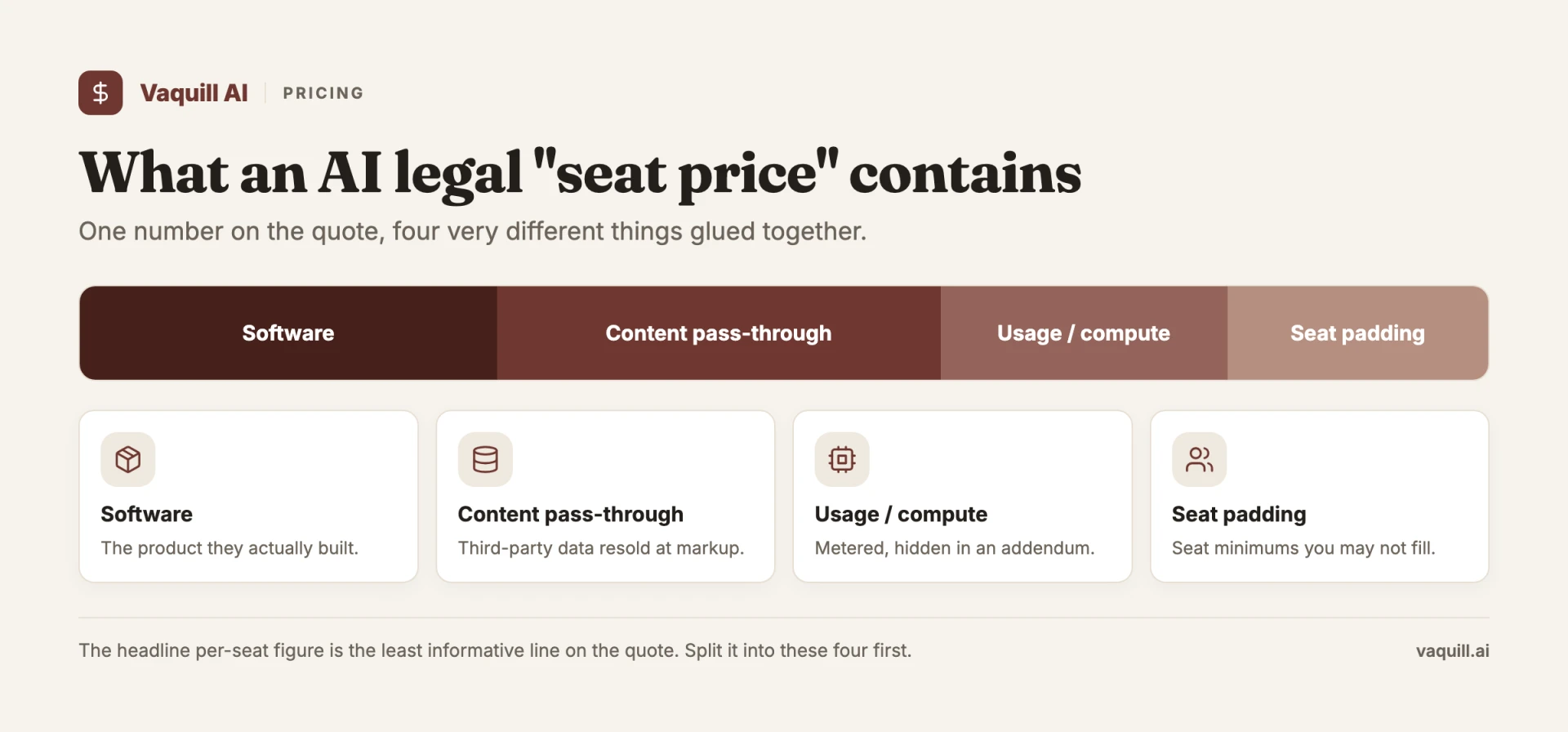
One per-seat number, four very different things glued together.
The four buckets every seat price hides
When a quote says "$1,200 per seat per month," mentally split that number into four lines the moment you read it. You will rarely get the vendor to itemize it for you, so you have to do the decomposition yourself.
Bucket 1: the wrapper, the software the vendor actually built. This is the real product: the orchestration, the retrieval, the agentic workflows, the document tooling, the UI lawyers will actually open every morning. This is the part you are genuinely paying a vendor to maintain and improve. It is also, in most quotes, a minority of the headline number.
Bucket 2: third-party content passed straight through. If the seat includes Lexis, Westlaw, or Practical Law access, you are paying the underlying license plus, often, a margin on top. The vendor did not create that content and frequently cannot discount it, because they are reselling someone else's database under someone else's contract.
Bucket 3: usage and compute. Tokens, agent runs, document-processing volume. Historically baked into the flat seat. Increasingly broken out, capped, or metered separately, sometimes in an addendum you will not see unless you ask for it.
Bucket 4: seat-count padding. The gap between the seats you need and the seats the contract forces you to buy. Minimums, tiers, and "platform fees" all live here. This bucket is invisible on a per-seat basis and brutal on a per-lawyer basis.
Get these four numbers, even as rough estimates, and the quote stops being a single intimidating figure and becomes a negotiation with four separate levers, only some of which the vendor controls.
| Bucket | What it is | Negotiable? |
|---|---|---|
| 1. Wrapper | Software the vendor actually built (orchestration, UI, workflows) | Yes, this is the product |
| 2. Content | Third-party licenses (Lexis, Westlaw, Practical Law) passed through | Not the license itself; refuse to pay if you already own it |
| 3. Usage | Tokens, agent runs, document volume, often in an addendum | Cap it, define the unit, get audit rights |
| 4. Padding | Seat minimums, platform fees, the gap between seats needed and seats bought | Yes, and small firms bleed here most |
Bucket 2 in the wild: content is a pass-through, not a feature
The cleanest illustration is Harvey. Harvey costs $1,200 to $2,000+ per user per month for unlimited AI usage, and the reason it is a range is that Harvey is a bundled product with per-feature add-ons: the tier and add-on mix set the per-user price (Harvey also offers a pay-as-you-go credit-metered option). Third-party trackers land inside that band: Irys (Apr 2026) reports roughly $1,200 per lawyer per month at the base with a ~25-seat minimum and a 12-month commitment, and a Lexis bundle that roughly doubles the per-seat price to about $2,400 (eesel AI, 2026). That doubling is Bucket 2 in one line.
A chunk of the move from the bottom of that band to the top is content and add-ons riding inside the seat, not a more capable model or a better agent. When a Lexis integration is part of the bundle, that license is sitting inside the seat price. You are buying a Harvey-plus-content bundle, and a meaningful slice of the delta is Bucket 2.
That changes how you negotiate. You cannot argue Lexis down through Harvey; Harvey is passing through a license it does not own. But you can ask the question almost no buyer asks: do we already have a Lexis subscription, and if so, why are we paying for it twice?
Many firms with a standing Westlaw or Lexis contract end up double-paying for content they already license, because the AI vendor folds it into the seat and nobody on the buying side maps the overlap. The pass-through is not negotiable. The duplication is.
The same logic runs the other direction. A seat with no content bundled (a tool that brings its own corpus or relies on open data) is not "cheaper" in a way you can compare apples-to-apples against a Lexis-bundled seat.
It is a different bucket-2 value, possibly zero, possibly negative if you then have to license content separately. The headline numbers are only comparable after you strip Bucket 2 out of both.
This is also where open data quietly reshapes the math. A meaningful slice of "premium" legal content is primary law: statutes, regulations, and judicial opinions that are public record.
US court opinions are public record, and statutes and regulations are public by definition. A vendor charging you a content pass-through for primary law is charging you for packaging, not for proprietary rights. Worth knowing before you accept a content premium as fixed.
For related vendor / pricing / buyer-guide coverage, see Legal Research Costs in 2026: What Firms Actually Pay and Why Harvey Costs $2,400 a Seat in 2026 (and Whether It's Worth Anywhere Near That).
Bucket 4: where small firms actually bleed
If Bucket 2 is the headline trap, Bucket 4 is the silent one. Irys describes it plainly: enterprise tools "often require minimum seat purchases. A five-lawyer firm may need to buy ten seats to meet the minimum, effectively doubling the per-user cost." Several enterprise legal AI tools attach a multi-seat minimum and an annual term to their contracts.
Run that through the math. A five-lawyer firm staring at a 25-seat minimum at $1,200 a seat is not looking at a $6,000-a-month decision. It is looking at $30,000 a month, $360,000 a year, for a product five people will use.
The effective per-lawyer cost is five times the quoted per-seat cost. The seat price was never the price.
This is the gap between AmLaw economics and small-firm reality, and it is the friction underneath every skeptical r/legaltech pricing thread. The four-figure per-seat tiers are priced for AmLaw use intensity and AmLaw headcount, where 25 seats is a rounding error and every practice-area agent gets used by someone.
For a solo or a 2-to-15-lawyer firm, the minimum is the real number, and it rarely appears on the first page of the quote.
Three questions surface Bucket 4 fast:
- What is the seat minimum, and is it a floor or a tier? A floor you pay regardless. A tier you can sometimes step down.
- Is there a separate platform or implementation fee on top of seats? These are pure Bucket 4 by another name.
- What is the term, and does the minimum apply for the whole term? A 25-seat annual lock is a very different commitment than a 25-seat quarterly one.
If you are a small firm, this bucket alone should send you to look at tools built for your headcount. The best AI options for solo and small firms are usually the ones with no minimum at all, where one lawyer pays for one seat. If a Harvey or Legora quote is what triggered the math, our Harvey alternatives for in-house teams and how much Legora costs break down the same minimums in detail.
Bucket 3: the meter that is replacing the seat
Here is where 2026 differs from 2024. The industry is drifting from flat seats toward usage and outcome pricing, and that drift quietly relocates risk onto the buyer.
The legal lens on this comes from contract lawyers, not vendors. Kemp IT Law argues that AI SaaS contracts now need an explicit cost-pass-through clause, spelling out whether the vendor's own input and compute cost changes flow through to you, plus spend caps and "price shock" controls. That is a contract lawyer telling other lawyers that the pricing unit itself is now a negotiated term, not a given.
The trap is signing flat-seat optics while the real meter sits in an addendum with no ceiling. The first page says "$1,200 per seat." Page nine says agent runs above some threshold are billed separately, or that document-processing volume over X pages a month incurs overage, or that the vendor reserves the right to pass through model-cost increases. You signed a predictable line item and got a variable one.
Demand four things in writing before you sign anything usage-flavored:
- The pricing-unit definition. What exactly is a "run," a "query," a "credit," a "document"? Vague units are unbillable to your clients and unforecastable in your budget.
- A hard spend cap. A monthly or annual ceiling above which you are not charged without re-signing. Without it, a single power user or a runaway agent loop can blow the budget.
- Escalation and pass-through limits. If the vendor can raise prices or pass through model-cost changes mid-term, cap how much and how often. The TCO and escalation mechanics are covered in depth in our legal research costs breakdown.
- Audit and true-up rights. You should be able to see your own usage in detail and reconcile the bill against it. A meter you cannot read is a meter you cannot trust.
Usage pricing is not inherently bad. For a small firm, paying for what you actually use can be far cheaper than a 25-seat flat floor.
But "pay for what you use" only protects you when you can see, cap, and forecast the meter. Otherwise it is just Bucket 4's padding with a more modern name.
Why bundling makes all of this harder
The reason this decomposition is hard is that vendors increasingly do not want you to do it. Irys notes that some vendors "bundle AI into existing subscriptions, making it difficult to determine what the AI component actually costs," and that CoCounsel, now inside the Thomson Reuters stack after the $650M Casetext acquisition, has no standalone price at all.
When the AI is folded into a Westlaw or Lexis renewal, the four buckets collapse into a single negotiated platform number, and your leverage collapses with them. You cannot tell what the AI costs, so you cannot tell whether it is worth it, so you renew the whole bundle and hope.
That is the opposite of buying like a procurement pro. It is buying like a renewal.
The antidote is to force itemization even when the vendor resists. Ask for the AI component as a separate SKU. Ask what the platform costs without it. If the answer is "it's all bundled," that is itself a data point: you are being sold opacity, and opacity is a cost.
This is why transparent, self-serve pricing matters as a market signal. A scoped statutes and legislation API you can sign up for and use directly (search and fetch across the full U.S. Code, the CFR, and all fifty state codes) is one example: the point is not that everything should be sold this way, but that pricing you can see without a sales call is worth looking for.
A buyer who can see the unit can do math. A buyer who cannot is negotiating blind. (Scope reminder: the public API is statutes-only; case-law search and grounded answers are in-product features, not REST endpoints.)
A worked decomposition
Put it together on a single hypothetical quote. Say a vendor offers you "$1,500 per seat per month, 20-seat minimum, annual term, Lexis included, standard agent usage." Decompose before you respond:
- Bucket 1 (software): the orchestration, workflows, and document tooling. Probably $600 to $900 of the seat once you back out content.
- Bucket 2 (content): the Lexis pass-through, likely several hundred dollars. Ask: do we already pay for Lexis? If yes, this is duplication, not value.
- Bucket 3 (usage): "standard agent usage" is undefined. Get the unit, the threshold, the overage rate, and a cap. Until you do, treat it as an open liability.
- Bucket 4 (padding): you need, say, twelve seats. The 20-seat minimum means you are paying for eight phantom seats: $144,000 a year for nobody. That is the first thing to negotiate, before the per-seat rate.
Notice how little of your negotiating energy should go to the headline $1,500. The real wins are killing the Lexis duplication, capping the usage meter, and closing the eight-seat gap.
The partner who highlighted the per-seat number in yellow was negotiating the one line he had the least leverage on.
What most buyers get wrong
They line up headline seat prices, $1,200 against $399 against a self-serve seat, and treat them as comparable. They are not. One bakes in a Lexis license, another bakes in nothing, a third is gated behind a 25-seat minimum that quintuples its real per-lawyer cost.
Comparing the headlines is comparing a furnished apartment, an empty one, and a building you have to lease ten units of, all by the rent on the sign out front.
The second mistake is ignoring the usage layer entirely, signing for the flat-seat comfort while the actual cost driver sits unmetered and uncapped in an addendum. By the time the overage shows up on an invoice, the leverage is gone.
The fix is not a spreadsheet of vendor logos. It is a habit: four buckets, every quote, every time. Software, content, usage, padding. The seat price is the question, not the answer.
FAQ
How much does an AI legal seat cost in 2026?
There is no single number, because the headline per-seat figure is four things glued together: software, content pass-through, usage, and seat-count padding. As a reference band, Harvey runs $1,200 to $2,000+ per user per month for unlimited AI usage (the range is set by tier and per-feature add-ons), while a no-minimum suite like Vaquill AI is self-serve at a fraction of that. Compare those only after you strip out content and padding.
Why is legal AI so expensive per seat?
Most of the price is not the model. A large share is third-party content (Lexis, Westlaw, Practical Law) passed straight through, plus seat-count minimums that force you to buy more seats than you can staff. The software the vendor actually built is often a minority of the headline figure.
What is the cheapest AI legal tool for a small firm?
The cheapest real option is usually a suite with no seat minimum, where one lawyer pays for one seat. Vaquill AI is self-serve and priced per seat with no minimum (sign up to see current pricing). Enterprise tools that quote a low per-seat rate can be far more expensive in practice once a 10 or 25-seat floor is applied to a five-lawyer firm.
What is a seat minimum and why does it matter?
A seat minimum is the number of seats a contract forces you to buy regardless of headcount. Irys notes that a five-lawyer firm may have to buy ten seats to meet a minimum, doubling the effective per-user cost. For a solo or small firm, the minimum, not the per-seat rate, is often the real price.
Is usage-based pricing better than per-seat pricing?
It can be cheaper for low-volume firms, but only if you can see, cap, and forecast the meter. Kemp IT Law argues AI SaaS contracts now need an explicit cost-pass-through clause, a spend cap, and price-shock controls. Without a hard cap and a clear pricing-unit definition, a metered plan is just seat padding with a newer name.
How much does Harvey AI cost per lawyer?
Harvey runs $1,200 to $2,000+ per user per month for unlimited AI usage, set by tier and per-feature add-ons (founder-confirmed). Third-party trackers put the common enterprise base near $1,200 per lawyer per month with a ~25-seat minimum and a 12-month term (Irys, Apr 2026). A Lexis bundle can roughly double the per-seat number to about $2,400, so the real per-lawyer cost depends on the bundle, not the headline tier.
What is the cheapest AI legal tool for lawyers in 2026?
For a true legal seat, the cheapest sustainable option is a no-minimum suite where one lawyer pays for one seat. Vaquill AI is a self-serve, per-seat suite with published pricing (sign up to see the latest). General chatbots like ChatGPT Plus and Claude Pro are $20 per month (Elephas, Mar 2026), but they have no legal grounding or citations, so the low price buys a different thing.
What hidden costs should I watch for when buying legal AI?
The four usual ones are seat minimums (paying for seats you cannot staff), content pass-through (a Lexis or Westlaw license folded into the seat that you may already license), usage overage (per-run or per-document charges buried in an addendum), and implementation or platform fees disclosed late. Ask for each in writing before you sign.
Can ChatGPT or Claude replace a paid legal AI seat?
For drafting first passes and summarizing your own documents, a general chatbot can carry real load at $20 per month. It cannot ground answers in current statutes and case law with checkable citations, and it should not hold privileged matter content without a vetted data agreement. Most teams use it alongside, not instead of, a legal-grounded tool.
How do I read a legal AI quote like a buyer?
Split every quote into four buckets the moment you read it: software, content, usage, padding. Ask whether you already license the bundled content, demand the usage unit and a spend cap in writing, and negotiate the seat minimum before the per-seat rate. The headline number is the question, not the answer.
How much does Vaquill AI cost?
Vaquill AI is self-serve and priced per seat, with no seat minimum and no bundled-content pass-through. Sign up to see current pricing. It includes grounded US legal research, drafting, document comparison, and matter document management in a single seat.
For more on decomposing seat pricing and seeing the unit, see self-serve pricing or the US primary law API. If you are comparing seats for an in-house team, our roundup of the best legal AI tools for in-house counsel applies the same four-bucket lens tool by tool.
New legal AI guides, weekly.
Further Reading
Top AI Legal Research for Solo Attorneys on a Budget
Read postBest AI Software for Plaintiff Law Firms (2026): 11 Tools Compared
Read postLegal AI Tools for Solo Practitioners: 7 Picks That Fit a One-Person Firm
Read postPersonal Injury AI in 2026: What It Actually Does for Plaintiff Lawyers
Read post7 Ways AI Helps Personal Injury Lawyers Win Cases Faster
Read postTop Legal Research Tools for Solo Family Law Attorneys
Read post
Co-Founder & CEO · Attorney
Arshita leads product and strategy at Vaquill, building the legal AI suite that solo, small-firm, and in-house US lawyers use to run a matter end to end.