
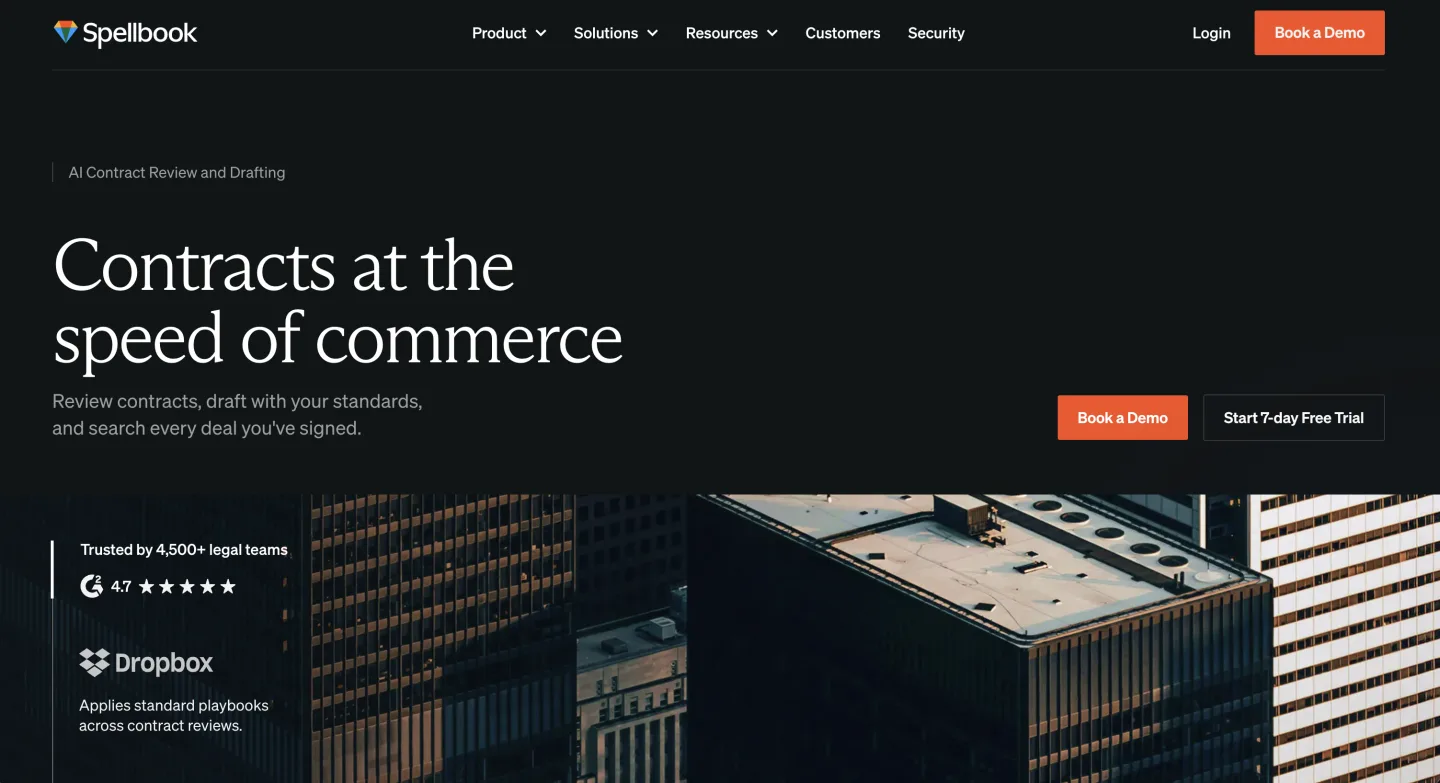
Spellbook is an AI tool for contract drafting and review inside Microsoft Word. It is built for in-house and deal lawyers who work in Word all week. Its features center on Word-native redlines, playbook deviation checks, and clause-level market data.
Its scope is contract drafting and review. Legal research, document matrices, citation checks, matter management and a public API are different categories of tool. The full review follows.
Do you draft or review contracts in Microsoft Word for a living? Then someone in your network has probably mentioned Spellbook. The Toronto company built its product around one question: what does contract AI look like if you never leave Word?
The company is well funded. In October 2025 Spellbook closed a $50M Series B led by Khosla Ventures (BusinessWire, Oct 2025; also reported by BetaKit and Artificial Lawyer). In March 2026 it added a $40M RBCx debt facility for acquisitions.
Spellbook says it serves 4,500-plus in-house teams and law firms in 80-plus countries, and it signed an exclusive Canadian Bar Association deal in March 2026. These are vendor figures, not audited ones.
At a glance
| Spellbook | |
|---|---|
| Price | Not published; quote-based, determined by the number of team members on a license (spellbook.com/pricing, accessed Jun 2026) |
| Access | Sales-led, demo required |
| Best for | Deal counsel and small-to-mid in-house contract teams in Word |
| Free trial | 7 days (longer for bigger teams) |
| Word-native | Yes, a Microsoft Word add-in |
| Customization | Playbooks encode your clause standards |
Rated about 4.1 out of 5 by Lawyerist (accessed Jun 2026).
TL;DR
- Spellbook is built for in-Word contract drafting and review. The product is designed around the contract open in Word.
- Core features: Word-native feel, AI redlines on track changes, playbook deviation checks, and clause-level market data from the 2026 State of Contracts set (hundreds of thousands of contracts, 30 countries, 270-plus benchmarks).
- Scope: contract drafting and review. Research, multi-document matrix work, citation checks, matter management and a public API are outside it.
- Who it fits: deal counsel and small-to-mid in-house contract teams who work in Word.
- What to test in a trial: your own playbook, your own paper, and the commercial terms.
What is Spellbook built for?
Part of our legal AI vendor comparison and pricing series.
What Spellbook is
Spellbook is an AI add-in that lives inside Microsoft Word. Install it, sign in, and a side panel opens next to the document. Highlight a clause, and the panel suggests a redline.
Ask for a missing indemnity, and it drafts one. Ask how a clause compares to most SaaS MSAs, and it pulls benchmarks from a large contract dataset. You never have to leave Word.
Workflow is a large part of legal AI uptake. Picture a senior associate reviewing a vendor agreement at 4 PM. They are unlikely to copy a clause into a browser tab, ask a question, then paste the answer into a Word comment forty times in an hour. Spellbook's bet, held since 2022, is that contract AI belongs where lawyers already redline.
Spellbook started in 2018 as Rally. It moved to GPT-era contract review in 2022 to 2023 and rebranded. Scott Stevenson is CEO. The product team sits in Canada. The customers are global, with the U.S. as the biggest market. Under the panel it runs on frontier models, and Spellbook cites GPT-5 and Claude, swapped as they improve (spellbook.com, accessed Jul 2026).
The product is five surfaces, all inside the Word panel:
| Surface | What it does |
|---|---|
| Review | AI redlines and risk flags on Word's native Track Changes |
| Draft | Generates clauses from your precedents (Smart Clause Drafting) |
| Ask | Q&A on the open contract, with citations to specific provisions |
| Compare to Market | Benchmarks a clause against the State of Contracts dataset by sector, jurisdiction, and deal type |
| Associate | Multi-document agent for transactional work: data-room review, financing docs, disclosure schedules |
Source: spellbook.com feature pages (accessed Jul 2026).
A typical Spellbook session
A test week tends to go like this. Day one: a partner installs the add-in and runs a stock NDA through it. Day two: load a 47-page vendor MSA and run "review." Spellbook walks the document section by section and flags clauses against your uploaded playbook, or against generic market practice if you skipped that step.
Flags come back as Word comments in the existing thread, plus tracked-change suggestions you accept or reject. The suggestions are incremental. Spellbook nudges a $1M cap toward your standard $2M instead of rewriting the whole liability section on its own, which suits a tool a GC has to sign off on.
Say the indemnification is missing a third-party-claim carve-out. Highlight it, type "add a third-party IP indemnity with mutual carve-outs for gross negligence and willful misconduct," and Spellbook drafts the clause in the style of the surrounding text. You review it, tighten the phrasing, and move on.
What many teams notice in week one is how much friction goes away. Context switches between Word, browser, and clipboard drop.
Say you hit a liability cap that feels aggressive. Click "compare to market." Spellbook returns a distribution: in vendor MSAs of this size, caps cluster around fees paid in the prior 12 months, with a long tail at 2x or 3x for higher-value deals.
The data comes from the 2026 State of Contracts corpus (hundreds of thousands of contracts, 30 countries, 13 agreement types, 270-plus clause benchmarks).
For longer jobs, like "draft a one-way NDA, governing law New York, two-year survival," you reach for Spellbook Associate, the agent surface that produces a full first draft from a prompt. It is the newest layer and the most likely to keep changing.
Spellbook pricing: how it is set
Spellbook does not publish per-seat pricing. The pricing page says "custom pricing for modern legal teams" and "pricing is determined by the number of team members on a license," then routes you to a demo (spellbook.com/pricing, accessed Jun 2026). There is a seven-day free trial, longer for bigger teams, and academic institutions can ask for free access. Everything past that is a sales-set quote.
Because the vendor publishes no figure, this review quotes none. The number that applies to your team is the one in your written quote. The factors that shape it:
- Seat count on the license.
- Modules and features included in the tier.
- Term length and any auto-renewal.
- Minimum commitment, if any, including for a pilot.
- Renewal terms and any cap on increases.
- Onboarding and playbook support.
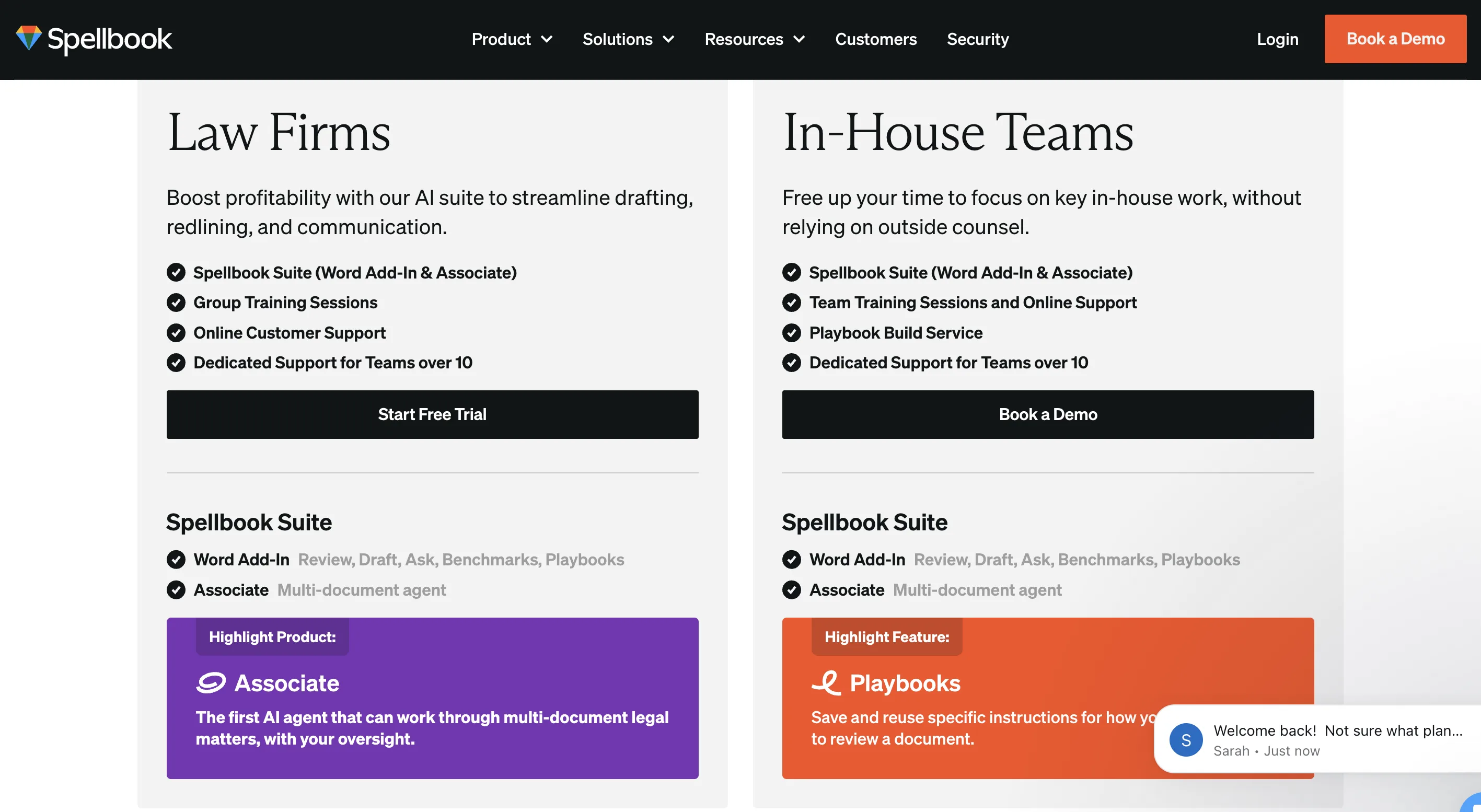
Ask for the quote, the seat count it assumes, the term, and the renewal clause in writing before you sign. For the full pricing structure, see Spellbook pricing: how plans are structured and what drives cost.
A simple way to frame value: estimate the hours a reviewer saves per week on contract work, multiply by your blended internal hourly cost, and compare it with the quoted cost per active lawyer. Value depends on contract volume more than on seat count.
Three procurement notes. First, no published price is common in sales-led legal AI, so expect a demo step. Second, seven days is short for the work that matters: building a playbook against your own templates. Ask in the demo for an extended trial that covers a real playbook build. Third, playbook authoring is what makes deviation checks reflect your team's standards, and the same discipline pays off whichever tool you pick (see our in-house contract review playbook). Budget senior lawyer time for it. Without a playbook the tool falls back to generic market practice.
What Spellbook is built to do well
Four areas, named plainly.
1. The Word integration. Track Changes is native, the panel sits beside the document, comments thread into Word's comment system, and there is no copy-paste step. The job it targets is AI-assisted redline review of inbound third-party paper.
2. Clause-level market comparison. The State of Contracts dataset is a sizeable corpus, built from customers via a give-to-get model. For "where does this clause sit on the curve," the dataset gives a distribution rather than a single opinion. Coverage varies by agreement type and jurisdiction, so check it against the paper you handle.
3. Adoption among small and mid-size transactional teams. The 4,500-plus figure is a vendor number. Spellbook has focused on three-to-fifteen-lawyer in-house teams, and the product reflects that buyer's workflow.
4. The annual State of Contracts report. Released in December 2025, it analyzed hundreds of thousands of contracts across 30 countries. It found a near-50% jump in tariff-related contract mentions between June and October 2025. It tracked the rise of "AI Usage Policy" as a standalone clause type in software deals.
It also showed split dispute defaults. IP agreements lean 80% litigation. MSAs lean 68% litigation. SaaS contracts split three ways: 39% litigation, 43% mediation, and 46% with no binding mechanism named. This is a benchmark dataset contract lawyers can cite.
Scope
Spellbook is a contract drafting and review product, and its scope follows from that. These are categories it is not designed around, which matters for how you assemble a stack.
Legal research. Researching a case, pulling a current statute section, running a citation graph or building a brief is a different category of tool. Contract teams that also do litigation or regulatory work typically pair a drafting add-in with a research source. Legal-AI platforms and in-house tools can build that layer on a primary-law API, see Vaquill AI's US legal API.
API access. As of mid-2026, Spellbook has no public API. For most contract lawyers that does not matter. For legal-ops teams wiring intake into a broader stack, or developers building agentic workflows, it is a scoping question. See the MCP integration plane for legal AI for how teams connect tools programmatically.
Multi-document matrix work. Spellbook's design center is one document at a time inside Word. The "load 80 NDAs and tell me which three deviate" job is the document matrix surface legal AI is moving toward, which is a different interface from a side panel.
Citation checks across case law and statutes. Contract drafting rarely turns on case-law checks. When a clause cites authority, such as a force majeure clause citing Kel Kim Corp. v. Central Markets, Inc., 70 N.Y.2d 900 (1987), verify the citation through a research source.
Matter management. Spellbook works on the document. Teams that want the matter as the unit of work, with the draft, redline, email thread and closing checklist in one place, use a different category of software.
What to test in a trial
Seven days is short, so go in with a plan.
- Run your own paper. Use a real inbound agreement, including a clause outside your standard playbook, not a sample NDA.
- Build a small playbook. Load three to five of your clause positions and check that the deviation flags match your standards.
- Check Compare to Market against your agreement types. Confirm the dataset covers the sectors and jurisdictions you handle.
- Review every suggestion. Note where a suggestion needs correction, and who on your team signs off.
- Confirm security and data terms. Ask for the current SOC 2 report and data-processing terms, and where documents are stored and for how long.
- Get the commercial terms in writing. Seat count, term, any minimum commitment, auto-renewal, and renewal cap.
- Map what sits outside it. List the research, citation and matter tasks your team does and which tools cover them.
Who Spellbook fits
Spellbook fits a transactional lawyer or deal counsel whose week is mostly Word and mostly contracts. It also fits a three-to-twenty-lawyer in-house contract team that wants one AI surface for drafting and review without a full CLM, and teams for whom compare-to-market would turn "is this market" debate into a quick check.
The buyer described on its product pages: senior in-house counsel at a growth-stage company, five to twelve reports, with a steady flow of inbound contracts.
Teams whose main work is research or litigation, who work mainly outside the major English-language markets, who need matrix review across stacks of similar documents, or who need programmatic access will weigh the fit differently. Check the comparison data for your jurisdictions before committing.
Summary
For AI-assisted redline review of inbound third-party contracts inside Microsoft Word, Spellbook is purpose-built. The Word-native surface, compare-to-market data, and the State of Contracts dataset define the product. Funding supports continued iteration.
One line per team type:
- Transactional law firm partner, three-to-twenty lawyers: a natural fit, budget time for playbook work upfront.
- In-house GC at a growth-stage company: a fit if you have several reviewers and steady contract volume.
- Litigator or regulatory practitioner: pair any drafting tool with a research source.
- Multi-jurisdiction dealmaker outside the major English-language markets: check the comparison data for your jurisdictions before committing.
- Legal-ops or platform engineer: confirm integration needs against the lack of a public API.
- Low contract volume: compare the quoted cost per active lawyer against hours saved.
FAQ
How much does Spellbook cost?
Spellbook does not publish per-seat pricing; the page says "custom pricing" and routes you to a demo, with pricing determined by the number of team members on a license (spellbook.com/pricing, accessed Jun 2026). There is a seven-day free trial, longer for bigger teams, and academic institutions can request free access. Get your own written quote.
Does Spellbook have a minimum contract or commitment?
Spellbook does not state a term on its pricing page. Ask in the demo whether any minimum term, minimum number of licensed users or auto-renewal applies, and get the answer in writing.
Is Spellbook secure and SOC 2 compliant?
Spellbook states it is SOC 2 Type II certified and adds HIPAA, GDPR, and EU AI Act compliance, with Zero Data Retention agreements so your documents are not used to train its models (spellbook.com, accessed Jul 2026). It encrypts data in transit and at rest. For regulated work, ask in the demo for the current report and the data-processing terms, and confirm where your contracts are stored and for how long.
Who is Spellbook built for?
Contract lawyers who work in Microsoft Word, such as deal counsel and in-house contract teams. The value of any contract AI tracks contract volume and how closely it follows your playbook.
Do I need to verify Spellbook's output?
Yes, as with any AI drafting tool. Suggestions on clauses outside your playbook deserve the closest review. Spellbook does not run a citator across case law, so verify any cited authority through a research source.
Is Spellbook good for solos or small firms?
It is designed around three-to-twenty-lawyer transactional and in-house teams. A solo with low contract volume should compare the quoted cost per active lawyer against the hours saved.
Does Spellbook have a free trial?
Yes, seven days, longer for bigger teams. Seven days is short for building a playbook against your own templates. Ask in the demo for an extended trial that covers a real playbook build.
What should I compare when evaluating contract AI tools?
Fit with your workflow (Word or another surface), playbook support, benchmark data coverage for your agreement types, security terms, and commercial terms. Scope each tool to what it covers and list what still needs another subscription.
Does Spellbook integrate with practice management software?
Spellbook lives inside Microsoft Word and has no public API as of mid-2026. Ask in the demo about any integrations with practice-management or matter-management systems that your team relies on.
New legal AI guides, weekly.
Further Reading
- Luminance Review 2026: What It Is Built For and Who It Fits
- Legora Review: Who It's For, How It's Sold, and How It Fits In-House Teams
- CoCounsel Review 2026: What It Is Built For and Who It Fits
- Westlaw Precision AI Review 2026: What It Is Built For and Who It Fits
- LinkSquares Review 2026: What It Is Built For and Who It Fits
- Lexis+ AI Review 2026: What It Is Built For and Who It Fits

Co-Founder & CEO · Attorney
Arshita leads product and strategy at Vaquill AI, the US primary law data API. As an attorney, she decides which law we carry, how each section is sourced and cited, and what legal AI and compliance teams need from the data.