An AI compliance check reads a contract, DPA, or policy clause by clause, maps each clause to the specific obligations under a privacy or financial-reporting framework (CCPA/CPRA, GDPR, HIPAA, SOX, PCI-DSS), and returns a severity-ranked list of what is missing, weak, or contradictory. Used right it is a first pass that a lawyer reviews, never a sign-off. The same framework that governs your underlying data governs the AI that touches it: there is no "productivity tool" exemption in CCPA, GDPR, or SOX.
A head of legal at a 90-person B2B SaaS company, the only lawyer in the building and closing roughly fifteen new customer agreements a month, told me her real compliance workflow last year was a color-coded spreadsheet, a saved Slack search for the word "DPA," and a recurring sense of dread every time sales closed a deal in Europe. She is not unusual.
For a two-to-ten person legal team carrying CCPA, GDPR, SOX, and a healthcare customer that drags HIPAA into the picture, the work is not hard because the law is mysterious. It is hard because the volume of documents, frameworks, and overlapping clauses outruns the headcount.
An AI compliance check does not fix the law. It fixes the volume problem, and only if you understand exactly what it is good at and where it will quietly fail you.
TL;DR
Part of our guide for in-house counsel.
- An AI compliance check reads a contract, DPA, or policy clause by clause and maps each clause to the specific obligations under a framework (CCPA/CPRA, GDPR, HIPAA, SOX, PCI-DSS), then flags what is missing, weak, or contradictory. Done right, it produces a gap list with severity, not a summary.
- It is genuinely good at three things: surfacing missing mandatory clauses (Article 28(3) DPA terms, breach-notification windows, sub-processor rights), catching internal contradictions across a long agreement, and giving you a remediation starting point for each gap.
- It must never be the final word on novel regulatory interpretation, materiality judgments under SOX, or anything a regulator would call a "reasonable expectation" question. Those are lawyer calls, full stop.
- The 2025-2026 regulatory shift (California's Delete Act enforcement, the EU's billion-euro fine year, the HIPAA Security Rule NPRM, PCAOB AI-in-audit scrutiny) raised the cost of a missed clause faster than most in-house teams scaled their review capacity. That gap is the actual case for tooling.
- Wire the check into contract review and DPA intake as a first pass, not a sign-off. The lawyer reviews the flags, not the whole document.
What does the post call the most dangerous failure mode of an AI compliance check?
What an AI compliance check actually does
Strip away the marketing and a compliance check is a mapping exercise. A framework like GDPR is, for contract purposes, a finite set of obligations: Article 28(3) lists exactly what a data processing agreement must contain (subject matter, duration, processor instructions, confidentiality, security, sub-processing rules, audit rights, deletion or return on termination, and assistance with data subject requests).
A good AI compliance check holds that obligation list, reads your document, and answers one question per obligation: is it present, is it adequate, or is it missing?
That sounds mechanical because it largely is, and that is the point. The reason a junior lawyer or a paralegal can spend four hours on a single DPA is not that the analysis is intellectually deep.
It is that they are cross-referencing a forty-page agreement against a checklist in their head and praying they did not skip a clause at 6pm. The machine does not get tired at clause 34. That is its entire structural advantage.
The output that matters is not a paragraph that says "this contract appears generally compliant with GDPR." That output is worse than useless because it invites you to trust it.
The output that matters is a gap list: clause 7.2 limits the processor's breach-notification duty to 72 hours after "confirmation," which is weaker than Article 33's "without undue delay" standard and creates a window where you are non-compliant while your vendor investigates.
That is a finding a busy lawyer can act on in thirty seconds. The difference between a useful tool and a dangerous one is whether it produces the first kind of output or the second.
How CCPA, GDPR, and SOX apply when you use AI on regulated data
The first thing to get straight: the regime that governs the data governs the AI. If your AI tool reads, extracts, stores, or returns personal data or financial-reporting data, the same obligations attach to that tool as to a human doing the same work. None of these frameworks has a carve-out for "it was just a model." The deploying company is the controller or the responsible party, and you cannot push the liability onto your vendor.
Each regime applies along a slightly different axis, which is why running one document against all of them at once catches conflicts a single-framework review misses.
| Regime | When it applies to AI use | What an AI compliance check verifies | The line a tool cannot cross |
|---|---|---|---|
| CCPA/CPRA | The AI processes a California consumer's personal information, or makes/significantly informs a decision about them (the ADMT rules) | Service-provider/contractor clauses, sale/share opt-out language, sensitive-data category handling, pre-use ADMT notice and opt-out terms | Whether a real-world practice meets the "reasonable" security standard |
| GDPR | The AI processes any EU or UK personal data, regardless of where your servers sit (Art. 3 territorial scope) | Art. 28(3) processor terms, lawful basis recorded, Art. 30 records include the AI workflow, Art. 33 breach window, Art. 22 automated-decision safeguards | Whether your lawful basis actually holds for a novel use |
| SOX | The AI touches any system or process that affects the accuracy or integrity of financial reporting (ITGC scope) | That AI use is named in controls documentation and risk assessments, access is logged and attributable | Whether a deficiency is a material weakness (a judgment call) |
| HIPAA (if in scope) | The AI accesses PHI on behalf of a covered entity or business associate | BAA presence and adequacy, breach-notification window, minimum-necessary scoping, unique-user access logging | Whether your actual safeguards are "reasonable and appropriate" |
A clause-mapping check is strong on the middle column for every row. It is structurally incapable of the right-hand column, which is the lawyer's half of the job. Hold that distinction and the rest of the workflow design follows.
A per-regime AI-use checklist
Run these against any AI tool that touches regulated data before it goes live, and against the contracts that govern it.
CCPA/CPRA
- Vendor is bound as a "service provider" or "contractor" with the statutory restrictions on use, retention, and onward disclosure.
- If the AI feeds a significant decision (hiring, lending, housing, education, healthcare), a pre-use ADMT notice and an opt-out or human-appeal path exist (see the ADMT section below).
- Sensitive personal information categories are identified and the limit-use right is honored.
GDPR
- A documented lawful basis exists for the processing the AI performs (consent or legitimate interest in most product contexts).
- The processor contract carries every Article 28(3) term, and the AI workflow appears in your Article 30 records of processing.
- Breach-notification terms meet the Article 33 "without undue delay, within 72 hours" standard, not a vaguer vendor-defined window.
- If the AI makes solely-automated decisions with legal or similarly significant effect, Article 22 safeguards (human review, explanation, right to contest) are in place.
SOX
- Any AI used inside a financial-reporting process is named in the ITGC documentation, with the controls around it described.
- AI data access is logged and attributable to a unique user or service identity.
- The AI system is included in the annual control risk assessment, not treated as out of scope.
Severity is the feature, not the gap count
The first time most teams run a compliance check across their contract portfolio, they get a number that horrifies them: 340 gaps across 60 agreements. The number is meaningless.
Half of those gaps are a missing data-return clause in a vendor contract for office snacks, and a handful are a sub-processor in a country with no adequacy decision sitting inside your highest-revenue customer agreement.
A compliance check earns its keep by ranking. Severity should fall out of two axes: how mandatory the obligation is (a statutory must-have versus a best-practice nicety) and how much exposure the document carries (a master agreement with your biggest customer versus a one-off NDA). The same missing clause should resolve to a different severity depending on where it sits:
- Missing Article 28(3) sub-processing term in your platform DPA: critical. It is a statutory must-have in your highest-exposure agreement, and it is exactly the category regulators have been fining.
- Same term missing in a low-spend vendor contract that touches no personal data: low. Note it, do not block on it.
- Missing breach-notification window in a BAA with a healthcare customer: critical, and rising, given where the HIPAA Security Rule is heading.
- Missing data-return-on-termination clause in a mutual NDA: informational at most.
A check that flags all four identically is just generating noise your team will learn to ignore, and ignored alerts are how compliance programs die.
The ranking is the product. The list of gaps is the raw material.
One pattern worth naming: across the DPAs we have watched teams run through a check, the most common critical gaps are not exotic. They cluster on three clauses every time: a breach-notification window that is vaguer or longer than the framework requires, sub-processor terms that grant flow-down rights on paper but no real objection right, and a deletion-or-return-on-termination clause that goes silent on backups and archives.
If you only audited those three clauses across your portfolio this quarter, you would catch most of what actually gets fined.
This is also where the framework overlap becomes an asset instead of a headache. The same data-handling clause often touches CCPA, GDPR, and HIPAA at once.
A service provider clause that satisfies CCPA's "service provider" definition may still fail GDPR's processor requirements, and a BAA that covers HIPAA may say nothing about CCPA sensitive-data categories. Running one document against several frameworks in a single pass and seeing the cross-framework conflicts is something no spreadsheet does well and no human does quickly.
The 2025-2026 signal that changed the math
The reason this stopped being optional for in-house teams is not that AI got better. It is that the downside of a missed clause got more expensive and more enforced, fast.
On the California side, the Delete Act moved from statute to teeth. The California Privacy Protection Agency stood up a data-broker strike force, issued its first registration settlements (two of them in the mid-thirty-thousand-dollar range for late registration alone), and put real deadlines on the calendar: the Delete Request and Opt-Out Platform opened to consumers in January 2026, and from August 1, 2026 data brokers must check the deletion mechanism every 45 days.
SB 361, passed in 2025, expanded the sensitive-data categories brokers must disclose. If your company touches consumer data resale in any form, your service-provider and data-flow clauses are now load-bearing in a way they were not in 2023.
On the EU side, 2025 was the billion-euro year. European regulators issued over a billion euros in fines, anchored by the Irish Data Protection Commission's 530 million euro penalty against TikTok in May 2025 for unlawful EU-to-China transfers.
The average GDPR fine sits in the low millions, and the CMS enforcement tracker attributes a distinct line of fines specifically to inadequate Article 28 data processing agreements, separate from the breach itself.
The point for an in-house team is narrow and useful: regulators are fining the contract, not just the breach. A weak or missing DPA is now its own liability, independent of whether anyone's data ever leaked.
SOX moved too, in a quieter way that lawyers tend to underweight. The PCAOB has put auditors' use of technology, including generative AI, on its inspection agenda, and the SEC announced a dedicated enforcement focus on audit-quality failures in early 2026.
The trend in financial-reporting controls is toward continuous, AI-assisted monitoring and away from periodic sampling. The practical translation: if your company uses AI inside any financial-reporting process, your controls documentation needs to name that use and the controls around it.
SOX compliance was always about whether a control exists and operates, not whether a clause reads nicely, and that is exactly the boundary where an AI compliance check stops being able to help you. More on that next.
And HIPAA is mid-transition. The Security Rule NPRM published in January 2025 proposes to delete the long-standing "addressable versus required" distinction and make controls like encryption, MFA, and annual business associate certification mandatory and auditable.
It is not final law yet, so the current rule still governs, but any team with healthcare customers should be reviewing BAAs now against the current rule, OCR's own guidance and enforcement record, and where the rule is clearly heading, because retrofitting forty signed BAAs after a final rule lands is the kind of fire drill in-house teams cannot absorb.
The automated-decision rules you cannot ignore (ADMT and Article 22)
The fastest-moving piece of all this is the rules on letting software, including AI, make or substantially shape decisions about people. Two regimes set the bar, and they set it differently.
California's ADMT rules (CCPA/CPRA). The CPPA finalized its regulations on automated decisionmaking technology in 2025; the Office of Administrative Law approved them and they took effect January 1, 2026, with the substantive ADMT obligations phased in for businesses using the technology for significant decisions (CPPA regulations). ADMT is defined as technology that processes personal information and uses computation to replace or substantially replace human decisionmaking. A "significant decision" is one affecting finances, housing, education, employment, or healthcare. Where ADMT drives such a decision, a business must provide a pre-use notice, an opt-out (subject to exceptions, including where a qualified human can review and overturn the decision on appeal), and access to information about the logic and how outputs are used. Law-firm analyses of the final text put the core compliance deadline for significant-decision uses at January 1, 2027; confirm the exact date for your use case against the approved regulation text, as published commentary varies on the day-level phase-in.
GDPR Article 22. The EU rule is older and stricter on its face. An individual has the right not to be subject to a decision based solely on automated processing that produces legal or similarly significant effects, unless one of three bases applies (contractual necessity, explicit consent, or law). Where it does apply, the individual gets human review, an explanation of the logic, and the right to contest the outcome. The practical contrast: GDPR leans opt-in and unconditional on the safeguards, while California leans opt-out with appeal-or-opt-out flexibility.
For an in-house team, the action item is concrete. If any AI in your stack scores resumes, prices a loan, ranks tenants, or flags accounts in a way that decides an outcome, that use needs a notice, an opt-out or appeal path, and a record of the logic. A compliance check can confirm those clauses exist in the vendor contract and the customer-facing notice. It cannot decide whether your specific use is "solely automated" or whether your appeal process is real. That is the lawyer's call.
Where you must not trust it
Here is the part the vendor demos skip. An AI compliance check is a clause-mapping engine, and there are three categories of work where mapping is the wrong tool and trusting it is malpractice-adjacent.
Novel regulatory interpretation. When a framework is genuinely ambiguous, or a regulator has signaled a new reading that has not yet hardened into published agency guidance, the model is interpolating from training data that predates the question.
Ask it whether your specific cross-border arrangement survives the latest transfer-mechanism scrutiny and you will get a confident, plausible, and unaccountable answer. That is a lawyer's judgment call informed by current enforcement posture, not a clause lookup.
Materiality and "reasonableness" judgments. SOX is the clean example. Whether a control deficiency is a material weakness, whether a disclosure is adequate, whether your AI-in-ICFR controls are "designed effectively" are all judgment calls that depend on facts the document does not contain: dollar amounts, likelihood, the rest of the control environment.
The same is true of GDPR's "reasonable" security and "undue delay." A tool can flag that a clause is silent on a standard. It cannot tell you whether your actual practice meets it.
Anything where being wrong is silent. The dangerous failure mode is not the false positive, which a lawyer catches in review. It is the false negative: the obligation the tool did not flag because the clause was phrased in a way it did not recognize, or the framework edition it was not trained on.
You never see what it missed. This is why a compliance check belongs at the front of a workflow that ends with a human, never at the end of one.
The honest framing is that an AI compliance check changes what the lawyer spends time on. It does not remove the lawyer. It moves the human effort from finding the issues to deciding what the issues mean, which is the only part that needed a JD anyway.
Wiring it into contract review and DPA intake
The wrong way to deploy this is a standalone "compliance" portal nobody opens. The right way is to put the check where documents already arrive.
For inbound contract review, run the compliance check as the first pass the moment a redline or a counterparty paper hits the queue. The reviewer opens the document already seeing the flagged gaps ranked by severity, with a suggested remediation next to each one, and spends their time on the three flags that matter instead of re-reading the whole agreement to find them.
This follows the same logic as keeping AI redlines in real Microsoft Word track changes rather than a separate tool: the work has to live where the lawyer already works, or it does not get used.
For DPA intake specifically, the playbook is tighter because the obligation set is so well-defined. Every inbound DPA gets checked against the Article 28(3) list plus your own non-negotiables (your sub-processor objection rights, your audit cadence, your data-location requirements) before anyone reads it line by line.
If you want the full manual version of that review, our DPA review field guide walks the clause-by-clause logic the check is automating. The tool front-loads the mechanical part so the lawyer arrives at the negotiation, not at the checklist.
Two operational rules make this stick. First, log the flags the lawyer overrode and why, because that override log is your audit trail when a regulator or an acquirer asks how you reviewed a given contract.
Second, keep the framework definitions versioned and dated, so that when the HIPAA Security Rule goes final you re-run your BAA portfolio against the new definition deliberately, not by accident. A compliance check is only as current as the obligation list behind it, and regulations in 2026 are moving fast enough that a stale list is its own risk.
Before you trust any tool to run this check, you also need to know what the tool itself does with the documents you feed it, since uploading a customer DPA to a vendor that trains on inputs is its own compliance problem. Our guide on where your legal AI data actually goes covers the questions to ask before a single contract leaves your building.
There is a quieter implementation risk that legal-ops and the engineers supporting them should own jointly. The obligation library is itself a legal artifact, and it needs the same hygiene as any other: it should be jurisdiction-versioned (CCPA is not CPRA, and California is not Virginia), reviewed and signed off by counsel rather than scraped from a blog, and regression-tested whenever the underlying model or the prompts change.
A model upgrade that silently shifts how the check reads a clause is a real risk, because your "passing" contracts did not change but the grader did.
If you are also standing up the broader policy layer around all of this, our AI governance policy template covers the approved-tools, audit-log, and vendor-risk pieces that sit one level above the contract-by-contract check.
The quiet shift this represents
For most of the last decade, in-house compliance work scaled the only way it could: hire another lawyer, or buy another firm's hours. Neither option is available to a fractional GC or a four-person legal team running a company through a growth stage.
What changed is that the mechanical layer of compliance review, the cross-referencing of a document against a known obligation set, became something a machine does in under two minutes with reasonable accuracy and a severity-ranked output.
That does not make the lawyer optional. It makes the lawyer's judgment the scarce resource it always was, and stops wasting it on clause-counting.
The teams that win the next two years of this are not the ones that trust the tool more. They are the ones that draw the line between mapping and judgment cleanly, automate everything below the line, and put a human on everything above it.
FAQ
Does CCPA, GDPR, or SOX apply to using AI tools? Yes. All three apply to the AI exactly as they apply to a human doing the same work, because the rules govern the data, not the method. If the AI processes California consumers' personal information, EU personal data, or anything affecting financial reporting, the obligations attach. None of the three has a "productivity tool" exemption, and you cannot shift the liability to your AI vendor.
What is an AI compliance check? It is a clause-by-clause review that maps a contract, DPA, or policy against a specific framework's obligations and returns what is missing, weak, or contradictory, ranked by severity. Done well it produces a gap list a lawyer can act on, not a paragraph that says the document "appears compliant." It is a first pass, not a sign-off.
How do you use AI in compliance with privacy laws? Confirm a lawful basis and a signed processor or service-provider agreement before any regulated data reaches the tool, keep the AI workflow in your records of processing, log access so it is attributable, and check that the vendor does not train on your inputs. Use the AI to find issues and a human to decide what they mean.
What is the difference between CCPA and GDPR on automated decisions? GDPR's Article 22 leans opt-in: an individual generally cannot be subject to a solely-automated decision with significant effects without a legal basis, and gets human review, an explanation, and a right to contest. California's ADMT rules lean opt-out: for significant decisions a business must give pre-use notice and either an opt-out or a human-appeal path. GDPR's safeguards are broader; California's are newer and more flexible on the appeal-or-opt-out choice.
When do California's ADMT rules take effect? The CPPA's final ADMT regulations took effect January 1, 2026, with the substantive obligations for businesses using ADMT for significant decisions phasing in toward 2027 (law-firm analyses cite January 1, 2027 for the core deadline; confirm the exact phase-in for your use against the approved regulation text).
Can an AI compliance check replace a lawyer? No. It changes what the lawyer spends time on. It is good at surfacing missing mandatory clauses, catching contradictions across a long agreement, and giving a remediation starting point. It cannot make materiality calls under SOX, judge whether a "reasonable" security standard is met, or interpret a novel regulatory question. Those need a JD.
What is the most dangerous failure mode of an AI compliance check? The false negative: an obligation the tool never flagged because the clause was phrased in a way it did not recognize, or the framework edition it was not trained on. You see false positives and dismiss them in review; you never see what it missed. That is why the check belongs at the front of a workflow that ends with a human.
Does SOX cover AI? Yes, where the AI touches a system or process that affects the accuracy or integrity of financial reporting. SOX IT general controls apply, so the AI use needs to be named in controls documentation, its access logged and attributable, and the system included in the annual control risk assessment.
Run a check on your own contracts
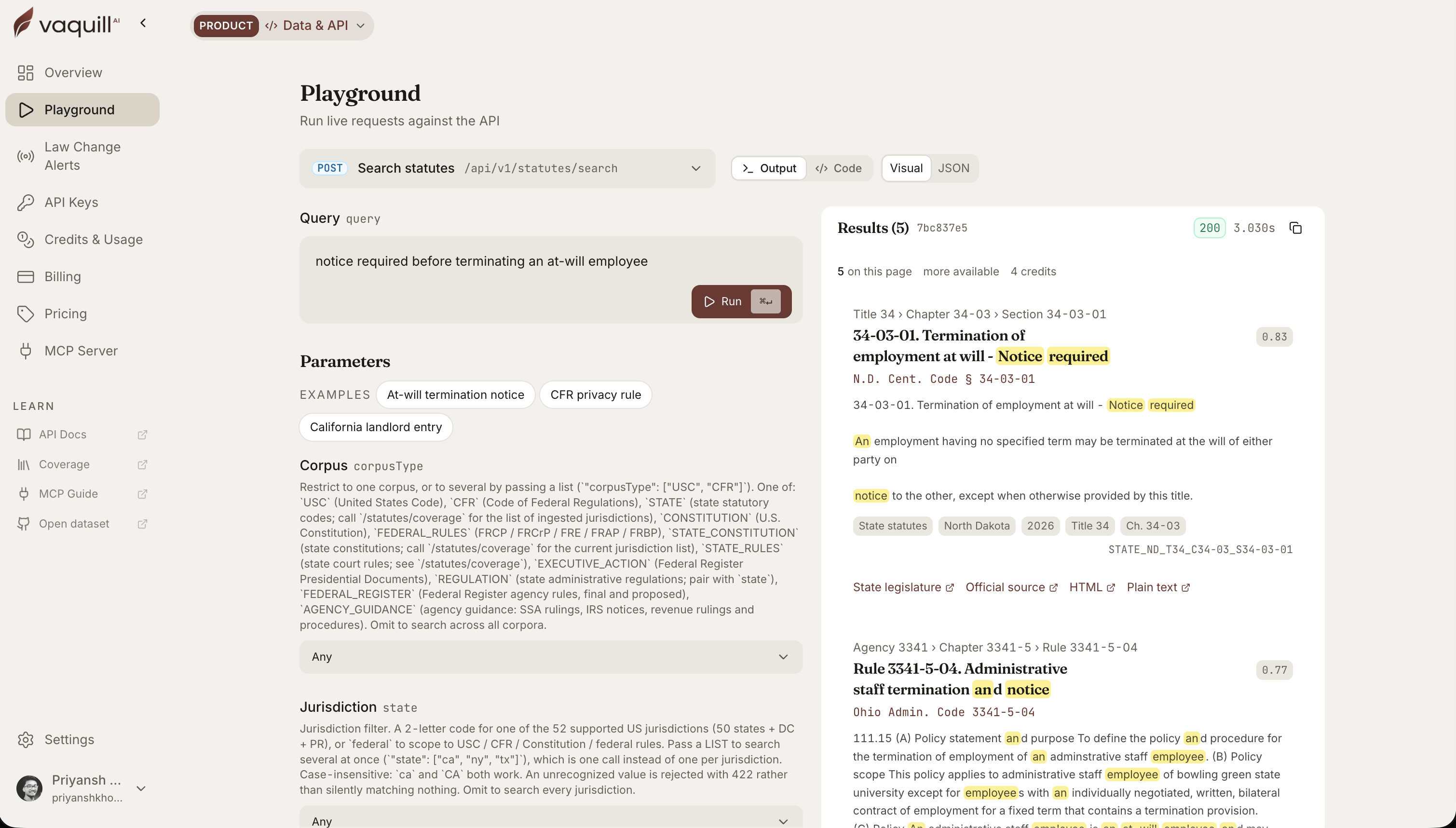 The same corpus behind this article, queried live. Every result carries its citation and a link to the official source.
The fastest way to see where your portfolio actually stands is to run a few of your live agreements through a real check and look at the gap list.
Vaquill AI's compliance check maps a contract against CCPA, GDPR, HIPAA, SOX, PCI-DSS and more in one pass, with severity-ranked gaps and a remediation starting point for each. Upload a DPA or a customer agreement and try it in the workbench to see the clause-level findings on your own paper.
New legal AI guides, weekly.
Further Reading
Legal AI for Chief Legal Officers (CLOs) in 2026
Read postRolling Out Legal AI to Your Team (Adoption Playbook)
Read post12 Best Legal AI Tools for In-House Counsel (2026)
Read postBuild vs Buy: Legal AI for In-House Teams (2026)
Read postYour First Legal Hire: Building an In-House Function With AI
Read postGenerative AI for Legal: An In-House Counsel's Guide (2026)
Read post
Product & Content
Legal AI suite for US working lawyers: research, drafting, document comparison, document matrix, matters, and citation-verified answers, in one tool.