Legal AI for chief legal officers is a department-level decision, not a tool purchase. The CLO job is to govern how the function uses AI, prove a return the board cares about (outside-counsel spend, cycle time, risk), set one data-posture standard, and make adoption stick. A staff lawyer asks if a tool makes Tuesday faster; the CLO has to answer whether the whole function is defensible, cheaper, faster, and safer at once.
Here is the awkward number every chief legal officer is now living with. According to the 2026 ACC/Everlaw survey, 81% of CLOs say generative AI is accelerating legal work, but most cannot prove it. They have the conviction and not the metric.
That gap, the distance between "this is clearly working" and "here is the number I showed the board," is the single most important problem in the CLO seat this year. It is why legal AI for chief legal officers is a different question than legal AI for the lawyer doing the drafting.
The lawyer asks whether the tool makes their Tuesday faster. The CLO answers something harder: does this make the function defensible, cheaper, faster, and safer at once, and can I stand behind it when the CEO asks what we spent and what we got.
Most writing about legal AI is for the first person. This is for the second.
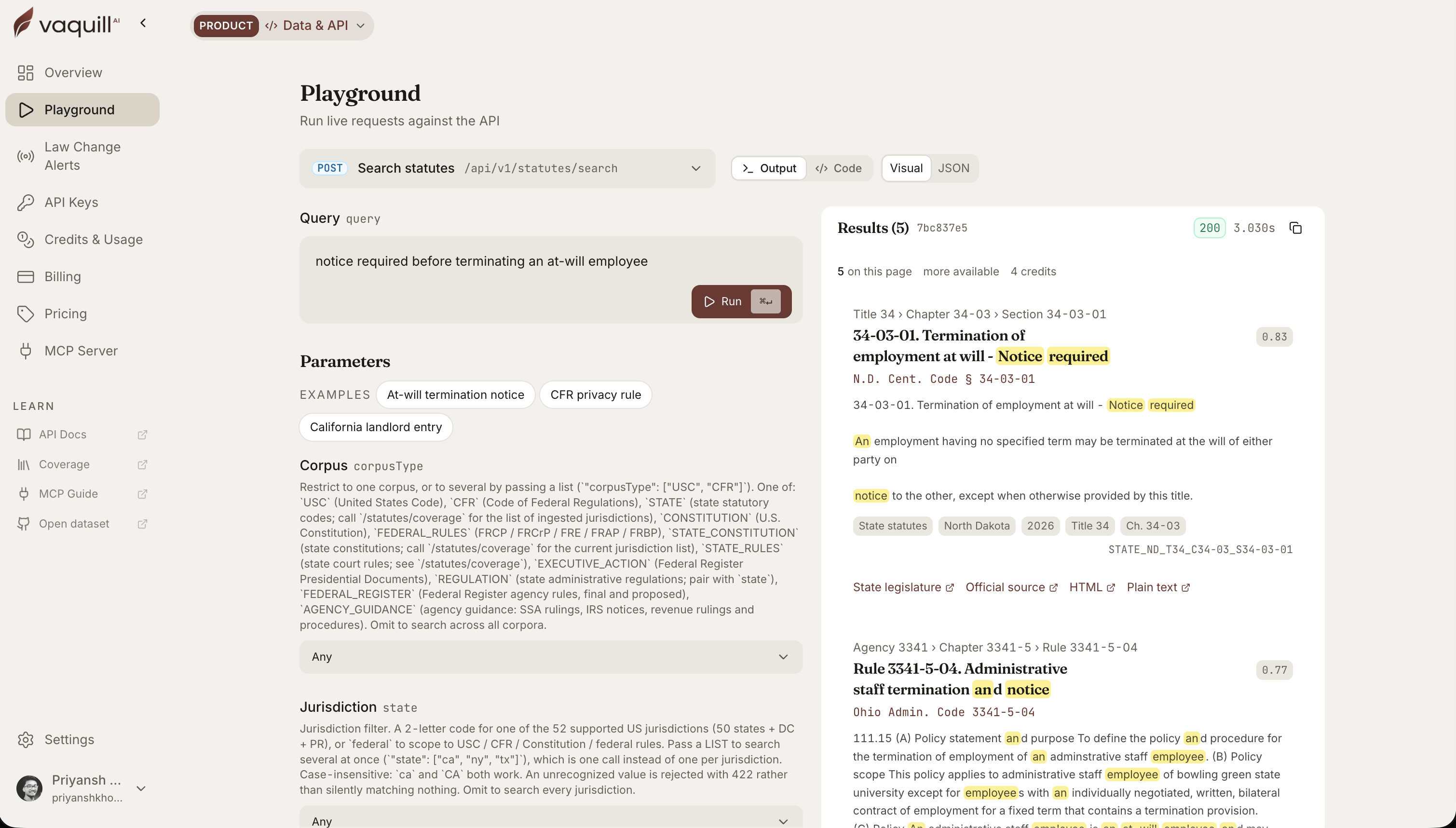 The same corpus behind this article, queried live. Every result carries its citation and a link to the official source.
Vaquill AI's drafting workspace, the kind of standardized, repeatable output a CLO can roll out across the department.
TL;DR
- Adoption is no longer the question. GC use of generative AI jumped from 44% in 2025 to 87% in 2026 (FTI Consulting/Relativity, 2026 General Counsel Report). The CLO's job has moved from "should we" to "how do we govern, measure, and standardize it across the function."
- The board case is not built on "AI is the future." It is built on three lines the CFO already cares about: outside-counsel spend, cycle time, and risk reduction. Lead with the spend.
- Most departments have no AI governance standard, just shadow usage. 56% of legal teams use general-purpose tools like ChatGPT, but only 14% have adopted a purpose-built legal tool (Wolters Kluwer). That spread is a data-leak problem the CLO owns.
- Measurement is the moat. The CLOs who win budget next cycle are the ones who instrumented matter intake, cycle time, and self-service rate before they bought, not after.
- Buy-vs-build is mostly settled for departments under a few hundred lawyers. The math on building rarely clears once you price the team you would have to hire.
- Adoption fails on workflow, not on the model. If the tool lives outside the systems your team already works in (Word, the matter file, the inbox), it dies quietly regardless of how good the AI is.
What share of CLOs say generative AI is accelerating legal work but cannot prove it?
Why "legal AI for chief legal officers" is its own problem
A CLO does not own a task. A CLO owns a function, plus the risk it reports up. So evaluating AI is not about whether a model can draft an NDA; you know it can.
It is five questions a staff lawyer never has to ask:
- Can I show the board a return without hand-waving.
- Can I set one standard for the whole department instead of fourteen people each pasting contracts into a consumer chatbot.
- Can I measure whether the function is actually getting faster, or just feels busier.
- Should I buy this, or is my department big enough that building makes sense.
- Will my team actually use it, or will I have bought shelfware with a logo.
Each is a real decision with a real cost of being wrong. Take them in order.
These five are not a checklist you clear once. They are a loop a CLO reruns every budget cycle, each pass tightening the standard, the metric, and the adoption.
BCG framed the same shift in March 2026 (BCGonTech, "From Pilots to Impact," named without a link because Medium blocks automated checks): 91% of legal teams now pilot AI and 93% use general-purpose assistants, yet most have not scaled the impact. The three questions BCG says every general counsel should ask map directly onto the CLO seat: are my people willing and able to use it, does outside counsel have any incentive to use it, and have I changed how legal engages the business. The work is no longer adoption. It is turning adoption into a result you can report.
Building the board case: lead with spend, not with "the future"
The mistake I watch CLOs make is pitching AI to the board as transformation. Boards have heard "transformation" about every technology since the fax machine. What a board responds to is a number it already tracks moving the right way, and for legal that is outside-counsel spend.
The timing is unusually good. For years, in-house budgets braced for outside counsel to keep climbing. That expectation just broke: in CLOC's 2026 State of the Industry Report, the share of departments expecting to increase outside-counsel spend fell from 58% the prior year to 37%.
Legal leaders now believe they can keep more work in-house, and AI is a big part of why. The first-draft contract, the redline against your own playbook, the research memo, the routine review once shipped to a firm at firm rates: those are the jobs a workbench handles now.
So the board case writes itself if you frame it as spend, not magic. Make it concrete. Say your department sends 200 routine vendor agreements a year to a firm, each about 3 hours of associate time at roughly $600 an hour, call it $1,800 a review, or $360,000 you can point at.
Bring 70% of that volume in-house on AI-assisted draft-and-review, keep firm escalation for the hard 30%, and you are modeling roughly a quarter-million dollars clawed back against a seat cost in the low thousands per year. The figures are yours; the slide is a category, a count, a per-unit cost, a percentage you keep in-house. That is a CFO conversation, not a hype one. To put real numbers behind it, our ROI calculator is built for this.
The second line is cycle time, because the board feels slow legal as a revenue problem long before a cost one. A deal that sits eleven days instead of three is a deal the business resents. Show contract turnaround dropping and you are no longer the department that says no; you are the department that ships.
Gartner estimates generative AI could lift legal-department productivity 10% to 20% over the next two to five years, mostly by killing rework and duplication. The CLOs who capture that are the ones who can name where the time went.
The third line, the one most likely to save your job, is risk reduction. More on that next, because it is also where the danger lives.
Setting the governance and data-posture standard
Here is the uncomfortable reality under the adoption numbers: your team is already using AI. The only question is whether it is something you sanctioned or something they found.
The Wolters Kluwer Future Ready Lawyer 2026 report puts hard edges on it: 56% of legal departments use general-purpose generative tools (the consumer chatbots), only 14% have adopted a purpose-built legal solution, and 40% report no sanctioned AI at all.
Stack those and the pattern jumps out: a large slice of departments has "no AI strategy" on paper and rampant consumer-tool use in practice. That is the worst of both worlds, unsanctioned AI touching privileged material with no audit trail, no data guarantee, no one accountable.
This is the part of the CLO job that does not delegate. 2026 is the year AI governance stops being an IT footnote, and the pressure comes from concrete US signals: ABA Formal Opinion 512 on a lawyer's duties of competence and confidentiality with generative AI, the steady drip of court sanctions for fabricated citations in filings, SEC examination focus on AI-driven third-party vendor risk, and the patchwork of new state privacy laws taking effect this year.
The governance standard a CLO sets has three parts, and you can write a first version in an afternoon:
- A data posture line. State plainly whether your tools may train on your matters. For privileged work the answer is no, and it has to live in the vendor contract, not on a marketing page. Demand specifics before signing: no training on your data, retention limits and deletion rights, audit logs, a current SOC 2 or ISO posture, a disclosed subprocessor list, privilege handling, and breach notice. That clause set disqualifies more consumer tools than any feature comparison.
- An approved-tool list. Replace "use your judgment" with a short list of sanctioned tools and a rule that privileged material goes nowhere else. Shadow AI thrives where no sanctioned alternative exists, so give people something good enough that they stop reaching for the chatbot.
- A human-accountability rule. Every AI output that leaves the department carries a named owner who reviewed it. That line keeps you out of the sanctions headlines and lets you tell the board, honestly, that AI is assistive, not autonomous.
For the data-posture clause, here is the actual scorecard to run a vendor through before you sign. Pass means it survives a privilege question from your CFO or your auditor.
| Requirement | Pass | Fail |
|---|---|---|
| Training on your data | Contractual "no training on customer content" | "We may use data to improve our services" |
| Retention and deletion | Stated retention limit plus a deletion-on-request right | Indefinite retention, no deletion path |
| Security posture | Current SOC 2 Type II or ISO 27001, report on request | "Enterprise-grade security" with no report |
| Subprocessors | Disclosed list, notice on change | Undisclosed, can change silently |
| Audit logs | Per-user activity logs you can export | None |
| Privilege handling | Documented, output stays in your tenant | Output routed through shared infrastructure |
| Breach notice | Defined window in the contract | Silent or "best efforts" |
That seven-line check disqualifies more consumer tools than any feature comparison. For a structure rather than a blank page, we wrote a full AI governance policy template for in-house legal you can adapt. The point is to ship a v1 now.
An imperfect standard that exists beats the perfect one you are still drafting while your team pastes contracts into a public model.
Measuring the department: the metric is the moat
Back to that opening number. 81% of CLOs feel the lift and cannot prove it, and the reason is almost never the technology. It is that legal departments never instrumented themselves. You cannot show a before-and-after on cycle time you never measured.
So the highest-leverage move a CLO can make in 2026 is not buying a tool. It is deciding what the function measures and starting a quarter before the AI arrives, so you have a baseline.
Make each metric a one-line commitment the board can hold you to. "NDA turnaround, 6 days now, 2 days by Q3, reported by the ops lead" is a sentence a board remembers: metric, baseline, target, owner. The metrics that move them are not exotic:
- Cycle time per matter type. Intake to done for an NDA, a vendor agreement, a commercial deal. Your proof that legal got faster.
- Outside-counsel spend by category. Where the money goes and which categories you are clawing back in-house. Your proof that legal got cheaper.
- Throughput and self-service rate. How much volume the same headcount absorbs, and how much routine work the business now handles itself with templates. Your proof that legal scaled without hiring.
- Risk surface. Open matters past SLA, contracts signed outside the playbook, share of work touching a sanctioned tool versus an unsanctioned one.
The departments that win budget treat their operation as data. If your matter management and your AI live in one system, these numbers fall out for free instead of becoming a quarterly spreadsheet fire drill.
That is the quiet argument for an integrated workbench over a pile of point tools: not the features, the reporting. Our legal operations software guide goes deeper on the stack.
Buy vs build: picking AI for a CLO's department
Every CLO past a certain size eventually gets asked, usually by an enthusiastic engineering leader, why not build this ourselves. We have the data, the models are on tap.
Before that, know that "buy" is not one option. The 2026 market breaks into categories, and the tradeoff is coverage versus depth versus ownership.
| Category | What it does well | The blind spot | Best for |
|---|---|---|---|
| Enterprise general-purpose AI | Broad reach, cheap seats | Not legal-aware, no privilege posture | Org-wide productivity, not legal work product |
| CLM-native AI | Smart inside the contract system | Blind outside the contract record | Departments whose only pain is contracts |
| Drafting-and-research workbench | Drafting, review, redlining, matter work in one place | Trades the last 5% of depth on any single task | Departments wanting one data posture and one reporting layer |
| E-discovery AI | Litigation review at scale | Litigation-only, no transactional value | Heavy-litigation functions |
| Build-your-own copilot | Fits idiosyncratic workflows exactly | You own maintenance, security, and evaluation forever | Departments already running legal engineering |
A general copilot covers everything shallowly, a point tool goes deep on one job and leaves the rest, a workbench trades a little depth for the integration and reporting a function runs on. Most departments under a few hundred lawyers pick the workbench because the reporting and single data posture matter more than the last 5% on any task.
The build question deserves a real answer, and for most departments it lands on "buy." Building looks cheap when you price only the model API. It stops looking cheap the moment you price the rest: the people who maintain it, the legal-specific evaluation to know it is not quietly wrong, the security review, the Word integration nobody wants to own, the on-call rotation for when it breaks at 6 p.m. before a signing.
You are not building a feature, you are starting a product team inside a cost center, recruiting against actual AI companies.
The defensible build case is narrow: a department large enough to already run a legal-engineering function, with workflows so idiosyncratic no vendor fits, and the stomach to own maintenance forever.
For a 2-to-10-person legal team that is not you, and buying a tool that already solved the integration, security posture, and evaluation is the disciplined choice. The build instinct usually traces to frustration with one bad vendor, which argues for a better vendor, not for becoming one.
The change-management reality nobody puts in the deck
You can clear the board, write the governance standard, pick the right tool, and still fail. The most common way legal AI dies is not rejection but indifference. People try it twice, it lived in a separate tab, it did not fit how they work, and they drift back to the old way without telling you.
The pattern across the rollouts that stuck is blunt: the tool has to meet the lawyer inside the workflow they already live in. The common failure mode: a in-house team buys a slick contract-review product, runs an enthusiastic 30-day NDA pilot, and watches usage crater by week three, not because the suggestions were wrong but because every redline meant leaving Word, working in a portal, and pasting changes back by hand.
The teams that get the opposite result keep the lawyer in the document. AI redlining that produces real tracked changes inside the Word file they are already editing gets used; a separate portal does not, no matter how good the suggestion. Friction is the enemy, and friction is almost always about where the tool lives, not how smart it is.
What separates the rollouts that take from the ones that fizzle:
- Pick a champion, not a committee. One respected lawyer who uses it daily and shows a real win converts more people than any mandate.
- Start with one painful, high-volume job. Contract review against your playbook, or first-draft NDAs. A narrow, undeniable win buys permission for everything after.
- Make the sanctioned tool the path of least resistance. If your approved option is clunkier than the consumer chatbot, governance loses. People route around friction every time.
- Report the wins internally. The same cycle-time and spend metrics you take to the board are what convince a skeptical colleague this is not a fad.
This is the part the CLO cannot outsource to procurement or IT. Adoption is a leadership act: the function changes because the person who runs it decided it would, measured whether it did, and adjusted.
Where this leaves the 2026 CLO
The decision in the CLO seat this year is not whether to use AI; the 87% number settled that. It is whether your department's use of it is governed, measured, and standardized, or happening in the shadows with none of those things. There is no version of 2026 where your team is not using AI.
The CLOs who come out ahead treat this as an operating decision about the function, owned at the top. They lead the board conversation with spend and cycle time, not with the future. They set a data-posture standard their vendor contracts actually enforce.
They instrument the department before they buy so the return is a number, not a feeling. And they pick tools that meet their lawyers inside the work, because the best AI nobody uses is worth exactly nothing.
That is why an integrated workbench, where drafting, review, AI redlining in real Word track changes, and matter management share one data posture and one reporting layer, tends to beat a drawer of disconnected tools for a CLO answering to a board.
FAQ
What is legal AI for chief legal officers?
It is the set of tools and the governance, measurement, and adoption decisions a CLO makes so a whole legal function uses AI safely and provably, not one lawyer using a chatbot. The CLO question is whether AI makes the department defensible, cheaper, faster, and safer at once, and whether the return survives a board question.
How does a CLO build the AI business case for the board?
Lead with outside-counsel spend, then cycle time, then risk reduction, because those are numbers the CFO already tracks. Model a real category: volume sent to a firm, per-unit cost, and the share you bring in-house on AI-assisted draft-and-review. The slide is a count, a per-unit cost, and a percentage you keep in-house, not a pitch about the future.
What is the right legal AI strategy for general counsel in 2026?
Govern, measure, and standardize before you scale. Set a data-posture standard your vendor contracts enforce, instrument cycle time and outside-counsel spend a quarter before the tool arrives so you have a baseline, and pick tools that meet lawyers inside the work they already do. Adoption of generative AI by GCs jumped from 44% in 2025 to 87% in 2026 (FTI Consulting/Relativity, 2026 General Counsel Report), so the strategy question is no longer whether to use it.
Should outside-counsel spend go down now that firms use AI?
Not automatically, because under the billable hour a firm has little incentive to pass savings on. The spend that drops is the routine work you bring in-house: first-draft contracts, playbook redlines, and routine review you used to send out at firm rates. CLOC's 2026 report found the share of departments expecting to increase outside-counsel spend fell from 58% to 37%.
Should a legal department buy or build its own AI?
For almost every department under a few hundred lawyers, buy. Building looks cheap when you price only the model API, then stops once you price maintenance, legal-specific evaluation, security review, the Word integration, and on-call. The defensible build case is a department already running a legal-engineering function with workflows no vendor fits.
What should a CLO ask an AI vendor before signing?
Run the seven-line data-posture scorecard above: no training on your data, retention and deletion rights, a current SOC 2 or ISO report, a disclosed subprocessor list, exportable audit logs, documented privilege handling, and a contractual breach-notice window. A vendor that cannot answer these in writing is a privilege risk, not a tool.
Why do legal AI rollouts fail?
Usually indifference, not rejection. People try a tool twice, it lived in a separate tab, and they drift back. Rollouts that stick keep the lawyer inside the document (AI redlining as real Word track changes, not a portal), pick a champion over a committee, and start with one painful high-volume job.
See it in your own function
If you have to answer the spend-and-return question this quarter, the fastest way to a real answer is to put your own work through it. Start a 7-day trial at app.vaquill.ai, self-serve, no sales cycle, and run a category you currently send to outside counsel through the workbench.
For the department-level picture, see our solution for in-house counsel and the pillar guide, Legal AI for In-House Counsel. If the board case is your priority, start with reducing outside-counsel spend with AI and the ROI calculator.
New legal AI guides, weekly.
Further Reading
Rolling Out Legal AI to Your Team (Adoption Playbook)
Read postAI Compliance Check: CCPA, GDPR, and SOX for In-House Teams (2026)
Read post12 Best Legal AI Tools for In-House Counsel (2026)
Read postBuild vs Buy: Legal AI for In-House Teams (2026)
Read postYour First Legal Hire: Building an In-House Function With AI
Read postGenerative AI for Legal: An In-House Counsel's Guide (2026)
Read post
Co-Founder & CEO · Attorney
Arshita leads product and strategy at Vaquill, building the legal AI suite that solo, small-firm, and in-house US lawyers use to run a matter end to end.