The first in-house counsel hire is the one role at a startup that founders almost always make a year too late. By the time someone finally says "we need a lawyer on staff," there are usually two hundred contracts on the company's paper that nobody reviewed against a standard, a sales team promising indemnity terms the company can't honor, and an outside-counsel bill that quietly crossed the cost of a full-time salary three quarters ago.
The trigger gets noticed in hindsight, in the founder's inbox, not on the org chart.
This is a playbook for that moment, for both sides of it: the founder deciding whether it's time, and the first in-house counsel who just accepted the job and has ninety days to turn a pile of legal exposure into a function.
The thesis is simple and a little contrarian. The first legal hire used to need a small team to be effective. They no longer do, because the AI workbench has compressed what once took three lawyers into what one can run. That changes both when you hire and what you build first.
TL;DR
- Hire when one of three signals fires: legal fees rival a full-time salary, the work needs 40-plus focused hours a week, or a deal is being shaped by people with no legal judgment. Revenue alone (the usual "$5-10M ARR" rule of thumb) is a lagging indicator, not the trigger.
- Be honest about which hire you're making. The first lawyer is usually a builder who runs contracts day to day, not a strategic GC who manages a department. Hiring the second when you need the first is an expensive mismatch.
- The first 90 days are about order, not speed: intake and triage first, then templates and playbooks, then a matter system, then the AI workbench, then a data and AI policy. Build the funnel before you optimize any single task in it.
- Keep the repeatable, high-volume, low-stakes work in-house (NDAs, vendor paper, employment basics, triage). Send the bet-the-company and specialist work out. The line moves as your judgment and your tooling improve.
- AI is what makes a solo function viable. A workbench that drafts, reviews, redlines in real Word track changes, and tracks matters lets one lawyer cover the surface area that used to need a small team, which is exactly why founders can now hire later and lighter.
How many hiring signals should fire before you make the first in-house hire?
When to make the first in-house counsel hire
Start with the question founders actually ask: is it time yet? The honest answer is that revenue is the worst metric to decide on, even though it's the one everyone cites.
The common rule of thumb puts the first general counsel between $5M and $10M in ARR, or once revenue clears roughly $20M. That's a real pattern, but it's a correlation, not a cause.
Plenty of $30M companies run fine on a fractional lawyer for another year, and plenty of pre-revenue companies in regulated markets (health, fintech, anything touching data) need counsel on staff long before the revenue logic kicks in.
Three signals matter more than the ARR line:
- The spend crossover. When the monthly outside-counsel invoice starts rivaling what a full-time lawyer would cost, the math has already flipped. Run the break-even: a first in-house lawyer's base in 2026 commonly lands from the high $100Ks to mid-$200Ks depending on stage and city, before bonus and equity. A fractional GC bills in the $150 to $350 an hour range, so two or three engagements running in parallel quietly clear $150K a year. Once outside spend approaches the loaded cost of a salaried hire, you're paying for a lawyer you don't get to keep.
- The 40-hour test. When the legal work could fill a real work week (not "someone should look at this," but a steady queue of contracts, questions, and fires), you have a job, not a task. Below that, a fractional GC or a firm on retainer is the better buy.
- The judgment gap. The signal nobody puts on a spreadsheet: deals are being shaped, terms agreed, and risk accepted by people whose job is not legal. A sales rep redlining an MSA in a quarter-end push is the most expensive legal hire you'll never see on the budget.
When at least two of those fire at once, it's time. None of them is "we hit a number."
There's a real argument for staying out-of-house longer than the old playbook says. The Association of Corporate Counsel's 2025 Law Department Management benchmarking found companies consolidating their law firm panels (the reported median number of firms a department uses fell from 14 to 10 in a year) and leaning harder on fractional and alternative providers.
For a company whose legal needs are real but lumpy, a fractional GC plus AI tooling can cover the ground a junior in-house hire would, without the fixed cost.
The case for hiring in-house is not "you've grown up enough." It's that institutional knowledge, the kind that lives in a lawyer who sits in the standups and remembers why clause 7 of the standard MSA exists, compounds in a way a rotating outside relationship can't.
You hire to own the memory, not just the hours.
Which hire are you actually making
Here is the mistake that costs the most and shows up the least: confusing the two very different jobs that both get called "first legal hire."
The first internal lawyer most companies need is a builder: someone who lives in contracts, runs the intake queue, drafts and reviews, and fields whatever lands. The strategic general counsel (the executive who sits at the leadership table, owns the department's budget, and shapes corporate risk strategy) is a different animal hired for a different stage.
Most companies making their first hire need the builder but write a job description for the executive, then either overpay for a strategist who is bored doing NDAs, or underpay for a builder and resent that they can't do board-level work.
Be precise. If your week is mostly contracts, intake, and operational risk, hire the builder and pay for execution. If it's genuinely strategic (M&A, fundraising mechanics, regulatory positioning, managing a team), you're past the first-hire stage and into building a department.
Founders, write the job for the work that exists this quarter, not the work you imagine in two years.
Full-time GC, fractional GC, outside counsel, or legal ops
Four models compete for the "first legal hire" budget, and they are not interchangeable. The table below is the decision in one screen. Costs are sourced inline; treat them as ranges, not quotes.
| Model | Typical cost (US, 2026) | What it covers | Best when |
|---|---|---|---|
| Full-time in-house lawyer (builder) | ~$135K-$200K+ base, plus equity and benefits (ZipRecruiter startup GC data, Dec 2025; Robert Half 2026 guide) | Daily contracts, intake, employment basics, institutional memory | Legal work fills a 40-hour week and you want the knowledge to stay |
| Fractional GC | ~$3K-$25K/mo retainer (Lexology, 2025) | Senior judgment 1-2 days a week, proactive risk planning | Needs are real but lumpy, or you want a strategist before a full desk of work exists |
| Outside counsel / law firm | Hourly, often seven figures a year for sizable departments (ACC, 2025 benchmarking) | Specialist and bet-the-company work, as needed | Low-volume, high-stakes, or specialist matters (M&A, litigation, IP prosecution) |
| Legal ops hire | Varies by seniority | Process, tooling, vendor and spend management, not legal advice | You already have lawyers and the bottleneck is workflow, not judgment |
For most first hires the real contest is the builder versus a fractional GC. If you want the fractional path first, our guide to legal AI for fractional general counsel covers how one senior lawyer runs several clients on a workbench.
For the candidate: treat the offer like an investment
The founder's side of this decision gets all the ink. The lawyer accepting the job has the harder read, and the best first in-house hires run diligence on the company the way an investor would before wiring a check (Legal Dive / BarkerGilmore, 2025).
Start with the numbers you would want as a shareholder, because with equity you effectively are one. Cash burn and runway tell you whether the role survives the next down round. The investor syndicate tells you who backs the company and how patient that money is. The growth assumptions tell you whether the legal work you are hired to handle is real or aspirational.
Then pin down the role itself. Leadership almost always wants a functional hire who clears contracts and reduces friction, not a strategic advisor with a board seat, whatever the title on the offer says. Test their thinking directly: ask what specific work lands on your desk in month one. If the answer is a queue of MSAs and DPAs, you are the builder from the section above, and that is fine as long as everyone agrees on it.
Watch for one red flag in particular: management that expects outside-counsel spend to drop to zero. It never does. There will always be litigation, specialist regulatory questions, and bet-the-company matters you should not touch alone. A leadership team that budgets for zero outside spend has not thought clearly about legal, and you will spend year one managing that expectation instead of the work.
Two structural terms are worth negotiating before you sign. First, the reporting line: early in-house hires often report to the CFO or COO rather than the CEO, which reflects the tactical nature of the first hire. That can work, but get CEO access in writing for the matters that need it. Second, authority over outside counsel: own the decision to hire and fire firms, or you will be accountable for a bill you cannot control.
The first 90 days: build the funnel, then optimize it
Every credible "first 90 days as GC" guide says the same counterintuitive thing, and new in-house lawyers ignore it under pressure: the first three months are about doing the right things in the right order, not doing everything fast.
The instinct is to start answering questions and putting out fires, because that feels productive. The discipline is to build the funnel first, so the questions and fires route through a system instead of through your DMs.
Here's the order that works, each stage feeding the next.
Days 1 to 30: intake and triage
You cannot manage demand you cannot see. Before anything else, stand up a single front door for legal requests. Not a fancy contract-lifecycle platform on day one, just one form or channel where every "can you look at this" lands.
It does two things: stops legal work from arriving as random taps on the shoulder, and within two weeks shows you the actual shape of demand. You'll learn that most of your queue is the same three contract types, that one business unit generates half the volume, and that the "emergencies" cluster predictably around quarter-end.
A concrete version: the first GC at a Series B SaaS company expects the queue to be product and partnership work. Four weeks of intake data usually says otherwise. The real demand drivers turn out to be inbound customer MSA redlines clustered at quarter-end, DPA review triggered every time a prospect's procurement team shows up, and vendor security questionnaires engineering keeps forwarding with "can legal answer this?"
Three mundane, high-frequency categories, not the strategic work in the job posting. That mismatch is the most useful thing the first month teaches you, and you can only see it if requests route through one door.
Run one thing in parallel with the intake build: a listening tour. Sit with the leaders who generate legal work (sales, product, the CFO) and ask what slows them down. The intake front door is your first visible quick win, the thing that proves legal is a service and not a speed bump. Every experienced first GC says a version of the same line: in the opening ninety days, trust with leadership matters as much as any system you stand up, because legal advice nobody trusts gets ignored (SpotDraft, 2025).
That data is the whole game: it tells you what to systematize next. Triage on the way in: this gets handled in-house, this gets a template, this goes to outside counsel. Our breakdown of a matter intake and triage workflow for a solo GC walks through how to build the front door so it scales past you.
Days 30 to 60: templates and playbooks
Now that intake has told you what repeats, kill the repetition. Take your three highest-volume contract types and build a standard template for each, plus a playbook: your fallback positions, your walk-away terms, the clauses you'll never accept, and the ones you'll trade.
A playbook is the highest-leverage artifact a solo legal function produces, because it's how you delegate your judgment without cloning yourself. Once sales knows the approved redline positions on the standard MSA, half your review queue stops reaching you at all.
This is also where AI earns its first keep. Building a clause library and fallback positions from your existing signed contracts is exactly the pattern work that used to eat a junior associate's week and now takes an afternoon with the right tooling.
Days 60 to 90: the matter system and the workbench
With intake routing demand and playbooks absorbing the routine, stand up the system that holds it all: a matter system so you know what's open, what's stuck, and what's waiting on the business, and an AI workbench so you can execute the volume alone.
A matter system at this stage does not mean enterprise software. It means one source of truth where every active piece of legal work has an owner, a status, and a next step, so nothing dies in your inbox and you can answer "where does the Acme deal stand" without a search party. Visibility, not bureaucracy. (Our in-house legal software guide for 2026 covers what to buy and what to skip.)
The workbench is the multiplier, and it gets its own argument below. The sequencing matters: bring it in after intake and playbooks exist, because the workbench amplifies whatever you point it at. Pointed at chaos, AI just produces faster chaos.
The piece everyone skips: a data and AI policy
Before day 90, write the one document nobody asks you for and everyone needs: a short policy on how the company (and you) use AI on legal and confidential work. This is not corporate hygiene.
Under ABA Formal Opinion 512, the July 2024 guidance on generative AI, managerial lawyers have an affirmative duty to set policy on AI use, and the competence and confidentiality rules apply to in-house counsel with the same force as in a firm. The opinion is blunt: don't feed company confidences into tools that train on your inputs, and boilerplate consent buried in a contract won't cover you.
In practice, the policy is short. Which tools are approved. What can and can't go into a general-purpose chatbot. The rule that any legal AI touching company contracts must contractually exclude your data from training. Who reviews AI output before it leaves the building.
Our pillar on legal AI for in-house counsel covers the governance and evaluation criteria in full.
What stays in-house and what goes out
The whole point of the first hire is to pull work in-house, but pulling all of it in-house is how a solo lawyer burns out by month four. Draw the line deliberately.
Keep in-house the work that is high-volume, repeatable, and low-to-moderate stakes. NDAs, standard vendor and customer paper, run-of-the-mill employment questions, the intake and triage itself, first-pass review against your playbook. This is the work that builds institutional memory and where speed matters more than specialist depth. It's also the work AI compresses, which is why one lawyer can now own all of it.
Send out the work that is low-volume and high-stakes, or genuinely specialist. Bet-the-company litigation, the actual M&A mechanics when you sell or raise, novel regulatory questions in a domain you don't live in, patent prosecution.
You are not trying to replace the law firm. You are trying to stop paying firm rates for NDA review, and to become a demanding buyer of the firm work you do need. Partner rates at large firms now clear $1,000 an hour (First Round Review, 2024), so every routine agreement a firm touches at those rates is money a playbook and a workbench would have kept.
A good in-house lawyer often saves more by managing outside counsel well (consolidating the panel, scoping engagements, killing the open-ended hourly drift) than by doing the work themselves. The ACC benchmarking puts median outside-counsel spend in the seven figures for sizable departments, and a lot of that is recoverable just by having someone in the building who reads the bills.
The line is not fixed. As your playbooks mature and your tooling gets sharper, work that felt too risky to keep in-house last quarter becomes routine. The line moves inward over time, and that drift is the function getting healthier.
Why one lawyer can now do what a team used to
This is the structural shift that rewrites the old playbook, and it's worth being specific about rather than gesturing at "AI changes everything."
A first-hire legal function historically needed a small team for a boring reason: the work was bottlenecked at the keyboard. One person could only draft, redline, and read so many agreements in a week before review quality dropped or the queue backed up. So you hired a contracts manager, then a paralegal, then a junior associate, and the function grew to match the volume.
The workbench breaks that link between volume and headcount. When a lawyer can review a contract against a playbook in minutes instead of an hour, generate a clean first redline in real Microsoft Word track changes (the kind a counterparty can accept or reject clause by clause, not a rewritten blob), build a document matrix across a stack of agreements at a glance, and have matter status maintained as a byproduct of the work, per-lawyer throughput multiplies.
The bottleneck moves from execution to judgment, which is the one thing you actually hired a lawyer for.
That's the quiet reason founders can hire their first lawyer later and lighter than the 2018 playbook said. It's not that legal matters less. A single sharp operator with the right workbench covers the surface area that used to require three people, so "can one hire handle this" tilts toward waiting until you genuinely need the judgment, then giving that person tooling that works on day one, not month six.
The caution worth stating: tooling amplifies judgment, it doesn't replace it. Be precise about the line. AI owns the execution layer: extracting clauses, generating a first redline, building a comparison matrix, flagging deviations from your playbook.
The lawyer keeps the accountability layer: the final call on a negotiated position, the privilege and confidentiality judgment about what goes into a tool at all, the check on whether the AI invented a clause or a citation, and the sign-off before anything leaves the building. AI pointed at a function with no playbooks, no intake, and no policy produces faster mistakes. Build the funnel, then turn on the amplifier.
FAQ
When should a startup hire its first in-house lawyer?
Hire when at least two of three signals fire: outside-counsel fees rival a full-time salary, the legal work fills a real 40-hour week, or non-lawyers are shaping deals and accepting risk. A common shortcut is to act when outside legal fees reach roughly twice the cost of a good in-house lawyer (TechCrunch, March 2022). Revenue thresholds like "$5M-$10M ARR" track the pattern but lag the actual need, especially in regulated markets like fintech and health.
What does the first in-house counsel actually do?
The first hire is usually a builder, not a strategist. The day-to-day is contract drafting and review, running an intake queue, NDAs and vendor paper, employment basics, and triaging what goes to outside counsel. Strategic work (M&A mechanics, fundraising, regulatory positioning) comes later, often once the same person grows into the role.
How much does a first in-house lawyer cost in 2026?
Base salary for a startup in-house lawyer commonly runs from the mid $100Ks to low $200Ks before equity and benefits (Robert Half 2026 guide; ZipRecruiter startup GC data, Dec 2025). A fractional GC is the cheaper entry point at roughly $3K-$25K a month on retainer (Lexology, 2025), which is why lumpy or early-stage needs often start there.
Should I hire a full-time GC or a fractional general counsel first?
If legal work fills a real work week and you want the institutional memory to stay, hire full-time. If the work is real but lumpy, a fractional GC plus AI tooling covers similar ground without the fixed cost. The deciding question is volume and continuity rather than seniority. See our fractional general counsel guide for the economics.
What should the first in-house counsel build in their first 90 days?
In order: a single intake-and-triage front door (days 1-30), templates and playbooks for the highest-volume contract types (days 30-60), a matter system and an AI workbench (days 60-90), and a short data-and-AI policy before day 90. Build the funnel first, then optimize tasks inside it.
Can one lawyer really run an in-house legal function alone?
Yes, more than the old playbook assumed. An AI workbench that reviews against a playbook, generates redlines in real Word track changes, builds document matrices, and keeps matter status current lets one lawyer cover surface area that used to need a small team. AI owns execution; the lawyer keeps judgment and sign-off. See will AI replace in-house lawyers for where the line sits.
Who should the first in-house lawyer report to?
Early first hires commonly report to the CFO or COO rather than the CEO, which reflects the tactical, contracts-heavy nature of the role (Legal Dive / BarkerGilmore, 2025). That structure works, but if you are the candidate, negotiate direct CEO access for the matters that need it, plus clear authority to hire and fire outside counsel, before you accept.
Does the first hire mean firing the law firm?
No. The point is to stop paying firm rates for repeatable work (NDA review, standard paper) and to become a demanding buyer of the firm work you still need. Bet-the-company litigation, M&A mechanics, and specialist regulatory questions stay with outside counsel.
The takeaway
Founders: make the hire when the spend, the hours, or the judgment gap tell you to, not when a revenue chart does. Write the job for the builder you need this year, not the strategist you imagine in two. The strategist comes later, if at all, and often the builder grows into the role.
And the first legal hire is no longer the start of a department. With the right workbench, it can be a complete, durable function of one. That's the genuinely new thing, and it's good news for in-house teams.
See what a function of one can run
If you're the first in-house counsel standing up a function (or a founder deciding when to make that hire), the fastest way to feel the difference is to run a real contract through a workbench and watch the redline land in your own Word track changes. Drop in an NDA or MSA you've reviewed a hundred times at app.vaquill.ai. Then decide for yourself whether the first hire still needs a team behind it.
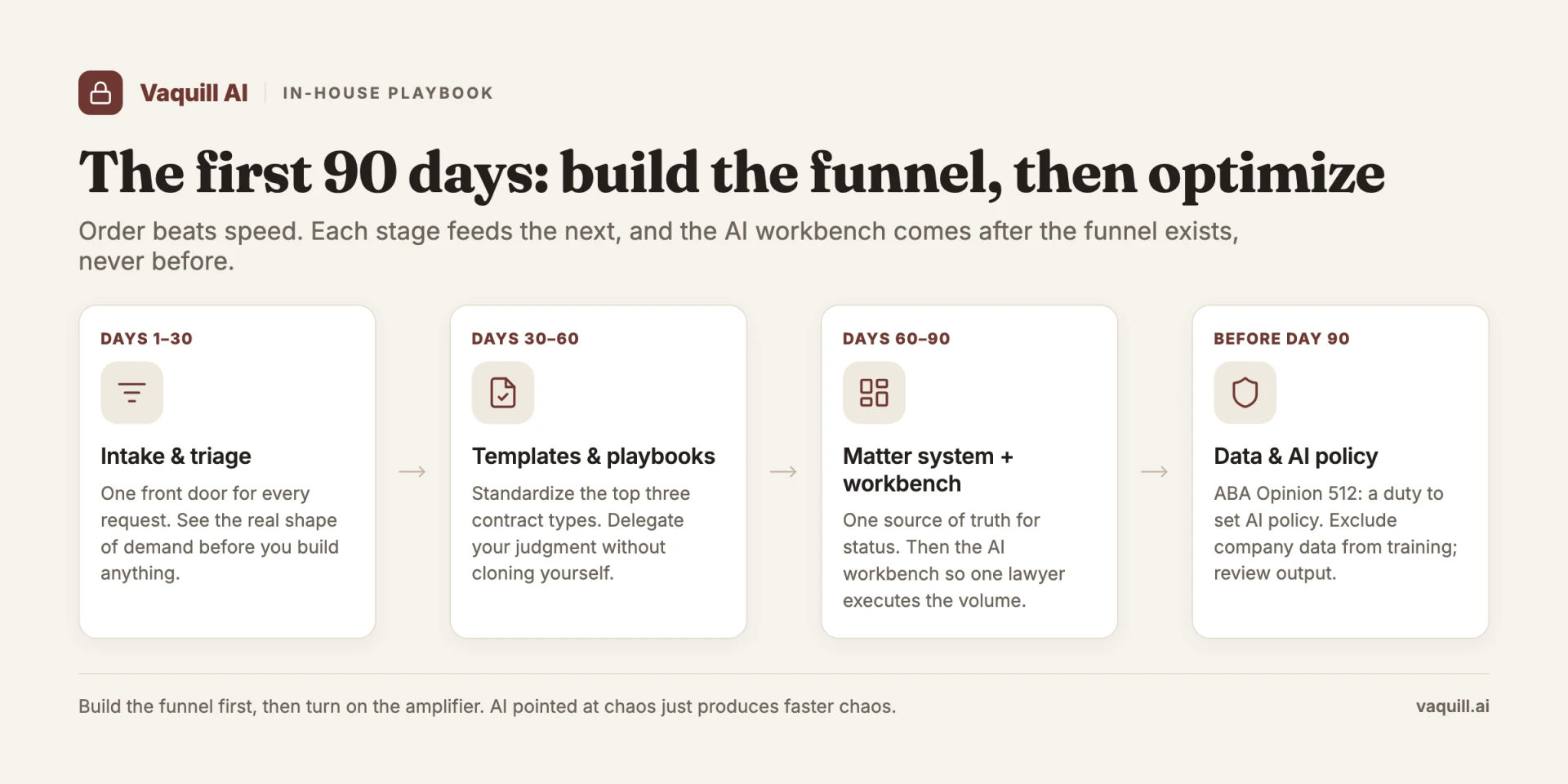
The first 90 days in order: intake and triage, templates and playbooks, matter system plus AI workbench, then a data and AI policy.
New legal AI guides, weekly.
Further Reading
Legal AI for Chief Legal Officers (CLOs) in 2026
Read postRolling Out Legal AI to Your Team (Adoption Playbook)
Read postAI Compliance Check: CCPA, GDPR, and SOX for In-House Teams (2026)
Read post12 Best Legal AI Tools for In-House Counsel (2026)
Read postBuild vs Buy: Legal AI for In-House Teams (2026)
Read postGenerative AI for Legal: An In-House Counsel's Guide (2026)
Read post
Co-Founder & CEO · Attorney
Arshita leads product and strategy at Vaquill, building the legal AI suite that solo, small-firm, and in-house US lawyers use to run a matter end to end.