The fastest way to misjudge generative AI for legal work is to ask whether it is "good enough for lawyers." Wrong frame. The model is not the lawyer and was never going to be.
The real question, the one that separates teams who get leverage from teams who get sanctioned, is narrower and more useful: which slices of an in-house week can you safely hand to a probabilistic text engine, and what has to be true about your setup before you do it?
By mid-2026 the adoption argument is over. The ACC/Everlaw survey found active generative AI use in corporate law departments jumped to 52% in 2025, more than double the 23% a year earlier. The FTI/Relativity General Counsel Report put GC-level usage at 87%, up from 44% the year before.
In-house legal did not wait for permission. It moved faster than the law firms it hires, and now the interesting work is operational, not philosophical.
Short answer: Generative AI for legal means using large language models to draft, review, summarize, and research legal work. For in-house counsel it pays off on first-draft contracts, clause-by-clause review against your playbook, redlining, summarization, and first-pass research. It stays risky on citations, privilege, and final judgment. The teams that win pair it with three small governance pieces (a data posture, a one-page use policy, and a verification gate) and keep a human between the model and anything that gets filed, sent, or signed.
TL;DR
- The adoption debate is settled: in-house generative AI use roughly doubled in a single year (ACC/Everlaw: 23% to 52%; FTI: 44% to 87%). The open question is governance, not whether to use it.
- GenAI is strong at first-draft contracts, clause-by-clause review against your positions, redlining, summarization, and first-pass research. It is weak exactly where it sounds most confident: citations, edge-case judgment, and anything touching privilege if your data posture is wrong.
- The Stanford RegLab study found even purpose-built legal tools hallucinated on 17% to 33% of research queries. "Legal-grade RAG" reduces the problem; it does not remove your duty to verify.
- The governance you need is small and concrete: a written data posture, a one-page AI use policy, and a verification step that happens before anything leaves the building. Not a committee.
- Adopt narrow and deep. Pick two recurring jobs, instrument them, and expand from evidence, not from a vendor roadmap.
How much did active generative AI use in corporate law departments reach in 2025?
How generative AI for legal actually works
Three layers sit behind every legal AI tool, and knowing which is which tells you where it will fail.
The foundation model (GPT, Claude, Gemini) is the language engine. On its own it predicts plausible text, which is why a raw chatbot will invent a case that reads perfectly and does not exist. Retrieval-augmented generation (RAG) bolts a search step in front of the model: before it answers, it pulls real documents (your templates, your prior deals, a statute database) and tells the model to answer from those. Your data posture is the contract layer that decides where your inputs go, whether the vendor trains on them, and how long they are kept.
RAG is why a purpose-built legal tool beats a consumer chatbot on accuracy, and the data posture is why it can be safe for privileged work. Neither layer removes your duty to verify, a point the Stanford data below makes hard to ignore.
What generative AI for legal actually does well
Start with where the leverage is real, because that is also where the survey data and the ROI agree. Here is the at-a-glance version before the detail.
| Use case | What genAI does | Risk level | Verification needed |
|---|---|---|---|
| First-draft contracts | NDA, MSA, DPA, offer from your template + plain instructions | Low | Human reads every word before it ships |
| Clause review vs playbook | Flags clauses that deviate from your positions, ranked | Low to medium | Read every clause that cleared, not just the flags |
| Redlining | Returns Word track changes the counterparty can accept or reject | Low | Confirm edits match your intended position |
| Summarization and triage | 90-page agreement to operative obligations, NDA stack sorted | Low | Spot-check the operative terms against the source |
| First-pass research | Orientation, what statute governs, what to read next | High | Pull and read every cite against primary law |
The pattern in that table: drafting and summarization are where you start, research is where you stay cautious. Now the detail.
First-draft contracts: the safest place to start
The single highest-volume in-house job, and the one genAI handles best. An NDA, a vendor MSA, an employment offer, a DPA from your own template and plain-English instructions, in seconds. In the ACC data, drafting was the most common application by a wide margin.
The reason is structural: drafting is generative by nature, you already own the source of truth (your templates and prior deals), and a human reviews every word before it goes out. The failure mode of a bad first draft is wasted time, not malpractice.
That asymmetry is why drafting is the safest place to start. See AI legal drafting for what jurisdiction-aware, template-bound generation looks like in practice.
Clause-by-clause review against your playbook
This is the job generic chatbots do worst and purpose-built tools do best, because the value is not summarizing the contract, it is comparing the contract to what your company will and will not accept. Give the model your playbook (limitation of liability capped at 12 months fees, no auto-renewal past 30 days, mutual indemnity only) and it flags every clause that deviates, ranked by how far off it is.
Picture a 30-inbound-NDA week: triage that used to eat a full day now sorts the stack in minutes, standard agreements clear fast, and the two genuinely off-market ones surface to the top.
The catch worth internalizing: a tool tuned to your playbook will catch the deviations it was told to look for and can sail right past a non-standard auto-renewal buried in a definitions section if your playbook never named it. The model checks against your list, not against your instincts, which is exactly why a human still reads the ones that clear. The legal tools suite treats review, redline, and matter as one continuous job rather than three apps. For the full method, see the AI contract review guide and the in-house contract review playbook.
Redlining in real track changes
Underrated, and the detail that separates a tool you actually use from a demo you abandon. If the output is a chat window full of "consider revising clause 8," you still have to do the work.
If the output is a Microsoft Word document with real track changes your counterparty can accept or reject, you have offloaded the mechanical part of negotiation. The deliverable is the point, not the conversation about it.
Summarization and triage
A 90-page master agreement compressed to its operative obligations, a stack of inbound NDAs sorted by which ones deviate from standard, a board deck distilled to the three questions legal needs to answer. This is genAI working inside its competence: reading long documents and surfacing what matters. Low risk, high time savings, every day.
First-pass research
Note the qualifier. First-pass means orientation and source-finding, not legal conclusions you rely on. GenAI is excellent at orienting you (what is the general shape of the law here, what statute likely governs, what should I be reading) and dangerous as a final authority.
Every proposition it hands you has to be verified against primary law or trusted secondary material before it informs advice or goes near a filing. Use it to start the research, never to end it. For more day-to-day jobs and prompt patterns, see practical AI uses for in-house legal teams and 100 generative AI prompts for in-house lawyers. Which brings us to the part most guides soft-pedal.
Where it breaks, and why the failures cluster
The mistakes are not random. They concentrate in three places, and all three are predictable.
Hallucination, still, in 2026. The Stanford RegLab study (peer-reviewed in the Journal of Empirical Legal Studies in 2025) tested the marquee legal research tools, Lexis+ AI and Westlaw's AI-Assisted Research among them, and found hallucination on more than 17% of queries for the best performer and roughly 33% for another, where a hallucination meant a response that was either factually wrong or cited a source that did not support it.
These are not consumer chatbots. These are the purpose-built, retrieval-augmented, sold-to-lawyers systems. RAG narrows the gap; it does not close it.
The practical translation: a tool can be genuinely good and still be wrong one time in five, and it will be wrong in the most fluent, citeable, professional-looking prose you have ever read. That is the trap.
Confidence is not correlated with accuracy in a language model, and lawyers are trained to read confident prose as reliable prose.
For the full anatomy of how this ends in court, see AI hallucinations and the sanctions reality.
Privilege and data exposure. The risk people underestimate, and the one where the lawyerly distinctions matter most. Pasting a privileged memo into a free consumer chatbot is not the same risk as using an enterprise tier with a signed agreement, and the difference lives in four variables: does the vendor train on your inputs, what is the retention window, who can the provider disclose to, and what does your contract actually bind them to.
A consumer tool that trains on inputs and retains them indefinitely is a genuine confidentiality problem under Model Rule 1.6 and a plausible privilege-waiver argument; an enterprise tier with zero retention, no training, and a DPA is a defensible posture. The mistake is treating "AI" as one risk category instead of reading those four variables for each tool.
ABA Formal Opinion 512 (July 2024) is explicit that lawyers must understand where their inputs go before they use a tool, and that "self-learning" tools that train on inputs raise distinct confidentiality problems.
The fix is not "don't use AI." It is "use AI with a verified data posture": zero retention with the model provider, no training on your data, US residency, a BAA where you handle PHI. Get it in writing. The compliance-check workflow exists because the data question and the legal question are the same question for an in-house team.
Overconfidence and the judgment gap. GenAI has no model of consequence. It does not know that this indemnity clause is the one that matters because your company got burned on it two deals ago, or that this counterparty always concedes on the cap if you hold on governing law. It pattern-matches; it does not exercise judgment.
The teams that get hurt are the ones who let fluent output substitute for the judgment that is precisely the job. The teams that win treat output as a strong first draft from a fast, tireless, occasionally-wrong junior, never as a decision.
There is a fourth failure that is really about people, not models: skill erosion. If junior counsel never draft the clause themselves, they never learn why it reads the way it does, and in three years you have a team that can prompt but cannot judge. Worth watching before it is a problem.
Generative AI for legal teams: the governance a in-house team actually needs
Here is the good news for a lean in-house legal team without a procurement department: the governance that matters is small. The enterprise playbook (steering committee, vendor risk taxonomy, quarterly AI governance review) is overhead a in-house team cannot afford and does not need. Three things carry almost all the weight.
A written data posture. One page. For every tool the team uses: where does the data go, does the vendor train on it, what is the retention, where is it hosted, is there a DPA or BAA.
If you cannot fill in those blanks for a tool, that is your answer about whether to put a contract into it. This single document resolves the privilege question for everything downstream.
A one-page AI use policy. Not a 40-page framework nobody reads. The useful version fits on a page and answers: which tools are approved, what may never go into an unapproved tool (privileged material, client PII, anything under NDA), who is accountable for verifying output, and the one non-negotiable rule. The non-negotiable rule, every time, is the same.
Verification before it leaves the building. Nothing generated by AI gets filed, sent, or signed until a human has checked the load-bearing parts: every citation pulled and read, every dollar figure and date confirmed against the source, every clause that creates an obligation verified against your actual position.
This is not professionalism as an aspiration. It is a checkable step in a workflow: make it a line item in the matter file ("citations pulled and read, figures confirmed, positions verified") with the reviewer's initials before anything ships, so the verification is documented, not just assumed.
It is the difference between a tool that makes you faster and one that ends with your name in the next sanctions order. The post-Mata reality is unforgiving: courts have made clear there is no "the AI did it" defense, and the sanctions docket keeps growing precisely because lawyers skipped this step.
That is the whole governance stack for a in-house team. Data posture, use policy, verification gate. You can stand it up in an afternoon, and it covers the failure modes above better than any committee would. If you want a starting draft, the AI governance policy template gives you the one-page version to edit.
A sober adoption path
Most adoption advice is either "transform everything now" or "wait and see." Both are wrong for an in-house team. Here is the version that actually compounds.
Pick the highest-volume, lowest-stakes job first. For most in-house teams that is contract drafting or NDA triage. High volume means you feel the time savings immediately. Low stakes means a mistake costs minutes, not a malpractice claim.
You are building trust in the tool and muscle memory in the team at the same time.
Instrument it. Track something real: hours saved per week, turnaround time on inbound NDAs, percentage of first drafts that survive review with minor edits. The CLO does not need a vendor's ROI deck; they need your numbers from your matters. This is also how you defend the spend at renewal.
Expand from evidence, not roadmap. Once drafting is working and measured, add the adjacent job: review, then redline, then matter management. Let each step prove out before the next. Resist the urge to turn on every feature at once, because you cannot tell what is working if you change six things at once.
Prefer the workbench to the stack. A in-house team that buys a separate vendor for drafting, another for review, another for redline, and another for matters ends up integrating software it does not have the headcount to integrate, and reviewing four data postures instead of one.
The in-house jobs feed each other (review informs redline informs the matter file), so a tool that keeps the work in one place beats a pile of point solutions. For a team that lives in contracts, the consolidation thesis usually wins on both cost and posture.
Keep a human between the model and the consequence. Always. The adoption curve that ends badly is the one where verification gets quietly dropped because the tool has been right so many times. The tool being right 95% of the time is exactly what makes the missing 5% dangerous, because that is when people stop checking.
The honest bottom line
Generative AI for legal is, in 2026, a real edge for in-house teams and a real liability for the careless, and those are not in tension. They are the same fact stated twice. The leverage and the risk both come from the same property: the model produces fluent, professional, confident output at superhuman speed, whether or not it is correct.
The teams pulling ahead are not the ones with the most advanced tool. They are the ones who matched the tool to the jobs it does well, built the three-part governance that fits a in-house team, and never let speed quietly erase the verification step.
That is not a technology problem. It is a discipline problem, and discipline is something in-house counsel already know how to do.
FAQ
What is generative AI for legal?
Generative AI for legal is the use of large language models to produce and analyze legal text: drafting contracts, reviewing clauses, redlining, summarizing documents, and orienting first-pass research. It predicts plausible language from patterns, so it is fast and fluent but not authoritative, which is why a lawyer verifies the output before it is relied on.
How is generative AI different from regular legal tech?
Older legal tech automated fixed steps (templates, clause libraries, e-billing rules). Generative AI produces new text on demand from a prompt and context, so it handles open-ended drafting and review rather than filling preset fields. The tradeoff is that its output is probabilistic, so it can be confidently wrong in a way a rules engine cannot.
Is generative AI safe for confidential or privileged legal work?
It can be, if your data posture is right. Check four things for any tool: whether the vendor trains on your inputs, the retention window, who they can disclose to, and what the contract binds them to. An enterprise tier with zero retention, no training on your data, US residency, and a signed DPA is a defensible posture under ABA Formal Opinion 512 (July 2024). A free consumer tool that trains on inputs is not.
Can generative AI replace in-house counsel?
No. It speeds up the mechanical parts of legal work (first drafts, summaries, deviation flags) but has no model of consequence and cannot exercise judgment about which risk actually matters to your company. It works as a fast, tireless, occasionally-wrong junior whose work a human still owns.
How accurate is generative AI for legal research?
Less than it looks. The Stanford RegLab study found purpose-built legal research tools hallucinated on roughly 17% to 33% of queries, where a hallucination meant an answer that was wrong or cited a source that did not support it. Retrieval-augmented tools beat consumer chatbots, but no tool removes your duty to pull and read every citation.
What are the biggest risks of generative AI for in-house counsel?
Three: hallucinated citations and facts, privilege or confidentiality exposure when inputs are trained on or retained, and overconfidence, where fluent output substitutes for the judgment that is the job. A fourth, slower risk is skill erosion if junior counsel stop drafting and learning the reasoning themselves.
Where should an in-house team start with generative AI?
Start with the highest-volume, lowest-stakes job, usually contract drafting or NDA triage, so you feel the time savings while a mistake costs minutes, not a malpractice claim. Instrument it (hours saved, turnaround time), then expand to review, redline, and matter management once each step proves out.
Do I need an AI policy before using generative AI in-house?
Yes, but a small one. A in-house team needs three things, not a 40-page framework: a one-page written data posture per tool, a one-page use policy naming approved tools and what may never go into an unapproved tool, and a verification gate before anything is filed, sent, or signed. You can stand it up in an afternoon.
See it on your own work
The fastest way to know whether generative AI earns a place in your week is to run it on your actual contracts, not a demo dataset. Drop a real inbound MSA into Vaquill AI, review it against your positions, and export the redline in Word track changes, then judge it on the deliverable.
If you want the full picture of how a workbench fits a in-house team (drafting, review, redlining, matters, and compliance in one place), start with the in-house counsel solution and the complete in-house legal AI guide.
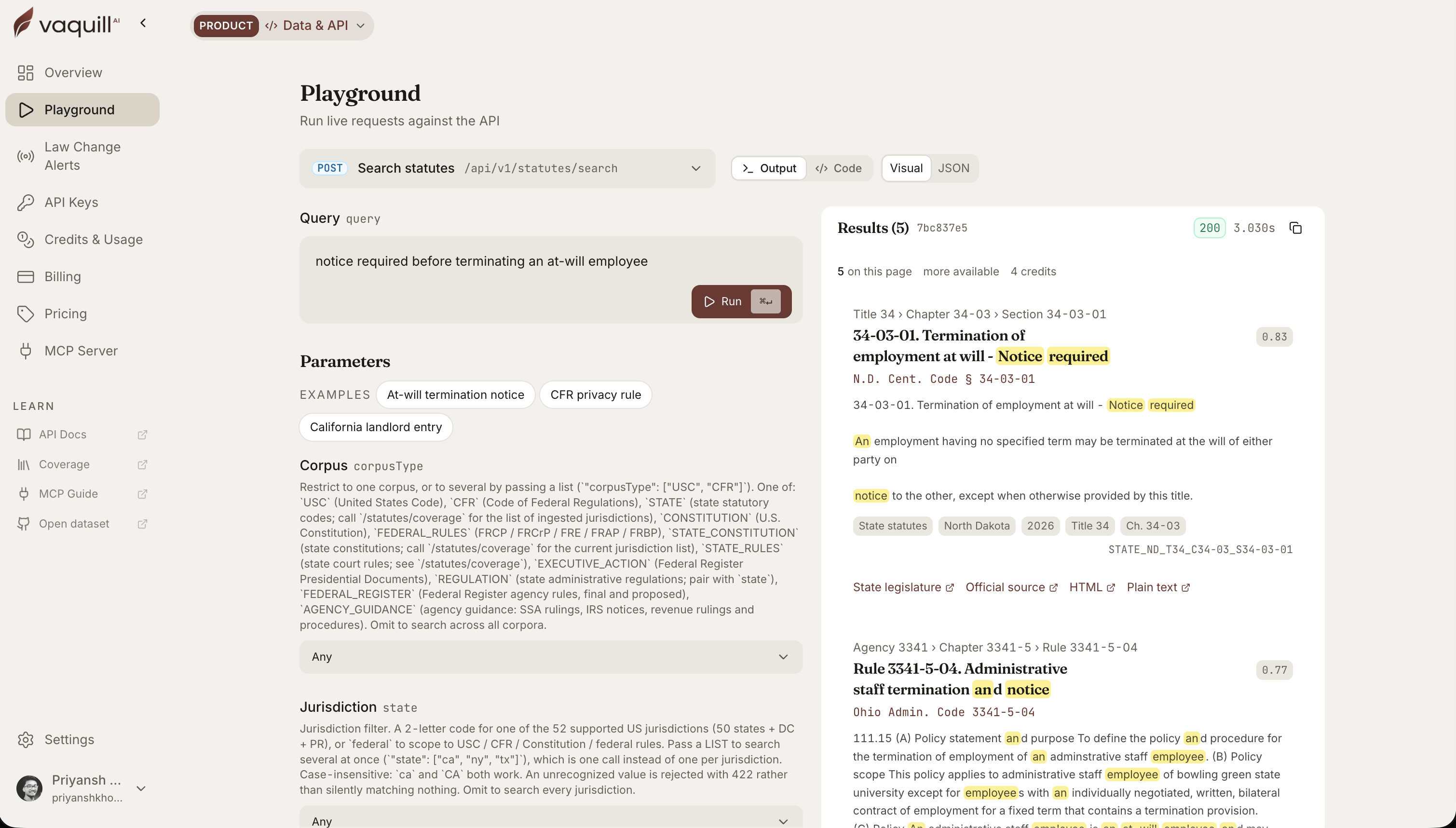 The same corpus behind this article, queried live. Every result carries its citation and a link to the official source.
New legal AI guides, weekly.
Further Reading
Legal AI for Chief Legal Officers (CLOs) in 2026
Read postRolling Out Legal AI to Your Team (Adoption Playbook)
Read postAI Compliance Check: CCPA, GDPR, and SOX for In-House Teams (2026)
Read post12 Best Legal AI Tools for In-House Counsel (2026)
Read postBuild vs Buy: Legal AI for In-House Teams (2026)
Read postYour First Legal Hire: Building an In-House Function With AI
Read post
Product & Content
Legal AI suite for US working lawyers: research, drafting, document comparison, document matrix, matters, and citation-verified answers, in one tool.