The contract is signed, the seats are provisioned, and the welcome email went out three weeks ago. Then you check the usage dashboard: two people logged in once, your most senior lawyer never logged in at all, and the inbound NDAs are still being marked up by hand in Word.
The tool works. Nobody is using it. That gap, between a purchase and a habit, is where most of the money in legal AI quietly disappears, and rolling out legal AI well is the only thing that closes it.
Short answer: to roll out legal AI to your team, pick one high-volume workflow (inbound NDAs), name one champion who does that work, settle your data and verification policy before the first login, train on live files instead of demos, and define "adopted" as a tracked number (weekly active use, workflow coverage, hours reclaimed) before day one. Legal AI adoption is change management, not an IT install. The tool is rarely the reason rollouts fail.
This is not a buying guide and it is not a pilot post. You already chose the tool. The real question is narrower: how do you get a skeptical, overloaded, two-to-ten-person legal team to actually use it next Tuesday, and the Tuesday after that, until doing the work without it feels slower than doing it with it.
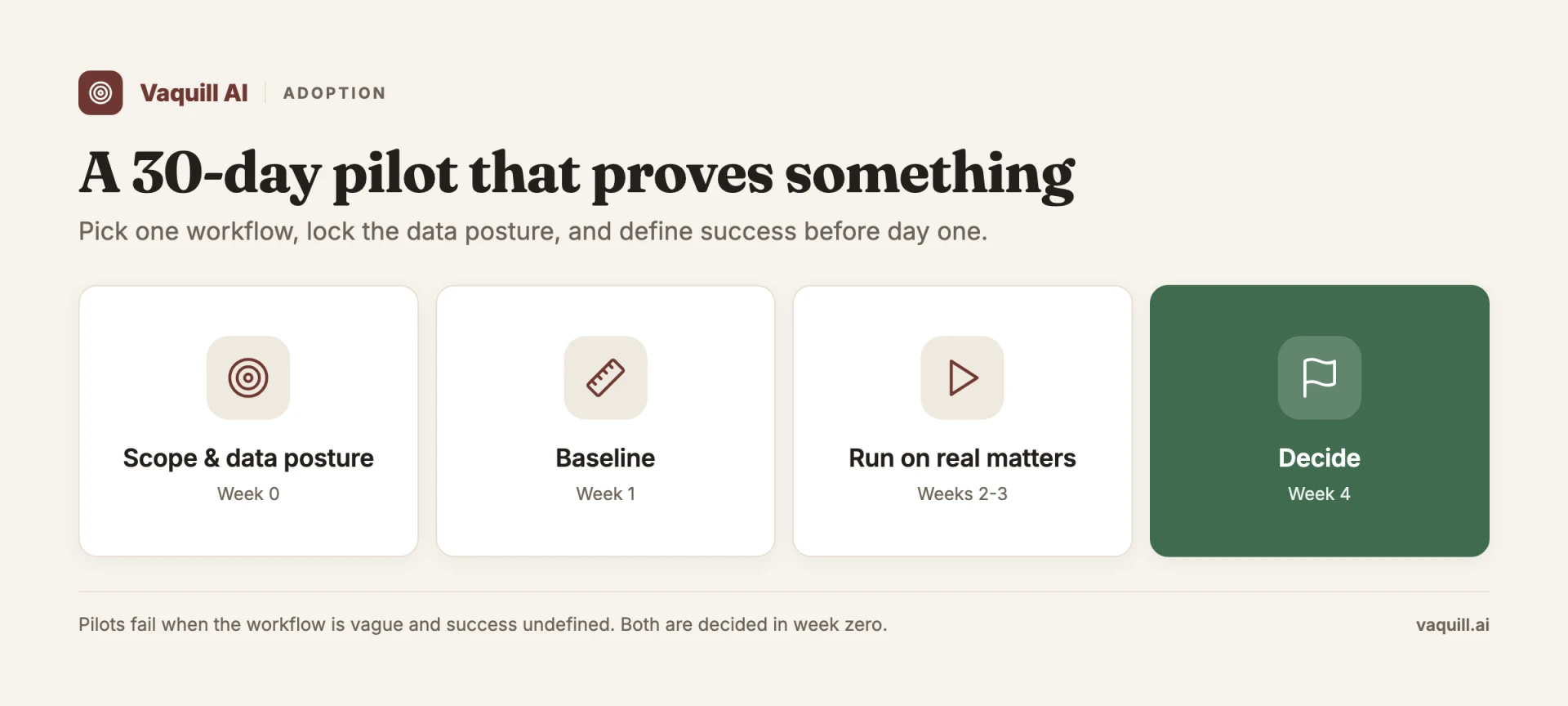
Scope and success metrics are set in week zero; the go/no-go decision is week four.
TL;DR
- The barrier to legal AI adoption is behavioral, not technical. Lawyers do not refuse tools because they are bad; they refuse them because "I will just do it myself" is faster than learning something they do not yet trust.
- Pick one beachhead workflow (inbound NDAs is the canonical choice) and one champion. Do not roll out a suite to a whole team at once. That is how you get shelfware.
- Set your data posture and AI policy before the first login, not after. Lawyers will not put a real contract into a tool they cannot answer two questions about: where does this data go, and does it train on my work.
- Train on live matters, never on demos. A scripted demo proves the vendor can drive. Adoption requires your team to drive, on their own files, the first week.
- Define "adopted" as a number before you start. Weekly active use, percent of NDAs run through the tool, hours reclaimed. If you cannot measure it, you cannot defend the renewal.
- The failure modes are predictable: a top-down mandate with no support, too many tools at once, no named owner, and no work on verification trust. Avoid those four and you are most of the way there.
Which single workflow does this playbook recommend as the beachhead for a legal AI rollout?
Rolling out legal AI is a behavior-change project
Adoption numbers look great from a distance. Generative AI use in corporate legal departments hit 87% in 2026, up from 44% a year earlier, per the FTI Consulting and Relativity General Counsel Report (March 2026). By late 2025 a majority of lawyers reported using AI daily or hourly, a near-total reversal from mid-2024 when most said they never used it.
So the macro story is settled. The micro story, on your team, is not. Buying the tool and getting the team to use it are different problems, and the second one is where rollouts die. Axiom's analysis of legal AI pilots cites MIT research (reported in Harvard Business Review, September 2025) finding that 95% of AI pilots across industries fail to deliver measurable business impact, almost always for reasons that have nothing to do with the model. Rolling out legal AI is not an IT install; it is the work of changing how a handful of busy people decide to spend the next two minutes.
Here is what actually happens inside a in-house department. A lawyer gets an inbound NDA at 4:40pm. They have done four hundred of these. They know the three clauses that matter and the two they will concede.
Opening a new tool, finding the right workflow, reading an unfamiliar output, and then second-guessing whether it caught something they would have caught anyway, all of that feels slower than just turning on track changes and doing it. So they do it themselves. Repeat that decision fifty times across a quarter and you have a tool nobody uses, bought by someone who is now defending the line item.
I watched this exact pattern on a four-lawyer team. Two weeks in, the usage view showed the GC with one login, a senior counsel with zero, and one mid-level who had quietly run nineteen documents.
When we asked the senior counsel why, the answer was not "the tool is bad." It was "I tried it on the Meridian NDA, it flagged a clause I had already decided to concede, and I figured I was faster on my own." That is the whole problem in one sentence. The tool was not wrong. It was just slower than her hands at the one moment that counted, and she never came back to find out it gets faster.
The thing to internalize: the competition for your legal AI tool is not another vendor. It is the lawyer's own hands and their existing muscle memory. People do not adopt tools that are merely better. They adopt tools that are better and lower-friction at the exact moment of the decision. Your entire rollout is an exercise in winning that 4:40pm moment.
There is a second, quieter failure that looks like adoption and is not. Your team is already using AI. They are pasting clauses into ChatGPT or Claude on personal accounts because it is fast and nobody is watching.
Shadow AI is not a hypothetical risk for in-house legal; it is the default state you are rolling out against. If your sanctioned tool is even slightly more annoying than a browser tab, you lose to the browser tab, and your confidential redlines keep leaking into a consumer chatbot. Rolling out legal AI is partly a project to make the safe path the fast path.
Pick a beachhead, not a battlefield
The most common rollout mistake is treating "we bought a legal AI suite" as a launch. A suite (drafting, contract review, AI redlining, matter management, playbooks, a document matrix, workflows) is a lot of surface area.
Throw all of it at a team at once and every person picks a different starting point, nobody gets good at anything, and the group consensus becomes "it is a lot." Breadth kills early adoption.
Instead, choose one workflow where the pain is sharp, the volume is high, and the verification is fast. For most in-house teams that is inbound NDA review.
It checks every box: high frequency (so reps build fast), bounded (so the output is checkable in two minutes), low stakes per document (so an early miss is survivable), and universally hated (so anyone you free up is grateful). Run every inbound NDA through the tool for thirty days. Nothing else. That is the beachhead.
Why a beachhead beats a broad rollout:
- Reps compound. Someone who runs twenty NDAs in two weeks develops real intuition for where the tool helps and where to overrule it. Someone who tries eight different features once each develops nothing.
- One verification habit forms cleanly. The whole adoption fight is about trust, and trust comes from a tight loop of "tool says X, I check X, X holds." A narrow workflow lets that loop run dozens of times fast.
- You get a story. "We cut average NDA turnaround from two days to two hours" is a sentence that recruits the next workflow and survives a budget review. "We rolled out a platform" is not.
Once the beachhead is a genuine habit, usually around day 30 to 45, expand to the adjacent workflow (DPA review, then your MSA redline playbook, then matter intake). Adoption spreads workflow by workflow, not all at once. Our 30-day legal AI pilot guide covers how to structure that first sprint if you are still in the choosing phase; this post assumes you are past it.
Name a champion, not a committee
Every successful rollout has exactly one person whose job it is to make the thing stick. Not a steering committee, not "the team," not "IT will support it." One named champion.
The champion is not necessarily the most senior lawyer. They are the person with three traits: they do the beachhead work themselves (so they have credibility), they are genuinely curious about the tool (so they will push past the first awkward week), and other people on the team listen to them (so adoption is social, not mandated).
On a five-person team this is often a mid-level counsel, not the GC. The GC sponsors; the champion adopts out loud.
What the champion actually does: runs their own work through the tool first and publicly, shares the wins and the misses in your team channel, fields the "how do I make it do X" questions so people do not give up in silence, and owns the metric.
On the team above, the thing that finally moved the senior holdout was not a training session. It was the mid-level posting in Slack: "ran the Vantage MSA through it before lunch, it caught a survival clause I would have missed, redline took eleven minutes." That one message did more than the vendor's onboarding call.
Peer advocacy is the mechanism that drives adoption from inside a team. A lawyer will try a tool because the colleague at the next desk says "this actually saved me an hour," and will quietly ignore the same tool when the only signal is a mandate from above.
Set the guardrails before the first login
You cannot ask a lawyer to put a real client contract into a tool and then not be able to tell them where it goes. Get the data posture and the AI use policy settled before rollout, because the first time someone hesitates over "is this allowed," you lose momentum you will not easily get back.
The minimum you need answered, in writing, before day one:
- Data and training. Confirm in the contract or DPA that the vendor does not train foundation models on your matter data, and that inputs and outputs are not retained for vendor model improvement. Then tell your team that answer in one plain sentence. Verification is a real exercise; we walk through how to actually confirm it in we do not train on your data.
- What is in scope and what is not. Be explicit: NDAs and standard commercial contracts, yes; the live M&A deal under a heightened NDA, not yet. Permission is clarity. Ambiguity reads as "no" and the tool sits idle.
- The verification rule. State plainly that AI output is a draft, never a filing or a final position, and that the human lawyer owns every word that leaves the building. This is not legal boilerplate; it is the psychological permission slip that lets a cautious lawyer try the tool at all.
If you do not have a policy yet, do not invent one under deadline. Start from a structure built for this; our AI governance policy template for in-house legal gives you the scaffold so the guardrails take an afternoon, not a month.
The goal is a one-page answer the team can read in five minutes, not a forty-page memo nobody opens.
Train on real work, not demos
Leaning on the vendor demo is the quiet mistake here, and not because vendors are dishonest. A demo proves the vendor can drive the tool on a clean sample. Adoption requires your lawyers to drive their messy files under their time pressure. Those are different skills, and only the second one creates a habit.
So the first training session is not a webinar. It is a working session where every person brings a real, live document from their actual queue and runs it through the beachhead workflow while the champion is in the room.
Not a sanitized example. The ugly NDA with the broken formatting and the weird indemnity carve-out. People learn the tool by watching it handle the exact thing they were about to handle anyway, and they build trust by catching the one place it got it wrong and seeing that catching it was easy.
Make the first session show real output, not a tour of buttons. Here is the kind of flag a lawyer should see on their own file, the format that builds trust because it is checkable in seconds:
| Clause as written | House position | The flag |
|---|---|---|
| "Confidentiality obligations survive in perpetuity." | Survival capped at 3 years (5 for trade secrets) | Perpetual survival; propose 3-year term, carve out trade secrets |
| "Receiving Party may disclose to Affiliates and advisors." | Affiliates only if bound by equivalent terms | "Advisors" is undefined and uncapped; tie disclosure to a written confidentiality obligation |
| Governing law: Delaware. Venue: New York. | Match law and venue to one state | Split law/venue clause; align both to Delaware |
That is three populated rows from one real NDA, not a feature list. When a lawyer sees the tool surface the perpetual-survival clause they would have caught anyway, then catches the one row it overstated, the trust loop closes in a single document. That is the moment a demo can never manufacture.
This is also where the AI redlining in real Word track changes earns its keep: when the output lands as accept/reject changes in the document a lawyer already lives in, the friction of "learning a new surface" largely vanishes. The closer the tool sits to the lawyer's existing muscle memory, the shorter the gap between "trained" and "adopted." Train where the work already happens.
Two training rules that matter more than they sound:
- Teach verification first, capability second. Before you show someone what the tool can produce, show them how to check it in under two minutes. A lawyer who knows exactly how to verify an output will use the tool fearlessly. A lawyer dazzled by output they cannot check will use it once, get nervous, and stop. The fear of getting burned by a hallucination is rational and it is the single biggest brake on adoption. You defeat it with a verification habit, not with reassurance.
- Train in cohorts of work, not calendars. "Everyone do five NDAs this week and bring your weirdest one Friday" beats a one-hour onboarding call that everybody forgets by Monday.
Define what "adopted" means, then measure it
If you cannot say in a number whether the rollout worked, you have already lost the renewal conversation, because procurement will ask and "the team likes it" is not an answer.
The 2024 and 2025 wave of enterprise legal AI contracts is now hitting renewal, and analysts tracking the category describe buyers pulling usage logs and renegotiating on seat counts that were never logged into. A bought-and-unused seat is, in the buyer's own framing, a procurement failure.
Decide your definition of adopted on day one, in advance, so you are measuring against a target instead of rationalizing after the fact.
Three metrics carry the weight for a in-house team, and each needs a target and a trigger. You do not need a dashboard for this; a shared sheet works.
- Weekly active use. What fraction of provisioned seats did real work in the tool this week. Target for a five-seat team: 4 of 5 active weekly by day 30. This is the blunt heartbeat. Trigger: if you are at 2 of 5 by the end of week two, the champion sits with the inactive lawyers that week and runs one of their live documents with them. You do not wait for renewal to find out it stalled.
- Workflow coverage. What percent of inbound NDAs (your beachhead) actually went through the tool versus got done by hand. Target: 70% of inbound NDAs through the tool by week four, 90% by week eight. This is the adoption-quality number. A team can be "active" and still route the real volume around the tool. Trigger: if coverage stalls below 50%, the work is being shadow-done by hand, and you find out which lawyer and why before you add a second workflow.
- Hours reclaimed. Self-reported is fine to start; a one-line Friday "roughly how many hours did this save you" is enough. The published benchmarks are real and useful as a target: GC AI's ROI study put average in-house time reclaimed at roughly 14 hours per week, with most respondents seeing value inside the first month. You do not need to hit that to win; you need a credible, rising number you can defend.
A note on what not to measure early: do not lead with outside-counsel-spend reduction. It is the metric the CFO loves and it is real over time, but it lags by quarters and it is noisy.
Lead with the in-the-building metrics that move in weeks (active use, coverage, hours), and let the spend number show up later as confirmation. For the broader scoreboard, our piece on legal department KPIs puts these in context.
The 30/60/90 sequence
Days 1 to 30: one workflow, real reps, daily presence. Guardrails published before day one. One beachhead (NDAs), one champion, everyone runs every inbound NDA through the tool. Working sessions on live files in week one.
The champion posts a win or a miss every couple of days so the tool stays psychologically present. Watch weekly active use like a hawk. The single goal of month one is one solid habit, not breadth.
Days 31 to 60: prove it, then widen by one. Lock in the NDA numbers (turnaround, coverage, hours) and tell the team the story in plain language. Then add exactly one adjacent workflow, usually DPA review or your standard MSA redline playbook.
Encode the conceded-versus-flagged positions you keep repeating into a reusable playbook so the tool starts reflecting your house style, not generic review. This is the point where a workbench starts to feel like your workbench.
Days 61 to 90: make it the default and defend it. The original workflow should now be unconscious; people reach for the tool without thinking, and doing the NDA by hand feels like the slow path.
Bring in matter management or the document matrix for the people ready for it. Write the one-page renewal case from your own numbers. Identify the one or two holdouts and find out why, because a holdout is data, not a defect.
The four failure modes, named
Failed rollouts tend to die from one of these, and they are all avoidable.
- Top-down mandate with no support. "Everyone must use the AI tool" with no champion, no training on real work, and no metric produces resentful compliance for a week and silence after. Mandates set expectations; they do not build habits. Sponsorship plus a champion does.
- Too many tools or too much surface at once. A team handed a full suite and told to "explore it" explores nothing. Same disease whether it is three vendors or one vendor's twelve features. Narrow ruthlessly, then expand.
- No owner. If making it stick is everyone's job, it is no one's job. Without a named champion who owns the metric, the rollout has no immune system and quietly dies the first busy week.
- No trust-building on verification. This is the subtle killer. Skip the verification habit and the first time the tool produces something a lawyer cannot immediately check, fear wins and usage stops. You cannot reassure your way past this. You build a fast verification loop, run it dozens of times in the beachhead, and let earned trust do the work.
A rollout checklist you can actually use
Before launch:
- One beachhead workflow chosen (default: inbound NDAs)
- One named champion who does the work, not just the GC
- Data and training posture confirmed in writing, in one plain sentence for the team
- Scope defined: what is in, what is explicitly out for now
- Verification rule written: AI output is a draft, the human owns it
- "Adopted" defined as a target number before day one
First 30 days:
- Working session on live files in week one, not a demo
- Verification taught before capability
- Every beachhead document routed through the tool
- Champion posts a win or miss every few days
- Weekly active use tracked from week one
Days 31 to 90:
- Beachhead numbers locked and shared as a story
- Exactly one adjacent workflow added at day 30
- House positions encoded into a reusable playbook
- Holdouts diagnosed, not ignored
- One-page renewal case written from your own data
FAQ
What is the first step in rolling out legal AI to a team? Pick one high-volume, low-stakes workflow as a beachhead (inbound NDA review is the usual choice) and run everything through the tool for thirty days before you touch anything else. A narrow start lets reps compound and one verification habit form cleanly. Breadth at launch is how you get shelfware.
Why do most legal AI rollouts fail? They fail on the human side, not the technology. The four predictable killers are a top-down mandate with no support, too many tools or features at once, no single named owner, and no work on verification trust. Axiom's analysis (citing MIT research via Harvard Business Review, September 2025) puts the cross-industry pilot failure rate at 95%, almost always for adoption reasons rather than model quality.
Who should own legal AI adoption on a small team? One named champion, often a mid-level counsel rather than the GC. They do the beachhead work themselves, share wins and misses in the team channel, field the "how do I make it do X" questions, and own the metric. The GC sponsors; the champion adopts out loud. Peer advocacy moves holdouts that mandates do not.
How do you measure legal AI adoption? Track three numbers against targets you set on day one: weekly active use (fraction of seats doing real work that week), workflow coverage (percent of your beachhead volume actually run through the tool), and hours reclaimed (self-reported is fine to start). Lead with these in-the-building metrics; let outside-counsel-spend reduction show up later as confirmation, since it lags by quarters.
How long does it take to roll out legal AI? Plan for about ninety days. Days 1 to 30 build one solid habit on the beachhead workflow. Days 31 to 60 lock in the numbers and add exactly one adjacent workflow. Days 61 to 90 make the tool the default and write the renewal case from your own data. Buying is a one-day decision; adoption is a ninety-day behavior project.
What is shadow AI and why does it matter for rollout? Shadow AI is your team pasting clauses into consumer chatbots on personal accounts because it is fast and unmonitored. It is the default state you are rolling out against, not a hypothetical. If your sanctioned tool is even slightly more annoying than a browser tab, confidential redlines keep leaking. Make the safe path the fast path.
Do you need an AI policy before rolling out legal AI? Yes, settle it before the first login. Get three things in writing: the data and training posture (confirm the vendor does not train on your matter data), what is in scope and what is not, and the verification rule that AI output is a draft the human lawyer owns. The first time someone hesitates over "is this allowed," you lose momentum that is hard to recover.
Where this leaves you
Buying legal AI is a one-day decision. Adopting it is a ninety-day behavior project, and the teams that win treat it that way.
Narrow the surface to one painful workflow, put a real person in charge of making it stick, settle the data and verification questions before anyone logs in, train on the ugly live files instead of the clean demo, and define success as a number you can defend.
Do that and the tool stops being a line item you justify and becomes the way the work gets done. Skip it and you join the teams pulling usage logs at renewal, explaining seats nobody ever opened.
If you are rolling out a tool now and want one built to sit inside the lawyer's existing Word workflow, start a free 7-day trial of Vaquill AI. And if you are still choosing, our pillar guide on legal AI for in-house counsel and the in-house legal software guide for 2026 cover what to buy before you worry about how to roll it out. If you are a department of one, your first legal hire might be AI changes the rollout math entirely.
New legal AI guides, weekly.
Further Reading
Legal AI for Chief Legal Officers (CLOs) in 2026
Read postAI Compliance Check: CCPA, GDPR, and SOX for In-House Teams (2026)
Read post12 Best Legal AI Tools for In-House Counsel (2026)
Read postBuild vs Buy: Legal AI for In-House Teams (2026)
Read postYour First Legal Hire: Building an In-House Function With AI
Read postGenerative AI for Legal: An In-House Counsel's Guide (2026)
Read post
Co-Founder & CEO · Attorney
Arshita leads product and strategy at Vaquill, building the legal AI suite that solo, small-firm, and in-house US lawyers use to run a matter end to end.