Short answer: GC AI is the leading in-house legal AI platform in 2026, and for a contract-heavy in-house team of three or more lawyers it is worth the $500 per seat per month. It is a strong buy if your week is mostly NDAs, DPAs, and vendor MSAs inside Microsoft Word. It is a weaker fit for an hourly-billing law firm of 2 to 15 lawyers, or a deep-research or appellate team. Read on for where each line falls.
One distinction up front, because it decides the whole buying question. A solo or fractional GC is not the same buyer as a solo law-firm practitioner. GC AI markets its Individual plan to the former by name, "for solo or fractional GCs who want full access to the platform" (gc.ai/pricing, Sep 2026), and that is a segment it fits well. Where the $500 seat gets hard to justify is the hourly small-firm economics of a law-firm practice, which is a different business model with a different budget line. Every "who it is not for" call below means the law firm, not the in-house GC of one.
This GC AI review is written for in-house counsel doing a real vendor evaluation, not a feature recap. Most gc.ai reviews hide the buying decision under a feature list. So here is the short version. Before you book the demo, run five tests in order.
One, workflow fit. Is your week 70% contracts or 30% research? Two, contract volume. Are you doing 8 to 10 commercial agreements a month? Three, integration risk. Will you need API or MCP access within a year?
Four, admin and control. Whose company profile, whose data retention? Five, segment fit. In-house team, small firm, or developer shop?
GC AI scores high on the first two. It is middling on admin, and the seat price is set for in-house budgets rather than hourly law-firm ones. The rest of this review is the detail behind that scorecard.
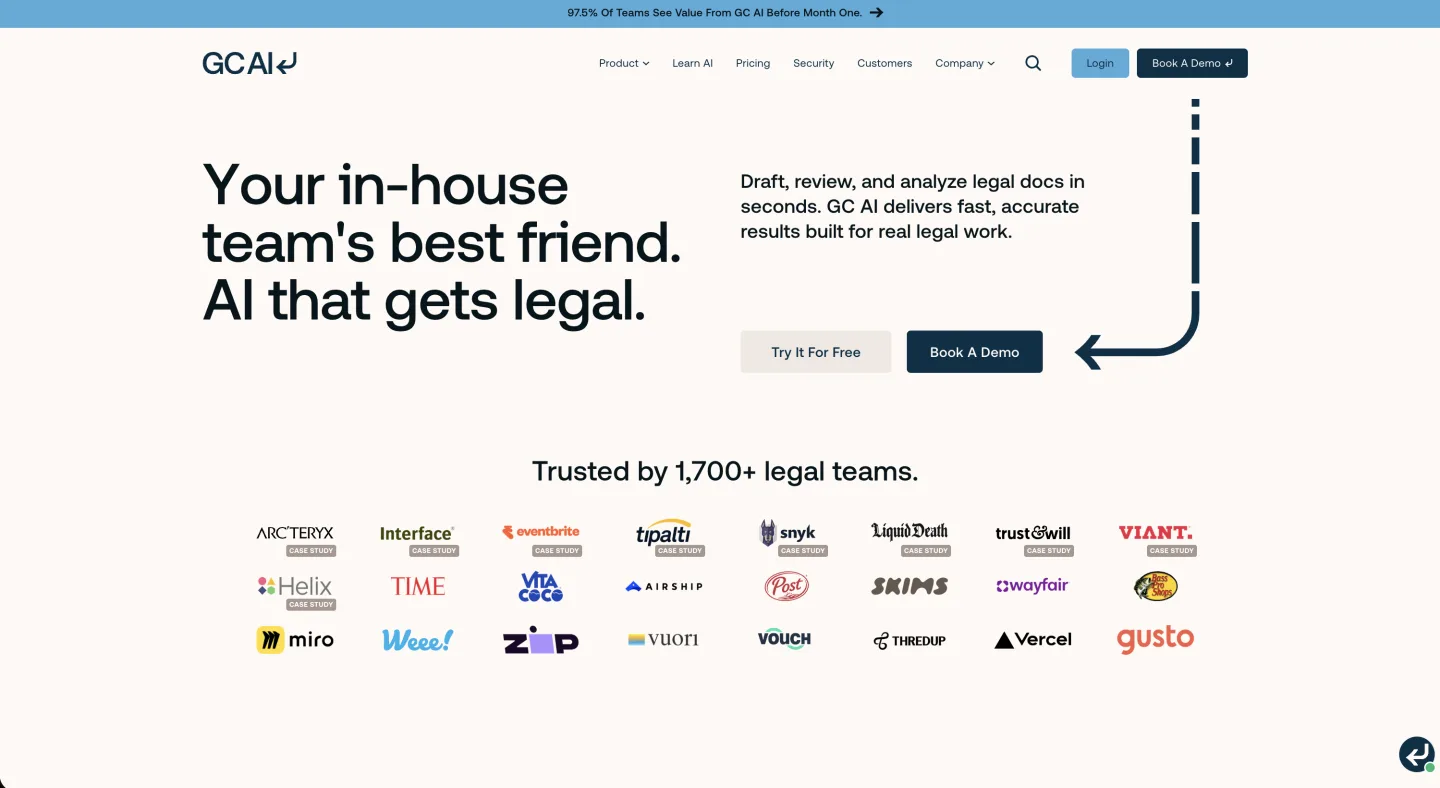
At a glance
| GC AI | |
|---|---|
| Price | $500 per seat/mo, or $5,000/yr annually, Individual (gc.ai/pricing, Sep 2026) |
| Access | Self-serve trial, then sales for Team/Enterprise |
| Best for | In-house teams of 3+ on contract-heavy weeks, plus solo and fractional GCs |
| API | Publicly available since July 29, 2026, multi-turn (gc.ai) |
| Free trial | 14 days, no credit card |
| Word-native | Yes (Word add-in) |
| Legal research | 13M+ US opinions, add-on on Individual (gc.ai, Jul 2026) |
| Trains on your data | Playbooks and Projects encode your standards |
TL;DR
- GC AI is the leading in-house legal AI tool in 2026. More than 2,100 legal teams (gc.ai, Sep 2026). Built by a three-time GC. Published price of $500 per seat per month, or $5,000 a year on annual billing, with a 14-day free trial and no seat minimum.
- It is well funded. GC AI closed a $60M Series B in November 2025 at a $555M valuation, $73M raised in total (gc.ai, Nov 2025). ARR went from $1M to over $10M in under a year. So vendor risk is lower than most legal AI startups.
- The headline numbers come from GC AI's own December 2025 ROI study of 100-plus active customers: 14 hours saved per lawyer per week, and a 14% cut in outside counsel spend. For a typical $1.8M department, that is roughly $252K a year.
- Where it wins: in-house focus, a Word-native workflow (Chat2, Exact Quote, Easy Prompt, Playbooks), SOC 2 Type II security, and a 20,000-line legal system prompt that tells the model to act like in-house counsel.
- Where it has real gaps: research bundled only on higher tiers, suite breadth versus full workbenches, and a seat priced for in-house budgets rather than hourly law-firm economics. The API is no longer on that list. It became publicly available on July 29, 2026 and supports multi-turn conversations (gc.ai).
Part of our legal AI vendor comparison and pricing series.
What is GC AI's published Individual plan price?
What GC AI actually is
Cecilia Ziniti started GC AI in November 2023 with co-founder Bardia Pourvakil. Ziniti was general counsel three times, at Anki, Bloomtech, and Replit, and before that worked in-house at Amazon and Cruise. That background shows up in the product. Named customers include Vercel, Gusto, Snyk, Columbia Sportswear, Liquid Death, Arc'teryx, and Eventbrite (gc.ai, Jul 2026).
The company is also one of the better-capitalized bets in legal AI. It raised a $60M Series B in November 2025 led by Scale Venture Partners and Northzone, at a $555M valuation and $73M raised in total, on the back of ARR that grew from $1M to over $10M in under a year (gc.ai, Nov 2025; Pulse 2.0, Nov 2025). That matters for a buyer. After Robin AI's 2025 layoffs and winding-up petition (Artificial Lawyer, Oct 2025), vendor stability is a real line item, and GC AI clears it better than most.
GC AI is built around the jobs that fill an in-house week: review an NDA, mark up a vendor MSA against the playbook, answer a product manager's question, draft a clause that matches last quarter's deal. It is a legal tool, not a general chatbot with a legal coat of paint, and not a litigation product crammed into the in-house seat.
Two design choices explain almost everything about it.
The first is that the tool lives inside Microsoft Word as an Add-in. Not a chat tab next to Word. Inside it. The bet is that the lawyer's day already happens in Word, and a tool that makes you alt-tab to a browser dies of workflow inertia by week four. Whether that is a moat is a separate question. The bet itself is right for the customer.
The second is the 20,000-line legal system prompt wrapped around the underlying model. Before your query reaches the model, the prompt sets it up as an in-house lawyer with a clear posture on citations, hedging, and document-grounded answers.
ChatGPT answers like a helpful generalist. GC AI answers like a careful in-house lawyer who has been told what "good" looks like for a vendor MSA. In side-by-side outputs the gap is easy to see.
The product surface, and what each piece is actually doing
Five features carry the product. The fair way to judge them is to ask what each one does on the third Tuesday of a real in-house month, not what the demo shows.

Chat2 in the Word add-in. A web-research chat inside Word. You can ask "what does Delaware require for indemnification carve-outs in vendor contracts" while you mark up a clause, and the answer comes back with source links in a side pane.
On bounded questions the speedup is real. On wide-open ones it gets thinner. Ask it to compare indemnification standards across Delaware, California, and New York and it is competent, but it feels one layer behind a dedicated research surface.
Exact Quote. Character-level citation. It pulls a verbatim string from the source so you can check it. After Mata v. Avianca, this is table stakes, and GC AI does it cleanly.
Test it on a recently amended statute and the quote matches the current text, not a stale copy. The version-skew bug that bites other vendors is not the one GC AI fails on.
Easy Prompt. A layer that rewrites plain language before the model sees it. Type "can you check if this NDA is okay" and it cleans the prompt up first. A lawyer who already knows how to prompt does not need it. A lawyer two weeks into their first AI tool very much does, and it keeps the bottom of the adoption curve from quitting.
Playbooks and skills. Agentic contract review, and the closest thing GC AI has to a moat. Pre-built for NDAs, DPAs, MSAs (SaaS), and MSAs (commercial). Your team encodes its clause standards, say a liability cap of fees paid in the prior 12 months, or Delaware governing law unless the counterparty sits in California. GC AI now also lets you chain reusable instructions in a Skill Library and run contract agents inside Word (gc.ai, Jul 2026).
When a new contract lands, the playbook runs, flags the deviations, and produces a first-pass markup. This is where most of the 14-hour weekly savings comes from. It is also where the demo and the real thing line up best.
Projects. Persistent matter memory. Upload your documents and the context survives across sessions, so a lawyer working a matter over six weeks does not re-upload the deal files every time. It looks minor on a feature list. In-house lawyers bring it up unprompted, which is the tell.
A live trial surfaces three things the demo skips. First, ask Chat2 what Delaware, California, and New York each require for indemnification carve-outs and it leans on Delaware first, treating the other two as add-ons. You have to re-prompt for a clean three-state answer. Narrow, not wrong.
Second, run Playbooks against an odd contract, like a complex services agreement that does not map to the SaaS or commercial templates, and you get a usable but generic first pass that needs more cleanup than the four standard types.
Third, ask it to reason about how a clause interacts with a recently amended statute and you hit the edge of the system prompt. The answer is correct, but the model hedges in a way that reads like the wrapper telling it to play it safe where a free-running model would have committed.
A GC reads that as a feature. A senior associate judging it against their own style might read it as friction.
Pricing reality
GC AI publishes its price, which already sets it apart from most of this category. The Individual plan is $500 per seat per month. There is a 14-day free trial, no credit card, and no seat minimum. Team and Enterprise pricing is on request.
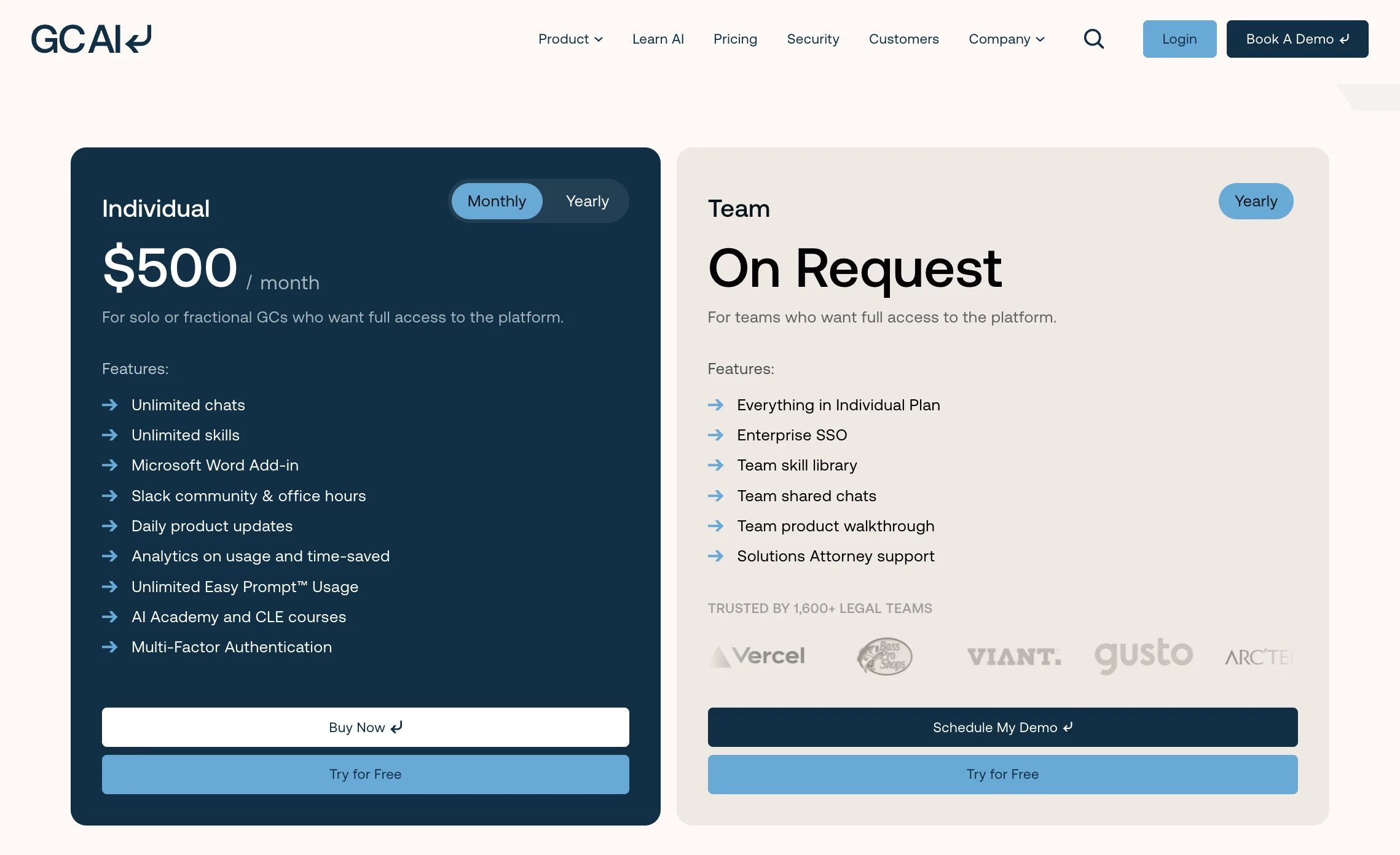
Here is the full plan structure as published, so you can see what each tier actually includes:
| Plan | Price | Billing | Key inclusions |
|---|---|---|---|
| Individual | $500/seat/mo, or $5,000/yr annually | Monthly or yearly | Unlimited chats and skills, Word add-in, Easy Prompt, AI Academy and CLE courses, MFA. US Case Law is a paid add-on |
| Team | On request | Yearly only | Everything in Individual, Enterprise SSO, team skill library, shared chats, Solutions Attorney support, US Case Law included |
| Enterprise | Custom | Negotiated | Custom integrations, managed procurement and onboarding, change management, ROI forecasting, dedicated support |
Source: gc.ai/pricing, Jul 2026.
At the monthly rate a single seat runs $6,000 a year, and annual billing brings that to $5,000 (GC AI docs, Sep 2026), a saving of about $1,000 or 17 percent. Two smaller catches worth flagging: legal research (US Case Law) is a paid add-on on the Individual plan and only bundled on Team and up, and the Team tier is annual-billing only. For the full tier-by-tier breakdown, seat minimums, and the reported Team number, see our GC AI pricing post.
For context, Harvey runs $1,200 to $2,000+ per user per month (see the Harvey pricing reality post). Legora runs $300 to $800.
So GC AI sits well below Harvey per seat and above what a solo or five-person firm usually pays. It is in-house-team pricing, almost exactly. A Series B GC with three lawyers pays $1,500 a month. A 15-lawyer department at a public company pays $7,500.
Those are numbers a GC can put on a budget without a procurement fight. And the free trial with no credit card kills the single biggest objection a wary GC raises about a new vendor.
The structural point worth keeping: GC AI tells you the entry price, monthly and annual. Harvey and Legora make you ask. In a category where pricing usually hides behind a sales call and an NDA, that openness counts for something, even if the two higher tiers still sit behind a conversation.
The user-base claims
These all come from GC AI's own published material as of mid-2026. Treat them as vendor-sourced until someone independent checks them.
The list: 2,100-plus legal teams (gc.ai homepage, Sep 2026, up from the 1,800-plus the page carried in July 2026). Add 53 countries, 80-plus public companies, 25 unicorns, and a December 2025 ROI study of 100-plus active customers reporting 14 hours saved per lawyer per week, a 14% cut in outside counsel spend, 21% higher perceived accuracy than generic AI on the same tasks, and 97.5% reporting value within the first month.
These are vendor numbers, not vendor lies, but a serious review treats them as a starting point. The 14-hour figure is self-reported, the same caveat that hangs on every productivity claim from every vendor here.
The 14% outside counsel cut is more useful because a GC can check it against last year's invoices. At the ACC 2024 median spend of $1.8M, 14% is about $252K a year. That clears a $500 seat for any team of three or more many times over. If it is even directionally right, the seat pays for itself.
The 21% accuracy lift is "perceived accuracy" from survey takers, not a blind test. Believable in direction, but not a benchmark to treat as gospel, unlike a reproducible open accuracy benchmark you can rerun yourself.
A real procurement review builds a ten-contract gold set, runs Playbooks against it, and measures how the redlines overlap with what a senior in-house lawyer would have written. That is a week of work. It is also the only measurement that survives a CFO question.
What to check before you sign. Ask for the customer mix behind the 2,100-team number: how many public companies, late-stage startups, mid-market. Ask for the response rate and selection method behind the December 2025 study.
Then call two existing customers in your size range whose names did not come from a vendor reference list. The numbers do not have to be wrong to mislead you. They just have to be unrepresentative of your segment, and only unscripted reference checks tell you that. If the response rate was low or the mix skews toward heavy users, discount the headlines.
The net: the study is more transparent than most legal AI vendors bother to be, it carries the usual self-reporting caveats, and the effect sizes match what in-house users say in third-party reviews.
Honest caveat on those reviews: there is not much genuine forum discussion of GC AI out there. Most of what you find is PR or vendor-published case studies. For a product serving 2,100-plus teams, the thin independent-review trail (two verified G2 reviews as of September 2026, few unscripted Reddit threads) is worth noting, not because it signals a bad product, but because it leaves you fewer outside checks than a Harvey or a CoCounsel has. The Legal Technology Hub vendor listing and attorney Carolyn Elefant's My Shingle review (myshingle.com, Sep 2025, rated it "first in class") are real third-party coverage, but do not expect a deep Reddit thread of war stories. Do not import the vendor numbers whole into your business case.
On security, GC AI is SOC 2 Type II and SOC 3 certified, is GDPR-compliant, encrypts data with AES-256 at rest and TLS in transit, holds zero-data-retention agreements with OpenAI and Anthropic, and states it does not use customer data to train its models (gc.ai, Jul 2026). That clears the baseline most in-house procurement teams ask for, though enterprise buyers should still run their own vendor security questionnaire.
Where GC AI clearly wins
In-house focus. Tight scope means the product gets used every day instead of demoed once a month. The workflow and the tool actually match.
Word-native workflow. Living inside Word is the right call for the in-house contract week. The Office Add-in surface itself is available to any vendor, so the durable advantage is less the integration than what gets built on top of it.
What is defensible is the habit. Lawyers who use GC AI inside Word for six months stop reaching for browser chatbots even when they could.
The habit is the moat, not the integration itself. Daily use inside the tool a lawyer already has open is hard for a competitor to dislodge, whatever the feature parity.
GC-built product design. The four pre-built Playbooks, NDAs, DPAs, MSAs (SaaS), and MSAs (commercial), are the exact documents that eat most of an in-house lawyer's contract week. Projects exists because in-house lawyers work matters, not one-off transactions. Those are calls you only make if you have sat in the chair.
Onboarding and enablement. Every plan bundles AI Academy and CLE courses, plus a Slack community and office hours (gc.ai/pricing, Jul 2026). For a team standing up its first legal AI tool, that training scaffolding is a real reason the bottom of the adoption curve does not quit two weeks in.
Adoption speed. More than 2,100 legal teams in roughly thirty-four months is fast. GCs who try it tell other GCs. In a category where most products stall after the pilot, that is real signal.
Where GC AI has gaps
These are shape-of-the-product limits a serious review should surface.
Research depth and where it sits in pricing. GC AI now ships a research surface over 13M-plus US court opinions (gc.ai, Jul 2026), so the old "no real research" knock is narrower than it was a quarter ago. Two caveats stay. On the $500 Individual plan, US Case Law is a paid add-on, bundled only on Team and Enterprise, so a solo seat does not get it by default. And the depth is strongest on opinions and bounded questions. Multi-state statutory and regulatory work, or a memo across an unsettled area, still feels a layer behind a dedicated research workbench. If your team is 70% contracts and 30% research, GC AI handles the whole load well. Flip the ratio and the research surface will feel light.
Public API access, now closed as a gap. This section used to read as a limitation. It is no longer one. GC AI's API became publicly available on July 29, 2026 and handles multi-turn conversations the same way chat does, with setup run by an organization admin rather than an account rep (gc.ai). A legal-ops team wiring GC AI into Zapier, Make, or n8n can do that directly now, so price it as a capability rather than friction.
Suite breadth versus a full workbench. GC AI is an AI assistant plus a Word add-in plus playbooks plus projects. For the in-house job, that is the right shape. It is not a full workbench in the sense of the legal AI suite wars.
It is lighter on document comparison as a first-class export, lighter on matrix workflows across forty contracts (the matrix shape), and lighter on an agent mode that chains research, drafting, and verification in one session. GC AI has moved here: it runs contract agents in Word and lets you chain skills in the Skill Library, so the agent gap is contract-shaped rather than absent. What is still missing is a general agent that reaches across research, drafting, and verification outside the contract lane. If your bottleneck is bulk review across a stack rather than per-contract markup, the matrix gap will still bite.
Pricing against hourly law-firm economics. $500 a seat is in-house-team money. A solo or fractional GC carrying a company's whole legal function clears that easily against one avoided outside-counsel hour, which is why GC AI sells the Individual plan to exactly that buyer. A five-lawyer firm billing hourly is the harder case: the seat competes with a different budget line and a different revenue model. It is a positioning question, not a product flaw, but worth naming, because buyers who land here from a "best legal AI" list without checking which of those two they are will bounce.
Who fits, who doesn't
The clean buy is an in-house team of three or more lawyers, a contract-heavy week of NDAs, DPAs, and vendor MSAs, a Word workflow, and a budget with room for $1,500 to $7,500 a month in AI tooling.
Public-company in-house teams with mid-volume contract review sit right in the sweet spot. So do late-stage startup GCs with one or two direct reports, and the solo or fractional GC the Individual plan is built for. The price is real, but 14 hours a week against a fractional GC's billable rate pays for it fast.
The harder fits are easy to call. Pure research teams doing appellate work or multi-jurisdictional regulatory analysis will find a dedicated research workbench deeper, and should price in the US Case Law add-on if they stay on Individual. Hourly-billing law firms of 2 to 15 lawyers will find $500 a seat priced against in-house department budgets rather than a billable-hour model, and should look at tools built for that economics (the small-firm stack). Teams that need a full workbench, with clean redline export, a matrix across forty contracts, an agent mode chaining tools, and verification wired through, will find GC AI covers some of that well and leaves the rest.
Is GC AI worth it? The bottom line by segment
GC AI is the real category leader for in-house AI in 2026. Even half the claimed ROI would justify the seat. The remaining gaps, research bundling on Individual and workbench breadth, are real but knowable. Here is what to do next.
- In-house team, 3+ lawyers, contract-heavy week. Start the 14-day trial. Load three real contracts into Playbooks: an NDA, a DPA, a vendor MSA. Time the markup. If you save five hours across the three, the seat pays for itself. Sign for one seat and expand.
- In-house team, research-heavy or multi-jurisdictional. Pilot it alongside a dedicated research workbench, and price in the US Case Law add-on if you stay on Individual. If Chat2 misses the cross-jurisdictional comparisons you need, buy the research tool first and revisit GC AI in 12 months.
- Solo or fractional GC. This is a named target for the Individual plan, and the no-minimum single seat plus the 14-day trial makes it a low-risk test. Run your own NDA and vendor MSA through Playbooks and measure the hours against your own rate.
- Hourly-billing law firm of 2 to 15 lawyers. Check which buyer you are before the feature list. At $500 a seat GC AI is priced against in-house department budgets. Tools aimed at billable-hour economics will fit that model better, whatever the feature comparison says.
FAQ
How much does GC AI cost?
The Individual plan is $500 per seat per month, published openly on gc.ai/pricing (Sep 2026), which works out to $6,000 a year monthly or $5,000 a year on annual billing (GC AI docs). Team and Enterprise pricing is quote-based, and the Individual price is list-price, not negotiable. There is a 14-day free trial with no credit card and no seat minimum.
Is GC AI worth it?
For an in-house team of three or more lawyers on a contract-heavy week, the math usually works. GC AI's own December 2025 ROI study reports 14 hours saved per lawyer per week and a 14% cut in outside counsel spend; at the ACC median department spend of $1.8M, 14% is roughly $252K a year, which clears a $500 seat many times over. Treat the study as vendor-sourced and pressure-test it against your own invoices.
Does GC AI do legal research and case law?
Yes. GC AI added a research surface over 13M-plus US court opinions (gc.ai, Jul 2026), plus Exact Quote for verbatim citations. The catch is pricing: on the $500 Individual plan, US Case Law is a paid add-on and is only bundled on the Team and Enterprise tiers. Research depth is strongest on opinions and bounded questions and lighter on deep multi-state statutory or regulatory work.
Does GC AI hallucinate or invent citations?
GC AI's Exact Quote feature pulls a verbatim, character-level string from the source so you can check it, which is its answer to the citation-fabrication problem that surfaced after Mata v. Avianca. As with any legal AI, you still verify the cited authority yourself before it goes out the door.
Is GC AI good for solo and fractional GCs?
Yes, and GC AI says so directly: the Individual plan is sold "for solo or fractional GCs who want full access to the platform" (gc.ai/pricing, Sep 2026), with no seat minimum. The separate question is the solo or small law firm billing by the hour, where a $500 seat sits against in-house department budgets rather than a billable-hour model. That is a business-model question, not a quality one.
Does GC AI have a public API?
Yes. The API became publicly available on July 29, 2026, supports multi-turn conversations the same way chat does, and is set up by an organization admin rather than through an account rep (gc.ai). Earlier versions of this review described it as a private, single-turn beta, which was accurate at the time and is no longer.
Does GC AI have a free trial?
Yes, 14 days with no credit card and no seat minimum, which removes the biggest objection a cautious GC raises about a new vendor. There is no permanent free plan.
What are the best GC AI alternatives?
It depends which job you are solving. For enterprise BigLaw, Harvey. For Word-native transactional work, Spellbook (see our Spellbook review). For teams that want research, drafting, and matter management in one place, the broader workbench category is worth a look. Our ranked field for this buyer is the best legal AI tools for in-house counsel, where GC AI comes first for the in-house generalist.
GC AI vs Harvey: which is better for in-house counsel?
GC AI is purpose-built for the in-house contract week and publishes its $500 seat price openly. Harvey is broader and stronger on M&A diligence and cross-border research, but runs $1,200 to $2,000+ per user per month with a longer enterprise buying cycle. An in-house team usually fits GC AI better; a Fortune 500 legal department with procurement fits Harvey. See our GC AI vs Harvey breakdown and our Harvey honest review for the full detail.
Who founded GC AI and is it well funded?
GC AI was founded in November 2023 by Cecilia Ziniti, a three-time general counsel, and CTO Bardia Pourvakil. It raised a $60M Series B in November 2025 at a $555M valuation, $73M in total funding, led by Scale Venture Partners and Northzone (gc.ai, Nov 2025). Annual recurring revenue grew from $1M to over $10M in under a year, so it is among the more stable vendors in the category.
Is GC AI safe, and does it train on your data?
GC AI is SOC 2 Type II and SOC 3 certified, is GDPR-compliant, encrypts data with AES-256 at rest and TLS in transit, holds zero-data-retention agreements with OpenAI and Anthropic, and states it does not use customer data to train its models (gc.ai, Jul 2026). Its Exact Quote feature also pulls verbatim source strings so you can verify any cited authority. Enterprise buyers should still run a vendor security questionnaire before signing.
Whichever way you land, run the same test before you sign: three real contracts, an NDA, a DPA and a vendor MSA, timed end to end against your current process.
For more on legal AI vendor comparisons, see /topics/vendor-comparisons.
New legal AI guides, weekly.
Further Reading
What Lawyers Really Think of Legal AI in 2026 (Reddit + Reviews)
Read postLuminance Review 2026: An Honest Assessment for In-House Counsel
Read postCoCounsel Review 2026: An Honest Assessment for In-House Counsel
Read postLegora Review: Who It's For, What It Costs, and Where It Falls Short
Read postTop 10 Harvey Alternatives for In-House Counsel (2026)
Read post12 Best Legal AI Tools for In-House Counsel (2026)
Read post
Co-Founder & CEO · Attorney
Arshita leads product and strategy at Vaquill, building the legal AI suite that solo, small-firm, and in-house US lawyers use to run a matter end to end.